

Introduction
Over the past thirty years, the nature of work has undergone a significant transformation. In industrialised countries, full-time jobs that were once the standard throughout the twentieth century have gradually been replaced by non-standard employment arrangements. These alternative work relationships typically offer lower wages, less predictable working hours, reduced benefits and uncertain career prospects. Among the various changes, none has sparked as much debate as the emergence of the gig or platform economy, exemplified by companies like Uber and its competitors.1
Gig work includes short-term contracts, freelance projects and temporary jobs, giving individuals more flexibility and independence. But the origins of this type of work come from a combination of factors in different places and times.
To some, these companies represent a wave of small-scale entrepreneurship and business growth, providing new and powerful opportunities. However, others view them as a threat that could lead to a dystopian labour market, where traditional careers disappear, every worker becomes a freelancer, every work arrangement is short-term, and wages are constantly driven down through collusion.2
Studying where gig workers came from needs a comparison of different places and historical periods. We must look at how the economy, society and technology have influenced the gig economy’s development. By studying gig work in different regions and times, we can learn why it became popular and what drives it.
When we compare different places, we can see how the laws and rules affect gig work. We can look at labour laws, social security systems and protections for workers in different countries. This helps us understand what makes gig work grow or what makes it harder. Comparing the experiences of gig workers in different places also tells us how different rules affect their jobs, how secure they are, and how they feel overall.
Looking back in history can also tell us about gig work. We can find examples of independent contractors, piecework and other non-traditional jobs from the past. This helps us see where gig work started and how it changed over time. We might find patterns and similarities that tell us how the economy and society have changed and made gig work more common today.
Changing Labour Markets in the Developed World
Labour markets in the developed world have undergone significant transformations in recent decades. Traditional employment models, characterised by stable, full-time jobs with regular hours and comprehensive benefits, have increasingly given way to more flexible and diverse forms of work. This shift has been driven by a combination of economic, technological and social factors, leading to both opportunities and challenges for workers and employers.
One key aspect of changing labour markets is the rise of non-standard employment arrangements. These include part-time work, temporary contracts, freelance and gig work, independent contracting, and self-employment. Non-standard employment offers flexibility and autonomy for workers, allowing them to pursue multiple income streams or tailor their work schedules to fit personal needs. At the same time, it often comes with lower job security, fewer employment benefits and limited access to social protection systems.3
Labour markets have changed significantly as a result of technological improvements. New types of labour, such as gig work and remote freelancing, have been made possible by the expansion of the digital economy and online platforms. Technology has made it possible to connect people with job openings on a global scale, overcoming geographic barriers and creating new options for project-based employment and talent sourcing.4 However, as automation and artificial intelligence progressively replace mundane work, it has also given rise to worries about job displacement, since the need for some occupations may decline.5
The impact of globalisation on labour markets in industrialised nations has increased. Certain job tasks have been outsourced to nations with reduced labour costs as a result of the increasing mobility of products, services and capital, affecting industries such as manufacturing and customer service. This has created winners and losers, with some workers facing job losses or wage stagnation, while others benefit from new employment opportunities and increased market competitiveness.6
The ageing population and evolving societal norms are just two examples of how demographic shifts have affected the work market. Flexible work schedules and policies that take older workers’ preferences and abilities into account are becoming more and more necessary as the workforce matures. The demand for flexible work choices among younger generations has also been fuelled by a desire for work-life balance and more professional management.7
The changing work markets have a big impact on employees, firms and policymakers. People may need help adjusting to non-traditional employment by learning new skills, navigating a fragmented job market, and addressing worries about income instability and social safety. On the other hand, companies must manage a more diverse workforce while balancing flexible work schedules with organisational needs and handling any legal and ethical challenges.8 The challenge for policymakers is to ensure that there are sufficient social safety nets, programmes for skill development, and employment safeguards that meet the demands of employees in the changing job market. It is a difficult task to strike a balance between promoting innovation and economic progress and preserving the rights and wellbeing of workers.
The researcher is of the view that the labour markets in the developed world have experienced significant changes characterised by the rise of non-standard employment, driven by technological advancements, globalisation, demographic shifts and changing work preferences. These changes present opportunities for flexibility and entrepreneurial endeavours, but also raise concerns about job security and income inequality. Navigating these evolving labour markets requires proactive policies that support workers, promote skills development, and ensure a fair and inclusive economy for all.
A. Rise of the Gig Economy in the World: A Historical Perspective
The gig economy has grown worldwide, and many countries have played important roles in its development. It is hard to say which countries were the first to start it, but some nations are known for making significant contributions to the gig economy. In this part of the article, the researcher undertakes a cross-jurisdictional and historical study of the evolution of the gig economy and a specific study of various nations of the world that may be called the pioneers of the gig economy.
B. Rise of the Gig Economy in India
Gig work in India has a long history, even before the internet era. People used to do temporary jobs like daily labour or freelancing for various tasks. When the internet and smartphones became popular, new opportunities emerged.
The decade between 2000 and 2010 saw the first rise of the gig economy, when digital platforms started connecting gig workers with customers who needed services. This created what we call the “gig economy”. In big cities, services like ride-hailing (Ola, Uber) became very popular. People with cars could offer rides to others through these apps, making money on a flexible basis.
Soon after, food delivery services like Swiggy and Zomato also became part of the gig economy. People could sign up as delivery partners and deliver food to customers’ homes.
The gig economy expanded beyond transportation and food delivery. Freelancing platforms like Upwork and Freelancer allowed skilled professionals, like writers and designers, to find work online from clients worldwide. With affordable smartphones and internet access becoming common, more people could join the gig economy and work on their own terms.
However, the gig economy also brought some challenges. There were concerns about workers’ rights, job security and benefits. Some workers did not have proper protection or stability in their gig jobs.
During the COVID-19 pandemic, some gig jobs like food delivery became even more in demand, while others like ride-hailing faced challenges due to less travel. Despite challenges, the gig economy in India has encouraged entrepreneurship. Many people started their own businesses or worked as freelancers, using digital platforms to find customers.
C. Historical Evolution of the Gig Economy in India
In India, the gig economy has roots in informal work arrangements in rural and urban areas, driven by the widespread adoption of smartphones, the internet, and platforms connecting workers to work opportunities, providing alternative income sources.
• Pre-1990s: existence of an informal agrarian economy in rural areas, and informal work arrangements in urban industrial hubs and domestic spaces.9
• 1991–2000: the introduction of MNCs to the Indian market and workforce furthered the emergence of a culture of ‘extended hours of work’ with odd-hour shifts.
• 2001–2010: growth of the informal sector, coupled with rapid adoption of smartphones and the internet, contributed to alternative income-generation opportunities.
• 2011–2020: a rapid increase in the number of freelancing platforms and digital startups contributed to the growth of the ‘gig culture’.
• Way forward: India’s gig sector is expected to contribute 1.25% to GDP by the mid-2020s and add 16 million jobs to the economy.10
The following figure shows the gig workforce in India at the time of the formulation of the Code on Social Security, 2020.11
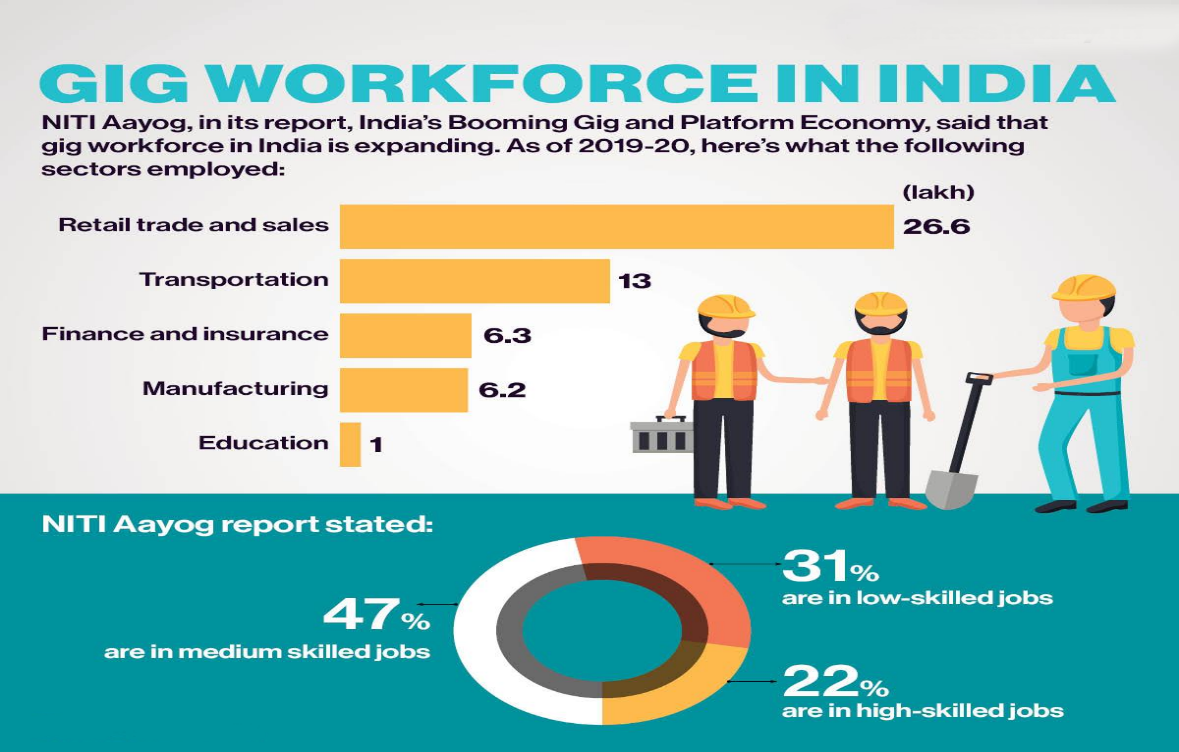
Figure
In the past decade, the growth of freelancing platforms and digital startups has led to the expansion of the gig culture. India has emerged as the fifth-largest country for gig work, and it is projected to continue growing at a compound annual growth rate (CAGR) of 17% by 2024.12 The gig economy in India is expected to triple in the next three to four years, adding over 16 million jobs to the non-farm sector. Many workers in this sector rely on gigs as their main source of income. This growth is anticipated to have a long-term impact, with the economy potentially employing up to 90 million people and contributing 1.25% to India’s GDP.
In India, the most visible areas of gig work have been in the transport, last-mile delivery and at-home personal services industries. Digital platforms have played a significant role in facilitating employment creation, particularly in urban areas. During the COVID-19 pandemic and the subsequent lockdown, consumer behaviour shifted towards increased reliance on online platforms for essential products and services. This digital revolution is expected to address the inefficiencies of the unorganised sector and create more employment and income opportunities, especially for women, by offering flexible working hours and mobility options.
India has witnessed a rapid rise in the gig economy, driven by platforms like Ola, Swiggy and UrbanClap. These platforms have transformed sectors such as ride-hailing, food delivery and home services, creating income-generating opportunities for millions of workers in the country. These platforms were among the pioneers in introducing gig-based services in India. They leveraged the power of digital technology to connect gig workers with customers and businesses, creating new avenues for flexible work opportunities. Over time, these platforms and others in the gig economy landscape have continued to evolve, shaping the gig work culture in the country and impacting the way people find and provide services.13
D. First Platforms Providing Gig-Based Services in India
Some of the first platforms that provided gig-based services in India were the following.14
• OLX (founded in 2006): OLX is an online marketplace where individuals can buy and sell used goods. It allowed people to list items they wanted to sell, and others could connect with them to make purchases. This platform enabled gig-based selling for individuals who wanted to earn money by selling items they no longer needed.
• Naukri.com (founded in 1997): while Naukri.com is primarily known as a job portal, it was one of the early platforms that allowed companies to post temporary and freelance job opportunities. It enabled gig workers to find short-term employment in various industries.
• Uber (launched in India in 2013) and Ola (founded in 2010): Uber and Ola are ride-hailing platforms that revolutionised transportation in India. They provided opportunities for individuals with vehicles to offer rides on a flexible basis. Drivers could work whenever they wanted, making them pioneers in introducing gig work for drivers in the country.
• Freelancer (founded in 2009): Freelancer is a global freelancing platform that connects businesses and individuals with skilled professionals. It allowed Indian freelancers to find work opportunities from clients around the world, opening up gig-based work options in diverse fields like writing, design and programming.
• Zomato (formerly Foodiebay, founded in 2008) and Swiggy (founded in 2014): Zomato and Swiggy are food delivery platforms that transformed how Indians ordered food. These platforms created gig opportunities for delivery partners who could deliver food from restaurants to customers’ homes.
• Urban Company (formerly UrbanClap, founded in 2014): Urban Company is a platform that connects customers with service providers for various home services like plumbing, electrical work, cleaning and beauty services. It provided gig work opportunities for professionals in these fields.
E. United States
Although “gig work” is a popular term nowadays, the concept of doing short-term tasks can be traced back to the early 20th century.15 After the Great Depression in the United States, when job opportunities were limited, “temp agencies” emerged to connect workers with short-term employment. As technology advanced, websites like Craigslist transformed this idea, and the internet and dot-com boom further expanded it.16 The term “gig” is now used to describe a wide range of activities, including part-time jobs, contract work and on-demand services. In recent decades, various types of online platforms have emerged, connecting businesses and customers, and offering different gig services. Despite the different definitions, the number of people engaging in gig work, whether part-time or full-time, continues to increase globally.
The United States is often considered a frontrunner in the gig economy due to the early emergence of platform-based companies like Uber and TaskRabbit.17 These companies pioneered the concept of using digital platforms to connect independent workers with consumers, creating new opportunities for flexible work arrangements.18
The historical development of gig workers in the USA can be traced back to several key factors and eras that have shaped the gig economy as we know it today. The term “gig economy” refers to a labour market characterised by short-term or freelance work, where individuals work on a per-project or task basis, often through online platforms. The major incidents in the historical development of gig workers in the USA can be summarised as follows.
F. Early Forms of Gig Work in the USA in the Late 19th and 20th Century
The concept of gig work has roots in informal labour arrangements that existed before the digital age. In the late 1800s and early 1900s, it was common for workers, such as musicians and day labourers, to take on short-term gigs or temporary jobs to earn a living. These gigs were typically project-based and lacked the traditional long-term employer-employee relationship.19
During the years from the 1940s to the 1970s, something called temporary labour agencies started to become popular. These agencies connected businesses with workers who could do short-term jobs or work temporarily to meet their needs. Instead of hiring permanent employees, companies could get help from these temporary workers when they required extra hands.
These agencies connected businesses with temporary workers to meet fluctuating demands. Temporary jobs offered workers more flexibility, but they often lacked the benefits and job security associated with traditional employment. The use of temporary workers expanded across various industries.
G. From Independent Contractors and Freelancers to the Emergence and Expansion of Online Platforms
During the decade between 1980 and 1990, a significant shift occurred as more individuals began to work as independent contractors or freelancers. Advances in technology, such as personal computers and the internet, enabled people to offer their skills and services independently. This period saw the growth of the self-employed workforce, particularly in fields like consulting, graphic design, writing and software development.
The late 2000s brought a transformation in the gig economy with the rise of online platforms that facilitated gig work. Companies like Uber20 and Airbnb21 played a pivotal role in the gig economy’s modern development. Uber, for example, introduced ride-sharing services that allowed individuals to become drivers using their own cars, and Airbnb provided a platform for people to rent out their properties to travellers.22
In 2010, the gig economy experienced significant growth, fuelled by an increasing number of platforms catering to various services. Task-based platforms like TaskRabbit and Fiverr allowed people to offer specific skills and services to a global audience. The accessibility of smartphones and mobile apps further facilitated the growth of gig work by enabling seamless connections between workers and consumers.23
Labour and Legal Issues
The growth of the gig economy also brought about various labour and legal challenges. As gig workers were often classified as independent contractors, they were excluded from many traditional employment benefits and protections. This led to debates over worker classification and calls for better protections and rights for gig workers. Several legal battles ensued, with some jurisdictions reclassifying gig workers as employees to afford them more protections.24
During the period from 2010 to 2020, the United States experienced significant labour and legal issues that shaped the workforce and employment landscape. Some of the key labour and legal issues during this time included the following.25
• Gig economy and worker classification: the rise of the gig economy, characterised by on-demand and freelance work, brought forth debates about worker classification. Companies like Uber, Lyft and many others classified their workers as independent contractors, which meant that these workers were not entitled to traditional employee benefits and protections, such as minimum wage, overtime pay, and access to benefits like healthcare and retirement plans. This issue sparked legal battles and discussions about whether gig workers should be classified as employees, with some states and jurisdictions passing laws to provide gig workers with additional protections.26
• Fight for a higher minimum wage: advocacy for a higher federal minimum wage gained momentum during this period. Many workers and labour organisations argued that the existing federal minimum wage was insufficient to support a decent standard of living. There were numerous protests and campaigns calling for an increase in the minimum wage, which varied across states and localities.27
• Workplace discrimination and harassment: around 2010 there was an increase in public awareness and discussions about workplace discrimination and harassment. High-profile cases, such as the #MeToo movement, shed light on the prevalence of sexual harassment and abuse in various industries. This led to increased scrutiny of workplace policies, training and legal measures to address and prevent discrimination and harassment.28
• Rise of non-traditional work arrangements: the gig economy was not the only form of non-traditional work arrangement that gained prominence. Temporary work, part-time work and contract work also increased during this period. This shift raised concerns about job security, access to benefits, and workers’ rights in these non-traditional arrangements.
• Unionisation efforts and labour rights: there were continued efforts to protect and expand workers’ rights through unionisation and collective bargaining. Workers in various industries, including fast food, retail and tech, organised strikes and campaigns to demand better working conditions, fair wages and improved benefits.
• Immigration and labour: immigration policies and their impact on the labour market were significant issues during this decade. Debates around immigration reform intersected with discussions about the rights of immigrant workers, their job opportunities, and how immigration policies affected various industries.
Worker Safety During the COVID-19 Pandemic and the Pandemic’s Impact
The outbreak of the COVID-19 pandemic in 2020 brought significant labour and legal issues to the forefront. There were debates about essential worker protections, workplace safety measures and access to paid sick leave during the pandemic. Many workers faced increased health risks while continuing to provide essential services.29
The enforcement of labour laws and worker protections was a recurring concern. Ensuring that employers complied with labour laws, including wage and hour regulations, was a challenge. The misclassification of workers and the issue of wage theft were also subjects of legal and regulatory attention.
Throughout this decade, various stakeholders, including workers, labour organisations, policymakers and employers, engaged in ongoing discussions and efforts to address these labour and legal issues. The dynamics of the labour market continued to evolve, bringing attention to the need for policies and regulations that protect workers’ rights and ensure fair and equitable workplaces.30
The COVID-19 pandemic in 2020 had a profound impact on the gig economy. While some gig workers experienced increased demand for their services (for example, food delivery drivers), others faced significant reductions in opportunities due to lockdowns and economic downturns. The pandemic brought attention to the precarious nature of gig work and highlighted the need for greater safety nets and support systems for gig workers.31
The researcher therefore in general is of the view that the history of gig workers in the USA is complicated and always changing. It has been influenced by new technology, how the economy works, and how society changes. Some people like gig work because it gives them flexibility and chances to work on different projects. However, it has also made us think about important issues like workers’ rights, support systems, and what the future of work will look like in this century.32
Comparison of Gig Workers and the Gig Economy in India and the USA
While the gig economy and gig workers in both India and the USA share common features related to flexibility and digital platforms, the specific dynamics, challenges and regulatory environments differ significantly between the two countries. Some points that can be generally noted while comparing gig workers and the gig economy of the USA with India are as follows.
| Gig Economy in India: |
|---|
| Size and Growth: India’s gig economy has been rapidly expanding in recent years, driven by factors such as increased smartphone penetration, internet connectivity, and a large young population seeking flexible work opportunities. |
| Nature of Jobs: In India, the gig economy includes a wide range of jobs, such as ride-hailing (e.g., Ola, Uber), food delivery (e.g., Swiggy, Zomato), freelance services (e.g., content writing, graphic design), and domestic work (e.g., house cleaning, cooking). |
| Informality: The gig economy in India often operates in the informal sector, with workers having less job security and limited access to benefits like health insurance, retirement plans, and paid leave. |
| Labour Regulations: Labour regulations in India are still evolving to accommodate the unique challenges posed by the gig economy. Worker classification, minimum wages, and social security benefits for gig workers have been topics of discussion and reform. |
| Gig Economy in the USA: |
| Maturity: The gig economy in the USA is relatively more established compared to India and has been growing steadily for several years. |
| Industry Dominance: In the USA, ride-hailing (e.g., Uber, Lyft), food delivery (e.g., DoorDash, Postmates), and freelance work (e.g., Upwork, Fiverr) are significant components of the gig economy. |
| Labour Regulations: Gig workers in the USA have faced debates and legal battles over worker classification, with some seeking to be recognized as employees to access additional benefits and protections. |
| Benefits and Protections: Gig workers in the USA may have access to certain benefits, such as healthcare subsidies and retirement plans, but these are often contingent on their employment status. |
| Gig Workers in India: |
|---|
| Demographics: Gig workers in India come from diverse backgrounds and age groups, including students, part-time job seekers, and individuals seeking supplemental income. |
| Earnings: While some gig workers in India can earn a decent income, many face issues related to low pay, lack of job security, and income volatility. |
| Platform Diversity: Gig work in India often involves multiple platforms, as workers may switch between different apps or services to maximize their earnings. |
| Digital Literacy: Due to variations in digital literacy levels, some gig workers in India may face challenges in effectively using technology platforms. |
| Gig Workers in the USA: |
| Worker Classification: The classification of gig workers as independent contractors has been a subject of controversy, with implications for worker rights and benefits. |
| Unionization Efforts: Gig workers in the USA have seen increased interest in unionization to advocate for better working conditions and benefits. |
| Earnings: While some gig workers in the USA can earn decent incomes, there have been concerns about the lack of stability and potential for exploitation in certain sectors. |
| Legal Protections: Gig workers in the USA may have access to certain labour protections, but these can vary based on their employment status and state-specific regulations. |
The Rise of the Gig Economy in Europe
The gig economy’s expansion has led to notable transformations in Europe’s labour market in recent times. This sector is evolving rapidly, and courts are striving to adapt to novel working arrangements while new laws are being proposed both at the EU and country levels. The report by the PwC employment law network33 outlines significant developments in ten European countries (including the UK) concerning the classification of gig economy workers, offering valuable insights into the current position of the gig economy in European countries.
In the aftermath of the 2008 financial crisis, traditional job markets faced challenges, leading many individuals to explore alternative income sources. The gig economy offered a way for people to supplement their earnings or find employment opportunities in a more flexible manner.
The gig economy encouraged entrepreneurship and allowed individuals to work independently. People could start their own businesses, work as freelancers, or become gig workers, offering their skills and services to a broader market.34
Platforms providing on-demand services, such as ride-hailing, food delivery and home services, gained popularity in many European countries. Companies like Uber, Deliveroo and TaskRabbit facilitated convenient and efficient services for consumers, contributing to the growth of the gig economy.
United Kingdom
The United Kingdom has been a prominent player in the gig economy, particularly in cities like London. The growth of platforms such as Deliveroo and Uber has reshaped industries like food delivery and transportation, providing opportunities for individuals to participate in gig work.35
The history and development of gig workers in the UK have been influenced by various factors, including changes in the labour market, advancements in technology, and shifts in worker preferences. The researcher gives an overview of the historical development of gig workers in the UK below.36
A. Forerunners of the Gig Economy in the UK
The concept of gig work in the UK has roots in informal labour arrangements that existed before the digital age, in the 19th and early 20th century. Workers, such as musicians, performers and casual labourers, took on short-term gigs or temporary jobs to earn a living. This form of gig work laid the foundation for the gig economy as we know it today.37
B. Rise of Temporary and Casual Labour
During the 20th century, temporary and casual labour started to become more common in the UK. Temporary staffing agencies emerged, connecting businesses with workers for short-term projects. The use of casual labour increased in industries like agriculture, hospitality and events. Workers were often hired for specific tasks or events without the traditional long-term employment relationship.38
C. Expansion of Freelance Work (Late 20th and Early 21st Century)
With advancements in technology and communication, freelance work started to gain popularity in the late 20th and early 21st century. Freelancers, such as writers, designers and consultants, could offer their services to clients on a project-by-project basis. This trend contributed to the growth of the gig economy in the UK.39
D. Emergence of Online Gig Platforms
Like the global trend, the UK saw the emergence of online gig platforms somewhere in the middle of the 2000s. Platforms like TaskRabbit, Upwork and Deliveroo provided opportunities for individuals to find gig work across various sectors, including delivery services, home services and creative work.40
E. Gig Economy Boom
Around 2010, the gig economy in the UK experienced significant growth. Platforms like Uber and Airbnb expanded their services in the country, providing opportunities for people to work as drivers or offer accommodation to travellers. The gig economy’s boom brought both benefits and challenges for workers, including greater flexibility but also concerns about worker rights and protections.41
F. Worker Rights and Legal Issues
The gig economy’s rapid growth led to debates and legal challenges over worker classification and employment rights. In the UK, as in other countries, there were discussions about whether gig workers should be classified as independent contractors or employees and thus be entitled to certain benefits and protections.
G. COVID-19 Pandemic Impact
The COVID-19 pandemic in 2020 had a significant impact on gig workers in the UK. With lockdowns and restrictions, many gig workers faced reduced demand for their services, leading to financial hardships. The pandemic also raised concerns about worker safety and access to protective measures for those continuing to provide essential gig services.42
H. Differences in the Gig Economy Set-Up of the UK and the USA
The gig economy has been growing in popularity worldwide, including in the USA and the UK. However, specific regulations and market conditions may differ between the two countries, leading to some differences in how the gig economy operates. The researcher has tried to point out some key distinctions relating to:
• the legal and regulatory environment;
• employment rights and benefits;
• platform regulations; and
• unionisation and collective bargaining.43
The details of these distinctions form part of the study in the next article of this thesis.
The legal and regulatory frameworks governing the gig economy can vary between the USA and the UK. These regulations may cover areas such as worker classification, minimum wage laws, labour rights and benefits. For instance, in the USA, there has been ongoing debate over whether gig workers should be classified as independent contractors or employees, which affects their rights and protections. In the UK, worker classification has also been a topic of discussion, with court cases challenging the classification of gig workers as self-employed.44
In both countries, gig workers may have different rights and benefits compared to traditional employees. However, the specifics of these rights can differ. For example, in the UK, workers are entitled to certain rights, such as the national minimum wage, holiday pay and sick pay. In the USA, gig workers have often faced challenges in accessing benefits like health insurance, retirement plans and unemployment benefits. Some states in the USA have implemented new regulations to address these issues, but the situation remains dynamic.45
The companies that facilitate gig work, often through digital platforms, may be subject to different regulations in the USA and the UK. These regulations can impact aspects like worker ratings, dispute resolution and platform fees. Both countries have been exploring ways to regulate gig platforms while balancing innovation and protection for workers.
The ability of gig workers to unionise and collectively bargain may differ between the USA and the UK due to variations in labour laws and attitudes towards unions. In the UK, there has been some progress in unionising gig workers, with some unions advocating for better rights and representation. In the USA, unionisation efforts among gig workers have also emerged, but they face challenges in certain states due to labour laws that may restrict organising efforts.
I. Comparison of the Gig Economy and Gig Workers in India and the United Kingdom
China
China has experienced a significant expansion of the gig economy, with platforms like Didi Chuxing, Meituan-Dianping and Alibaba’s Taobao. These platforms have had a substantial impact on various sectors, including ride-hailing, food delivery and e-commerce, contributing to China’s vibrant gig work landscape.46
The gig economy in China has experienced significant growth and transformation over the years. The gig economy, also known as the “platform economy” in China, refers to a system where temporary, flexible jobs are offered through online platforms, connecting businesses or individuals with workers to fulfil short-term tasks or services.47
When we look at the history of the gig economy in China, we find that its origin can be traced back to the early 21st century, when the internet and mobile technology began to proliferate in the country. Online platforms started emerging, offering various services, such as freelancing, ride-hailing, food delivery and task-based jobs.
One of the earliest and most prominent examples of the gig economy’s growth in China was the rise of ride-hailing services. Companies like Didi Chuxing (formerly Didi Kuaidi) and Uber China (acquired by Didi Chuxing) competed intensely for market share, providing ride-hailing services to millions of users across the country.48
Over time, the gig economy expanded into various sectors beyond ride-hailing. Food delivery services like Meituan-Dianping and Ele.me gained popularity, offering quick and efficient food delivery to consumers. Additionally, online platforms emerged for offering freelancing services, such as remote work opportunities, graphic design and content creation. Along with all these developments, China was facing lawlessness, or what we can term regulatory challenges, with the modern business set-ups and technological developments. Some of the regulatory challenges can be noted as concerns regarding worker protections, labour rights and fair wages, which were raised, leading to discussions about the legal status of gig workers and their benefits.49
A closer look at the advancement in technology and inventions can suggest the example of mobile phones. China’s gig economy was heavily enabled by advancements in mobile technology, digital payment systems and artificial intelligence. Mobile payment platforms like Alipay and WeChat Pay facilitated seamless and efficient transactions between service providers and users.
The rise in digital technology also brought platform dominance, which can be said to be dominance over small companies by a single large company that can provide multiple facilities at the same time. For example, a few major companies, such as Didi Chuxing and Meituan-Dianping,50 came to dominate their respective sectors of the gig economy. These platforms expanded their services, offering a wide range of on-demand services and becoming an integral part of many people’s daily lives.
Looking at China in the new normal also suggests that the COVID-19 pandemic had a significant impact on the gig economy in China, with increased demand for food delivery services and online shopping. It also highlighted issues related to worker safety and labour conditions.51
Conclusion
Thus, it can be concluded that the cross-jurisdictional study of gig workers in the USA, the UK, India and China reveals significant variations in the gig economy landscape and the experiences of gig workers across these countries. Each nation possesses its unique set of economic conditions, labour regulations and cultural factors, influencing how the gig economy operates and how gig workers are impacted. In the USA and the UK, gig work is more established, and there are discussions about worker rights and benefits. In India and China, the gig economy is rapidly growing, but gig workers face challenges like limited job security and benefits.
Gig workers in all four countries have different experiences and access to resources. Income can vary, and some gig workers struggle to access benefits like health insurance or retirement plans.
To support gig workers, policymakers need to create fair rules and protections. It is important to find a balance between promoting gig economy growth and ensuring that gig workers’ rights are respected. Continued research is essential to understand how the gig economy affects workers in each country and to improve their working conditions.
The researcher also suggests that there is a need for collaboration and understanding across borders to create a positive and fair environment for gig workers worldwide.
*****
Footnotes
1. Alex J. Wood, Nicholas Martindale & Brendan Burchell, Gig Rights & Gig Wrongs: Initial Findings from the Gig Rights Project: Labour Rights, Co-Determination, Collectivism and Job Quality in the UK Gig Economy (University of Bristol, 2023), https://papers.ssrn.com/sol3/papers.cfm?abstract_id=4446226 (last visited 11 July 2025).
2. Jeremy Pilaar, Assessing the Gig Economy in Comparative Perspective: How Platform Work Challenges the French and American Legal Orders, 27 Journal of Law and Policy 47 (2019), https://ssrn.com/abstract=3385733 (last visited 11 July 2025).
3. David H. Autor & David Dorn, The Growth of Low-Skill Service Jobs and the Polarization of the U.S. Labor Market, 103(5) American Economic Review 1553 (2013).
4. Otto Kässi & Vili Lehdonvirta, Online Labour Index: Measuring the Online Gig Economy for Policy and Research, 137 Technological Forecasting and Social Change 241 (2018).
5. Erik Brynjolfsson & Andrew McAfee, The Second Machine Age: Work, Progress, and Prosperity in a Time of Brilliant Technologies (W.W. Norton & Company, 2014).
6. Autor & Dorn, supra note 3.
7. Deloitte, The Millennial Survey 2020: Millennials and Gen Zs Hold the Key to Creating a “Better Normal” (2020), https://www2.deloitte.com/global/en/pages/about-deloitte/articles/millennialsurvey.html (last visited 11 July 2025).
8. Richard B. Freeman, Labor Regulations, Unions, and Social Protection in Developing Countries: Market Distortions or Efficient Institutions? (National Bureau of Economic Research Working Paper No. 14789, March 2009), https://ssrn.com/abstract=1359505 (last visited 11 July 2025).
9. Sattva Consulting, Challenges and Opportunities in the Gig Economy in a Post-COVID World: Investigating the Interactions Between Gig Workers and Platforms (August 2022), https://asiafoundation.org/wp-content/uploads/2022/12/India-Challenges-and-Opportunities-in-the-gig-economy-in-a-post-COVID-world.pdf (last visited 11 July 2025).
10. Sattva Consulting, supra note 9, at 21.
11. Figure © NITI Aayog, Government of India (2022).
12. NITI Aayog, India’s Booming Gig and Platform Economy: Perspectives and Recommendations on the Future of Work (June 2022), https://www.niti.gov.in/sites/default/files/2022-06/25th_June_Final_Report_27062022.pdf (last visited 23 July 2025).
13. Id. at 31-35.
14. List of Companies Which Provides Work to Gig Workers of India, StartupTalky, https://startuptalky.com/gig-economy-companies-india/ (last visited 23 July 2025).
15. Martin Kenney & John Zysman, The Rise of the Platform Economy, 32(3) Issues in Science and Technology 61 (2016).
16. G. Bali, India’s Rising Tryst with Gig Economy and Opportunities in Direct Selling for Ambitious Millennials, The Economic Times (14 February 2022) (last visited 11 July 2025).
17. Veena Dubal, A Brief History of the Gig, Logic Magazine, Issue 10: Security (4 May 2020), https://ssrn.com/abstract=3649694 (last visited 21 July 2025).
18. Sarah Kessler, Gigged: The Gig Economy, the End of the Job, and the Future of Work (St. Martin’s Press, 2018).
19. NITI Aayog, supra note 12.
20. Uber is a popular ride-sharing platform that was founded in 2009. It provides an easy way for people to book rides using their smartphones. With Uber, passengers can request a ride from nearby drivers, who use their own cars to provide the service. The app shows the estimated fare and arrival time, making it convenient for passengers to get around without having to wait for traditional taxis. Uber has become a popular alternative to traditional transportation services, and its presence has transformed how people travel in many cities around the world.
21. Airbnb is a company that was founded in 2008 and offers a unique accommodation-sharing platform. It allows homeowners and hosts to rent out their properties, whether it is a spare room, an entire apartment or even a vacation home, to travellers looking for a place to stay. Travellers can search for accommodation on the Airbnb website or app, and they can choose from a wide range of options in various locations.
22. Jennifer Van Grove, Gig Work and the Past, Present and Future of American Labor, The San Diego Union-Tribune (3 September 2017), https://www.sandiegouniontribune.com/business/technology/sd-fi-gig-history-20170903-story.html (last visited 21 July 2025).
23. Aspen Institute, The Gig Economy: Research and Policy Implications of Regional, Economic, and Demographic Trends (January 2017), https://www.aspeninstitute.org/wp-content/uploads/2017/02/Regional-and-Industry-Gig-Trends-2017.pdf (last visited 21 July 2025).
24. Bureau of Labor Statistics, Contingent and Alternative Employment Arrangements, May 2017 (news release, 7 June 2018).
25. Monica Anderson, Colleen McClain, Michelle Faverio & Risa Gelles-Watnick, The State of Gig Work in 2021, Pew Research Center (December 2021).
26. AmTrust Financial, Employment Classification and Its Impact on the Gig Economy, https://amtrustfinancial.com/blog/small-business/employment-classification-impact-on-gig-economy (last visited 21 July 2025).
27. National Employment Law Project, App-Based Workers Speak: Studies Reveal Anxiety, Frustration, and a Desire for Good Jobs (produced in collaboration with Gig Workers Rising, Gig Workers Collective, Mobile Workers Alliance, We Drive Progress, Rideshare Drivers United and Philadelphia Drivers Union, October 2021).
28. Marketplace-Edison Research Poll, Sexual Harassment in the Workplace: #MeToo, Women, Men, and the Gig Economy (June 2018), https://www.edisonresearch.com/wp-content/uploads/2018/06/Sexual-Harassment-in-the-Workplace-metoo-Women-Men-and-the-Gig-Economy-6.20.18-1.pdf (last visited 21 July 2025).
29. Joe Piacentini, Harley Frazis, Peter B. Meyer, Michael Schultz & Leo Sveikauskas, The Impact of COVID-19 on Labor Markets and Inequality (U.S. Bureau of Labor Statistics Working Papers, 5 August 2022), https://www.bls.gov/osmr/research-papers/2022/pdf/ec220060.pdf (last visited 21 July 2025).
30. Bureau of Labor Statistics, supra note 24.
31. Sattva Consulting, supra note 9.
32. Daniel Schneider & Kristen Harknett, Consequences of Routine Work-Schedule Instability for Worker Health and Well-Being, 84(1) American Sociological Review 82 (2019), https://doi.org/10.1177/0003122418823184.
33. PwC, The Gig Economy in the EU and the UK (2021), https://www.pwc.co.uk/services/legal/insights/gig-economy-eu-uk-2021.html (last visited 23 July 2025).
34. D. Dazzi, Gig Economy in Europe, 12(2) Italian Labour Law E-Journal 67 (2019), https://doi.org/10.6092/issn.1561-8048/9925.
35. A.J. Wood, The Gig Economy: A Critical Introduction, 31(1) Work, Employment and Society 171 (2017).
36. United Kingdom’s Gig Economy: New Regulations and Their Implications, Global People Strategist, https://www.globalpeoplestrategist.com/united-kingdoms-gig-economy-new-regulations-and-their-implications/ (last visited 22 July 2025).
37. Alex J. Wood, Mark Graham, Vili Lehdonvirta & Isis Hjorth, Good Gig, Bad Gig: Autonomy and Algorithmic Control in the Global Gig Economy, 33(1) Work, Employment and Society 56 (2019), https://doi.org/10.1177/0950017018785616 (last visited 22 July 2025).
38. Diane Coyle, The Promise and Peril of the Gig Economy: It’s Transforming Work, but There Are Big Challenges Ahead, Harvard Business Review (June 2016).
39. Sattva Consulting, supra note 9.
40. Van Eecke & Vingerhoets, The Rise of the Gig Economy: Insights into Flexibility and Innovation (Springer, 2019).
41. International Labour Organization, Digital Labour Platforms and the Future of Work: Towards Decent Work in the Online World (2018), https://www.ilo.org/wcmsp5/groups/public/—dgreports/—dcomm/—publ/documents/publication/wcms_645337.pdf (last visited 1 May 2025).
42. Id. at 18-20.
43. Unionisation is workers joining together as a group, and collective bargaining is the process by which the group (union) negotiates with the employer to improve working conditions and benefits for all the workers.
44. The legal systems of the USA and the UK with reference to gig workers form the detailed subject of study in Chapter 6 of the thesis.
45. Alexandra Monkhouse & Peter Spiro, Employment Class Actions and the Gig Economy in the US and UK, and Implications for Canada (25 February 2020), https://doi.org/10.2139/ssrn.3548317 (last visited 24 July 2025).
46. H. Chen & M. Huang, The Gig Economy in China: Challenges and Prospects, 69 Journal of Asian Economics 101223 (2020).
47. Zhun Xu, The Gig Economy in China, in The Routledge Handbook of the Gig Economy 392 (Routledge), https://www.researchgate.net/publication/364808194_The_gig_economy_in_China (last visited 23 July 2025).
48. Julie Yujie Chen, Thrown Under the Bus and Outrunning It! The Logic of Didi and Taxi Drivers’ Labour and Activism in the On-Demand Economy, 20(8) New Media & Society 2691 (2018).
49. John Giles, Albert Park & Juwei Zhang, What Is China’s True Unemployment Rate?, 16(2) China Economic Review 149 (2005).
50. Hao Qi & Zhongjin Li, Putting Precarity Back to Production: A Case Study of Didi Kuaiche Drivers in the City of Nanjing, China, 52(3) Review of Radical Political Economics 506 (2020).
51. Zhun Xu, supra note 47.