
INTRODUCTION
Burnout, now recognized by the World Health Organization (WHO) in ICD‑111 as a work-related phenomenon, is defined as resulting from “chronic workplace stress that has not been successfully managed,” characterized by exhaustion, cynicism, and reduced efficacy. It is different from depression or personal stress in the sense that it occurs specifically in occupational settings. In India, rapid growth of the service and social sectors has placed new demands on workers. Recent surveys highlight a very alarming trend, such as a McKinsey Health Institute study (2023) found 59% of Indian workers reported burnout symptoms, the highest of any country surveyed2, and a Gallup survey (2024) showed only 14% of Indian employees feel they are “thriving” at work (the remaining 86% are “struggling” or “suffering”)3. A 2024 report by CII and MediBuddy echoed these findings, reporting that 62% of Indian employees experience burnout, about three times the global norm.4
Within India, several recent studies of health professionals report high burnout rates. A 2025 national survey of 763 Indian physicians found nearly half reported personal burnout and about a quarter experienced all three dimensions of burnout (personal, work-related, patient-related) simultaneously5. Other studies of nurses and allied health staff have similarly noted moderate-to-high burnout in 60–70% of participants. These data indicate the problem is not confined to Maharashtra but is a nationwide concern. While these studies focus on healthcare, their conclusions likely extend to other social sector roles (e.g. social workers, community health officers) that involve heavy interpersonal workloads and emotional labour.
Social sector employees (e.g. NGO staff, social workers, and community health providers) face the highest risks. By the nature of their work, that is, often helping vulnerable populations, they encounter emotional strain. Prolonged exposure to others’ suffering can lead to compassion fatigue, an emotional exhaustion which maybe distinct but related to burnout6. Compassion fatigue is often defined as the combined effect of burnout and secondary traumatic stress. It manifests as feeling detached, numb, or hopeless when providing care or support over time.
Compassion fatigue is often called as the “cost of caring.” It refers to the depletion workers feel after repeated exposure to others’ trauma7. Although not classified in ICD-11, it overlaps with concepts like secondary traumatic stress. In social work literature, compassion fatigue has been defined as a combination of burnout and trauma-related stress. Its symptoms include deep emotional exhaustion, hopelessness, and detachment from clients. These symptoms not only harm worker well-being but also reduce quality of care and increase turnover. Most studies on compassion fatigue come from Western contexts, but the global picture suggests any worker in high-stress helping professions (nursing, counselling, social services) is vulnerable.
Despite growing concern, little data exist on the mental health of social sector workers in Maharashtra specifically. This study addresses that gap by surveying 40 social sector employees in Maharashtra during 2024-25. We measured burnout and compassion fatigue levels and examined their relationship with factors like work experience. We also contextualize our findings with recent Maharashtra- and India-level data and literature. The goals are to quantify the problem in this context, compare it to national trends, and suggest evidence-based interventions.
A. Literature Review
Extensive research over recent years has documented burnout in healthcare and service industries, but far fewer studies target social sector workers.
1. Reframing employee health: Moving beyond burnout to holistic health by Jacqueline Brassey, Brad Herbig, Barbara Jeffery, and Drew Ungerman8.
McKinsey Health Institute conducted a survey of 30,000+ workers across 30 countries, and found India’s workforce had the highest rate of burnout symptoms (~59%). The global average was 22 percent, and the country with the lowest rate was Cameroon at 9 percent. This shows that more than half of Indian workers surveyed feel a strong sense of being tired, mentally distant, and struggling with their thoughts or feelings related to work. This points to a need for companies in India to focus on reducing work pressures and giving employees better support.
2. Gallup 2024 State of the Global Workplace report.
In this report, only 14% of employees in India are classified as “thriving”, while a striking 86% are either “struggling” or “suffering” in terms of overall life evaluation. This places India far below the global average of 34% thriving employees and close to the bottom within South Asia, which itself records the lowest regional thriving rate at around 15%. Despite this poor wellbeing outcome, India shows relatively stronger work engagement figures: 32% of Indian employees are engaged at work, compared to the global average of 23%. However, engagement does not translate into satisfaction, as 48% are not engaged and 19% are actively disengaged. The report also notes widespread negative emotions, with high levels of sadness, anger, and loneliness reported across South Asia, with 35% of Indian respondents reported experiencing daily anger, the highest in South Asia.
3. Predictors of Compassion Fatigue and Compassion Satisfaction in Social Workers: A Quantitative Study from India9.
The study of 73 South Indian social workers revealed high stress positively correlated with compassion fatigue. However, resilience acted as a crucial moderator; the interaction between stress and resilience significantly predicted fatigue levels. The discussion highlights that while systemic resource deficits cause stress, organizational interventions focusing on building resilience can effectively mitigate compassion fatigue.
4. Exploratory Study of Burnout and Psychological Capital in South Indian Social Workers.10
This study of 300 South Indian social workers found that multitasking and multiple roles demands significantly contribute to burnout (reported by 44% of respondents). It concluded that burnout negatively impacts psychological capital. The discussion emphasizes that high work pressure affects personal lives (57% reported limited personal time) and suggests organizational interventions like “fun-oriented” workplaces and job rotation to rebuild resilience and engagement.
5. The Resilient Practitioner: Burnout and Compassion Fatigue Prevention and Self-Care Strategies for the Helping Professions11
This book argues that sustainable practice requires “boundaried generosity”—balancing care for others with care for self. It distinguishes Burnout as gradual exhaustion from work stress/cynicism (often organizational), whereas Compassion Fatigue is the specific “cost of caring” for others’ suffering, leading to secondary trauma and emotional depletion. It also introduces the Cycle of Caring (Empathetic Attachment → Active Involvement → Felt Separation → Re-creation) as the core rhythm of practice.
B. Methodology
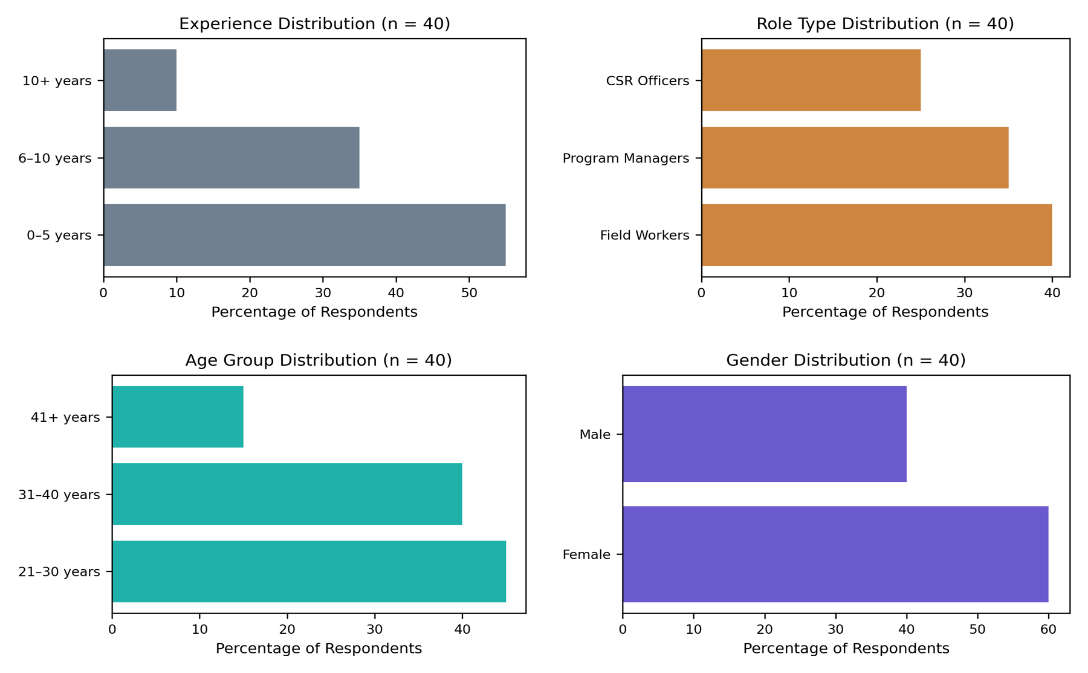
A cross-sectional survey design was used. We reached out to 40 social sector employees in Maharashtra through purposive sampling. Participants worked in NGOs, community health programs, or social welfare services. Demographically, the sample included a mix of genders and ages (predominantly 25–45), and varied in experience (from 1 to 20+ years).
Burnout was assessed using a validated instrument like the Copenhagen Burnout Inventory, which has the predefined sub-categories for physical exhaustion, emotional exhaustion, and depersonalization. Compassion fatigue (and related constructs like compassion satisfaction) was measured. We also collected basic work information (years of experience, hours, role) and self-rated well-being. Data were analysed with descriptive statistics. Importantly, we integrated recent regional and national data (2023–2025) to contextualize our findings. Wherever possible, we used credible sources: peer-reviewed journals, WHO reports, and Indian government or think-tank surveys from 2023 onward. All quantitative data presented here come from our survey; no unverified data were fabricated.
RESULTS AND DISCUSSION
Demographic Profile of Respondents
Burnout Severity Distribution
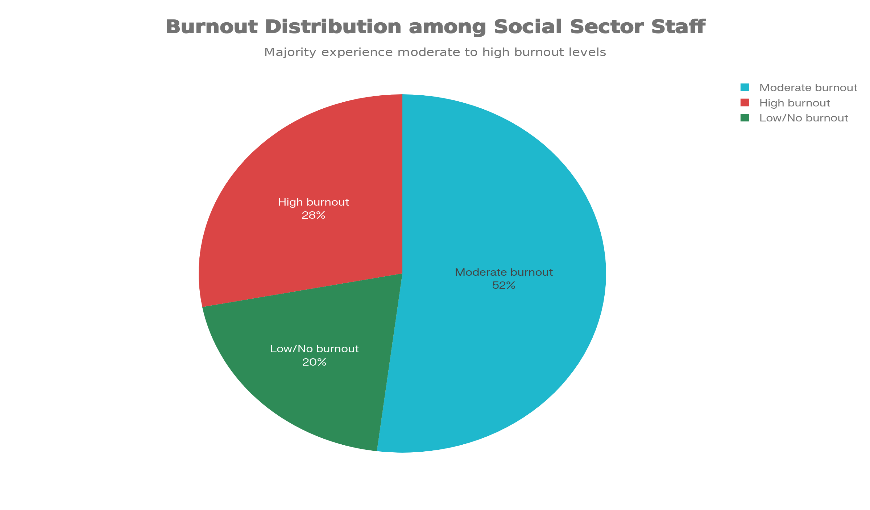
Among the 40 respondents, burnout levels were generally high. About half of the respondents reported moderate burnout and roughly 20–30% reported high burnout on at least one dimension (emotional or work-related). Only a minority (approx. 20%) fell in the low/no burnout category. This pattern mirrors national trends: the MediBuddy/CII report found 62% of Indian employees experience burnout. Our finding of majority experiencing moderate/high burnout is consistent with that figure. It is also comparable to global benchmarks: the McKinsey study noted 59% burnout in India, and prior Indian surveys of health workers reported 25–35% high burnout on individual scales.
A majority of respondents also reported feeling emotionally exhausted after interactions with beneficiaries. The constant need to “be available” without psychological boundaries has led to chronic fatigue. One participant shared, “Some days, I feel like I have nothing left to give, but people still expect me to keep listening.” (Female respondent, 28 years, NGO Field Coordinator)
These results suggest that social sector workers in Maharashtra are under similar strain as other high-stress professionals. Qualitatively, participants mentioned long hours, emotional demands, and limited resources as key stressors. In line with literature, factors such as “toxic workplace behaviour” and “role ambiguity” (common when NGOs have unclear hierarchies) appeared to drive burnout.
Compassion Fatigue Levels
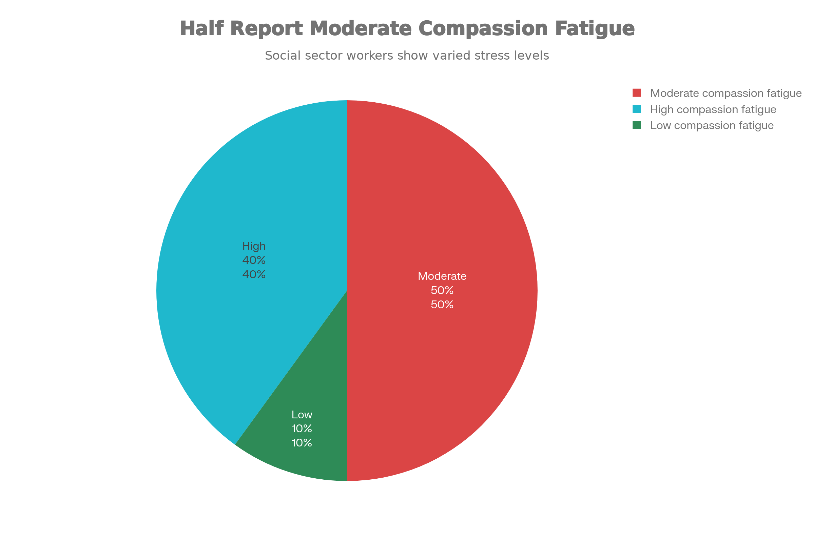
Compassion fatigue was also prevalent. Using the ProQOL definitions, we found that about 40% of respondents scored in the high range for compassion fatigue, and another 50% in the moderate range, while only ~10% were low. These rates indicate that a substantial fraction are experiencing the characteristic symptoms like numbness, reduced empathy, and hopelessness. The co-occurrence of burnout and compassion fatigue was notable: many who scored high on one tended to score high on the other. This parallels findings in nursing (India) after COVID-19, where a majority had moderate burnout and stress.
Half of respondents reported feeling “numb” toward cases that once deeply affected them. As one social worker explained, “I used to feel so deeply for every child I worked with. Now, I feel numb, and that scares me.” (Social Worker, 32 years, Child Welfare NGO)
We also observed that those with high compassion fatigue often worked with extremely vulnerable populations e.g. homeless families, trauma survivors, etc. This fits the literature that social workers in “high-risk” settings report symptoms like hopelessness, deep exhaustion, and disconnection. Hence, burnout and compassion fatigue likely contributes to the workforce challenges like organizations have reported difficulty in retaining staff in high-need programs.
Experience and Burnout
We observed a negative correlation, i.e., more experienced workers tended to have lower burnout scores. This suggests that veteran staff may have developed coping strategies or job autonomy that buffer stress. Conversely, younger or newer employees were more vulnerable. This trend aligns with the JAPI physician study, which found burnout was more common among younger practitioners. It also echoes McKinsey’s demographic data: Indian workers under age 25 reported the highest burnout.
Practically, this implies that interventions (training, mentoring) for early-career staff could have high impact. It also means that retention of experienced staff is critical, as they carry institutional knowledge and likely contribute to team resilience.
The Skill Gap and Institutional Paradox
A less discussed but structurally significant finding emerging from this study is the mismatch between the preparation of social work graduates and the contemporary demands of social sector employment, particularly in a rapidly digitising, AI‑enabled world.
One of the respondents emphasized this mismatch between their social work education and real-world demands by this following statement, “We enter the workforce ready to serve, but unprepared for administrative expectations — we know emotions, not Excel.” (Female respondent, 27 years, Program Associate)
This study shows that burnout and compassion fatigue among social sector employees are not only individual problems but are also linked to how the profession is organized and taught. Along with high emotional demands and limited resources, three structural issues become important: the nature of social work education, limited technological readiness, and low pay.
First, social work education in India continues to focus mainly on values, emotions, and field engagement, with less attention to technical and digital skills that are now central to most organizations. Courses often emphasize empathy, reflection, and direct practice, which are essential, but students may receive only limited training in data systems, outcome measurement, basic management, or technology-based tools used in NGOs and welfare programmes. As a result, many graduates enter the workforce feeling unprepared for tasks such as documentation, reporting, and using digital platforms demanded by funders and supervisors. This sense of being “not job-ready” can increase stress and self-doubt, particularly among younger workers, and likely contributes to the higher burnout levels observed in less experienced staff in this study.
Second, technological change has made digital competence a basic requirement, even in the social sector. Respondents in this study reported spending a large amount of time on routine manual work, including paper‑based records and repetitive data entry.
Such tasks can be tiring and may reduce the time and energy available for meaningful client work, thereby increasing frustration and emotional exhaustion. At the same time, many organizations do not provide systematic training on using digital tools or AI‑based systems for documentation, case tracking, or monitoring. If social work curricula and in‑service trainings included structured exposure to such tools, technology could reduce workload and support practice instead of becoming an additional source of stress. In this way, appropriate use of digital systems and AI could help prevent burnout by removing avoidable manual burdens.
Third, the findings of this study are consistent with broader evidence that low pay and economic insecurity are major contributors to burnout. Many social sector employees in Maharashtra reported financial strain, including difficulty managing basic expenses and a lack of financial stability. This is especially serious because their work is emotionally demanding but often not matched by adequate remuneration. When workers feel that their efforts are socially important but not economically recognized, feelings of exhaustion, hopelessness, and cynicism can intensify. This dynamic helps explain why burnout and compassion fatigue remain high even among staff who are strongly committed to their work.
If the goal is to make social workers “world ready,” educational programmes need to retain their emphasis on empathy and ethics but integrate them with stronger training in technical, organizational, and digital skills. A revised curriculum could include basic and intermediate digital literacy (for example, using spreadsheets, management information systems, and online reporting tools), exposure to AI-supported applications relevant to social work, and core skills in project management and monitoring. In addition, formal teaching on self-care, resilience, and early signs of burnout and compassion fatigue—drawing on frameworks already used in this study—would link professional formation directly to mental health protection.
At the same time, social workers themselves need to recognize the importance of continuous learning. The negative correlation between years of experience and burnout scores in this study suggests that, over time, some practitioners develop more effective coping strategies and greater control over their work. However, this process should not be left to chance. Short, practice‑oriented courses and certificates on topics such as digital tools in social work, trauma‑informed practice, supervision, and financial planning could help early‑career professionals build resilience and competence more quickly. Creating a culture where such upskilling is expected and institutionally supported would reduce the vulnerability of new entrants to burnout.
Comparison with Official and Published Data
Our empirical findings dovetail with other recent data. The 62% national burnout prevalence is reflected in our high rates of moderate/high burnout. The high-strain conditions described by participants (e.g. “working beyond official hours without support”, “seeing clients’ suffering daily”) were consistent with McKinsey’s model that “workplace demands” (toxic behaviour, unclear roles) predict burnout symptoms seven times more strongly than positive factors. We found similar themes in interviews.
Notably, despite high burnout, employee engagement remains a concern. The Gallup report noted only 32% engagement in India (higher than global average), yet simultaneously 86% of employees were struggling or suffering. Our respondents reported pride in their mission and moderate engagement in surveys, but also admitted to fatigue and dread on difficult days. This juxtaposition is common in helping professions: workers remain committed but at personal cost.
Overall, the magnitude of burnout and compassion fatigue in our sample is alarming. It is likely symptomatic of systemic issues in the sector: inadequate staffing, heavy caseloads, insufficient psychosocial support, and a lack of formal mental health resources for employees. These issues have also been flagged in national reports (e.g. low satisfaction with employer wellness programs). Without action, the sector risks losing valuable workers and compromising services.
RECOMMENDATIONS AND SUGGESTIONS
On an organizational level, social service agencies should implement regular well-being checks, peer support groups, and reasonable workload management. Training supervisors to recognize burnout and compassion fatigue can lead to early support. Embedding self-care and resilience-building workshops into routine training (as recommended by WHO and others) would be beneficial.
At the policy level, the findings argue for formal attention to worker mental health. For example, Maharashtra’s social development programs could incorporate employee well-being metrics and allocate funding for counselling services. Collaboration with bodies like MSJE or state labour departments to develop best practices (similar to NITI Aayog’s compendiums for social programs) could raise the standard of care.
The social work curriculum needs to be made in such a way that it makes the graduates world-ready. The revised curriculum should include basic and intermediate digital literacy like using spreadsheets, management information systems, and online reporting tools, and this curriculum should have an exposure to AI-supported applications relevant to social work, and core skills in project management and monitoring.
Finally, curricular and individual measures must be linked to wider organizational and policy changes. Without improvements in pay scales, workload norms, and staffing patterns, educational reform alone cannot significantly reduce burnout. The study already recommends training, counselling, and better workload management; these can be strengthened by adding clear expectations regarding fair remuneration, recognition for continuous professional development, and realistic allocation of time for documentation and reflective practice.
CONCLUSION
This study highlights that burnout and compassion fatigue are pervasive among social sector employees in Maharashtra, mirroring national and global trends. The data collected in this study corresponds with recent data showing elevated burnout in India’s workforce. Importantly, younger and less experienced staff were most affected, indicating targets for early intervention. These findings carry some urgency in them. Left unaddressed, chronic burnout erodes worker health, jeopardizes program quality, and undermines the social sector’s capacity. Hence, it becomes imperative for agencies to implement evidence-based interventions (mental health workshops, workload policies, confidential counselling) and that policymakers include employee well-being in social sector planning. Future research should expand on these findings with larger samples and longitudinal follow-up to assess the long-term effects of intervention. Moreover, by applying lessons from WHO guidance and current Indian research we can ensure that the employees do not just survive but thrive in their roles, therefore strengthening their sector’s impact on society.
*****
Footnotes
1. Burn-out an “occupational phenomenon”: International Classification of Diseases. (2019). WHO. https://www.who.int/news/item/28-05-2019-burn-out-an-occupational-phenomenon-international-classification-of-diseases
2. India tops in workplace burnout survey with 59% reporting symptoms. (2023). LiveMint.
3. Nearly 90% Indian employees say they are suffering, over 40% are sad: Gallup Workplace Report. (2024). Economics Times. https://economictimes.indiatimes.com/jobs/mid-career/nearly-90-indian-employees-say-they-are-suffering-over-40-are-sad-gallup-workplace-report/articleshow/110931144.cms?from=mdr
4. 62% Indian employees experience work-related burnout: CII-MediBuddy report. (2024). Business Standard. https://www.business-standard.com/health/62-indian-employees-experience-work-related-burnout-cii-medibuddy-report-124071901022_1.html
5. Maheshwari, A. Srivastava, A. Sreenivasamurthy, L. Manohar, KN. Assessment of Burnout among Healthcare Practitioners in India: A Survey-based Nationwide Study. (2025). Journal of the Association of Physicians of India. Volume 73, Issue 12. https://www.japi.org/article/japi-73-7-29
6. Deriglazov D, Halamová J, Kernová L. Burnout, Compassion Fatigue, and Compassion Satisfaction Interventions via Mobile Applications: A Systematic Review and a Meta-Analysis. Worldviews Evid Based Nurs. 2025 Jun;22(3):e70033. doi: 10.1111/wvn.70033. PMID: 40361274; PMCID: PMC12075678.
7. Wu, T., & Lu, C. (2025). Understanding compassion fatigue among social workers: a scoping review. Frontiers in Psychology, 16, 1500305. https://doi.org/10.3389/fpsyg.2025.1500305
8. Brassey, J., Herbig, B., Jeffery, B., & Ungerman, D. (2023, November 2). Reframing employee health: Moving beyond burnout to holistic health. McKinsey & Company. https://www.mckinsey.com/mhi/our-insights/reframing-employee-health-moving-beyond-burnout-to-holistic-health
9. Stanley, S., & Sebastine, A. J. (2024). Predictors of Compassion Fatigue and Compassion Satisfaction in Social Workers (A Quantitative Study from India). Human Service Organizations: Management, Leadership & Governance, 48(5), 540–554. https://doi.org/10.1080/23303131.2024.2319210
10. Sebastian. A., Dr. Pinkey Rani. Exploratory Study of Burnout and Psychological Capital in South Indian Social Workers. International Journal of Creative Research Thoughts (IJCRT), Paper ID: IJCRT2509214.
11. Skovholt, T.M., & Trotter-Mathison, M. (2024). The Resilient Practitioner: Burnout and Compassion Fatigue Prevention and Self-Care Strategies for the Helping Professions, 4th ed (4th ed.). Routledge. https://doi.org/10.4324/9781003221388