
A Doctrinal and Policy-Based Examination of the Legal Implications of Tax Justice, Equity, and Fiscal Sovereignty: Reassessing Progressive Taxation, Wealth Tax Regimes, and the Constitutional Limits of State Taxing Powers in Contemporary Global Economies
Contemporary debates on taxation increasingly revolve around legitimacy rather than revenue alone. States face pressure to fund social expenditure, reduce inequality, and protect fiscal sovereignty while remaining constrained by constitutional rights, mobility of capital, and international tax competition. This study critically examines the legal implications of tax justice and equity through three linked lenses: progressive income taxation, wealth tax regimes, and constitutional limits on state taxing power. It argues that tax justice cannot be reduced to a single distributive ideal. Instead, it arises from the interaction of ability-to-pay principles, equal treatment, administrative feasibility, non-confiscation, and democratic accountability. Progressive taxation remains the most durable instrument for embedding vertical equity in modern tax systems, yet its redistributive force can be undermined by preferential treatment of capital and cross-border avoidance. Wealth taxes offer an intuitively attractive response to concentrated asset ownership, but they raise serious valuation, liquidity, and avoidance challenges. Constitutional limits serve an essential rule-of-law function by restraining arbitrariness and protecting property, equality, and due process; however, excessively rigid constraints can also disable legitimate redistributive policy. The article concludes that fiscal sovereignty today is best understood as conditioned sovereignty: states retain broad taxing authority, but that authority must be exercised through proportionate, intelligible, and administrable measures. Durable tax justice therefore requires the integration of progressive taxation, targeted capital taxation, constitutional restraint, and international coordination against base erosion.
Introduction
Tax law is often described as a technical field, but its deepest controversies are constitutional and moral. Questions about who should bear public burdens, how far redistribution may go, and when taxation becomes arbitrary or confiscatory are inseparable from broader disputes about justice, democracy, and state authority. In contemporary global economies these questions have become sharper because inequality has widened, capital has become more mobile, and states must pursue revenue objectives in an environment of intense tax competition.1,2,3
Three legal concepts sit at the centre of this debate. The first is tax justice, which encompasses both vertical equity (differential treatment based on ability to pay) and horizontal equity (equal treatment of similarly situated taxpayers). The second is fiscal sovereignty, the state’s authority to raise revenue and structure distribution through law. The third is constitutional limitation, which restrains how that authority may be exercised through principles such as legality, proportionality, equality, due process, and protection against confiscatory burdens.4,5,6 Tension among these concepts is unavoidable. A tax system that seeks stronger redistribution may be criticised as threatening property or economic liberty; a system that prioritises taxpayer certainty may entrench inequality.
This article examines that tension through three policy instruments: progressive taxation, recurrent wealth taxes, and constitutional review of taxing power. It argues that modern tax justice should not be understood as limitless redistribution. Rather, it requires a calibrated framework in which the tax system raises sufficient revenue, allocates burdens according to capacity, preserves basic legal certainty, and remains administrable in light of avoidance risks and valuation constraints.7,8,9 The central challenge is therefore institutional design: how can states retain meaningful redistributive capacity while operating within constitutional and global constraints?
The article adopts a doctrinal and policy-based approach, drawing on public finance theory, constitutional tax scholarship, and recent OECD and IMF materials. Its principal claim is that progressive income taxation remains the backbone of tax justice, but it must be complemented by targeted taxation of wealth and capital. At the same time, constitutional limits should function as proportional safeguards against arbitrariness, not as rigid barriers that disable democratically chosen redistribution.10,11
This inquiry is especially timely because public debate often swings between two simplifications: that higher taxation of wealth is always required by justice, or that constitutionalism inherently demands tax restraint. Both positions are incomplete. Justice depends on institutional feasibility, and constitutionalism depends on preserving the public capacity to govern through taxation. A serious legal analysis must therefore resist ideological shortcuts and examine how design choices mediate between them.
Progressive Taxation and the Ability-to-Pay Principle
Progressive taxation remains the clearest legal expression of vertical equity. The underlying principle is that tax burdens should increase with a taxpayer’s capacity to contribute, not merely with formal participation in the economy. This idea has deep roots in public finance and political philosophy, from Musgrave’s distributive function of the state to Rawlsian concern for institutional arrangements that mitigate unjust social inequalities.12,13,14 In legal terms, progressivity translates the ability-to-pay principle into rate structure, exemptions, credits, and the treatment of labour and capital income.
The durability of progressive taxation lies in its compatibility with both democratic legitimacy and constitutionalism. Legislatures may reasonably conclude that those with greater economic capacity should finance a larger share of collective goods, especially where states must fund education, healthcare, infrastructure, and social protection. Progressive rate structures therefore do not inherently conflict with equality; they may instead operationalise substantive equality by recognising that equal nominal rates can impose unequal sacrifice.15,16,17
Yet modern progressivity is often less effective than it appears. Preferential treatment of capital gains, dividend income, carried interest, and lightly taxed business structures can erode redistributive outcomes even where statutory top rates remain high.18,19,20 International mobility compounds the problem. If high-income individuals can shift assets or change residence more easily than wage earners, the formal progressivity of the rate schedule may mask a narrower effective tax base. Consequently, progressive taxation cannot be evaluated only by looking at headline rates; it must be assessed in relation to reliefs, base design, cross-border enforcement, and the treatment of wealth-derived returns.21,22,23
The contemporary policy implication is not to abandon progressivity but to refine it. A coherent progressive system requires broader bases, fewer unjustified reliefs, better taxation of capital income, and coordination against avoidance. In that sense, progressivity remains necessary but incomplete. It expresses tax justice most clearly, yet it must operate within a wider framework of anti-avoidance, capital taxation, and constitutional discipline.24,25
Wealth Taxes, Capital Taxation, and the Problem of Concentrated Assets
Wealth taxes occupy a unique place in the justice debate because they target accumulated stocks of economic power rather than annual flows of income. Their normative appeal is straightforward: where wealth concentration significantly exceeds income concentration, taxing income alone may fail to address entrenched inequalities in economic opportunity, political influence, and intergenerational advantage.26,27,28 Recurrent net wealth taxes therefore appear attractive as instruments of both revenue and fairness.
However, the legal and administrative difficulties are serious. The OECD’s review of wealth taxes emphasises recurring problems of valuation, liquidity, avoidance, relocation, and limited net revenue yield in many jurisdictions.29 Closely held businesses, artworks, trusts, and illiquid assets can be difficult to value and easy to restructure. Taxpayers who are asset-rich but cash-poor may face liquidity pressure if annual liabilities are levied on paper valuations rather than realised returns. Moreover, where only a small number of taxpayers are affected, design errors can produce significant avoidance responses.30,31,32
These constraints do not imply that taxation of wealth is normatively mistaken. They imply that legal design matters enormously. In some settings, inheritance taxation, real property taxation, or stronger taxation of capital income may be more administrable than a broad annual net wealth tax.33,34,35 In others, a narrowly targeted wealth tax with high thresholds, anti-fragmentation rules, and robust valuation standards may still be justified. The key lesson is that tax justice requires not only progressive ambition but institutional realism. A badly designed wealth tax can undermine both revenue and legitimacy if it is perceived as arbitrary, easy to avoid, or economically distortive.
A more productive way to frame the issue is to treat wealth taxation as a portfolio rather than a single instrument. Progressive taxation of capital income, inheritance and gift taxation, recurrent property taxes, and selective net wealth measures can together address concentration more effectively than any isolated device.36,37,38 This portfolio approach is also more compatible with constitutional proportionality because it allows states to tailor burdens to valuation feasibility, liquidity, and equal-treatment concerns.
Constitutional Limits on the Taxing Power
Constitutional limits on taxation are not external obstacles to fiscal policy; they are part of the legal structure that makes taxation legitimate. Core constraints typically include legality (no taxation without law), equality and non-discrimination, due process, proportionality, and in some systems a prohibition on confiscatory taxation.39,40,41 These principles protect taxpayers against arbitrariness and help ensure that the state’s revenue power remains accountable.
The challenge arises when constitutional review is framed too rigidly. If courts treat property rights or formal equality as near-absolute barriers, legislatures may be prevented from responding to inequality, fiscal shocks, or new forms of wealth concentration. Conversely, if constitutional scrutiny is too deferential, tax systems may become opaque, discriminatory, or punitive. The most defensible approach is proportional review: courts should ask whether a tax measure pursues a legitimate public objective, uses intelligible and non-arbitrary classifications, and imposes burdens that are not grossly excessive relative to that objective.42,43
Recent scholarship on constitutional limits to taxing power reinforces this point. Tax constitutions do not merely protect taxpayers from the state; they also structure the conditions under which democratic fiscal choices can be made. A proportionality-oriented approach recognises that redistributive taxation can be constitutionally legitimate even when it differentially burdens wealth or high income, provided that the measure remains legally clear, non-confiscatory, and administratively rational.44,45,46
This has direct implications for wealth taxation and progressive rate design. Constitutional scrutiny should focus on valuation fairness, transition rules, access to review, and the cumulative burden imposed by overlapping taxes. It should not assume that redistribution is presumptively suspect. Fiscal sovereignty in constitutional democracies is thus neither unlimited nor hollow. It is conditioned by rights and rule-of-law principles, but it retains ample space for redistributive policy if that policy is carefully designed and justified.47,48
Fiscal Sovereignty in a Globalised Tax Order
The idea of fiscal sovereignty traditionally suggests that each state may define its own tax base and distributional priorities. Globalisation has complicated that image. Capital mobility, treaty commitments, tax competition, and cross-border avoidance all constrain how far states can pursue unilateral redistribution without risking erosion of the base or relocation of capital.49,50,51 Fiscal sovereignty today is therefore better described as constrained or conditioned sovereignty.
This does not mean sovereignty has disappeared. States still choose their rate structures, social priorities, and constitutional balances. But they exercise those choices within an international environment that can reward base mobility and penalise uncoordinated policy. This is why recent OECD and IMF work increasingly links tax justice to international coordination, anti-avoidance, and the taxation of capital.52,53,54 A progressive income tax can be hollowed out if capital income escapes into preferential regimes. A wealth tax can be undermined if asset reporting is weak and information exchange incomplete.
The practical implication is that domestic justice and international coordination are complementary rather than competing goals. Measures aimed at transparency, minimum taxation, and exchange of information can strengthen the state’s capacity to implement democratically chosen distributive policies. At the same time, domestic law must remain sensitive to constitutional boundaries and administrative feasibility. Sovereignty is not measured by the sheer breadth of nominal taxing power; it is measured by the state’s actual ability to adopt and enforce fair, stable, and lawful tax rules.55,56,57
Table I and Figure 1 capture this balance. Progressive taxation scores highly on normative equity and constitutional familiarity. Wealth taxes score highly on distributional targeting but lower on administrability. Constitutional limits score highly on legitimacy and rights protection but can become restrictive if interpreted formalistically. The modern task is to align these instruments so that tax justice is not sacrificed either to unfettered fiscal power or to doctrinal rigidity.
| Instrument | Equity | Admin. Fit | Constitutional Sensitivity |
|---|---|---|---|
| Progressive income tax | 5/5 | 4/5 | Low |
| Net wealth tax | 4/5 | 2/5 | Medium-High |
| Inheritance tax | 4/5 | 3/5 | Medium |
| Property tax | 3/5 | 4/5 | Low-Medium |
| Capital gains reform | 4/5 | 3/5 | Medium |
Table I. Author-generated evaluation of redistributive tax instruments.
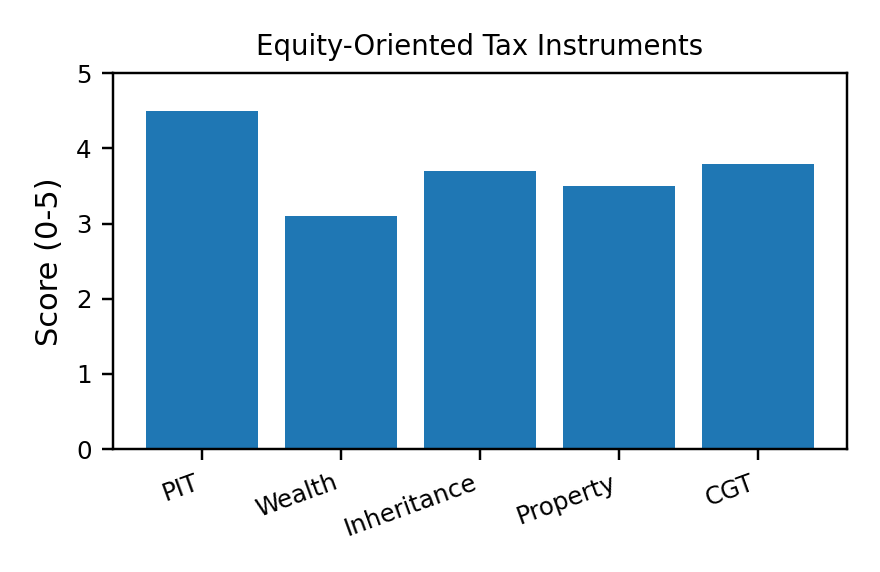
Figure 1. Overall justice-oriented performance scores combining equity and feasibility.
Policy Synthesis
A workable policy synthesis should begin with the recognition that tax justice is multidimensional. It requires vertical equity, horizontal coherence, legal certainty, and sustainable revenue. Legislatures should therefore avoid treating progressive taxation and capital taxation as substitutes. Progressive rate structures should be supported by narrower preferences for capital income, more effective inheritance and property taxation, and stronger reporting systems for high-value assets. Where recurrent wealth taxes are considered, thresholds, valuation rules, and liquidity safeguards should be carefully designed to preserve proportionality and minimise arbitrary burdens.58,59,60
Constitutional review should similarly adopt an enabling rather than disabling posture. Courts should insist on legality, transparency, and proportionality while acknowledging that redistribution is a legitimate fiscal objective in democratic societies. This would prevent the constitutionalisation of tax minimalism. Finally, international coordination remains indispensable. Exchange of information, anti-avoidance measures, and minimum-tax tools all enhance the practical capacity of states to make progressive choices effective rather than symbolic.61,62,63
The central policy lesson is that justice in taxation depends as much on institutional coherence as on normative aspiration. A state that proclaims equity but cannot tax mobile wealth effectively will struggle to realise distributive aims. Conversely, a state that taxes aggressively without constitutional discipline may erode legitimacy. Sustainable reform lies in balancing both demands.
Additional Comparative Reflection
There is also a temporal dimension to tax justice. Income taxes operate on annual flows, while wealth concentration and inheritance shape life chances over decades. A legal system focused only on current income may therefore underestimate entrenched inequalities rooted in asset ownership, intergenerational transfers, and unequal access to capital markets. This is one reason why a portfolio approach to taxing wealth is superior to a singular emphasis on labour-income progressivity. It allows the law to respond to the different time horizons on which economic advantage is accumulated and reproduced.
The constitutional counterpart of this temporal perspective is stability. Taxpayers require predictable rules, but societies also require adaptable fiscal instruments. Constitutional doctrines should therefore preserve room for evolutionary reform as new patterns of inequality emerge.
Conclusion
Tax justice, equity, and fiscal sovereignty should not be treated as isolated concepts. They are interdependent dimensions of a legitimate fiscal constitution. Progressive taxation remains the most stable legal expression of ability to pay and therefore the backbone of distributive justice in contemporary tax systems. Yet progressivity alone is insufficient where capital income enjoys preferential treatment and wealth concentration accelerates. For that reason, serious attention to the taxation of wealth and inheritances remains justified.
At the same time, constitutional limits are indispensable. They protect legality, equality, and proportionality, and they ensure that redistributive ambition is translated into law through intelligible and non-arbitrary means. But constitutional review should not fossilise a minimal state. Properly understood, it enables rather than disables fair taxation by distinguishing legitimate redistribution from arbitrary or confiscatory overreach.
The article’s central conclusion is that contemporary fiscal sovereignty is meaningful only when it is both effective and lawful. States require sufficient room to tax income and wealth progressively, but that room must be exercised through administrable design, respect for rights, and international coordination against erosion. Durable tax justice therefore depends on an integrated framework: broad-based progressivity, targeted capital taxation, constitutional proportionality, and cooperative mechanisms that preserve the practical ability of states to govern their fiscal destinies.64,65,66
*****
Footnotes
1. OECD, The Role and Design of Net Wealth Taxes in the OECD (2018).
2. Shafik Hebous et al., How to Tax Wealth (Int’l Monetary Fund, IMF How To Note No. 2024/001, 2024).
3. OECD, Tax Policy Reforms 2025: OECD and Selected Partner Economies (2025).
4. Richard A. Musgrave, The Theory of Public Finance: A Study in Public Economy (1959).
5. John Rawls, A Theory of Justice (1971).
6. Ari Glogower, The Constitutional Limits to the Taxing Power, 93 Fordham L. Rev. 781 (2024).
7. Liam Murphy & Thomas Nagel, The Myth of Ownership: Taxes and Justice (2002).
8. OECD, Net Wealth Taxes, supra note 1.
9. Thomas Piketty, Capital in the Twenty-First Century (Arthur Goldhammer trans., 2014).
10. Hebous et al., supra note 2.
11. Int’l Monetary Fund, Fiscal Monitor: Fiscal Policy Under Uncertainty (2025).
12. Musgrave, supra note 4.
13. Rawls, supra note 5.
14. Murphy & Nagel, supra note 7.
15. Musgrave, supra note 4.
16. Rawls, supra note 5.
17. Stephen Holmes & Cass R. Sunstein, The Cost of Rights: Why Liberty Depends on Taxes (1999).
18. Hebous et al., supra note 2.
19. OECD, Tax Policy Reforms 2025, supra note 3.
20. Int’l Monetary Fund, Fiscal Monitor: Putting a Lid on Public Debt (2024).
21. Hebous et al., supra note 2.
22. OECD, Tax Policy Reforms 2025, supra note 3.
23. OECD, Housing Taxation in OECD Countries (2022).
24. OECD, Net Wealth Taxes, supra note 1.
25. OECD, Tax Policy Reforms 2025, supra note 3.
26. OECD, Net Wealth Taxes, supra note 1.
27. Hebous et al., supra note 2.
28. Piketty, supra note 9.
29. OECD, Net Wealth Taxes, supra note 1.
30. Id.
31. Hebous et al., supra note 2.
32. OECD, Housing Taxation, supra note 23.
33. OECD, Net Wealth Taxes, supra note 1.
34. Piketty, supra note 9.
35. OECD, Housing Taxation, supra note 23.
36. OECD, Net Wealth Taxes, supra note 1.
37. Hebous et al., supra note 2.
38. OECD, Inheritance Taxation in OECD Countries (2021).
39. Glogower, supra note 6.
40. Int’l Monetary Fund, Fiscal Policy Under Uncertainty, supra note 11.
41. Marcus Hurn, State Constitutional Limits on New Hampshire’s Taxing Power: Historical Development and Modern State, 7 Pierce L. Rev. 251 (2009).
42. Glogower, supra note 6.
43. Hurn, supra note 41.
44. Glogower, supra note 6.
45. Hurn, supra note 41.
46. H. Peyton Young, Equity: In Theory and Practice (1994).
47. Glogower, supra note 6.
48. Int’l Monetary Fund, Fiscal Policy Under Uncertainty, supra note 11.
49. Hebous et al., supra note 2.
50. OECD, Tax Policy Reforms 2025, supra note 3.
51. OECD, Taxing Wages 2025 (2025).
52. OECD, Net Wealth Taxes, supra note 1.
53. Hebous et al., supra note 2.
54. OECD, Tax Policy Reforms 2025, supra note 3.
55. OECD, Tax Policy Reforms 2025, supra note 3.
56. OECD, Taxing Wages 2025, supra note 51.
57. Int’l Monetary Fund, Fiscal Monitor: Fiscal Policy in the Great Election Year (2024).
58. OECD, Net Wealth Taxes, supra note 1.
59. Hebous et al., supra note 2.
60. OECD, Inheritance Taxation, supra note 38.
61. OECD, Tax Policy Reforms 2025, supra note 3.
62. Int’l Monetary Fund, Fiscal Policy Under Uncertainty, supra note 11.
63. Int’l Monetary Fund, Fiscal Policy in the Great Election Year, supra note 57.
64. OECD, Net Wealth Taxes, supra note 1.
65. Hebous et al., supra note 2.
66. Glogower, supra note 6.