
INTRODUCTION
Forensic science is an integral element of the justice system, furnishing reliable scientific evidence that establishes facts and circumstances in criminal cases.1 The growing reliance of the criminal justice system on forensic evidence reflects this essential link between science and law. The current scientific knowledge is continuously evolving and is under a state of constant evaluation. Techniques like DNA testing, fingerprint analysis, ballistics, and cyber-forensics are widely used to prove facts with higher accuracy. The advancement of forensic science has led to the evolution of treating criminal cases before the courts, with the scientific evidence now considered paramount in the delivery of justice. Forensic science is multidisciplinary, utilising different branches of science in legal investigations to solve crimes, directing the investigators to the truth, identifying the criminals, and assisting a just system of justice.
Currently, there are seven Central Forensic Science Laboratories (CFSLs) in India, in addition to multiple state and regional labs. Rather than detailing each, this paper focuses on their effectiveness, challenges in accreditation, and capacity constraints.
Indian courts have been increasingly relying upon this kind of evidence, more so in cases involving DNA analysis, narcotics, and cybercrime. The Supreme Court in State of Bombay v. Kathi Kalu Oghad2 accepted fingerprint and handwriting samples as evidence of value. Later, in Selvi v. State of Karnataka3The Court drew a balance by disallowing involuntary narco-analysis while permitting voluntary use under safeguards. It always emerges as a challenge before the Hon’ble courts and the advocates to deal with these ever-changing ways of forensic science.
Although Sections 45–51of the Indian Evidence Act, 4 and now Sections 39- 45 of the Bhartiya Sakshya Adhiniyam5 recognise expert opinion, courts in India have not adopted a consistent approach in evaluating forensic evidence. The admissibility of forensic evidence sometimes becomes a matter of conflict in the courts. It depends on various factors, including its relevance, reliability, and authenticity. When evidence is considered important in the proceedings of a court, consideration of the admissibility of such evidence is undertaken.6 While DNA profiling has perhaps widely been accepted, methods such as narco-analysis and digital forensics have been questioned by courts with concerns about procedure, chain-of-custody, and lack of uniform standards.
This inconsistency stands in sharp contrast with the U.S. and U.K., where structured frameworks (Daubert standard and Criminal Practice Directions) are used to guide admissibility. Hence, the research problem centers on the Indian side, where there is no standard operating procedure, and no scientific test is accepted for forensic evidence. The National Crime Records Bureau (NCRB) felt the need for strengthening forensic facilities with the increase in cybercrimes, financial frauds, and violent crimes requiring scientific investigation.7 It was also suggested by the Malimath Committee Report (2003) that India adopt stricter forensic admissibility standards, similar to those internationally, for better judicial outcomes.8
This paper critically examines the criterion of admissibility of forensic evidence in criminal cases by analysing legislation and case law, as well as international comparative practice. It seeks to address lacunae in the Indian approach, study models of other nations, and propose reforms that will combine scientific integrity with constitutional safeguards such as fair trial and due process. This paper argues that the lack of codified admissibility standards in India reflects an over-reliance on judicial discretion, which risks inconsistency and undermines scientific reliability.
This paper employs both doctrinal and analytical methods. Statutes, judicial decisions, and academic commentary provide the basis upon which the paper traces the history of the rules of admissibility in India. The inquiry extends to a comparative consideration of jurisdictions like the United States and the United Kingdom to gain understanding from their different treatment of the subject matter. This exercise furthers the exposure of inconsistencies under Indian law and opens pathways toward reform that will result in the creation of a reliable and constitutionally compliant framework for the consideration of forensic evidence. The doctrinal method was selected because it enables a systematic analysis of statutes, case law, and secondary sources. Comparative analysis is used to highlight international best practices. The limitation of this study is that it does not include empirical data collection, focusing instead on legal doctrinal development.
CONCEPT AND LEGAL FRAMEWORK RELATING TO FORENSIC EVIDENCE
Forensic evidence relates to the information gathered and presented in court employing scientific principles and techniques. It incorporates different materials and methods that are ultimately used to interlink perpetrators, victims, and the scene of the occurrence of the crime. Forensic evidence often includes physical evidence like fingerprint impressions, footprints, and trace marks; biological evidence like blood stains, hair strands, saliva, other bodily fluids and DNA; analysis of any drugs, poisons, or alcohol; electronic evidence like emails, call records, and computer data; ballistic evidence including firearms and ammunition; and any document or handwriting examination to check its authenticity. Every kind of forensic evidence offers an objective, scientific outcome, but it is of value only on proper collection, careful preservation, and legal interpretation in line with the set standards. It allows judges and investigators to understand the events and get a better clarification of the facts in question.
Under the criminal law, the forensic evidence presented in court is primarily assessed on the following principles, i.e., relevance, reliability, and weightage. The Relevance is ascertained by seeing whether or not that evidence can prove or disprove a particular fact of that case.9 It makes sure that only scientifically validated and legally sound evidence is presented before the judiciary. The Reliability means the credibility of the evidence, implying that if the proper procedure in the collection, preservation, and analysis has been followed in accordance with the standards. If such methods appear to be erroneous, their evidentiary value is much weakened. The Weightage refers to the amount of persuasive value that the court attaches to such evidence. It depends on various factors such as the accuracy of the report formulated and the reasoning offered to support the results.10
The judge is empowered to decide whether a piece of evidence is relevant and to determine the order in which evidence is presented. The judges hold wide discretion to decide whether they should allow the expert testimony or forensic evidence to be admitted. Even if they decide in favour of its admissibility, how it will shape the outcome of the case still depends on various factors like the correctness of the expert’s report, the reasoning stated for reaching the particular conclusions, the accuracy and recognition of the scientific principles used therein, and lastly the requisite qualifications, skill, and the experience of the expert in question. This shows that in India, forensic evidence is not in itself regarded as conclusive. It must adhere to the prescribed judicial standards so that the fairness and scientific integrity in trials are ensured. In conclusion, India urgently requires codified standards for forensic admissibility, modelled on international frameworks but adapted to local constitutional safeguards. Without such reforms, forensic evidence will remain underutilised despite its potential to strengthen justice delivery.
The admissibility of forensic evidence in India is governed primarily by the Bharatiya Sakshya Adhiniyam (herein referred to as BSA). The Indian Government took a step towards reforming its criminal justice system by enacting new laws-the Bhartiya Nagarik Suraksha Sanhita (BNSS), the Bhartiya Nyaya Sanhita (BNS), and the Bhartiya Sakshya Adhiniyam (BSA). This is aimed at modernising and making the justice system more victim-centric and technologically advanced. Integrating forensic science and technology into investigations is a much-needed approach to utilise the potential of scientific technologies.
The new criminal laws include several provisions that promote the use of forensic science in investigations. Provisions include mandatory audio-video recording during search and seizure operations, the establishment of forensic institutions, and provisions ensuring the admissibility of electronic evidence. As a result, better quality evidence will be expected to be presented in the courts, leading to an increase in the number of convictions. The legislation indicates a shift towards digitisation by incorporating provisions for digital charge sheets, e-FIR, and zero-FIR.
The Bharatiya Sakshya Adhiniyam, 2023 (BSA) is the foundation under which expert testimony is admitted in India, specifically in cases involving forensic and scientific evidence. One of the basic problems with the forensic evidence that remains is that the Act doesn’t mention anything about the essential conditions that have to be followed by the court while examining forensic evidence. The only thing that the act mentions is that if a person becomes an expert in a particular field, then their opinion should be considered relevant on the particular fact.11 It also says that the grounds on which his opinion will be based will also be relevant.12
It provides that when the Court has to form an opinion upon a point of foreign law or of science or art, or any other field, or as to identity of handwriting or finger impressions, the opinions upon that point of especially skilled persons will be relevant. Moreover, when the court has to decide something based on information stored or shared through computers, phones, or other digital devices, the opinion of an expert known as the Examiner of Electronic Evidence (as mentioned in Section 79A of the IT Act, 2000) is considered important and can be used as evidence.13 Scientific evidence in India is generally made admissible through this section.14 But it does not define what qualifies as a “special skill” or set any threshold for the level of expertise required. There is no statutory requirement for licensing or certification of experts before their opinion is given evidentiary value in court. It further makes relevant any facts that either support or contradict an expert’s view, allowing the court to test its reliability.15 Sections 41 to 45 address related aspects, such as handwriting and signature identification, and the grounds upon which opinions are formed. Section 63 provides conditions for making the electronic records admissible. The uncertainty and inconsistency arise from the fact that an expert’s competency is left to judicial discretion without any specific certification criteria.
The Bharatiya Nagarik Suraksha Sanhita, 2023 (BNSS), attempts to integrate forensics in criminal investigations by making it mandatory for the forensic expert to visit the crime scene and collect forensic evidence with the required caution in those cases where imprisonment for seven or more years is provided.16 The JMFC may, on a written order, require any person, whether arrested or not, to give certain samples, like fingerprint impressions, handwriting, or voice samples.17 The reports made by government scientific experts are also allowed to be given in evidence without calling them to the court unless it’s necessary.18 Other than this, there exists no specific rule to address the question of the admissibility of forensic evidence and to ensure its reliability.19
JUDICIAL APPROACHES TO ADMISSIBILITY OF FORENSIC EVIDENCE
In the early years, Indian courts evaluated the expert testimony with caution. Judges used to consider such opinions as relevant but not conclusive, requiring corroboration from other primary evidence. In State of H P v Jai Lal,20 the Supreme Court held that the court is not bound by the expert testimony, and its probative value largely depends on the proper reasoning attached to the report. Similarly, in Murari Lal v State of M.P.,21 it was again suggested that expert opinion holds only corroborative value and guilt cannot be determined solely on its basis. In Ram Chandra v State of UP and Magan Bihari Lal v State of Punjab, the handwriting analysis done by the expert was considered to be weak evidence in the absence of any corroboration.22 Similarly, in S Gopal Reddy v State of A.P.,23 the Court highlighted that expert opinion must be based on a reliable scientific standard and it must undergo cross-examination. In Pattu Rajan v State of Tamil Nadu,24 the Court, dealing with DNA analysis, highlighted the need for strict procedural safeguards that must be followed while evaluating such evidence to ensure reliability.
Gradually, with the scientific and technological advancements, courts started accepting forensic evidence with more readiness. In State of Bombay v Kathi Kalu Oghad,25 the Supreme Court held that if an accused is required to give his fingerprints or handwriting samples, it does not amount to a contravention of the right against self-incrimination guaranteed under Article 20(3) of the Constitution. Therefore, this case is recognised for admitting physical identifiers as evidence. Later on, in Selvi v State of Karnataka,26 the Court asserted that techniques like narco-analysis, polygraph tests, and brain mapping, if done voluntarily, do not violate constitutional rights. Another case, Anvar PV v PK Basheer,27 laid down the rule of mandatory requirement of a certificate under Section 65B of the Indian Evidence Act for admissibility of electronic records. This requirement was reaffirmed in Arjun Panditrao Khotkar v Kailash Kushanrao Gorantyal.28 In the Jessica Lal Murder Case,29 an acquittal was reversed based on ballistic evidence, where techniques such as bullet and firearm matching, accompanied by CCTV footage, linked the accused to the crime. The Supreme Court highlighted the value of properly collected and interpreted forensic evidence in delivering justice. In the Tandoor Murder Case,30 the conviction of Sushil Sharma was mainly based on DNA evidence, which linked him to the crime scene and the victim. This case reflects the judiciary’s reliance on scientific evidence to establish guilt beyond a reasonable doubt and places importance on the necessity for cautious and accurate procedural processes in forensic investigations to ensure that justice is served.31
The judicial trend is shifting from considering the expert evidence as merely relevant to requiring it to be scientifically valid and reliable. This development is similar to the international standards, like the Frye Test in the USA32 which suggests that the scientific evidence should be admissible only when it has “general acceptance” within the scientific community. This criterion allowed courts to deny unreliable scientific evidence, but being too rigid and not open to accepting new evolving techniques, it was criticized. This was replaced by the Daubert Standard33 which requires judges to act as “gatekeepers.” Through the Daubert test, the U.S. Supreme Court requires courts to examine the scientific evidence on the following criteria: whether the scientific method employed is testable, peer-reviewed, has any existing error rates, and is generally accepted in the scientific community. This rule was later expanded in Kumho Tire v. Carmichael 34 to include technical and scientific expertise. These three separate judgments are referred to as the “Daubert trilogy” as a whole.35 Though Indian courts have not officially adopted the Frye or Daubert standard, judges have started to consider the procedural safeguards provided under such standards before deciding on the admissibility of various forensic techniques.
In the United States, some of the institutions and legal standards together form the framework to make forensic evidence admissible. The National Institute of Standards and Technology (NIST) is the authority responsible for developing national forensic science standards, and works with the Organisation of Scientific Area Committees (OSAC) to constantly upgrade the reliability and validity of such forensic methods. Forensic Science Advisory Committees function at the state level to monitor and provide accreditation for forensic laboratories, while also ensuring that it is in accordance with best practices and required ethical guidelines. The FBI Laboratory Division provides forensic services on the federal level and also works to maintain forensic analysis standards.
Rule 702 of the Federal Rules of Evidence governs the admissibility of expert testimony. In 2023, this rule underwent an amendment, stating that expert testimony is to be admitted in the court only if the court is of the opinion that it is more likely that the testimony meets the admissibility requirements provided under the said rule.36
Unlike the U.S., the United Kingdom does not follow a fixed test. In the U.K., forensic evidence is regulated through a clear legal and institutional framework to make sure it is reliable and fair for use in courts. The Forensic Science Regulator (FSR), which became statutory in 2021, sets mandatory quality standards for forensic science providers, accredits laboratories, investigates failures, and issues Codes of Practice and Conduct to ensure reliability. The United Kingdom Accreditation Service (UKAS) accredits forensic laboratories, making sure tests and reports meet strict technical requirements. The Crown Prosecution Service (CPS) gives legal guidance on the rules on admissibility, proper handling, and disclosure of such evidence under the Criminal Procedure and Investigations Act 1996. The College of Policing gives training and sets eligibility standards for forensic examiners and crime scene investigators. The Criminal Practice Directions (2015) were amended to ensure that the declaration by the expert witness is consistent with the declaration required by the Code.37 It requires experts to comply with their discipline’s Code of Practice and disclose any prevailing exceptions with the details on what steps were taken to eliminate any risk of error.
In the case of Dharam Deo Yadav v. State of U.P.38, the court concluded that, in addition to the Daubert criteria, relevancy and dependability might be considered based on additional elements. In the case of Harjinder Kaur,39 the Supreme Court said that the judges are obliged to act as gatekeepers and carefully analyse the standards determining which kind of scientific evidence and expert testimonies can be admitted into court. Indian courts are now relying on forensic science, but there exists a lack of well-structured admissibility standards. Integrating the international admissibility standards into our legal system would prove effective.
COMPARATIVE ANALYSIS OF LAWS RELATED TO FORENSIC EVIDENCE BETWEEN INDIA, THE USA AND THE UK.
| Criteria | India | United States of America | United Kingdom |
|---|---|---|---|
| Admissibility test | No codified standard, only judicial discretion | Daubert Standard (testability, peer review, error rate, acceptance) | Criminal Practice Directions & case law |
| Regulatory framework | No central regulator; limited statutory provisions | NIST, OSAC, FBI oversight | Forensic Science Regulator (statutory since 2021) |
| Accreditation of Labs | Partial, non-uniform accreditation | Forensic Science Advisory Committees; state-level accreditation | UKAS accreditation mandatory |
| Judicial role | Judges act as gatekeepers with discretion | Judges as strict gatekeepers (Daubert trilogy) | Judges guided by CPS & FSR codes |
| Training standards | Minimal, fragmented training | Judicial & expert training emphasised | College of Policing & CPS training modules |
Comparative Scoring

Interpretation of Comparative Scoring.
To make the comparative framework more amenable, a scoring system for India, the United States and the United Kingdom was applied across five key parameters. The scale may range from 1 to 5. A score of 1 indicates a very weak or absent framework, and 5 indicates a very strong, codified and institutionalised framework. A score of 2 stands for weak development, while a score of 4 indicates strong development. This system simplifies the comparison across jurisdictions and also indicates specific areas of deficiency where India lags.
On this count, India scores its lowest (1) in respect of admissibility tests. Due to a lack of a codified admissibility standard, Indian courts continue to rely on judicial discretion, which results in an inconsistency of judgments. In contrast, due to the Daubert trilogy, which requires judges to perform a gatekeeper function and ensures that scientific evidence is reliable, peer-reviewed and generally accepted, the United States receives the best rating of 5. The UK has a somewhat lower score (4), as although its framework is strong, it is mainly derived from regulatory practice and judicial directions rather than a single codified test of admissibility.
In other areas, the differences are equally stark. The U.K. The organisation has excelled in both accreditation and training, gaining UKAS accreditation and College of Policing approval and scored a 5 on both. The United States also scores reasonably well (4 and 5) because of NIST oversight, OSAC recommendations, and FBI forensic program oversight. In India, the accreditation (2) and training (2) activities remain weak, which is due to fragmented initiatives, a shortage of qualified experts, and the absence of uniform standards. With a rating of 3, judges in India are said to be acting as gatekeepers, but do not use a consistent evaluative framework. U.S judges have a rating of 5, whereas U.K. judges have a 4. According to the scoring system, India urgently requires standardisation, infrastructure investment and institutional training for best practices very close to global best practices.
CHALLENGES IN THE INDIAN SYSTEM
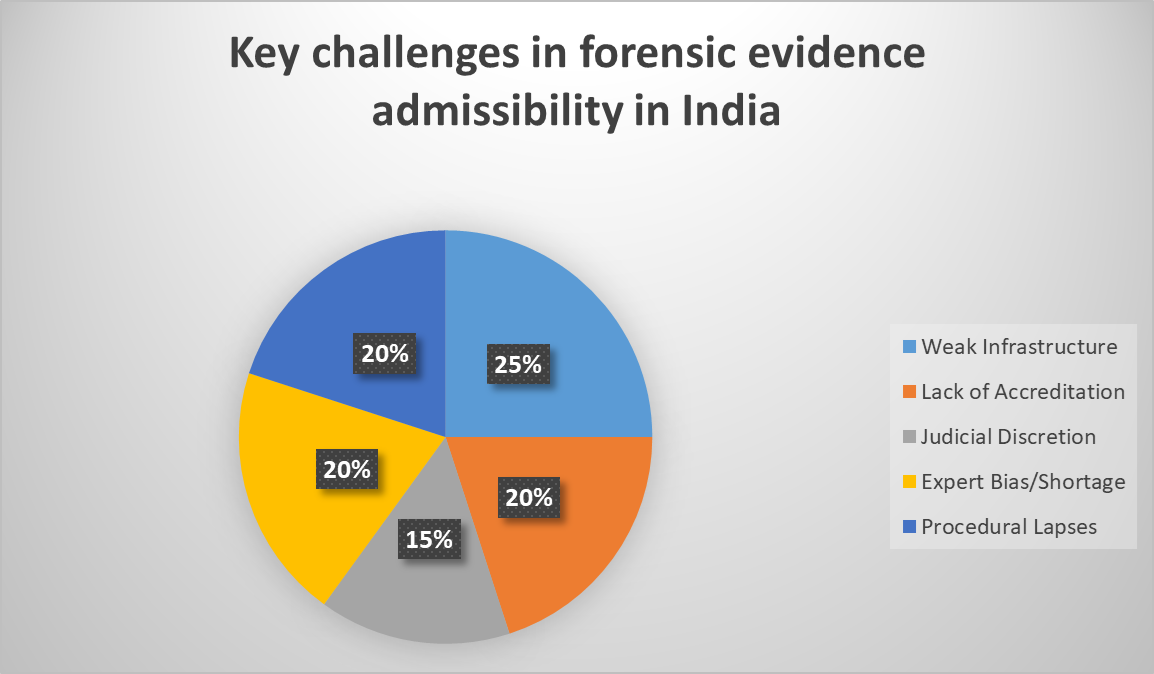
With the rapid scientific and technological advancements, it is well-settled that forensic evidence has an important role to play in aiding criminal investigations. The challenge lying ahead for the Indian criminal justice system is the difficulty in proving the credibility, admissibility, and setting proper standards for forensic evidence to elevate it from merely corroborative to the status of primary evidence. Issues such as changing forensic reporting, the absence of uniform protocols, the possibility of expert bias, and the lack of forensic regulatory authorities negatively affect the reliability of forensic evidence in trials.40
Our justice system still lacks a codified and uniform test which can aid the court in admitting expert evidence. It does not have standardised forensic collection, storage, and examination methods, which often leads to the problem of tampering, contamination, broken chain of custody of such evidence. It affects the credibility and reliability of such evidence. Different laboratories use different methodologies, resulting in contradicting findings in the same case.41
Moreover, the forensic science industry in India has a major shortage of suitable experts and trained law enforcement personnel. Often insufficiently trained to handle the complexities of modern forensic equipment and techniques. The lack of expertise not only reduces the quality of forensic investigations but also compromises the integrity of the evidence turned in to courts.42 There exists no Standard Operating Procedures (SOPs), and there is also a lack of quantitative data management and qualitative data assessment techniques.
Despite developments in forensic science, Indian courts still rely heavily on confessions, sometimes obtained in custody. This reliance contains the risk of forced statements and later retraction. In State of U.P. v. Deoman Upadhyaya,43 the Court confirmed that confessions are admissible under certain safeguards, yet in practice, forensic corroboration is often sidelined. A stronger emphasis on scientific corroboration would reduce wrongful convictions and enhance fairness. The Supreme Court also highlighted the issue of the lack of training of investigating agencies in carrying out an effective investigation and lapse on the part of the prosecution in establishing an unbroken chain of circumstances based on factual evidence rather than on unreliable testimonies of the witnesses.44
SUGGESTIONS:
EACH OF THE RECOMMENDATIONS CORRESPONDS TO SPECIFIC GAPS IDENTIFIED: CODIFIED ADMISSIBILITY STANDARDS ADDRESS JUDICIAL INCONSISTENCY
To benefit from the globally evolving scientific techniques, India requires a separate legal framework to give importance to forensic evidence. Even though the legislature enacted new criminal laws to give importance to such evidence, it falls short in setting out clear provisions regulating the admissibility to avoid inconsistencies. On the question of admissibility, Indian courts still depend largely on judicial discretion. Enacting a specific law or body of rules governing the use of scientific evidence in the justice-serving process could prove efficient in reaching just and fair outcomes in the trials. Besides this, a National Regulatory Authority can also be established to monitor forensic science standards.
Currently, there are seven Central Forensic Science Laboratories (CFSLs) in India, in addition to multiple state and regional labs. Rather than detailing each, this paper focuses on their effectiveness, challenges in accreditation, and capacity constraints. The Heads of Central and State FSLs should be given financial power to fund the research work. Equally important is the training and continuous education of forensic experts, along with international collaboration to adopt best practices. All forensic scientists and experts must become certified in their respective areas. There must also be standardisation of forensic educational institutions.
In addition to the above, judges often lack the scientific background to properly evaluate expert evidence. Regular training programs by the Judicial Academies on forensic techniques, their reliability, and their limitations should be conducted. This would reduce blind reliance on experts and enable judges to assess forensic reports critically. An All-India Level module may be formulated to provide uniform training for the appreciation of such evidence.
Along with this, much-needed effective training of law enforcement agencies, esp. Investigating officers are necessary for proper examination of the crime scene and efficient collection, handling, storage, and transportation of vital forensic samples to the FSLs. In Datar Singh v. State of Punjab,45 the Supreme Court highlighted how the mishandling of vital evidence can adversely impact the outcome of the case. It emphasised the importance of maintaining an unbroken chain of evidence, be it direct or circumstantial, and indicated the serious lapses in investigative processes that questioned its reliability.46
The Apex court in the recent case of Kattavellai @ Devakar v State of Tamil Nadu47 emphasized the importance of DNA evidence and how its improper handling can impact a case adversely. Despite the presence of such evidence court has to disregard it because proper methods and procedures were not followed in the collection, sealing, and storage in the course of the trial. The Court introduced comprehensive, nationwide guidelines for DNA evidence management, such as
• DNA samples must be collected with due care, properly packaged, and documented with details such as the FIR number, statute involved, investigating officer’s particulars, and serial number. The record should bear the signatures of the medical officer, investigating officer, and, where possible, independent witnesses if witnesses are unavailable, the efforts to involve them must be noted.
• It is the duty of the Investigating Officer to ensure DNA samples are quickly transported to the police station, hospital, or forensic lab within 48 hours of collection. Any delay due to unforeseen circumstances must be recorded in the case diary, and proper preservation measures must be maintained throughout.
• DNA evidence packages must remain sealed during the trial or appeal and may only be opened with the Trial Court’s approval, based on a qualified medical expert’s statement that it is necessary and will not compromise the evidence’s integrity.
• A Chain of Custody Register must be maintained to record every movement of evidence from the date of collection to the date of decision of a case, with countersignatures and reasons. It must form a part of the trial record, and any failure requires the Investigating Officer to explain.
• All State DGPs are directed to prepare standard Chain of Custody Register forms and related documents and circulate them to all districts with proper instructions.
Therefore, the Court required that the State Police Academies should assess the need to train Investigating Officers to ensure proper compliance with the prescribed procedures and precautions.
CONCLUSION
Forensic evidence is essential evidence in today’s criminal justice system, which offers courts scientific accuracy in fact-finding. In India, the result has been inconsistency, excess reliance on judicial discretion, and often procedural lapses, due to the absence of codified admissibility standards. The DNA profiling and electronic evidence, though increasingly used by courts, suffer from fragmentation and unreliability when compared to international standards.
The comparison indicates that the USA, through the Daubert trilogy, imposes stringent admissibility criteria rooted in reliability and peer validation. On the other end of the spectrum, a statutory Forensic Science Regulator, accreditation by UKAS and judicial guidance ensure accountability in the UK. As opposed to this, India does not have clear admissibility tests, a uniform accreditation of forensic laboratories and trained experts. The 2023 Bharatiya Sakshya Adhiniyam, while reforming certain areas, fails to lay down comprehensive standards for admissibility.
To take the next step, India must bring clarity to admissibility rules through legislation, set up a national regulatory authority, mandate accreditation of all laboratories and continuous training of judges, investigators and experts. The proposed measures will ensure that forensic evidence shifts from being mere corroborative evidence to reliable and specific evidence.
Incorporating best practices worldwide without compromising on constitutional protections like due process, privacy, and self-incrimination protects scientific integrity, increases accuracy, and builds public confidence in the justice system. For India’s forensic standards to be upgraded to international standards and to strengthen the criminal justice delivery, these reforms are necessary.
*****
Footnotes
1. Kshyamasagar Mahanta and Hima Bindu Maringanti, ‘Forensic Science: An Integral Component of the Justice System’ in S Sitharama Iyengar and others (eds), Fostering Cross-Industry Sustainability With Intelligent Technologies (IGI Global 2024) ch 2 https://www.igi-global.com/chapter/forensic-science/337525 accessed 11 August 2025.
2. AIR 1961 SC 1808.
3. AIR 2010 SC 1974.
4. Indian Evidence Act 1872 (Act 1 of 1872).
5. Bharatiya Sakshya Adhiniyam 2023 (Act 45 of 2023).
6. Laiba Tahreem, ‘Admissibility of Forensic Evidence in Courts’ (Legal Bites, 6 May 2024) <https://www.legalbites.in/forensic-law/admissibility-of-forensic-evidence-in-courts-972604> accessed 11 August 2025
7. National Crime Records Bureau, Crime in India Report 2022 (Ministry of Home Affairs, Government of India, December 2023) <https://data.opencity.in/dataset/fcb23738-6a70-42d4-9aa9-6a5e1aa5ce18/resource/d4b642dc-035b-4743-8515-efd09a17c9ed/download/1701608543crimeinindia2022book3.pdf> accessed 11 August 2025.
8. Committee on Reforms of Criminal Justice System, Report (Ministry of Home Affairs, Government of India, 2003).
9. Anton Koshelev and Ekaterina Rusakova, ‘The Problem of Admissibility of Evidence in Indian Civil Proceedings’ (2021) 106 SHS Web of Conferences EDP Sciences.
10. Malay Kumar Ganguly v Dr Sukumar Mukherjee AIR 2010 SC 1162.
11. Nisha Kumari, ‘Forensic Evidence and Their Admissibility’ (2020) 2(2) International Journal of Legal Science and Innovation 769, 769-75 <https://www.ijlsi.com/wp-content/uploads/Forensic-Evidence-and-Their-Admissibility.pdf> accessed 11 August 2025.
12. Bharatiya Sakshya Adhiniyam 2023, s 45.
13. ibid s 39.
14. Jeevan Shekar, ‘The Admissibility of Scientific Evidence in Bharatiya Sakshya Adhiniyam, 2023 and the Need for an Indian Daubert’ (11 August 2024) <https://ssrn.com/abstract=5052611> accessed 17 July 2025.
15. BSA 2023, s 40.
16. Bharatiya Nagarik Suraksha Sanhita 2023, s 176(3).
17. ibid s 349.
18. ibid s 329.
19. C E Pratap, ‘Reliability of Forensic Scientific Evidence in Criminal Trials: An Indian Perspective’ (2016) 3(11) The International Manager.
20. State of H P v Jai Lal (1999) 7 SCC 280.
21. Murari Lal v State of M P (1980) 1 SCC 704.
22. Ram Chandra v State of UP AIR 1957 SC 381; Magan Bihari Lal v State of Punjab (1977) 2 SCC 210.
23. S Gopal Reddy v State of A P (1996) 4 SCC 596.
24. Pattu Rajan v State of Tamil Nadu (2019) 4 SCC 771.
25. State of Bombay v Kathi Kalu Oghad AIR 1961 SC 1808 (India).
26. Selvi v State of Karnataka (2010) 7 SCC 263 (India).
27. Anvar PV v PK Basheer (2014) 10 SCC 473.
28. Arjun Panditrao Khotkar v Kailash Kushanrao Gorantyal (2020) 7 SCC 1 (India).
29. Manu Sharma v State (NCT of Delhi) (2010) 6 SCC 1.
30. Sushil Sharma v. State (NCT of Delhi), (2014) 4 SCC 317.
31. State of Gujarat v. Kishanbhai, (2014) 5 SCC 108.
32. Frye v United States 293 F 1013 (DC Cir 1923).
33. Daubert v Merrell Dow Pharmaceuticals Inc 509 US 579 (1993).
34. Kumho Tire Co v Carmichael 526 US 137 (1999).
35. Mansi Trivedi, Collection of Forensic Evidence and its Relevance in Criminal Justice System with Special Reference to India (PhD thesis, Jagran Lakecity University 2024) http://hdl.handle.net/10603/601852 accessed 17 July, 2025.
36. ‘Federal Rule of Evidence 702: Judicial Conference Amends Rule 702’ (2025) 138 Harv L Rev 899 <https://harvardlawreview.org/print/vol-138/federal-rule-of-evidence-702/> accessed 05 August 2025.
37. Forensic Science Regulator, Annual Report 25 July 2023 – 24 July 2024, (2025) (UK) <https://assets.publishing.service.gov.uk/media/687f74d276595a511a8a7448/Forensic_Science_Regulator_AR_2023-24__2207_.pdf> accessed 05 August 2025.
38. Dharam Deo Yadav v. State of U.P. (2014) (86) ACC 293 (SC).
39. Harjinder Kaur v. State of Punjab (2013) (2) RCR (Criminal) 146 (P&H HC).
40. Gautam Negi and Rishav Dogra, ‘Jurisprudence of Forensic Science in India: Analyzing the Parameters Comparatively with Reference to Forensic Evidence’ (2025) 13(4) International Journal of Creative Research Thoughts 1 <https://www.ijcrt.org/papers/IJCRT2504548.pdf> accessed 14 August 2025.
41. Ibid.
42. Khushi Jadhav, Pravin More, Yukti Meshram and GC Jadhav, ‘The Dark Side of Forensic Science: Issues and Pitfalls in India’ (2025) 6(3) International Journal of Research Publication and Reviews 1317 <www.ijrpr.com> accessed 20 August, 2025.
43. State of UP v Deoman Upadhyaya AIR 1960 SC 1125.
44. State of Gujarat v. Kishanbhai & Ors., (2014) 5 SCC 108.
45. Datar Singh v State of Punjab (2021) 12 SCC 654 (SC).
46. State of Gujarat v Kishanbhai , 2014 5 SCC 108.
47. Kattavellai @ Devakar v State of Tamil Nadu, 2025 SCC, SC 1439.