
INTRODUCTION
Drug Trafficking is the pervasive and is considered to be the most complex form of transnational organised crimes. It has the capacity to render the economy, infrastructure and political alignment of a nation state. It acts as a menace while posing as a challenge to the sovereignty, integrity and functioning of a particular nation state. When it comes to viewing the concept of drug trafficking as a transnational organised crime from the Indian perspective it can be construed that, India is within the grip of golden triangle and golden crescent due to its geographical position. Such a grip makes it vulnerable to the operations of drug trafficking as it acts as transit corridors for the transnational organised crimes.
When it comes to golden triangle it comprises of Loas, Thailand and Myanmar and it opens the doors of eastern corridor with regards to drug trafficking which impacts the northeastern states as it leads to insurgent activities and leads to the involvement of drug money in the states. Whereas, on the hand golden crescent comprises of Pakistan, Afghanistan and Iran and it opens the doors of western corridor with regards to drug trafficking and such routes gives birth to narco terrorism in India.
When it comes to understanding the existing framework to deal with drug trafficking and its effects as a transnational organised crime it can be seen that, there are various conventions of United Nations such as United Convention on Psychotropic Substances, 1971, United Nations Convention Against Illicit Traffic in Narcotic Drugs and Psychotropic Substances, 1988 and United Nations Convention against transnational organised crime, 2000 which are complementary to each other while dealing with the menace of drug trafficking as a transnational organised crime. When it comes to India, it a signatory to all the above-mentioned conventions and has its own national legislative framework to deal with the drug trafficking but it has maintained silence on dealing with drug trafficking from the lens of transnational organised crimes. Thus, putting forward the challenges of regulatory framework to deal with the aftermath of such a crime.
DRUG TRAFFICKING AS A TRANSNATIONAL ORGANISED CRIME
Drug Trafficking is puts forward itself as the most pervasive form of transnational organised crimes as it generates an amount of $426 to 652 billion annually as per the reports of United Nations Office on Drugs and Crime1. Drug Trafficking as a transnational organised crime acts as threat to the existence of nation states as it has the capacity to take down the economy and disrupt the infrastructure, integrity and functioning of a nation state. There exists various characteristics which contribute in portraying drug trafficking as a transnational organised crime2. They are hierarchical mechanisms which works from the production level to distribution level of drugs, there is use of advanced technology to deal with rapid and growing demands of drug markets around the world, there is systematic use of lacunas law enforcement mechanism in order to avoid the eyes of law and its enforcement agencies. Lastly, to maintain dominance in the drug markets and to have maximum territorial impact in the transit corridors and there is use of force in all possible means. For example; the Sinaloa Cartel operates on the above-mentioned characteristics. It has a Mexican cartel operating around 50 countries and promoting drug trafficking as a transnational organised crime3. It is a cell-based organization which supplies drugs through commercial shipping and they have an estimated revenue of $3 billion annually4.
It can be seen through the UNDOC Report, 2023 it can be seen that, there has been 5% increase from 2011 in the number of people using drugs on regular basis5. This is an alarming number. Apart from it, there are 39.5 million people who are suffering from drug use disorders6. Apparently, affecting the people and development of nation states.
DRUG TRAFFICKING AS A CATALYST FOR OTHER CRIMINAL ENTERPRISES
Drug trafficking operates and facilitates many other crimes within the network of transnational organised crimes. It does the same through its multilateral network, high capital accumulation. The various criminal enterprises for which the drug trafficking acts as catalyst are money laundering, human trafficking, arms trafficking, wildlife trafficking and cybercrimes7.
• When it comes to money laundering, drug trafficking acts as a catalyst as the money earned through the drug components is laundered on large scale. Thus, promoting money laundering as a transnational organised crime. For example; the HSBC Money Laundering Scandal of 2012 revealed that, around $881 million were laundered for the Mexican drug cartels8.
• When it comes to human trafficking, drug trafficking acts as a catalyst as when the enforcement agencies control the migrant routes, the migrants are illegally transferred through drug routes, women and children are exploited sexually to serve in the cartel prone zones9.
• When it comes to arms trafficking, drug trafficking acts as a catalyst as both of them flow bidirectionally10. For example; the Sinaloa Cartel also bidirectionally deal with arms trafficking and the enforcement agencies caught hold of them in the fast and furious operation of 2009-201111.
• When it comes to wildlife trafficking, drugs trafficking acts as catalyst as both of them operate via same routes and the cartels of wildlife trafficking operate same as drug trafficking.
• When it comes to cybercrimes, drug trafficking acts a catalyst as it facilitates the growth if it due to rapid technological development. Nowadays, the drug trafficking is dealt by the use of cryptocurrencies, dark webs and encrypted communication networks.
Impact on Border Security and Growth of Nation States from the Lens of Drug Trafficking in the Context of Transnational Organised Crime
Drug Trafficking as a transnational organised crimes challenge the sovereignty, integrity and functioning of a nation state. It impacts the border security and growth of nation states by posing as a challenge to the governing institutions. There are various incidences from which it can be understood that how drug trafficking as a transnational organised crime impacts the border security and growth of nation states.
• The USA- Mexico enforcement on border security has been impacted as despite the deployment of the customs and border security force and heavy investments from the enforcement agencies, around 10-20 % of total drug trafficking takes place through these borders12.
• The Darien gap which is situated between the Panama and Columbia is a 66-mile jungle puts forward border security challenge as it acts a route for drug trafficking from the context of transnational organised crimes. This is because both the Panama and Columbian governments are unable to control these routes13.
• The Afghan Kabul Bank Scandal of 2010 led to the embezzlement of $900 million which amounted to 5% of Afghanistan’s GDP. In further investigation it was found out that, these funds were proceeds of narcotics and were in the process of laundering. This scandal led to inflation and currency crisis14.
• The youth and the future of nation states are also targeted due to drug trafficking in the form of transnational organised crimes. In the case of Rio de Janeiro, there were more than 100 factions which were controlled by drug cartels and it involved around than 2 lakh individuals in the drug trade. Thus, pushing the youth of the country to the brink of drug consumption on large scale15.
INTERNATIONAL AND NATIONAL FRAMEWORK ON DRUG TRAFFIKING FROM THE LENS OF TRANSNATIONAL ORGANISED CRIME
The intersection of drug trafficking and transnational organised crimes acts as a challenge to the global security and the governance of nation states. Initially, drug trafficking evolved as a crime committed as an isolated criminal activity single handled but with emergence of rapid technological advancement and the growing nexus for drug related activities it started to operate as organised crimes. Whereas on the other hand, when it comes to transnational organised crimes it deals with those crimes which are committed irrespective of borders and are transnational in nature affecting the nation states altogether and drug trafficking is considered one such crime within the realms of the same.
A. Role of International Conventions on Drug Trafficking in the Light of Transnational Organised Crime
There are various United Nations conventions which deal with the drug trafficking and transnational organised crimes. They are as follows;
• Single Convention on Narcotics Drugs, 1961- This convention provides a comprehensive framework to deal with the narcotic drugs and under it has established the International Narcotics Control Board in order to criminalize the cultivation, production, sale and consumption of narcotic drugs except for the medical and scientific purposes16. The convention has created many universal definitions and puts an obligation on states to enact laws which will criminalize activities related to drug trafficking.
• Convention in Psychotropic Substances Act, 1971- This convention covers the psychotropic substances looking at its serious effects on public health. This convention is considered to be a continuation of narcotic drugs convention. It deals with the standards for international drug trade control and keeps a check on the limiting manufacture of psychotropic substances just for medical and scientific purposes17.
• United Nations Convention Against Illicit Traffic in Narcotic Drugs and Psychotropic Substances, 1988- This convention is popularly known as the Vienna Convention. This is considered to be a landmark convention as it discusses the facets of drug trafficking from the lens of organised crimes18. It addresses the notion of mutual legal assistance and deals with the money proceeds to break the financial support of drug trafficking as a growing form of organised crime.
• United Nations Convention Against Transnational Organised Crimes, 2000 – This convention is also known as the Palermo convention. It provides a comprehensive outlook on dealing with transnational organised crimes. It defines organize crime exclusively and states 4 principles like, participation in an organised crime activity, money laundering, obstruction of justice and corruption will be covered within its ambit19. It obligates the states to develop legal framework for the activities which are committed within the blanket of organised crimes. This convention exclusively talks about mutual legal assistance, extradition, joint investigations and international cooperation.
B. Complementary Role of United Nations Conventions while dealing with Drug Trafficking as a Transnational National Crime
The UN Conventions have played a complementary role in dealing with the drug trafficking as transnational organised crimes as they have eliminated all the loopholes which could have been exploited by the drug traffickers in order to facilitate the drug supply chain around the globe and promote the expansion of transnational organised crime. The UN Convention in Drugs and the UN Convention of transnational organised crimes walk hand in hand wherein the former address the drug related issues and the latter address the transborder issues with respect to drug trafficking20. The conventions together have bridged the substantial and procedural gaps as the drugs convention deals with the liability and criminalization aspects whereas on the other hand, the conventions on transnational organised crimes deals with the mutual assistance protocols and extradition21. Thus, putting forward the foundation stone for procedural and prosecution aspects. The convention on drugs and transnational organised crimes have recognized that, the vicious cycle of drug trafficking can be broken down by attacking their financial setups22. Therefore, the drug conventions deal with drug proceeds while the transnational organised conventions deal with aspects of money laundering on large scale. The conventions mentioned have ensured to encourage and obligate the nation states for providing technical assistance in order to build the required mechanism to deal with the challenges of drug trafficking as transnational organised crime.
C. Indian Legislations on Drug Trafficking in the context of Transnational Organised Crime
There are various Indian legislations which have thrown on drug trafficking from looking at it from the lens of transnational organised crimes. They are as follows;
• Narcotic Drugs and Psychotropic Substances Act, 1985- This legislation is considered to be the India’s primary legislation on drugs and it portrays India’s obligations towards the international instruments such as UN Single Convention of 1961 and Psychotropic Convention of 1971. This act prohibits the use, sale, consumption, cultivation, production of drugs and psychotropic substances except in cases of medical and scientific uses23. Under this act, under section 4 it talks about extraterritorial jurisdiction, thus enabling the prosecution of the drug traffickers who operate transnationally24. Apart from it, under section 36 there is a mention of special courts to deal with the matters of drug trafficking expediously25. Lastly, under section 21-29 there is detailed mention of penalties based on commercial quantity of drugs in order to consider the serious and threating nature of trafficking26.
• Prevention of Money Laundering Act, 2002- This act defines money laundering as an activity which deal with the proceeds of crime. The offences mentioned under the NDPS Act, 1985 are referred to as scheduled offences under this act so as to deal with the proceeds of drug trafficking27.
• The Unlawful Activities (Prevention) Act, 1967- It deals and address the crime syndicates who are involved in drug trafficking as an organised crime. It revolves around designating organizations as terrorist or banned associations while touching upon the notion of narco terrorism28.
• Indian Penal Code, 1860 and Bhartiya Nyaya Sanhita, 2023- Under IPC section 21229 and 216A30 talk about the notion of traffickers stating that the individuals who harbor and provide shelter to traffickers will be held liable and those facilitating trafficking will be held liable respectively. These provisions are also mentioned under section 249 31and 6032 of BNS, 2023 respectively
• Extradition Act, 1962- This act provides a comprehensive framework to extradite the offenders back to the treaty country. This act helps to bring back the drug traffickers who have absconded the country33.
Despite comprehensive framework, there are certain challenges which needs to be addressed in relation to Indian perspective such as the jurisdictional problems, extradition challenges and the evidence admissibility challenges in the court of law. In the case of Mohan Lal.V. State of Punjab34, it was established by the Supreme Court that, there is a requirement of procedural safeguards to deal with the matters of drug trafficking and comprehensive procedural setup is required under the NDPS Act, 1985. Also, in the case of Nikesh Tarachand Shah.V. UOI35, the Supreme Court emphasized that the organised activities of drug trafficking led to drug addiction among the youth which can prove to be dangerous in the future.
Such as at national level, they can deal with the problems of drugs trafficking circulated internally whereas at the international level, United Nations can opt for more comprehensive role apart from making conventions such as it can opt to sanction the member states who promote drug trafficking and are causing menace to other countries.
POSITION OF INDIA WITHIN THE GOLDEN GRIP WHILE DEALING WITH THE EMERGING APPROACHES IN LAW
The position of India within the golden grip is vulnerable due to its detrimental geographical location. The golden grip comprises of golden triangle and golden crescent and their nexus facilitates drug trafficking as a transnational organised crime. The golden grip makes India an easy target of drug traffickers as it weakens the eastern and western corridor of the nation. Therefore, placing it in a detrimental state and exposed to the menace of drug trafficking and making it as a transit for the distribution of drugs.
A. Golden Crescent and its impact on India while dealing with drug trafficking as a transnational organised crime
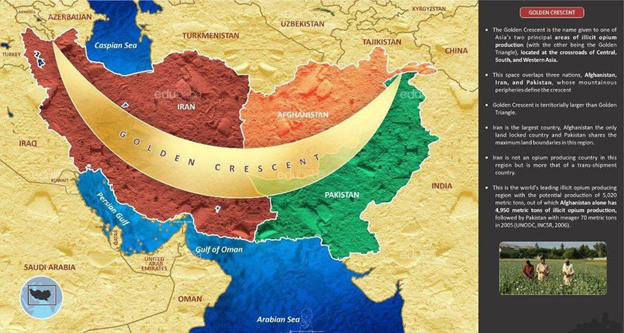
The region of Golden Crescent comprises of Afghanistan, Iran, and Pakistan and it is known for its illegal trade in narcotics. The history of drug trafficking in golden crescent region started in year 1979 with the invasion of Afghanistan by USSR. This invasion led to the establishment of Taliban movement and the whole country was captured back by 1993-1994 until the arrival of USA in Afghanistan in 2001. The war between the USSR and Taliban made the farmers of Afghanistan suffer in terms of crops and land. Thus, they all shifted to those crops which required less assistance and land and generated maximum profits. The answer to their thought was Poppy plants as it requires less water and has maximum profit earning capacity37. Therefore, this led to the start of opium production in Afghanistan. Eventually, the country started seeing an increase in the production of opium by late 1990’s Even after the arrival of USA in Afghanistan in 2001 the opium trade was flourishing38. This can be seen today as well. Consequently, these activities led to the emergence of the “Golden Crescent” region, where Afghanistan, Pakistan, and Iran emerged as prominent players in opium production. In recent years, poppy cultivation has been limited to the Afghan border but is spreading at a great pace. This boasts the narcotics production and trafficking in the region.
This golden crescent has made India’s western corridor of Punjab and Rajasthan vulnerable to drug trafficking. Afghanistan controls over 80% of opium market around the world which reaches other countries via Pakistan and Iran. It reaches the Indian borders through Pakistan via Arabian sea to Gujarat coast. Due to the rapid increase in the drug trafficking in the golden crescent region, there has been border security crisis, there has been an increase in the terrorism and drugs nexus. Therefore, affecting the western corridor of the country
B. Golden Triangle and its impact on India while dealing with drug trafficking as a transnational organised crime
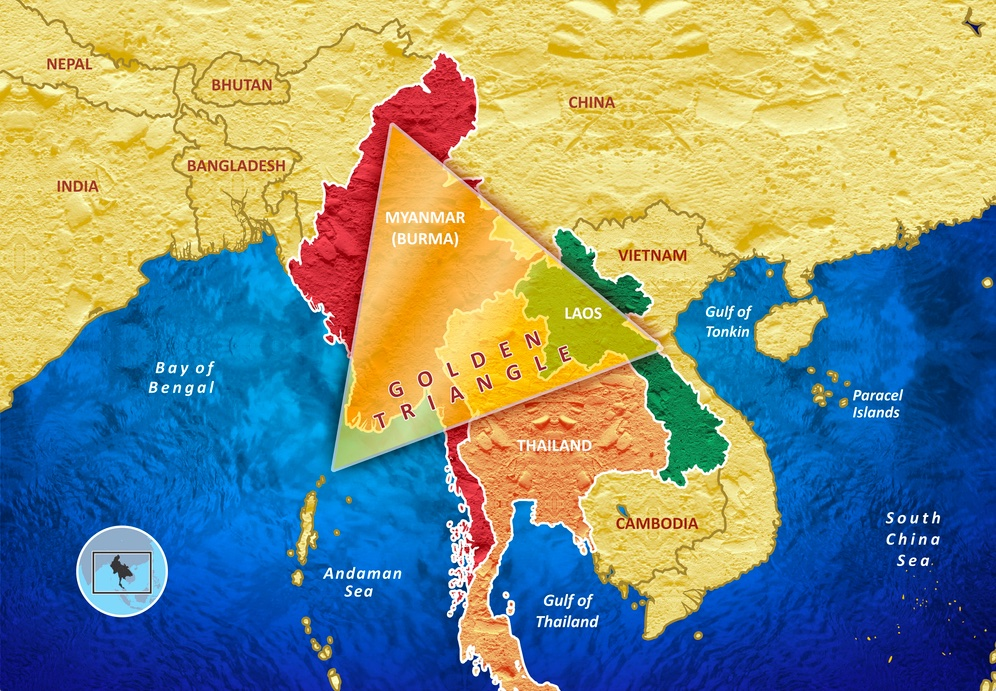
The golden triangle region comprises of Myanmar, Laos, and Thailand with the Mekong River, which is accompanied by mountainous region. It is known for its long history on drug trafficking. It is considered as one of the oldest routes wherein drugs were trafficked to North America and Europe40. When it comes to production of drugs, Myanmar produces largest amount of opium. Eventually, smuggling it through Laos and Thailand which reaches to the consumer states. Apart from that, Myanmar is also known for producing and distributing large amounts of synthetic drugs around the globe41. The synthetic drugs production and distribution happens in the northern part of Myanmar. The most popular synthetic drug around in the golden triangle region is methamphetamine tablets. They are also called as yaba pills or crystal methamphetamine42.After the coup of February 2021 in Myanmar, it can be seen that, there is a significant rise in drug trafficking activities in the golden triangle region43. This region is market to various countries such as Australia, the United States, the United Kingdom, Russia, South Korea, Japan, New Zealand, India, etc and provide them with various varieties of drugs. Moreover, the drug trade in the golden triangle region is facilitated by the insurgent groups and the organized crime syndicates which are active in those regions44. The availability of well-developed infrastructure, continuous supplies of financial proceeds from China and the security provided by insurgent groups collectively put this area at forefront showcasing it as a prominent supplier of synthetic drugs around the globe.
This golden triangle has made the north eastern states of India vulnerable to drug trafficking as it has limited infrastructure and surveillance, it is surrounded by dense forests which helps in smuggling of drugs easily. Through the golden triangle route, the drugs firstly enter in Manipur and then are distributed in Nagaland and Assam, from there they are sent to Bangladesh via maritime routes45. Due to the rapid increase in the drug trafficking in the golden triangle region, there has been a public health crisis in north eastern states, there has been an increase in the insurgent and drugs nexus due to the development of synthetic drugs in the region46. Therefore, affecting the eastern corridor of the country.
C. International Collective Approach to deal with the Golden Grip
An international collective approach can deal with the golden grip can help India in loosening its golden grip without affecting its global stand. Such international collective approach is already in action. Such as;
• SAARC Drugs offences monitoring desk which was established by SAARC to deal with the information exchange regarding drugs trafficking among South Asian countries47.
• The Colombo plan established by the Asia Pacific regional cooperation and its acts as a drug advisory program for the countries in Asia Pacific region to deal with the menace of drug trafficking48.
• Shanghai Cooperation Mechanism has a counter for narcotics mandate and it holds prime significance for India in order to deal with India’s transit routes on the Central Asian side49.
But there also lies certain lacunas with the collective international approach as sharing information exchange mechanisms are limited and inadequate. Every country has its own priorities where the prima facie importance is given to the development of the country rather than any enforcement mechanisms at global level50. The mutual legal assistance as directed under the Palermo convention is slow and apart from that India has extradition treaty with only 48 countries in which Pakistan is not there on the list51. Therefore, making it difficult to deal with the vulnerability of India when it comes to dealing with drug trafficking around the golden triangle and crescent nexus. There can be efforts made to improve the collective international approach towards drug trafficking by joint management border regulations, technology integration and cryptocurrency regulations, capacity building initiative can be seen already in place. For example; India’s SAARTHI approach in order to expand the Narcotics Control Bureau’s Scheme for Assistance, Rehabilitation and Training in Home Affairs52.
SUGGESTIONS AND CONCLUSION
The suggestions which can be provided are as follows;
1) There is a need to have clear comprehensive framework while dealing with drug trafficking as a transnational organised crimes as a separate ambit of legislation as many crimes are covered within the arena of drug trafficking. The offence of drug trafficking cannot be dealt within the existing legal framework as the current laws into existing are provided with open and liberal interpretation which acts as strategic loopholes for the offenders of drug trafficking to engage in transnational organised crime.
2) There should be clear policy and geographical analysis of the golden grip around India so as to make India less vulnerable to it. As under Article 253 of the Constitution of India53, India is signatory to various international conventions on drug trafficking and transnational organised crimes and laws have been made by it respectively. But it should not be construed that such grip around India will be tolerated without any global action or domestic action on it. As per the jurisprudential notion of social contract theory, when the state is unable to protect its citizens from the menace of such crime it hampers the contract and questions the legitimacy of the state to deal with such crimes.
3) The nation states affected by the golden grip can come together to have a collective framework to deal with the menace caused by drug trafficking as a transnational organised crime.
The intersection of drug trafficking and transnational organised crimes serves a challenge to the security and integrity of nation states. It is a catalyst for other transnational organised crimes. There are many international conventions and domestic legislations into force to deal with the menace of drug trafficking as an organised crime but the challenge lies in its implementation and policy framework. Moreover, when it comes to India it is situated within the grip of golden triangle and golden crescent due to which it has become vulnerable and acts as a transit corridor for the distribution of drugs around the globe. Though there exists certain legal framework at international and national level, it is the need of the hour to have a comprehensive framework to deal with menace of drug trafficking as a transnational organised crime while dealing with the golden crescent and golden triangle nexus.
*****
Footnotes
1. World Drug Report 2023, U.N. OFF. ON DRUGS & CRIME, https://www.unodc.org/unodc/en/data-and-analysis/world-drug-report-2023.html (last visited Oct. 15, 2025).
2. James Cockayne, Transnational Organized Crime: Multilateral Responses to a Rising Threat, 11 INT’L PEACE ACAD. 15 (2007).
3. PHIL WILLIAMS, TRANSNATIONAL CRIMINAL NETWORKS 67 (2001).
4. Supra note 12.
5. World Drug Report 2023, U.N. OFF. ON DRUGS & CRIME, https://www.unodc.org/unodc/en/data-and-analysis/world-drug-report-2023.html (last visited Oct. 15, 2025).
6. Id.
7. R.K. Raghavan, Drug Trafficking and Money Laundering: The Indian Scenario, 2 SCC J. 45 (2003).
8. HSBC Money Laundering Scandal – A Case Study, LEARNSIGNAL, https://www.learnsignal.com/blog/hsbc-money-laundering/ (last visited Nov. 1, 2025).
9. Louise I. Shelley, Transnational Organized Crime: An Imminent Threat to the Nation-State?, 48 J. INT’L AFF. 463 (1995).
10. Id.
11. Sinaloa Cartel, INSIGHT CRIME, https://insightcrime.org/mexico-organized-crime-news/sinaloa-cartel-profile/ (last visited Nov. 1, 2025).
12. Sandeep Chawla & Thomas Pietschmann, Drug Trafficking as a Transnational Crime, in HANDBOOK OF TRANSNATIONAL CRIME & JUSTICE 160 (Philip Reichel ed., 2005).
13. Id.
14. Jon Boone, Kabul Bank: Afghanistan’s $1bn Financial Scandal, GUARDIAN (June 16, 2011), https://www.theguardian.com/world/2011/jun/16/kabul-bank-afghanistan-financial-scandal.
15. FRANCISCO THOUMI & LINA NARANJO, ILLEGAL DRUGS AND STATE FRAGILITY 145 (2d ed. 2014).
16. NEIL BOISTER, PENAL ASPECTS OF THE UN DRUG CONVENTIONS (2d ed. 2017).
17. PHIL WILLIAMS, DRUG TRAFFICKING AND TRANSNATIONAL ORGANIZED CRIME (2013).
18. Neil Boister, Transnational Criminal Law, 13 EUR. J. INT’L L. 953 (2003).
19. Id.
20. Mangai Natarajan, International Drug Trafficking and the Role of Enforcement, in ROUTLEDGE HANDBOOK OF DRUG POLICY (2016).
21. JAMES H. MITTELMAN & ROBERT JOHNSTON, GLOBALIZATION AND ORGANIZED CRIME (2012).
22. Supra Note 20.
23. RATANLAL & DHIRAJLAL, THE NARCOTIC DRUGS AND PSYCHOTROPIC SUBSTANCES ACT (6th ed. 2020).
24. Narcotic Drugs and Psychotropic Substances Act, 1985, No. 61, § 4, Acts of Parliament, 1985 (India).
25. Narcotic Drugs and Psychotropic Substances Act, 1985, No. 61, § 36, Acts of Parliament, 1985 (India).
26. RATANLAL & DHIRAJLAL, THE NARCOTIC DRUGS AND PSYCHOTROPIC SUBSTANCES ACT (6th ed. 2020).
27. P.C. JAIN & GURBAX SINGH, NARCOTIC DRUGS AND PSYCHOTROPIC SUBSTANCES ACT (3d ed. 2018).
28. Ramesh Balakrishnan, India and the Crime-Terrorism Nexus, 10 COUNTER TERRORIST TRENDS & ANALYSES 14 (2018).
29. Indian Penal Code, 1860, No. 45, § 212, Acts of Parliament, 1860 (India).
30. Indian Penal Code, 1860, No. 45, § 216A, Acts of Parliament, 1860 (India).
31. Bharatiya Nyaya Sanhita, 2023, No. 45, § 249, Acts of Parliament, 2023 (India).
32. Bharatiya Nyaya Sanhita, 2023, No. 45, § 60, Acts of Parliament, 2023 (India).
33. PHIL WILLIAMS, DRUG TRAFFICKING AND TRANSNATIONAL ORGANIZED CRIME (2013).
34. Mohan Lal.V. State of Punjab (2018) 17 SCC 627 (India).
35. Nikesh Tarachand Shah.V. UOI WP (Criminal) No. 67 of 2017.
36. Image by Rattibha.
37. Santishree D. Pandit & Rimli Basu, The Retreat of the ‘State’: The Case of Afghan Opium, 73 INDIAN J. POL. SCI. 529 (2012).
38. Hermann Kreutzmann, Afghanistan and the Opium World Market: Poppy Production and Trade, 40 IRANIAN STUD. 605 (2007).
39. Image of Golden Triangle by Niti Tantra.
40. KO-LIN CHIN, THE GOLDEN TRIANGLE: INSIDE SOUTHEAST ASIA’S DRUG TRADE (2009).
41. KO-LIN CHIN & SHELDON X. ZHANG, THE CHINESE HEROIN TRADE: CROSS-BORDER DRUG TRAFFICKING IN SOUTHEAST ASIA AND BEYOND (2015).
42. Sandeep Chawla & Thomas Pietschmann, Drug Trafficking as a Transnational Crime, in HANDBOOK OF TRANSNATIONAL CRIME & JUSTICE 160 (Philip Reichel ed., 2005).
43. Supra Note 52.
44. Supra Note 47
45. Narcotics Control Bureau Annual Report 2023-24, NARCOTICS CONTROL BUREAU, https://narcoticsindia.nic.in/Publication/ncb-annual-report-2023-24.pdf (last visited Nov. 4, 2025).
46. Id.
47. BERTIL LINTNER, BURMA IN REVOLT: OPIUM AND INSURGENCY SINCE 1948 (1999).
48. Sandy Gordon, Regionalism and Cross-Border Cooperation Against Crime and Terrorism in the Asia-Pacific, 5 SECURITY CHALLENGES 27 (2009).
49. KO-LIN CHIN & SHELDON X. ZHANG, THE CHINESE HEROIN TRADE: CROSS-BORDER DRUG TRAFFICKING IN SOUTHEAST ASIA AND BEYOND (2015).
50. Louise I. Shelley, Transnational Organized Crime: An Imminent Threat to the Nation-State?, 48 J. INT’L AFF. 463 (1995).
51. Bilateral Documents, MINISTRY EXTERNAL AFF. (India), https://mea.gov.in/bilateral-documents (last visited Nov. 5, 2025).
52. Ramesh Balakrishnan, India and the Crime-Terrorism Nexus, 10 COUNTER TERRORIST TRENDS & ANALYSES 14 (2018).
53. INDIA CONST. art. 253.