
From E-Governance to Digital Constitutionalism: An Empirical Legal Analysis of Access, Transparency, Accountability and Citizen Empowerment in India
As India undergoes the transition to digital administration, the quality of the law of e-governance cannot be judged by efficiency alone. This empirical socio-legal study analyses responses from 120 users of digital governance services and examines the effect of e-governance policy on access satisfaction, service satisfaction and empowerment satisfaction. Using structural equation modelling, it finds strong effects on access satisfaction (β = .932, R² = .87), service satisfaction (β = .916, R² = .84) and empowerment satisfaction (β = .902, R² = .81). The paper interprets these results in the light of Articles 14 and 21 of the Constitution, the Information Technology Act, 2000, the Right to Information Act, 2005, disability and accessibility law, and the 2025 judgment in which the Supreme Court recognised digital access as a constitutionally guaranteed fundamental right. The results support a rights-based approach to digital administration that treats accessibility, transparency, traceability, reliability and citizen autonomy as legal rather than managerial principles of public service delivery.
Introduction
Digital government in India has evolved from an optional administrative innovation into a principal means by which citizens interact with the State. Licences and certificates, welfare payments, taxation, public information, grievance redress, identity verification and many other government services increasingly depend on electronic records, online portals, mobile applications and digitally authenticated transactions. The Information Technology Act, 2000 provides the basic legal framework for the recognition of electronic records and for electronic dealings with government bodies,1 but it also makes clear that the recognition of electronic processes does not by itself resolve every question of a citizen’s entitlement to electronic delivery. The constitutional issue therefore goes beyond the digitisation of government. It concerns the conditions under which digitisation remains equal, accessible, transparent, accountable and procedurally fair.
The change has become especially significant since the Supreme Court’s judgment in Pragya Prasun v. Union of India.2 The Court located meaningful digital access within the constitutional right to life and liberty, and observed that barriers arising from inaccessible design, poor connectivity, limited digital literacy and exclusionary technological systems can jeopardise dignity, autonomy and equal participation. The ruling raises administrative questions of digital inclusion to the constitutional level. It is especially important for e-governance, because a citizen’s capacity to access a portal, obtain reliable information, track an application or receive a service without unnecessary expense can determine whether that citizen is able to exercise a legal right at all.
Digital access is also connected to the older principles of equality, open government and procedural fairness. Articles 14, 19(1)(a) and 21 of the Constitution provide important constitutional foundations for access to information and communicative participation.3 The Right to Information Act, 2005 institutionalises transparency and proactive disclosure, including access to information in electronic form.4 The Rights of Persons with Disabilities Act, 2016 further provides for accessibility standards for information and communication technologies and for accessible electronic content.5 Taken together, these sources suggest that digital governance must be measured not merely by speed or convenience but by the quality of the relationship it establishes between citizens and the State.
This paper addresses a legal question that traditional e-governance satisfaction research usually leaves unanswered: if citizens report that digital government increases their satisfaction by reducing time and travel, delivering accurate information, enabling them to track applications, enhancing transparency and widening participation, what is the legal significance of those outcomes? The central argument is that these empirical dimensions correspond closely to the values of contemporary constitutional and administrative law. Access implicates substantive equality and digital inclusion; reliable and timely service implicates non-arbitrariness and procedural fairness; transparency and participation implicate the statutory and constitutional commitment to open government; application tracking implicates traceability and accountability; and empowerment implicates dignity, autonomy and meaningful participation in public administration.
At the same time, e-governance cannot be understood in terms of rights without privacy and data protection. In Justice K.S. Puttaswamy (Retd.) v. Union of India, the Supreme Court held privacy to be a fundamental right and specifically recognised informational privacy and decisional autonomy.6 The Digital Personal Data Protection Act, 2023 establishes a statutory regime for digital personal data that is being brought into force in stages.7 The institutional provisions, including those constituting the Data Protection Board, came into force on 13 November 2025, while the core processing obligations in sections 3 to 17 are scheduled under the commencement notification to take effect eighteen months later, on 13 May 2027. This paper therefore treats privacy as a legal safeguard that must surround citizen-centric digital governance, although it is not directly measured in the satisfaction model presented here.
Review of literature
A. The citizen as user of e-governance
Early e-governance literature in India presented information and communication technologies (ICTs) as tools that could enhance the speed, visibility and transparency of public administration. Shampa Paul found that Indian e-governance programmes can improve the supply of official information and transactions, can help connect e-governance with transparency, accountability, participation and social integration, and can make official information and transactions easier to access.8 On this approach, technology was an enabler of good governance. But the governance benefits of technology depend on how citizens actually use it: on portals that are intuitive, stable and inclusive, on accurate records, and on administrative processes that reduce rather than add friction.
For understanding digital access from a legal perspective, a key contribution is Pradip Thomas’s analysis of the Bhoomi and Gyan Ganga projects, which warns against technological determinism.9 Although digitisation can bypass some gatekeeping and increase transparency, the formal availability of technology does not resolve social and structural inequality. Pre-existing inequities in access, power and information can shape the actual usability of a digital system. This insight now carries direct constitutional implications, because the Supreme Court has recognised that exclusion from digital tools can threaten dignity and equal participation.10
Recent empirical studies have shifted towards a citizen-centric perspective on e-government quality. Examining Indian e-government web portals, Singh and co-authors found that information clarity, accuracy and completeness, system security, privacy, system stability and interactive services influence citizens’ perceptions and satisfaction.11 Similarly, recent e-governance satisfaction research shows that satisfaction and net benefits depend on system and service quality, and that the digital divide may moderate the relationship between system and service quality and citizen satisfaction.12 These studies support user satisfaction as a meaningful measure of citizens’ experience of information quality, reliability, accessibility and institutional responsiveness.
B. Transparency, accountability and the right to information
Transparency plays two roles in the e-governance literature. It is a feature of high-quality digital services and a legal requirement of public administration. Section 4 of the RTI Act requires public authorities to maintain their records, computerising them where appropriate, to disclose information about their organisation, functions and decisions, and to disseminate that information widely.13 The Supreme Court’s earlier open-government jurisprudence also established that the people have a right to know how they are governed. In State of Uttar Pradesh v. Raj Narain, the Court linked the people’s right to know with a democratic system in which public officials are accountable for their acts.14 S.P. Gupta v. Union of India likewise upheld the principle of openness and disclosure, subject to confidentiality recognised by law in the public interest.15
Digitalisation could make proactive transparency continuous rather than episodic. Mandowara and Thomas show how the digital implementation of the right to information regime can improve transparency and accountability, but also that the quality and consistency of institutional implementation are crucial to its success.16 The e-governance policy construct of the present study is therefore legally relevant, because its most prominent indicators are transparency and accountability, citizen participation and accessibility of government information. These features closely track the statutory rationale of section 4 of the RTI Act and the constitutional principle of administrative accountability.
C. Equality, disability and digital access
The concept of digital access shifted significantly in 2025, both in its definition and in its legal implications. In Pragya Prasun v. Union of India, the Supreme Court considered inaccessible digital KYC processes affecting persons with visual impairment and acid attack survivors. It held that the State’s obligations under Article 21, read with the guarantees of equality and social justice, extend to ensuring access to digital infrastructure and services.17 The judgment is especially important for e-governance because it establishes that a service is not legally accessible merely because it is technically online. Digital design must also take account of users who would be excluded if it were inaccessible.
The Rights of Persons with Disabilities Act supports this position. Section 40 requires the Central Government to lay down standards of accessibility, including for information and communication technologies and systems, and section 42 requires the appropriate Government to ensure that content in electronic media is available in accessible formats.18 The empirical finding that access satisfaction has the strongest relationship with e-governance policy can therefore be read in legal terms: digital access bears on citizens’ ability to obtain public services on an equal footing. It is not simply a matter of being able to reach a portal, but of being able to use it meaningfully and without discrimination.
D. Procedural fairness, traceability and citizen empowerment
Administrative law is concerned not only with outcomes but with ensuring a fair and rational process in public decision-making. Maneka Gandhi v. Union of India held that a procedure affecting life or personal liberty cannot be arbitrary, unfair or unreasonable.19 Although not every e-governance transaction involves a deprivation of personal liberty, the broader constitutional idea of fair and non-arbitrary State action is an important lens for assessing digital administration. Arbitrariness can be reproduced through code rather than through a physical office: a digital process may fail to acknowledge receipt, to show the status of a matter, to give intelligible reasons, or to offer a channel for correction or human review.
Traceability enables citizens to know whether their application has been received, where it is pending and whether any action has been taken. Electronic acknowledgement and auditability are recognised within the legal framework for electronic records in the Information Technology Act itself.20 Ease of monitoring applications is the strongest empowerment indicator in the present model. That finding suggests that citizens associate empowerment with “seeing” administrative action, and not only with convenience. Digital empowerment in this sense is closely related to procedural accountability.
This paper therefore addresses a gap in the literature and jurisprudence. There is empirical research on satisfaction and adoption, and constitutional scholarship on rights and statutory obligations, but relatively little work connects citizens’ actual experience of e-governance with the legal standards that bind the State. This study attempts to bridge that divide by treating access, service quality and empowerment as empirically observable facets of digital constitutionalism.
Research methods
The study adopts an empirical socio-legal research design. Its legal component is doctrinal and examines the constitutional, statutory and judicial principles relating to access, transparency, administrative fairness, accessibility, privacy and accountability in the digital sphere. Its empirical component is quantitative and assesses users’ experience of e-governance policy across three outcome dimensions: access satisfaction, service satisfaction and empowerment satisfaction. The two components are combined at the interpretation stage: the statistical relationships are first analysed without reference to any legal principle or authority, and are then mapped onto the relevant legal standards.
Primary data were collected from 120 respondents who had used digital or electronically delivered government services. Respondents with relevant experience were identified by purposive sampling, and the data were collected in Bengaluru, Karnataka, between January and March 2026.
The instrument (Table 1) comprised 20 measurement indicators across four constructs: E-Governance Policy (six items, E_GOV_POL_1 to E_GOV_POL_6), Access Satisfaction (four items, User_Sat_1 to User_Sat_4), Service Satisfaction (six items, User_Sat_5, User_Sat_6, User_Sat_7, User_Sat_10, User_Sat_11 and User_Sat_12) and Empowerment Satisfaction (four items, User_Sat_8, User_Sat_9, User_Sat_13 and User_Sat_14), as estimated in Figure 1. The E-Governance Policy construct covered accessibility of public information, government–citizen cooperation, citizen participation, development of information and communication technology, transparency and accountability, and reduction in government expenditure. The satisfaction constructs covered ease of use, cost and time savings, service delivery, clarity of procedures, information quality, grievance handling, application tracking, transparency, accountability and personal development. All items were answered on a five-point Likert scale ranging from 1 (Strongly Disagree) to 5 (Strongly Agree).
| Item | Statement |
|---|---|
| E_GOV_POL_1 | Objective of e-governance is to make every information of the government available to all in the public interest. |
| E_GOV_POL_2 | E-governance goals is to create a cooperative structure between the government and the people |
| E_GOV_POL_3 | To increase and encourage Users participation in the governance process. |
| E_GOV_POL_4 | e-Governance improves the country’s information and communication technology and electronic media |
| E_GOV_POL_5 | E-Governance objectives is to establish transparency and accountability in the governance process. |
| E_GOV_POL_6 | To reduce government spending on information and services. |
| User_Sat_1 | E-governance services are accessible to me at any time and at any place |
| User_Sat_2 | Overall process of availing e-governance services is time-saving |
| User_Sat_3 | Travelling cost involved in availing e-governance services is less |
| User_Sat_4 | Amount saved on expenses incurred on phone calls, posts, etc. for availing e-governance services is less |
| User_Sat_5 | E-governance services are delivered within the expected time frame |
| User_Sat_6 | The rules and procedures involved in availing e-governance services are clear to me |
| User_Sat_7 | Availability of information about e-governance services is accurate and reliable |
| User_Sat_8 | Complaint handling procedure is easy |
| User_Sat_9 | Monitoring the status of my application is easy |
| User_Sat_10 | Transparency is maintained when accessing e-governance services |
| User_Sat_11 | E-governance services can be accessed directly without the need to pay Intermediaries |
| User_Sat_12 | Government is accountable while providing e-governance services |
| User_Sat_13 | Using e-governance services enhances my skills (computer skills, technical skills etc.) |
| User_Sat_14 | Using e-governance makes my work easier allowing me time for personal development |
Table 1: Measurement items
Structural equation modelling (SEM) was used to test the measurement and structural models. Model adequacy was assessed using the chi-square statistic, the ratio of chi-square to degrees of freedom, the Goodness of Fit Index (GFI), the Comparative Fit Index (CFI), the Tucker-Lewis Index (TLI), the Root Mean Square Error of Approximation (RMSEA) and the Root Mean Square Residual (RMR). These indices allow absolute, incremental and parsimonious fit to be assessed rather than relying on a single test statistic.21 The criteria adopted were χ²/df < 3.00, GFI, CFI and TLI > .90, RMSEA < .08 and RMR < .05. The structural analysis then produced standardised path estimates between e-governance policy and each satisfaction construct, together with R² values for explained variance.
In the legal analysis, a high satisfaction coefficient is not treated as evidence of constitutional compliance. Rather, the statistical findings are treated as evidence of which features of digital administration bear significantly on users’ experience, and the legal analysis then examines whether those features correspond to constitutional or statutory standards. The distinction is methodologically important. The strength of the access relationship is an empirical finding about users’ experience, whereas the duty to avoid exclusion derives from the constitutional guarantee of equality and from Article 21, from disability legislation and from judicial precedent, not from user perception. The empirical and doctrinal strands inform and reinforce each other without reducing law to perception.
Data analysis and results
A. Overall model fit
| Fit Index | Obtained Value | Recommended Threshold | Interpretation |
|---|---|---|---|
| Chi-square (χ²) | 350.077 | – | – |
| Degrees of freedom (df) | 167 | – | – |
| χ²/df | 2.096 | < 3.00 | Good fit |
| GFI | 0.916 | > 0.90 | Good fit |
| CFI | 0.924 | > 0.90 | Good fit |
| TLI | 0.918 | > 0.90 | Good fit |
| RMSEA | 0.096 | < 0.08 | Not a good fit |
| RMR | 0.036 | < 0.05 | Good fit |
Table 2: Model fit statistics
The overall structural equation model was assessed using a series of goodness-of-fit indices. The chi-square statistic was 350.077 with 167 degrees of freedom, giving a χ²/df ratio of 2.096, below the adopted threshold of 3.00. The GFI (0.916), CFI (0.924) and TLI (0.918) exceeded the recommended threshold of 0.90, and the RMR (0.036) was below 0.05. The RMSEA, however, was 0.096 (90% confidence interval 0.082 to 0.110), above the recommended upper bound of 0.08. Although the other indices met their criteria, the high RMSEA indicates poor approximate model fit, and the model therefore cannot be regarded as fitting uniformly well. The structural relationships are accordingly interpreted with caution.
B. Structural relationships and explained variance
For the 120 respondents and 20 indicators, the standardised loadings ranged from 0.775 to 0.908, all of them above 0.70. The corresponding indicator reliabilities (the squared loadings) ranged from 0.601 to 0.824, meaning that the latent constructs account for between 60.1% and 82.4% of the variance in their individual indicators. The study does not, however, report construct-level reliability and validity statistics, namely Cronbach’s alpha, composite reliability and average variance extracted for each construct, or a test of discriminant validity such as the Fornell–Larcker criterion or the heterotrait–monotrait ratio. The measurement results therefore establish the strength of the individual indicator loadings only; internal consistency and discriminant validity at the construct level have not been established, and the structural estimates that follow are to be read as preliminary.
| Outcome construct | Structural path | β | R² | Empirical interpretation |
|---|---|---|---|---|
| Access satisfaction | E-Governance Policy → Access Satisfaction | .932 | .87 | Strongest structural effect; policy explains 87% of variance in access satisfaction. |
| Service satisfaction | E-Governance Policy → Service Satisfaction | .916 | .84 | Strong relationship with reliability, timeliness, transparency and service quality. |
| Empowerment satisfaction | E-Governance Policy → Empowerment Satisfaction | .902 | .81 | Strong positive relationship associated with application monitoring, digital skill enhancement, and personal development. |
Table 3: Structural effects of e-governance policy
Empowerment satisfaction showed a strong positive structural relationship with e-governance policy (β = 0.902; R² = 0.81). Perceived effectiveness of e-governance policy is thus strongly associated with citizens’ satisfaction in respect of application monitoring, skill enhancement and personal development. Although autonomy remains relevant to the constitutional analysis of digital governance, it was not included as a separate element or measured directly in the empirical model, and the study therefore makes no separate empirical finding on citizens’ autonomy.
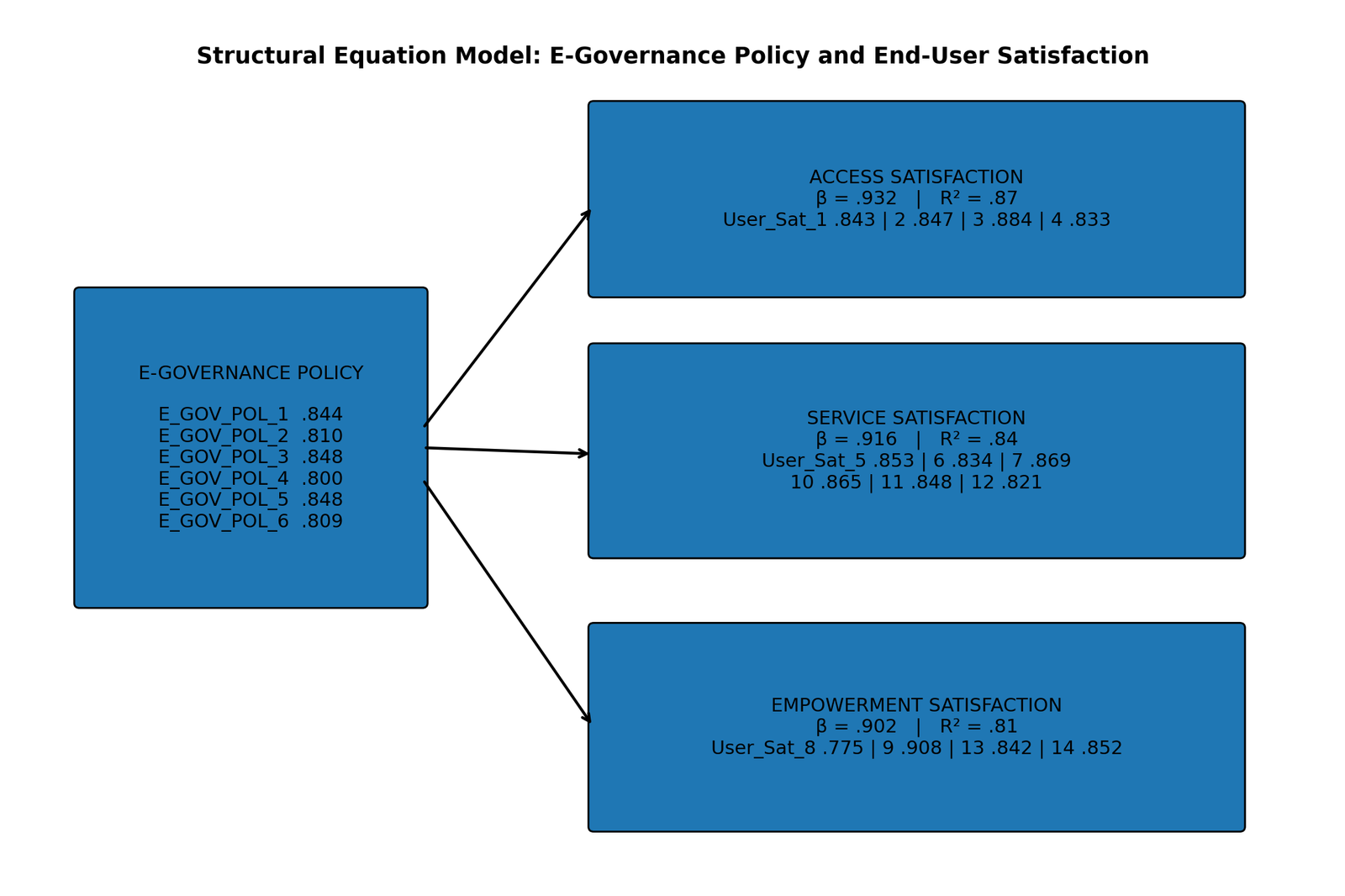
Figure 1: Structural equation model of e-governance policy and end-user satisfaction
Figure 1 presents the estimated structural equation model with its standardised loadings. The e-governance policy indicators range from .800 to .848, the access-satisfaction indicators from .833 to .884, the service-satisfaction indicators from .821 to .869, and the empowerment-satisfaction indicators from .775 to .908. The indicators therefore load strongly on their respective latent constructs.
C. Measurement indicators and their legal meaning
| Construct / item | Loading | Measured meaning | Analytical significance |
|---|---|---|---|
| E_GOV_POL_1 | .844 | Accessibility of government information | Information access is central to perceived policy effectiveness. |
| E_GOV_POL_3 | .848 | Increased user participation in governance | Participation forms part of the policy construct rather than a peripheral benefit. |
| E_GOV_POL_5 | .848 | Transparency and accountability | Transparency/accountability is among the strongest policy indicators. |
| User_Sat_2 | .847 | Time saving | Respondents perceive digital access as reducing administrative transaction time. |
| User_Sat_3 | .884 | Reduced travel cost | The strongest access indicator captures reduced physical-access burden. |
| User_Sat_5 | .853 | Timely service delivery | Timeliness is a substantial element of service satisfaction. |
| User_Sat_7 | .869 | Accuracy and reliability of information | The strongest service indicator is informational reliability. |
| User_Sat_10 | .865 | Transparency | Transparency is also strongly embedded in service satisfaction. |
| User_Sat_9 | .908 | Ease of monitoring applications | The strongest empowerment indicator is administrative traceability. |
| User_Sat_13 | .842 | Skill enhancement | Use of digital governance can enhance citizen capability. |
| User_Sat_14 | .852 | Personal development | Empowerment extends beyond transactional convenience. |
Table 4: Selected measurement indicators
D. Legal relevance of the empirical results
| Empirical result | Statistic / indicator | Legal value | Principal legal authority | Legal relevance |
|---|---|---|---|---|
| Access is the strongest outcome | β=.932; R²=.87 | Equality, meaningful digital access and non-exclusion | Constitution arts. 14 & 21; Pragya Prasun; RPwD Act §§ 40, 42 | A digital service must be practically usable; online availability alone is insufficient where design or access barriers exclude citizens. |
| Government information accessibility is a strong policy indicator | E_GOV_POL_1=.844 | Access to public information; open government | RTI Act § 4; IT Act §§ 4, 6 | Digitisation should make official information accessible and usable, not merely convert paper records into electronic form. |
| Participation is a strong policy indicator | E_GOV_POL_3=.848 | Participatory governance and communicative citizenship | Constitution art. 19(1)(a); RTI Act § 4(1)(b)(vii) | Digital systems can support consultation and citizen participation, strengthening the democratic dimension of e-governance. |
| Transparency/accountability is a strong policy indicator | E_GOV_POL_5=.848 | Open government and accountable exercise of public power | RTI Act § 4; State of U.P. v. Raj Narain; S.P. Gupta v. Union of India | User perceptions align with the legal expectation that governmental decision processes and records should be sufficiently visible and accountable. |
| Reduced travel cost and time are the strongest access indicators | User_Sat_3=.884; User_Sat_2=.847 | Substantive accessibility and equal opportunity to obtain public services | Constitution arts. 14 & 21; Pragya Prasun | Removing geographic and transaction barriers can make formal legal entitlements practically exercisable, especially for vulnerable users. |
| Reliable information and timely delivery are strong service indicators | User_Sat_7=.869; User_Sat_5=.853 | Non-arbitrariness, fair procedure and reliable administration | Constitution arts. 14 & 21; Maneka Gandhi; IT Act ch. III | Digital administration should be accurate, timely and reviewable; technological form does not displace basic standards of fair administration. |
| Transparency is also a strong service indicator | User_Sat_10=.865 | Transparency in service delivery | RTI Act § 4 | Transparency is experienced by users as a service-quality condition and is independently recognised in public-law disclosure duties. |
| Application monitoring is the strongest empowerment indicator | User_Sat_9=.908 | Traceability, accountability and procedural visibility | IT Act §§ 7A, 12; RTI Act § 4; arts. 14 & 21 | Status tracking reduces opacity by allowing citizens to observe the administrative life-cycle of their applications and identify delay or inaction. |
| Empowerment is strongly predicted by e-governance policy | β=.902; R²=.81 | Dignity, autonomy and meaningful participation | Constitution art. 21; Puttaswamy | Citizen-centred digital systems can enhance autonomy, but empowerment must be accompanied by safeguards for privacy and informational self-determination. |
Table 5: Empirical results and their legal relevance
E. From user satisfaction to digital constitutionalism
The empirical results suggest strong alignment between what users expect of e-governance and what public law requires of digital administration. The strongest structural relationship concerns access. This is consistent with Pragya Prasun. The constitutional question is not merely whether the government has put a service online, but what must be done to secure meaningful and inclusive access in the digital mode. A system that saves most users travel and time may still raise a constitutional concern, even as it enables greater efficiency for the majority of users. The access coefficient can therefore support a move from formal to substantive digital access.
The second major finding concerns service satisfaction. Accurate and reliable information, transparency and prompt service delivery are the strongest indicators of service satisfaction. These factors correspond to the administrative-law concepts of reliability, intelligibility, timeliness and non-arbitrariness. Digital systems often appear objective because decisions are made through a digital process. Automation does not, however, end public-law obligations. A late or incorrect electronic process is as arbitrary as a late or incorrect paper process. Article 14 of the Constitution and the jurisprudence that has developed around Maneka Gandhi require the State to act fairly, whether it acts through a physical or a technological interface.
Transparency appears in the empirical model in two forms: as an indicator of e-governance policy and as an indicator of service satisfaction. It therefore merits particular attention, and in legal terms this dual role matters. Transparency is not merely a good design feature that satisfies users; it has legal value in its own right. Under section 4 of the RTI Act, public authorities must organise, publish and make available information about their functions, procedures, decision-making and records. Digital governance makes continuous and searchable disclosure possible, but it can also create new forms of opacity, such as algorithms, workflow rules and application statuses that are not visible to the citizen. The empirical strength of transparency therefore supports an e-governance architecture that treats transparency as an integral component of the service, rather than as a problem to be addressed only when an RTI application is filed.
The empowerment results reveal a further dimension. The highest loading is for ease of monitoring applications (User_Sat_9), at .908. This suggests that citizens feel empowered when they can see how the government responds to their requests. In legal terms, status tracking brings procedure into the light. It can show whether an application has reached the State, whether a statutory or administrative deadline has been met, whether the application is being considered, and whether a grievance needs to be addressed. Traceability can thus strengthen accountability before a dispute escalates into litigation. It makes the administrative process intelligible to the person concerned.
Citizen participation needs to be considered separately. E_GOV_POL_3, which captures increased user participation in governance, loads at .848. Section 4(1)(b)(vii) of the RTI Act requires public authorities to publish the particulars of any arrangement for consultation with, or representation by, members of the public in the formulation or implementation of policy.22 Digital governance can strengthen such participation through online consultations, grievance platforms and feedback mechanisms. Participation must, however, be meaningful: it must rest on intelligible information, accessible interfaces and a genuine institutional process for taking account of citizens’ views. Otherwise, digital consultation will be symbolic rather than participatory.
Finally, digital constitutionalism must address privacy. The present empirical model does not directly measure data protection or consent, so no conclusion about respondents’ experience of either can be drawn from the SEM. Legally, however, the State’s collection and use of personal information remain constrained by the privacy principles set out in Puttaswamy, such as legality, a legitimate State aim and proportionality.23 The DPDP Act adds a further statutory layer, but its core processing obligations are not scheduled to operate until 13 May 2027.24 A sound e-governance system should therefore deliver the benefits identified in this study without presupposing that surrendering personal data is the price of participating in e-government.
Overall, the findings support a model of digital constitutionalism in which constitutional values take priority and technology serves them. E-governance succeeds in legal terms where it enhances citizens’ genuine ability to reach the government, makes public processes more transparent and traceable, provides accurate and timely information, enables participation, respects accessibility and protects autonomy. Satisfaction is not the ultimate constitutional test, but the degree of satisfaction reported offers empirical evidence of where legal safeguards and administrative design meet in citizens’ everyday experience.
Conclusion
This study approaches e-governance as a question of public law rather than of technology adoption. On the responses of 120 users of digital governance services, e-governance policy emerges as a strong predictor of access satisfaction (β = .932; R² = .87), service satisfaction (β = .916; R² = .84) and empowerment satisfaction (β = .902; R² = .81), although, as the limitations below explain, these estimates are preliminary. The findings matter because they align with constitutional and statutory provisions in India. Digital access is now recognised as part of the right to life under Article 21; transparency is embodied in the RTI Act; electronic governance is recognised in the IT Act; accessibility obligations are set out in disability law; and procedural fairness applies wherever administrative action takes place, whether in a physical office or a digital one. The ability to monitor an application and to obtain reliable information can therefore be regarded as an accountability mechanism and not merely as an interface feature.
The study thus demonstrates the relevance of digital constitutionalism. It shifts the focus away from the dichotomy between online and offline government towards the legal quality of government conducted online. A constitutionally sound digital service is one that citizens can access, understand and monitor; that produces reliable and timely governmental action; that treats citizens as participants rather than consumers; and that respects dignity and autonomy. As the DPDP framework is progressively brought into force, privacy and data protection must remain part of this account.
In practice, legal indicators should be considered alongside conventional ones in evaluating e-governance. Public authorities should audit digital services for accessibility; publish procedural information in accessible form; provide mechanisms to track the status of a matter and to give reasons; offer assisted and human review where automated processes fail; explain clearly what happens to the information that people disclose; and make grievance processes accessible from within the digital service. Such measures turn e-governance from a delivery platform into an accountable relationship between citizen and State.
Limitations
The study has methodological limitations. The empirical analysis used structural equation modelling with 20 indicators and 120 respondents, and this small sample may affect the statistical precision of the parameter estimates and the generalisability of the preliminary relationships found between e-governance policy and the three dimensions of citizen satisfaction. Because respondents were selected by purposive sampling in Bengaluru, Karnataka, the findings cannot be generalised to the wider population of digital governance users in India. The high RMSEA (0.096; 90% confidence interval 0.082 to 0.110) also indicates poor overall approximate model fit. Nor does the study report construct-level reliability and validity statistics (Cronbach’s alpha, composite reliability and average variance extracted for each construct) or a test of discriminant validity, so the measurement model rests on the indicator loadings alone. Future research should use larger and more geographically and demographically diverse samples, report construct-level reliability and validity, and validate the proposed structural model in other demographic and institutional settings.
*****
Footnotes
1. Information Technology Act, No. 21 of 2000, §§ 4-9, India Code (2000). Sections 4-10A (ch. III, “Electronic Governance”) establish the core framework for electronic governance; § 9 provides that §§ 6-8 do not by themselves confer a right to insist that documents be accepted in electronic form.
2. Pragya Prasun v. Union of India, 2025 SCC OnLine SC 993, ¶¶ 17-18, 2025 INSC 599 (India) (recognising the constitutional significance of inclusive digital access and issuing accessibility directions for digital KYC).
3. India Const. arts. 14, 19(1)(a), 21; Maneka Gandhi v. Union of India, (1978) 1 S.C.C. 248 (India).
4. Right to Information Act, No. 22 of 2005, §§ 2(j)(iv), 4, India Code (2005).
5. Rights of Persons with Disabilities Act, No. 49 of 2016, §§ 40, 42, India Code (2016).
6. Justice K.S. Puttaswamy (Retd.) v. Union of India, (2017) 10 S.C.C. 1 (India).
7. Digital Personal Data Protection Act, No. 22 of 2023, India Code (2023); Ministry of Electronics & Information Technology, Notification G.S.R. 843(E), Gazette of India, Extraordinary, pt. II, sec. 3(i) (Nov. 13, 2025). Under the notification, specified institutional provisions (including §§ 18-26) commenced on publication, § 6(9) and § 27(1)(d) commence after one year (Nov. 13, 2026), and the core provisions, including §§ 3-17, commence after eighteen months (May 13, 2027).
8. Shampa Paul, A Case Study of E-Governance Initiatives in India, 39 Int’l Info. & Libr. Rev. 176, 176-84 (2007), https://doi.org/10.1080/10572317.2007.10762747.
9. Pradip Ninan Thomas, Bhoomi, Gyan Ganga, E-Governance and the Right to Information: ICTs and Development in India, 26 Telematics & Informatics 20, 20-31 (2009), https://doi.org/10.1016/j.tele.2007.12.004.
10. Pragya Prasun, supra note 2, ¶ 17.
11. Sumanjeet Singh, Vimal Kumar, Minakshi Paliwal, Pratima Verma & Binod Rajak, A Citizen-Centric Approach to Understand the Effectiveness of E-Government Web Portals: Empirical Evidence from India, 27 Info. Polity 539 (2022), https://doi.org/10.3233/ip-220001.
12. Surya Bahadur G.C., Santosh Kumar Gurung, Subarna Bir Jung Bahadur Rana & Bharat Ram Dhungana, e-Governance, Citizen Satisfaction and Net Benefits: The Moderating Effect of Digital Divide, 11 Cogent Bus. & Mgmt. 2402512 (2024), https://doi.org/10.1080/23311975.2024.2402512.
13. Right to Information Act, supra note 4, § 4(1), (3).
14. State of Uttar Pradesh v. Raj Narain, (1975) 4 S.C.C. 428 (India).
15. S.P. Gupta v. Union of India, 1981 Supp. S.C.C. 87 (India).
16. Khushi Mandowara & Vineeth Thomas, Proactive Transparency in Governance: A Comparative Study of Digitalisation of the Right to Information Act in Central and State Governments in India, 8 Asian J. Compar. Pol. 594, 594-607 (2023), https://doi.org/10.1177/20578911231157437.
17. Pragya Prasun, supra note 2, ¶¶ 17-18; see also Maria Jawed & Girish R., From Digital Divide to Digital Dignity: Amar Jain v. Union of India and the Constitutional Right to Accessible Technology in India, 26 Int’l J. Discrimination & L. 595 (2026), https://doi.org/10.1177/13582291251382491.
18. Rights of Persons with Disabilities Act, supra note 5, §§ 40, 42.
19. Maneka Gandhi, supra note 3.
20. Information Technology Act, supra note 1, §§ 7A, 12.
21. See generally Rex B. Kline, Principles and Practice of Structural Equation Modeling (4th ed. 2016).
22. Right to Information Act, supra note 4, § 4(1)(b)(vii).
23. Puttaswamy, supra note 6.
24. Notification G.S.R. 843(E), supra note 7.