
Introduction
How a labour regime deals with maternity is one practical test of whether women can remain securely attached to paid work. In 2017, the Maternity Benefit (Amendment) Act more than doubled paid maternity leave, from 12 to 26 weeks, and introduced a statutory creche requirement (Maternity Benefit (Amendment) Act, 2017). Both entitlements now sit in the 2020 Code on Social Security, which took effect, alongside the remaining three Labour Codes, from 21 November 2025 (PIB, 2025b). On the face of the statute, a mother in a covered establishment in India now enjoys a longer period of paid leave than the minimum of fourteen weeks prescribed by the international standard (Addati et al., 2014; ILO, 2000).
A longer leave, however, does not by itself secure an unbroken career. Using Danish administrative records, Kleven et al. (2019a) showed that a first birth opened a lasting earnings gap of roughly a fifth between mothers and fathers, and Kleven et al. (2019b) observed a similar pattern, of varying magnitude, across several countries. Budig and England (2001) found that American mothers earned less with each additional child, while Correll et al. (2007) showed that evaluators judged mothers to be less capable and less dedicated than equally qualified childless women. Kleven et al. (2025) further suggested that the penalty associated with children becomes the dominant source of gender inequality as economies move towards salaried employment. The question for India is therefore not only how long a mother may remain on leave, but what becomes of her career after her return.
The Indian context lends particular urgency to this question. Klasen and Pieters (2015) documented that the labour force participation of married women in urban India barely moved over a period of more than twenty years. Participation has risen markedly in recent survey rounds (NSO, 2026; NSSO, 2024), although working women are still clustered in self-employment and many of those not in the labour force give childcare and home duties as their main reason (NSO, 2026). The consolidation of maternity law is thus taking place at a moment when more women are entering work and when the transition to regular salaried employment, in which the child penalty tends to be most pronounced, is under way.
To the author’s knowledge, no earlier study has mapped the maternity chapter of the 2020 Code onto the successive career stages at which the motherhood penalty is known to arise. The present paper addresses this gap. Its objectives are, first, to trace how the maternity protections of the 1961 statute were carried into the 2020 Code; second, to identify the stages of the career cycle at which the law protects women and those at which it is silent; third, to relate these findings to international and Indian evidence on the motherhood penalty; and fourth, to propose measures that would extend protection beyond the twenty-sixth week. The principal limitation, discussed later, is that the analysis rests on legal materials and published statistics rather than on workplace data, so that the associations it reports should not be read as causal effects.
Conceptual framework
A. The motherhood penalty
The term motherhood penalty refers to the shortfall in pay, employment and promotion that women face after having children, compared both with men and with childless women (Budig & England, 2001; Correll et al., 2007). Budig and England (2001) attributed part of the wage penalty to forgone experience and part to a residual that persisted after experience was controlled, a residual consistent with employer discrimination. Correll et al. (2007), using both an experiment and an audit study, found a hiring disadvantage for mothers that did not extend to fathers. Goldin (2014), by contrast, drew attention to the reward attached to long and inflexible hours, a pattern that particularly disadvantages workers with caring responsibilities. Blau and Kahn (2017) also linked continuing gaps in high-skill occupations to interrupted careers and shorter working hours. Read together, this evidence places much of the penalty in the way work is organised around caregiving rather than in the leave spell alone.
The event studies of Kleven et al. (2019a, 2019b) show that the penalty from childbirth follows a similar profile from one country to another but differs in size, and that the difference is influenced by family policy and prevailing gender norms. This variation indicates that policy is not neutral.
It follows that maternity law may be more appropriately assessed by its association with the entire post-birth trajectory than by the length of leave it grants.
B. The economics of mandated benefits
A second body of scholarship concerns the incidence of mandated benefits. Summers (1989) argued that a benefit mandated on employers operates in a manner analogous to a tax, the burden of which may be shifted to the protected group through lower wages or reduced hiring. Gruber (1994) reported that the cost of mandated maternity coverage in the United States was largely shifted to the wages of women of childbearing age. Ruhm (1998) found that parental leave mandates in Europe were associated with higher female employment, although longer entitlements were associated with lower relative wages. Olivetti and Petrongolo (2017) concluded, from a century of legislation, that the employment effects of leave are modest, whereas expenditure on childcare and early education appears more clearly beneficial to women’s careers. Patnaik (2019) reported that a reserved paternity quota was associated with a more equal division of household labour well after the leave had ended. For India, this makes the way leave is financed, and whether fathers are brought into the leave system, potentially as important as the number of weeks available to mothers.
C. The Indian evidence
Indian evidence is still relatively small in volume, but it is beginning to show a consistent pattern. Zumbyte and Das (2017) linked the presence of a young child to lower employment among urban mothers and found that the association had become stronger over time; limited access to formal childcare was identified as one constraint. Banerjee et al. (2026), comparing outcomes around the 2017 reform, reported a fall in employment among women aged twenty to twenty-nine. Their model attributes this response to firms facing the cost of leave and, as a result, applying more demanding hiring standards to women of fertile age. Interview studies add a workplace perspective: Gethe and Pandey (2023) and Chaudhary et al. (2025) found greater awareness of maternity rights, but continued concern about recruitment discrimination and uneven support from managers. While these studies differ in method and scope, they converge on the suggestion that part of the cost of the 2017 reform may have been transferred to the group it was intended to protect.
Research methodology
A doctrinal approach was adopted. The Gazette text of Chapter VI of the 2020 social security Code, together with connected provisions in the Codes on occupational safety (2020) and on wages (2019), was examined and set against the 1961 maternity statute in its post-2017 form. Judgments of the Supreme Court interpreting maternity entitlements were identified from law reports and judgment databases, and official statements on financing were traced through releases of the Press Information Bureau.
The doctrinal analysis was supplemented by two further sources. First, the study used the published survey figures on participation, type of employment, earnings and stated reasons for not seeking work (NSO, 2026; NSSO, 2024; PIB, 2025a); no unit-level data were analysed. Second, peer-reviewed international and Indian studies on the motherhood penalty and on mandated leave were reviewed. The findings were then organised around five stages of the career cycle, namely hiring, pregnancy and leave, return to work, early childcare and progression, and each stage was assessed for the presence and adequacy of legal protection.
Findings
A. Continuity from the 1961 Act to the Code
In substance, the Code keeps the amended 1961 Act largely intact. Under Section 60(1) of the 2020 Code, “every woman shall be entitled to, and her employer shall be liable for, the payment of maternity benefit at the rate of the average daily wage for the period of her actual absence”. Section 60(3) fixes the maximum period at “twenty-six weeks of which not more than eight weeks shall precede the expected date of her delivery”, and reduces it to twelve weeks for “a woman having two or more surviving children”. Table 1 shows, in practical terms, that consolidation changed the enforcement arrangement without materially changing either the entitlement or who pays for it.
| Feature | 1961 Act (after the 2017 amendment) | 2020 Code (Chapter VI) |
|---|---|---|
| Duration of paid leave | 26 weeks; 12 weeks with two or more surviving children | Same (s. 60(3)) |
| Eligibility | Minimum period of actual work before delivery | 80 days in the preceding twelve months (s. 60(2)) |
| Adoption and surrogacy | 12 weeks for a mother adopting a child under three months, and for a commissioning mother | Same text in s. 60(4); age limit read down by the Supreme Court in 2026 |
| Work from home after leave | Permitted by mutual agreement | Same; employer “may allow” (s. 60(5)) |
| Creche | Establishments with 50 or more employees; four visits a day | Same (s. 67(1)) |
| Nursing breaks | Two daily breaks up to the child’s age of 15 months | Same (s. 66) |
| Protection from dismissal | Dismissal during absence unlawful; benefit may be withheld for prescribed gross misconduct | Same, including the gross misconduct proviso (s. 68(1)) |
| Enforcement | Inspector under the Act | Inspector-cum-Facilitator (s. 72); penalties under ss. 133 and 134 |
| Financing | Employer, outside ESI coverage | Employer, outside ESI coverage (ss. 41(7), 60(1)) |
| Paternity leave | None | None in any of the four Codes |
Table 1: Maternity protection before and after consolidation
Note. Prepared by the author using the 2017 amending Act, the 2020 Code and Hamsaanandini Nanduri v. Union of India (2026). ESI denotes the Employees’ State Insurance scheme under Chapter IV of the Code.
The protective core of the earlier law has likewise been retained. Section 68(1) renders it unlawful for the employer “to discharge or dismiss her during or on account of such absence” or “to vary to her disadvantage any of the conditions of her service”. Section 67(1) requires every covered establishment employing “fifty employees or such number of employees as may be prescribed” to “have the facility of crèche”, with four visits a day, and Section 66 grants nursing breaks until the child attains fifteen months. The penal provisions have also been strengthened, with the proviso to Section 134 prescribing imprisonment of not less than two years for a repeated failure to pay the benefit. In short, consolidation did not weaken the statutory protections that operate during the leave period itself.
B. Coverage and eligibility
Generous on paper, these rights do not extend to every woman who works. The First Schedule limits the maternity chapter to factories, mines and plantations and to “every shop or establishment in which ten or more employees are employed”. Section 60(2) adds an individual eligibility condition: the woman must have worked “for a period of not less than eighty days in the twelve months immediately preceding the date of her expected delivery”. This leaves women in very small establishments, intermittent forms of work and own-account work outside the chapter.
The official labour force statistics indicate the scale of this exclusion. Women’s participation in the labour force climbed from 23.3 per cent in 2017–18 to 41.7 per cent in 2023–24 (NSSO, 2024) and stood at 40.0 per cent in 2025, under a revised survey design that the statistical office cautions may not be strictly comparable with earlier rounds (NSO, 2026). Figure 1 presents the series. In 2025, however, nearly two-thirds of working women (64.2 per cent) were self-employed, and fewer than one in five (18.2 per cent) had a regular wage or salaried job (NSO, 2026). Unorganised and platform workers are addressed only through schemes: Section 109 obliges the Central Government to frame schemes on “health and maternity benefits” for unorganised workers, whereas Section 114 provides merely that it “may frame” comparable schemes for workers in the gig and platform economy. For most women who work, maternity protection thus remains a prospective scheme rather than an enforceable wage entitlement.
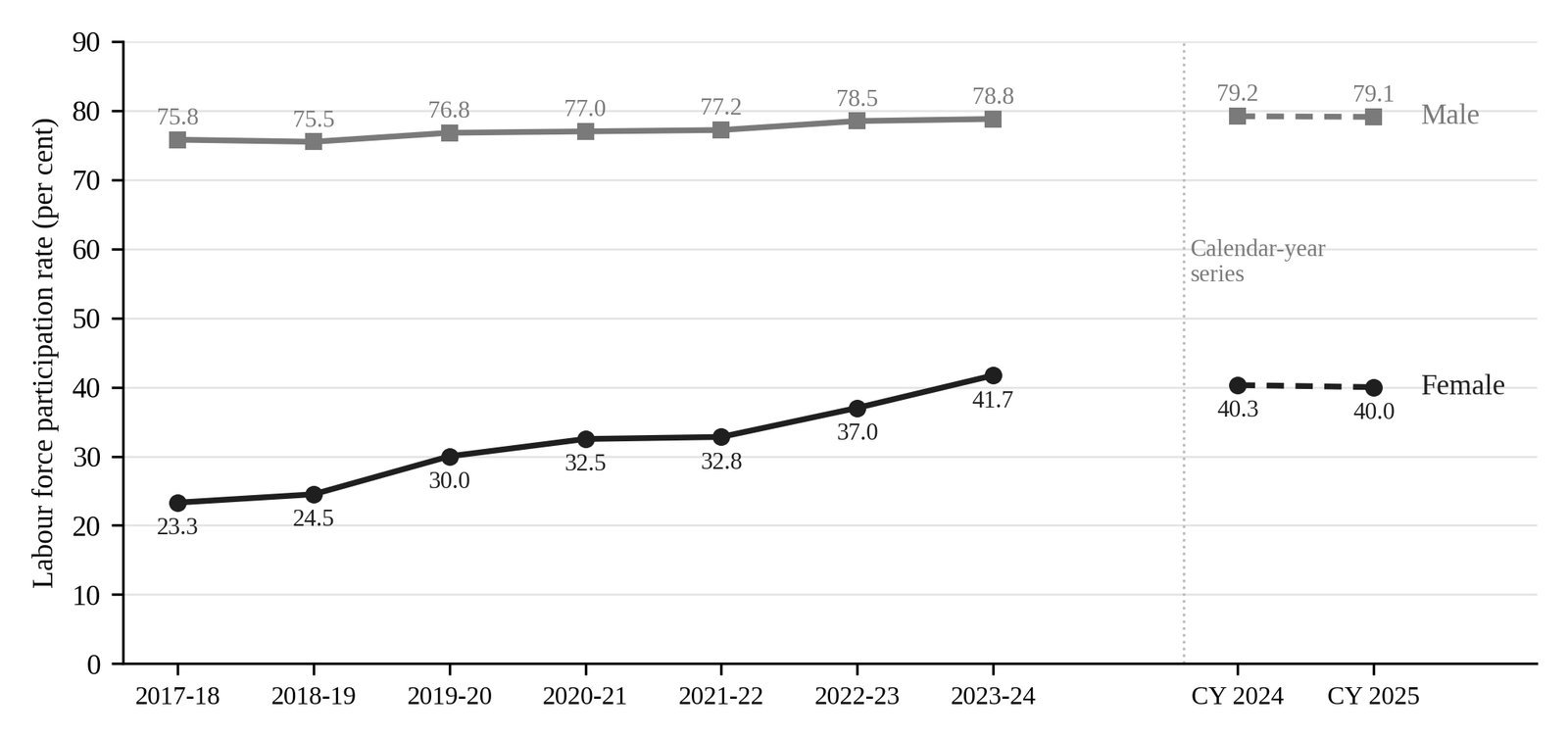
Figure 1: Labour force participation rate by sex, usual status, age 15 and over, India, 2017–18 to 2025
Note. Compiled by the author from NSSO (2024), PIB (2025a) and NSO (2026). Values from 2017–18 to 2023–24 refer to July to June survey years; CY 2024 and CY 2025 refer to calendar years, and the 2025 estimates follow a revised design that may not be strictly comparable with earlier rounds.
C. Financing and the hiring penalty
Financing is where the continuity is most apparent. Unless a woman is covered by the Employees’ State Insurance scheme, her employer remains responsible for paying wages throughout maternity leave; Section 41(7)(b) relieves the employer only where the woman is eligible for maternity benefit under that scheme. The Ministry of Labour and Employment did consider partial reimbursement in 2018. In a clarification issued that year, it stated that it was working on a scheme under which “7 weeks’ wages would be reimbursed to employers who employ women workers with wage ceiling upto Rs. 15000/-”, but it also recorded that it was still “in the process of obtaining necessary budgetary grant and approvals” (PIB, 2018). No provision for reimbursement appears in the Code.
By retaining employer liability, India stands apart from the wider international movement. According to Addati et al. (2014), the share of countries financing maternity cash benefits through employer liability “decreased from 33 per cent to 26 per cent” between 1994 and 2013, and only “34 per cent (57 countries) fully meet the requirements of Convention No. 183” on duration, level of benefit and source of funding (p. xi). Although India exceeds the Convention’s minimum of fourteen weeks, its reliance on the individual employer departs from the collective funding that the Convention favours (ILO, 2000), a Convention that India has not ratified.
Economic theory anticipates that an employer-funded mandate may be shifted to women through hiring or wages (Gruber, 1994; Summers, 1989), and the Indian evidence appears consistent with this expectation. The decline in the employment of women aged twenty to twenty-nine reported by Banerjee et al. (2026), together with the hiring concerns voiced by employees and managers (Chaudhary et al., 2025; Gethe & Pandey, 2023), suggests that the penalty may now arise before pregnancy, at the point of recruitment. Section 3(2)(ii) of the Code on Wages, 2019 prohibits discrimination “on the ground of sex while recruiting any employee for the same work or work of similar nature”, yet a refusal to hire on account of anticipated maternity cost is inherently difficult to prove. No Code, moreover, recognises pregnancy or family status as a protected ground, and the recruitment stage consequently remains the least protected point in the maternal career cycle.
D. Beyond the twenty-sixth week
The legal framework becomes markedly thinner once the period of leave ends. Section 60(5) does not create an employee right to continue working from home. Where the job permits it, the provision says that “the employer may allow her to do so after availing of the maternity benefit for such period and on such conditions as the employer and the woman may mutually agree”. The wording leaves the arrangement to agreement: an employee has no statutory right to request flexibility, and an employer need not give reasons for refusing it. Childcare support is also threshold-based. The creche duty applies at fifty employees, while Section 24(3) of the occupational safety Code of 2020 empowers the Centre to frame rules for creches where “more than fifty workers are ordinarily employed”. Section 43 of that Code also permits women, with consent and prescribed safeguards, to work “before 6 a.m. and beyond 7 p.m.”; the provision expands access to such hours but says nothing about how they interact with care responsibilities.
A further gap is the complete absence of paternity leave from the four Codes. The word paternity does not appear in any of them, with the consequence that the law continues to assign the care of infants to mothers alone. The Supreme Court took note of this gap in Hamsaanandini Nanduri v. Union of India (2026), observing that “women often sacrifice earnings and career progression for childbirth and child care” (para. 147) and urging the Union “to come up with a provision recognizing paternity leave as a social security benefit” (para. 169). Patnaik (2019) reported that reserved leave for fathers was associated with a more equal division of care beyond the leave period, and the omission therefore removes one of the few instruments linked to a smaller post-birth penalty. In the 2025 survey, “child care/personal commitments in home-making” was the main reason given by 44.4 per cent of women not in the labour force, and women in regular wage employment earned an average of Rs. 18,353 a month against Rs. 24,217 for men (NSO, 2026). Table 2 summarises the distribution of protection across the career cycle.
| Career stage | Protection in the Codes | Principal gap |
|---|---|---|
| Hiring | Code on Wages, s. 3(2)(ii): no sex discrimination in recruitment | No protection for pregnancy or family status; employer-funded leave creates an incentive to avoid hiring women of childbearing age |
| Pregnancy and leave | 26 weeks’ paid leave; medical bonus; protection from dismissal during absence (ss. 60, 64, 68) | Employer liability outside ESI; eligibility and establishment thresholds exclude most working women |
| Return to work | No work for six weeks after delivery; service conditions may not be altered to her detriment (ss. 59, 68) | No guaranteed return to her former job or a comparable one; work from home only at the employer’s discretion (s. 60(5)) |
| Early childcare | Nursing breaks to 15 months; creche in establishments with 50 or more employees (ss. 66, 67) | Threshold excludes small employers; no paternity or shared parental leave in any Code |
| Progression | General wage non-discrimination (Code on Wages, s. 3(1)) | No duty to prevent loss of appraisal, promotion or pay progression linked to leave or caring responsibilities |
Table 2: Legal protection across the stages of the maternal career cycle
Note. Prepared by the author from the social security, wages and occupational safety Codes. Section numbers refer to the Code on Social Security unless otherwise stated.
E. Judicial expansion of maternity rights
The Supreme Court has repeatedly read maternity entitlements generously. The benefit of the 1961 Act was held to reach women on muster-roll daily wages in Municipal Corporation of Delhi v. Female Workers (Muster Roll) (2000). In Deepika Singh v. Central Administrative Tribunal (2022), the Court ruled that an employee who had earlier taken child care leave for her husband’s children could not for that reason be denied maternity leave, noting that without such provisions “many women would be compelled by social circumstances to give up work on the birth of a child”. In Kavita Yadav v. Secretary, Ministry of Health and Family Welfare Department (2023), a contract employee who met the qualifying conditions was allowed the full benefit even where the leave ran past the end of her contract. K. Umadevi v. Government of Tamil Nadu (2025) associated maternity leave with reproductive choice and personal liberty under Article 21, and Hamsaanandini Nanduri v. Union of India (2026) found the three-month age ceiling for adoptive mothers in Section 60(4) to be inconsistent with Articles 14 and 21. Although these judgments have fortified the entitlement during and around the leave, they have not addressed the hiring and progression stages at which, on the evidence reviewed, the penalty is most likely to arise.
Discussion
One feature of maternity protection in India stands out. Although the period of maternity leave available under the law is comparatively long, the benefit reaches a limited section of working women and the protection becomes considerably weaker once the leave period is over. The twenty-six weeks of maternity leave exceed the international minimum of fourteen weeks (ILO, 2000). However, the benefit is mainly available to women in regular employment in establishments covered by the law.
The financial burden of maternity benefit also continues to rest with the individual employer. Earlier studies have indicated that such an employer-funded system may indirectly shift part of the employment cost to women themselves (Banerjee et al., 2026; Gruber, 1994; Summers, 1989). The consolidation of the maternity benefit provisions under the Code has not changed this basic arrangement.
It therefore appears that the employment penalty associated with maternity may not disappear merely because the period of leave is longer. Rather, the problem may shift from one stage to another. It may first influence the employer’s recruitment decision and subsequently reappear during the early years of childcare, when the woman resumes her employment. The employment disadvantage may therefore extend beyond the maternity leave period itself. From a human resource management perspective, three implications follow. First, compliance with the statutory minimum is unlikely to be sufficient for the retention of women after childbirth, because the decisive moments occur at return, appraisal and promotion, where the Codes impose few obligations (Blau & Kahn, 2017; Goldin, 2014). Second, because each employer bears the cost of leave on its own, line managers may, knowingly or otherwise, lean towards male candidates, as the interview evidence from Indian organisations suggests (Chaudhary et al., 2025). Third, the organisations most likely to retain mothers are those that treat flexible work, childcare support and fathers’ leave as components of talent management rather than as statutory costs, an interpretation consistent with the international evidence on family policy (Olivetti & Petrongolo, 2017; Patnaik, 2019).
The findings also carry implications for the rules and schemes that remain to be framed or revised under the Code. The Supreme Court has already urged the Union to recognise paternity leave, the reimbursement proposal of 2018 has not been carried into the Code (PIB, 2018) and Sections 109 and 114 leave maternity protection for unorganised and platform workers to schemes not yet designed. This is not to suggest that the twenty-six-week entitlement should be curtailed; rather, it indicates that the post-Labour Code framework can still be shaped at precisely the points where the career penalty appears to be concentrated.
The study has limitations. It relies on the enacted text of the Codes, on published estimates from official surveys and on a small number of Indian studies of the 2017 reform; no unit-level data were analysed; the 2025 survey estimates follow a revised design that is not strictly comparable with earlier rounds; and the rules and schemes through which several provisions will operate are still evolving. The conclusions should therefore be read as an assessment of where the law is likely to protect or fail to protect women, rather than as an estimate of the size of the penalty in Indian workplaces.
Recommendations
The findings support the following measures, which are directed at the legislature, the appropriate Governments and employers.
• Socialised financing: maternity pay for women outside the ESI scheme should come from a pooled social-insurance or public fund, in line with the ILO standard, so that individual employers no longer carry it (Addati et al., 2014; ILO, 2000).
• Paternity and shared parental leave: fathers should receive a paid, non-transferable leave entitlement under the 2020 Code, as the Supreme Court recommended in Hamsaanandini Nanduri v. Union of India (2026).
• Return and flexibility rights: women should be entitled to resume their previous role or a comparable one, and the Code should convert the discretionary work-from-home provision into a right to request flexible work, with reasons required for any refusal.
• Protection at hiring: pregnancy and family status should be recognised as protected grounds in recruitment, and employers above a stated size should be required to report the proportion of women hired and retained after maternity leave.
• Extension through schemes: Sections 109 and 114 should be operationalised through schemes that specify maternity cash benefits and access to creche support for women in unorganised, gig and platform work.
• Organisational practice: employers can complement the statutory framework by ensuring that maternity leave does not disadvantage appraisal or promotion, by offering a structured route back to work and by extending childcare support even where the legal threshold does not compel it.
Conclusion
This study asked a narrower question than the length of maternity leave alone: what protection remains for a woman’s career once the statutory leave period is over? The 2020 Code keeps the 26-week paid leave, the creche requirement and protection against dismissal during absence. At the same time, employer-funded leave remains in place outside the insured sector, coverage is constrained by establishment and eligibility thresholds, post-leave work from home depends on the employer, and the Codes contain no paternity leave. The Indian evidence reviewed here links the 2017 extension with weaker employment outcomes for women in the main childbearing ages, while official survey data continue to identify childcare as a major reason for women’s non-participation. The resulting picture is one in which statutory protection is strongest during leave, while important career risks arise afterwards. Addressing those risks would require attention to financing, the sharing of leave between parents, and enforceable safeguards at return to work and during later progression. Because the analysis relies on published statistics and legal materials, a useful next step would be research based on linked employer-employee data capable of estimating the child penalty within Indian workplaces.
Acknowledgment
Data availability. All statutory provisions, statistics and studies are drawn from the published sources listed in the references; no new data were generated. This study received no grant funding. The author declares no competing interests.
*****