

Introduction
The transformation of the Indian securities market into a far more accessible domain stands out as a significant financial development of the decade. The same elements that widened that access, however, such as smartphones, affordable data, gamified trading applications and social media, have also given rise to a new category of unregulated intermediaries. These “finfluencers”, or financial influencers, use social media platforms to circulate investment tips, market commentary and lifestyle-driven wealth narratives, often reaching audiences in the millions. A study by the CFA Institute in collaboration with YouGov India found that 82 per cent of retail investors exposed to social-media finance content acted on the advice they encountered, yet only about 2 per cent of the finfluencers examined were registered with SEBI.1 That distance between influence and regulatory oversight is the regulatory problem this study explores.
This paper pursues four objectives. It first provides a chronological account of the guidelines, consultation papers, regulations and circulars through which SEBI has come to regulate finfluencers. It then identifies the firms and individuals whose conduct, and the resulting investor harm, prompted those measures. It next translates the regulatory reasoning into frameworks and models that clarify the strategy. Finally, it assesses the regulatory system critically and suggests improvements. The central argument throughout is that regulation and enforcement have developed together: orders revealed patterns of harm, rule-making broadened the response, and fresh enforcement actions then tested the new boundaries.
Scholarly interest in the finfluencer phenomenon is recent, yet it is gaining traction quickly across marketing, behavioural finance, securities law and communication studies. The existing literature highlights three main areas of concern: the minimal barriers to entry that create investor-protection risks through unregulated financial content; the behavioural and psychological pathways by which finfluencer content shapes the decisions of retail investors; and governance strategies, ranging from statutory regulation to voluntary quality standards, aimed at distinguishing credible creators from those who cause harm. The following section examines that body of research before positioning the present contribution within it.
Literature Review
A. Low entry barriers, investor risk and the case for regulation
Borde, Borgave and Chugh (2024) use secondary research to argue that the minimal entry barriers facing creators of digital financial content pose significant risks to inexperienced investors, and they advocate more uniform global regulatory standards to curb fraudulent financial practices in this space.2
Henriques, Paes and Colaco (2025) similarly employ descriptive analysis of secondary data to show that, although finfluencers can genuinely educate retail investors, the absence of professional qualifications among many creators and the prevalence of misinformation call for a more robust regulatory response from SEBI.3
Alam and Yusuf (2026) combine econometric modelling with content analysis and find that exposure to finfluencer content markedly increases trading activity and speculative behaviour among younger investors, a vulnerability they attribute in part to inadequate disclosure norms in the Indian market.4
Pande (2025) uses survey data alongside econometric modelling and reports that perceived finfluencer expertise significantly affects the investment decisions of retail investors, which strengthens the argument for a dedicated regulatory framework.5
B. Behavioural and psychological channels of influence
Warkar and Durai (2025) use a quantitative survey design to show that finfluencer narratives reinforce behavioural biases among younger, Generation Z investors, which suggests that the effect depends less on informational content than on psychological framing.6
Rahayu and Ekawanti (2026) report, on the basis of a quantitative survey, that perceived finfluencer credibility can paradoxically reduce the quality of investment decisions by producing information overload, with the relationship moderated by an investor’s own level of financial literacy.7
Bhatia, Sethi and Panjwani (2026) conduct clustering and regression analyses across behavioural investor segments and find that psychological characteristics such as impulsiveness and trust shape whether retail investors prefer informal budgeting content over structured investment advice.8
In their taxonomy of finfluencer-follower relationships, Vu, Keating and Wang (2025) find that engagement and behavioural response to financial suggestions, especially among young adults, are driven largely by parasocial bonds sustained by the fulfilment of autonomy, competence and relatedness needs.9
Surveying Generation Z Instagram users, Akın (2026) finds through regression and moderation analysis that the strongest predictors of positive attitudes towards finfluencers, and therefore of the intention to act on their recommendations, are how trustworthy, likeable and relatable followers find them rather than their actual expertise.10
C. Quality frameworks and self-governance as an alternative to regulation
In a survey of 106 German-speaking Instagram finfluencers, Mölders, Bock, Barrantes and Zülch (2025) report that most see themselves as advocates for financial education, which the authors argue makes strategic industry partnerships a viable complement even though many creators operate under commission-based and conflicted business models.11
Zülch, Mölders and Hoffmann build on this by developing a “Finfluencer Quality” (FinQ) framework from expert interviews and a series of Instagram account case studies. Their multidimensional, forty-indicator framework positions quality assurance as a lighter-touch alternative to prescriptive regulation, helping corporate stakeholders to distinguish reliable creators from dangerous ones and to professionalise strategic partnerships.12
D. Sustainability, literacy and emerging themes
Bhatia, Sethi and Panjwani (2026), together with the related sustainable-finance strand of work by Zülch, Mölders and Hoffmann, connect finfluencer-driven behavioural clusters to preferences within sustainable-finance content, which suggests that the influence extends beyond conventional stock tips into ESG and green-investment narratives.13
After a systematic literature review, Badal and Sehgal (2026) conclude that rigorous, India-specific research on how short-form finfluencer content psychologically alters investors’ perceptions of risk remains scarce, and that existing scholarship still concentrates on financial literacy, source credibility and legal questions.14
Chatterjee (2026) examines how finfluencers and social media intersect with market integrity in India and places the regulatory response within the wider problem of maintaining orderly markets in a high-velocity information environment.15
Taken together, this literature establishes two points that motivate the present paper. First, there is broad academic agreement that the investor-protection risks associated with finfluencer-driven retail engagement are real and stem from both structural factors (low entry barriers, weak disclosure) and behavioural ones (parasocial trust, information overload, herding). Second, the literature is divided between those who treat voluntary quality signalling as a supplement or an alternative, particularly in the FinQ strand, and those who regard statutory regulation as the necessary response. What is largely missing is a systematic, chronological account of how a securities regulator has actually turned these concerns into binding rules. To close that gap, this paper traces SEBI’s rule-making and enforcement history in India from 2013 to 2026 and condenses it into an analytical model.
Research Questions
The gap identified above, a scholarly record rich in behavioural and quality-framework insight but thin on a systematic account of how a securities regulator translates those concerns into binding rules, motivates three research questions.
• How have SEBI’s regulatory reforms on finfluencers evolved since 2013?
• Which enforcement matters materially shaped that evolution, and what harm patterns did they reveal?
• What underlying model best explains SEBI’s chosen instruments, and where does that model remain vulnerable?
Methodology
This paper follows a qualitative, doctrinal document-analysis design, which suits a research question about how a regulatory regime evolved over time rather than about measurable investor outcomes.
A. Research design and approach
The study traces the sequence of SEBI’s rules and enforcement decisions chronologically. To reconstruct the regulatory timeline, it triangulates three categories of primary source:
• SEBI’s own instruments, namely consultation papers, Board press releases, amendment regulations and circulars, dated from August 2023 to 2026;
• SEBI’s enforcement orders, whether interim, final or by settlement, in the four flagship matters examined below; and
• the pre-existing statutory framework, comprising the Investment Advisers Regulations 2013, the Research Analysts Regulations 2014 and the PFUTP Regulations 2003, together with ASCI’s self-regulatory codes, which provide the benchmark against which the 2023 to 2026 reforms are measured.16
B. Case selection
The four enforcement matters discussed below, involving P.R. Sundar, Ravindra Bharti, “Baap of Chart” and Asmita Patel, were chosen purposively rather than sampled randomly, on three criteria: each is a SEBI order of record rather than merely a news report; each precedes or immediately follows a particular rule-making step, which allows the order-to-rule linkage claimed later in this paper to be traced; and, taken together, they cover the entire 2023 to 2025 window, capturing both the pre-rules and the post-rules enforcement environment. The four matters are not a statistically representative sample of all SEBI finfluencer actions, but this purposive approach supports the paper’s explanatory aim by illustrating recurrent harm patterns.
C. Secondary literature
The Literature Review draws on peer-reviewed and conference-published studies from 2024 to 2026. It is supplemented by data from the CFA Institute and YouGov survey and by client alerts from law firms, which are used only for factual or procedural detail such as filing dates and never in place of the original SEBI text.
D. Scope and cut-off
The analysis covers developments in regulation and enforcement up to the price-data-lag revision of 2026. The comparative material on the United Kingdom, the United States, the European Union and Australia is included only to give context to SEBI’s design choice; it is not an independent comparative empirical study. The paper is limited to the Indian securities market and to English-language primary and secondary sources.
Background: Retail Boom and the Anatomy of Finfluencers
A. Expansion of the investor base
The rapid expansion of retail participation is the structural backdrop to finfluencer regulation. Demat accounts increased from roughly 3.9 to 4 crore at the beginning of 2020 to about 15.1 crore by the close of the 2023–24 financial year, and to a record 18.5 crore by the end of calendar 2024, crossing 19 crore during 2025.17 In FY 2023–24 alone nearly four crore accounts were added, the largest increase in any single year. The March 2020 market crash, which drew in bargain-hunters, the emergence of discount brokers and the viral reach of finfluencers among novice and mostly young investors all contributed to this surge (Figure 1).
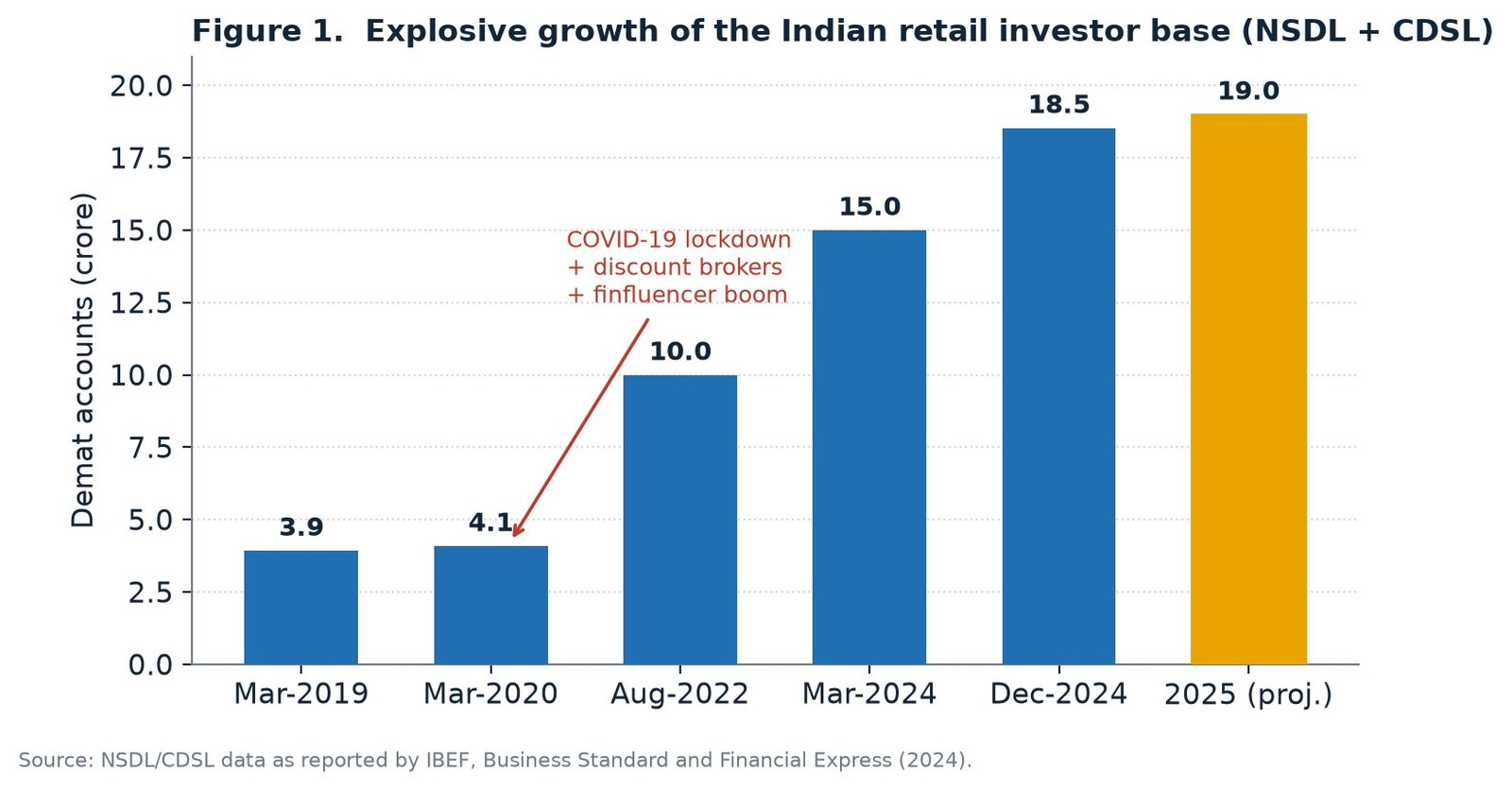
Figure
(Source: Authors’ construction from NSDL and CDSL figures reported by IBEF, Business Standard and Financial Express)
Figure 1. Growth of the Indian demat-account base, 2019–2025
Two features of this new cohort call for regulatory attention. It is young and technologically fluent; Generation Z and millennial investors make up a sizeable share of new entrants, and they base their trust on relatability and perceived “authenticity” rather than institutional reputation.18 It is also entering complex products at an early stage. SEBI’s own study of the equity derivatives segment found that the vast majority of individual traders lose money, which highlights the distance between the confidence that influencers instil and actual outcomes.19 In that setting, a charismatic creator who promises returns of 200 to 300 per cent can cause widespread harm.
B. Who is a finfluencer?
“Finfluencer” is not a legal term. For analytical clarity, this paper distinguishes four types, which map onto very different regulatory risk profiles.
Table 1. A working taxonomy of finfluencers by regulatory risk profile.
| Type | Description | Typical monetisation | Regulatory risk |
|---|---|---|---|
| Registered adviser creator | SEBI-registered RIA/RA who also publishes content | Advisory fees; legitimate sponsorships | Low-within perimeter |
| Educator | Teaches concepts, no security specific calls or return claims | Course fees; ad revenue | Low-medium-must stay behind the bright line |
| Promoter/affiliate | Markets products/brokers for referral or fixed fees | Referral fees; paid promotions | Medium-high-disclosure & association rules |
| Unregistered adviser (‘sinfluencer’) | Gives stock/option calls or guarantees returns for a fee, often as ‘education’ | Course/subscription fees; Telegram tips | High-core enforcement target |
(Source: Authors’ own classification, developed from the enforcement patterns discussed below)
The fourth category, and the grey area in which “education” is used as a cover for unregistered advice, is the main subject of the regulatory narrative. As the following section shows, the harms are systemic rather than incidental.
C. A conceptual framework of finfluencer harms
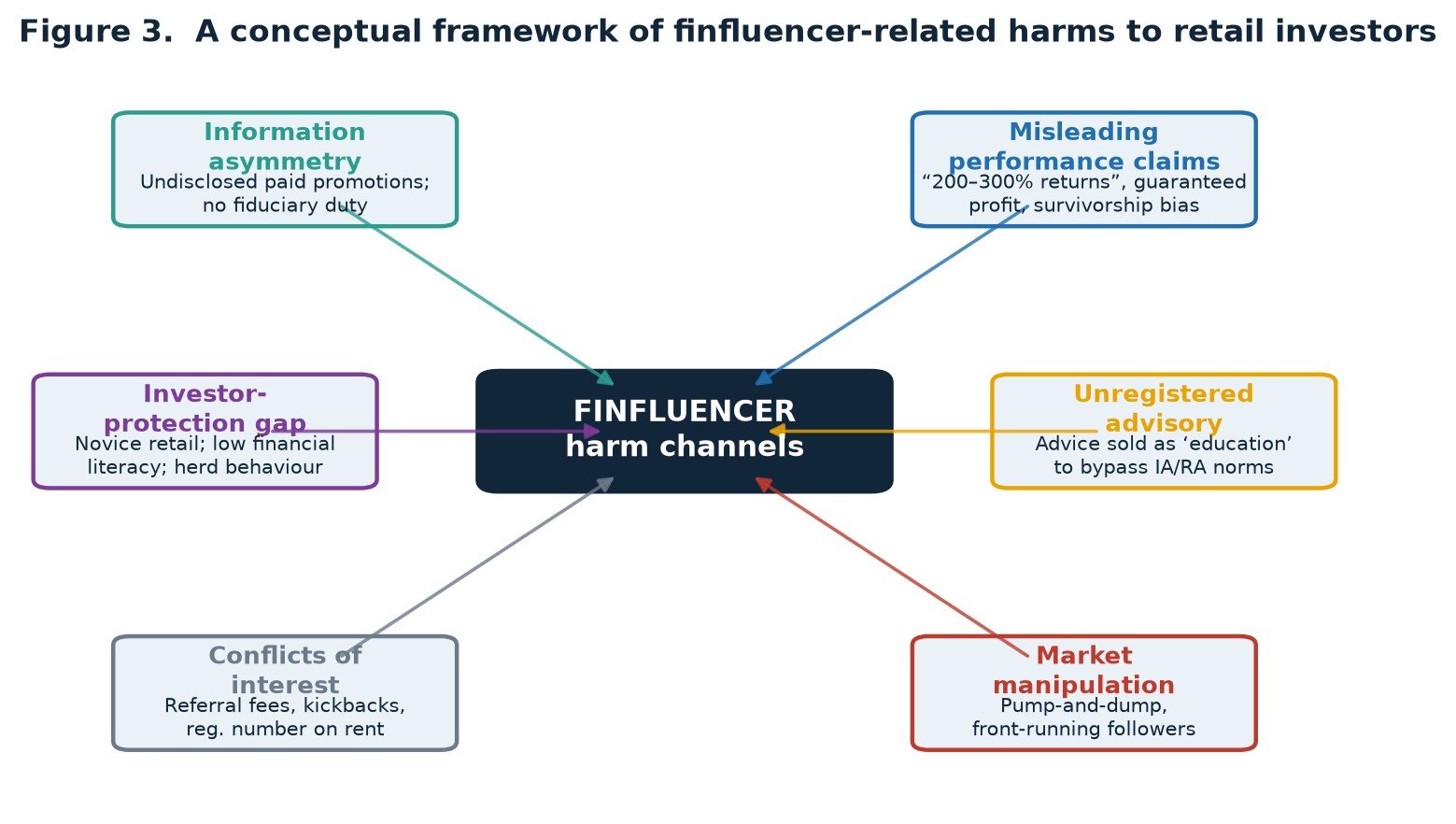
Figure
(Source: Authors’ construction, synthesised from the analysis in this section and the next)
Figure 2. A conceptual framework of finfluencer-related harms.
• Information asymmetry and the absence of fiduciary duty: undisclosed conflicts prevent the audience from discounting the recommendation.
• False performance claims, such as “guaranteed” profits, selectively displayed winners and survivorship bias, which systematically inflate expected returns.
• Unregistered advisory activity: stock and option calls sold as “courses” in order to avoid the Investment Advisers and Research Analysts regimes, which is the most litigated harm.
• Market manipulation, including pump-and-dump schemes and front-running of followers who move small-cap prices on cue.
• Conflicts of interest, including paid promotions, referral kickbacks and even the “renting” of a registration number in order to appear compliant.
• The investor-protection gap: every other channel is amplified by an inexperienced, low-literacy audience acting as a herd.
This framework explains SEBI’s choice of instruments. Rather than attempt the near-impossible task of licensing every content creator directly, SEBI targeted the arteries that carry these harms: client data, referrals, money, and the ambiguity between education and advice. The following sections examine that design choice.
D. The regulatory environment before SEBI’s intervention (2013–2023)
Finfluencers did not arise in a legal void. A number of instruments were already in place, even though none had been designed for social media.
i. Statutory framework
• The SEBI (Investment Advisers) Regulations 2013 define “investment advice” broadly and require any person offering such advice to be registered as a registered investment adviser. Most finfluencer enforcement rests on Section 12(1) of the SEBI Act 1992 read with Regulation 3(1) of these Regulations.20
• The SEBI (Research Analysts) Regulations 2014 impose registration, disclosure and conduct requirements on persons who produce research reports or recommend the purchase or sale of securities.21
• The SEBI (Prohibition of Fraudulent and Unfair Trade Practices Relating to Securities Market) Regulations 2003 supply the anti-fraud foundation, applied where claims are fraudulent or the conduct is manipulative.22
This regime assumed identifiable advisers and identifiable clients rather than viral, one-to-many, cross-border content monetised through opaque referral arrangements. The gap therefore lay not in the absence of law but in its fit and reach. One prominent malpractice that SEBI recorded in 2023 was finfluencers “renting” a registered investment adviser’s registration number in order to appear compliant while escaping conduct obligations.23
ii. ASCI guidelines
In May 2021, ahead of SEBI’s own intervention, ASCI released its Guidelines for Influencer Advertising in Digital Media. These require any content with a material connection to a brand to carry a clear disclosure label such as “Ad”, “Sponsored” or “Partnership”. A sector-specific rule for banking, financial services and insurance was added in August 2023: influencers who offer advice on stocks or investments must be registered with SEBI and must display their name, registration number and qualifications, while those who offer other financial advice must hold credentials such as an IRDAI licence or a CA or CS designation. Addendum 2, issued in April 2025, tightened the qualification-disclosure requirements for health and finance creators further.24 ASCI, however, is a self-regulatory body without statutory enforcement powers. Its codes bind advertisers and members, not the far larger population of unregistered creators. It was this limitation that brought the issue to SEBI’s door.
E. Evolution of SEBI’s regulatory response (2023–2026)
SEBI’s rule-making unfolded in a tight, cumulative sequence (Figure 3). Each step narrowed the space in which unregistered finfluencers could operate profitably.
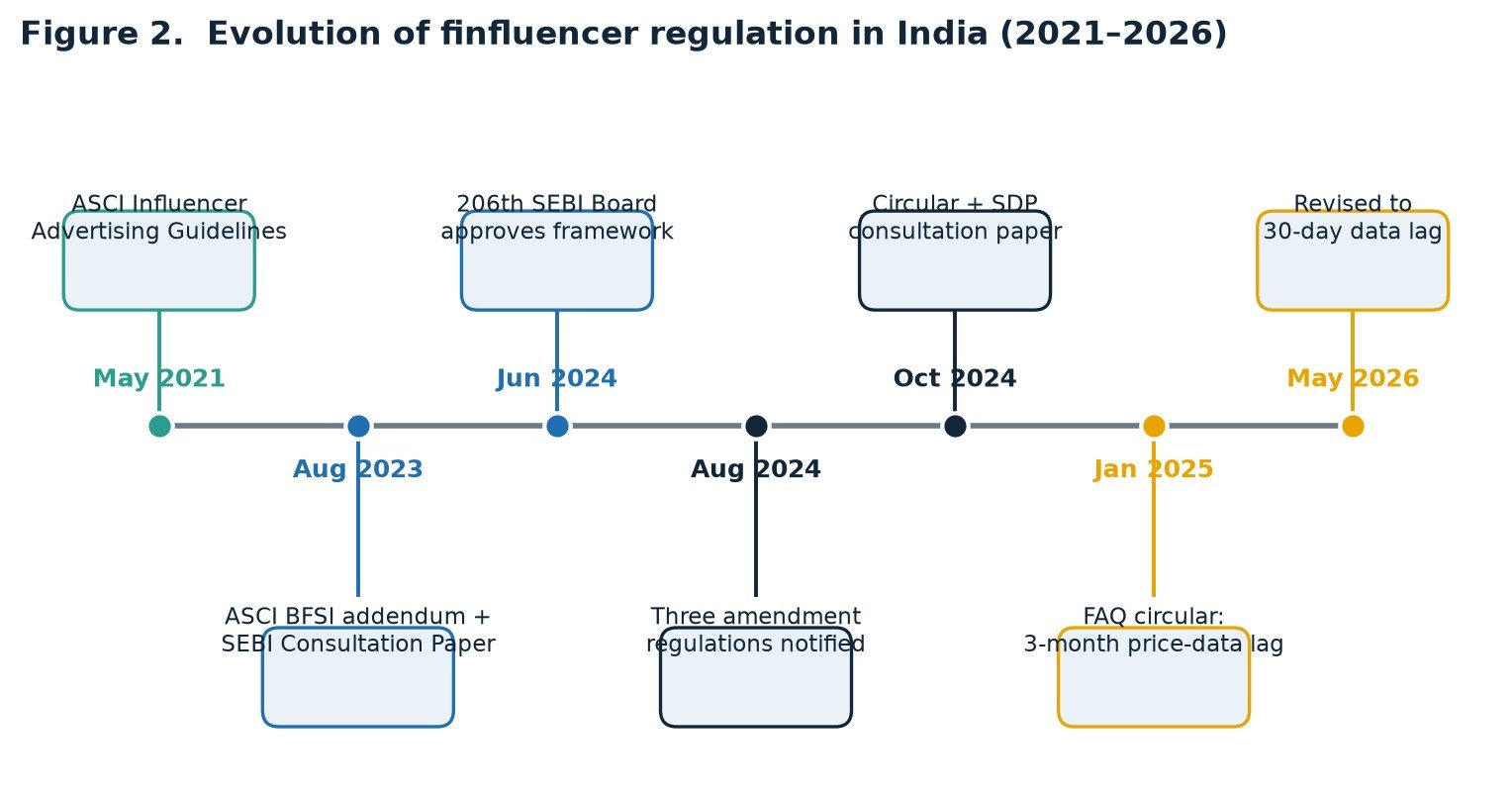
Figure
(Source: Authors’ construction from SEBI and ASCI sources)
Figure 3. The regulatory timeline, 2021–2026
F. August 2023: the consultation paper
On 25 August 2023 SEBI published its Consultation Paper on Association of SEBI Registered Intermediaries/Regulated Entities with Unregistered Entities (including Finfluencers). Significantly, SEBI did not propose to license finfluencers directly. It proposed instead to disrupt the revenue model of unregistered finfluencers by limiting the ways in which SEBI-regulated entities, such as brokers, investment advisers, research analysts and mutual funds, could collaborate with them. Registered finfluencers would in addition have to disclose their registration number, contact details and grievance-redressal information, while unregistered entities would be barred from access to client data.25
G. June 2024: Board approval
The SEBI Board approved this framework at its 206th meeting on 27 June 2024. Under the approved rule, regulated entities and their agents may not maintain financial, referral or technological links with any person who offers securities-related advice or makes claims about returns, unless that person is registered with or otherwise permitted by SEBI. The Board also carved out investor education and association through specified digital platforms carrying adequate preventive and curative controls.26
H. August 2024: the amendment regulations
The framework acquired legal force through three instruments published in the Gazette on 29 August 2024: the SEBI (Intermediaries) (Amendment) Regulations 2024, the Securities Contracts (Regulation) (Stock Exchanges and Clearing Corporations) (Fourth Amendment) Regulations 2024 and the SEBI (Depositories and Participants) (Second Amendment) Regulations 2024. Together they formalised the bar on association between regulated entities and unregistered persons engaged in regulated activities such as advice or return claims.27 A follow-on circular required non-compliant contractual arrangements to be terminated by 21 January 2025.28
I. October 2024: specified digital platforms
Recognising that a blanket bar might sweep in legitimate collaboration, SEBI released a consultation paper on 22 October 2024 proposing the recognition of Specified Digital Platforms, that is, platforms that implement preventive and curative mechanisms such as verification, takedown and monitoring, so that regulated entities may associate with creators through them without breaching the rules.29 The specified digital platform concept is the enabling layer of the regime: rather than simply prohibiting activity, it channels that activity onto accountable rails.
J. January 2025 and 2026: the education and advice bright line
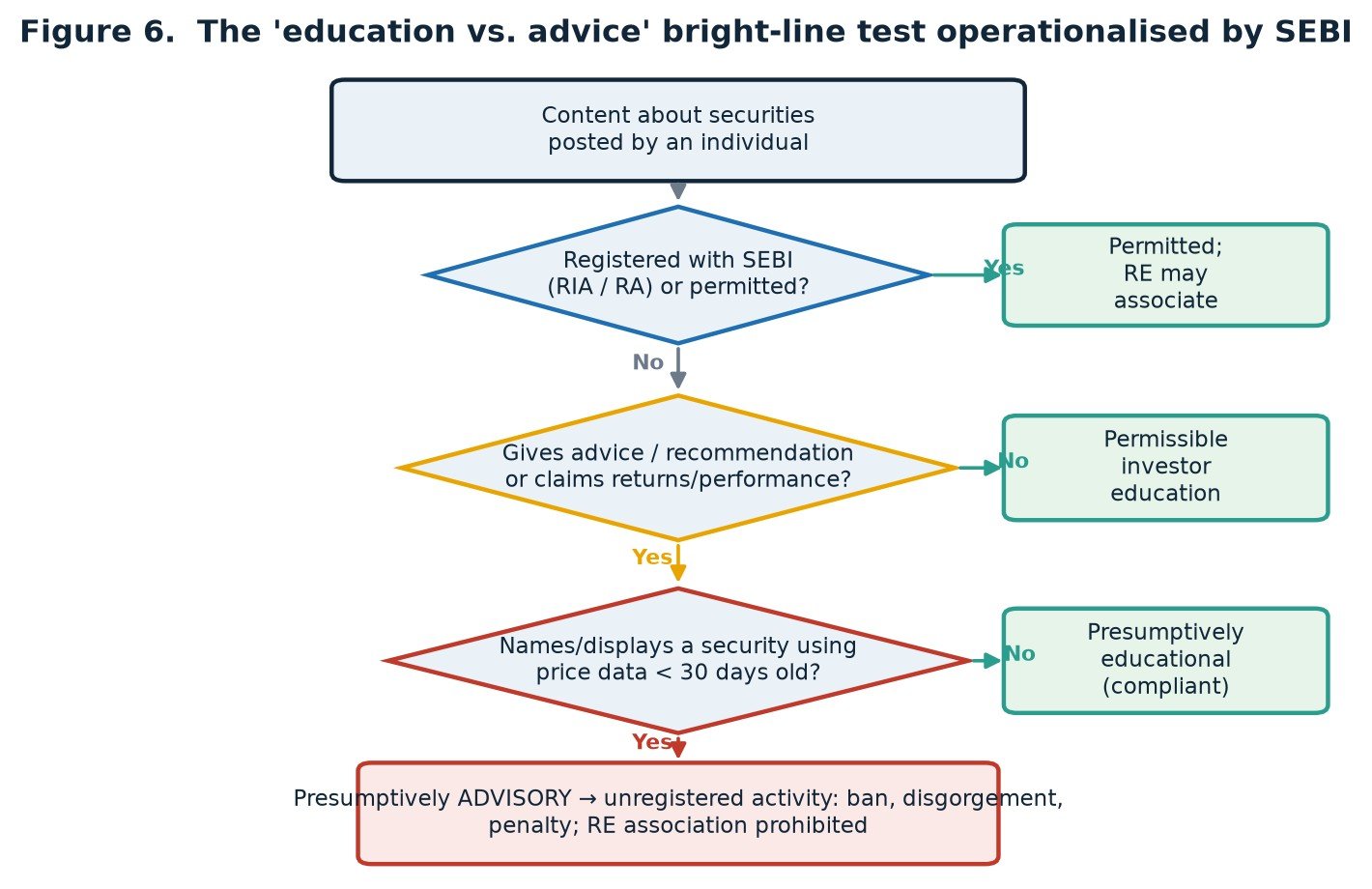
The most difficult conceptual problem was distinguishing genuine education from advice dressed up as education. SEBI’s circular of 29 January 2025 (No. SEBI/HO/MIRSD/MIRSD-PoD-1/P/CIR/2025/11) developed a content-level test under which a person “solely engaged in education” must not offer advice or recommendations, must not make claims about returns or performance, and must not use market price data of the preceding three months to name or display any security in a manner that indicates a future price, advice or recommendation.30 Responding to stakeholder feedback that a one-day sharing lag was too short while three months was too long for legitimate teaching, SEBI moved to a uniform 30-day threshold in 2026 for both the sharing and the educational use of price data, retaining only a one-day lag for the NISM simulation laboratory.31 This bright line is operationalised as a decision test in Figure 6 below.
K. Landmark enforcement matters that shaped the rules
SEBI’s rule-making was not abstract. It was driven by a string of high-profile orders with recurring facts: large sums collected from retail investors, unregistered advice sold as “education”, and inflated claims about returns. The flagship matters are set out in Table 2, and the case studies that follow draw out the harm patterns. The increasing financial scale is depicted in Figure 4.
Table 2. Flagship SEBI enforcement actions against finfluencers, 2023–2025.
| Case / entity | Order (year) | Core allegation | Key financial outcome | Provisions |
|---|---|---|---|---|
| P.R. Sundar, Mangayarkarasi Sundar & Mansun Consultancy | Settlement, May 2023 | Advisory services (Telegram calls) without RIA registration | ₹6.55 cr settlement (incl. ₹6.08 cr disgorgement); 1-yr market ban | IA Regs 2013 |
| Ravindra Balu Bharti & Ravindra Bharti Education Institute Pvt Ltd | Interim/Fina l, 2024 | Unregistered advice via YouTube (1.9M+ subs); returns of 25-1000% promised | Disgorge ₹9.49 cr + 6% interest; ₹20 lakh penalties; ban till Apr 2025 | IA Regs; PFUTP; SEBI Act |
| ‘Baap of Chart’-Mohammad Nasiruddin Ansari & 6 others (GSVPL) | Interim Oct 2023; Final Dec 2024 | ‘Educational’ courses inducing trades; ₹17.2 cr collected; assured-return claims | Refund ₹17.2 cr; ₹32 lakh penalties; ₹18+ cr recovery in 2025 | IA Regs; PFUTP; SEBI Act 12A |
| Asmita Patel (‘SheWolf’), Jitesh Patel & APGSTPL + 3 | Interim, Feb 2025 | Advisory/RA activity as ‘MPAT’ courses; false portfolio & return claims | ₹53.67 cr impounded; ₹104.6 cr fees under review; market ban | IA Regs; RA Regs; PFUTP |
(Source: Authors’ compilation from the SEBI orders cited in this section)
i. P.R. Sundar (2023): the settlement that signalled intent
The settlement reached in May 2023 with the options-trading personality P.R. Sundar, his wife Mangayarkarasi Sundar and their company Mansun Consultancy Pvt Ltd was an important turning point. SEBI’s examination alleged that Sundar had used his website to offer “advisory services, daily calls on Telegram” and had collected fees of about ₹4.36 crore through a payment gateway, together with a further ₹23.53 lakh credited directly, without registering as an investment adviser. The applicants settled the proceedings without admitting or denying the findings of fact and conclusions of law: they accepted a one-year restraint from dealing in securities and paid roughly ₹6.55 crore in all, comprising disgorgement of ₹6,07,69,863, being the fees collected together with interest at 12 per cent a year, and settlement charges of ₹15.6 lakh from each of the three applicants.32 Coming months before the consultation paper, the matter signalled that a sizeable following could not convert unregistered advice into a lawful activity, and that the fee itself was the object of restitution.
ii. Ravindra Bharti (2024): “education” as a façade
SEBI’s orders against Ravindra Balu Bharti and Ravindra Bharti Education Institute Pvt Ltd brought the education-façade model into public view. The institute had been in business since 2016, and Bharti ran two YouTube channels with more than 1.9 million subscribers between them. SEBI found that the group handled client trades, made security-specific recommendations and held out return projections ranging from 25 per cent to 1,000 per cent. Following an ex parte interim order of 5 April 2024, the order of December 2024 directed disgorgement of ₹9,49,24,122 with simple interest at 6 per cent a year, imposed penalties totalling ₹20 lakh, of which ₹15 lakh was payable jointly and severally by all five entities and a further ₹5 lakh by three of them, and barred the group from the securities market until 4 April 2025. The order records that the institute collected about ₹12.03 crore from 290 investors between March 2020 and August 2023.33 Its significance lies in treating “financial education” as a question of substance rather than label: the boundary is crossed when instruction turns into actionable, security-specific guidance.
iii. “Baap of Chart” (2024): the template case
The case against Mohammad Nasiruddin Ansari, who styled himself the “Baap of Chart”, and six associates including Golden Syndicate Ventures Pvt Ltd, served as a template. SEBI issued an interim order cum show cause notice on 25 October 2023, invoking Section 12(1) of the SEBI Act read with Regulation 3(1) of the Investment Advisers Regulations and alleging unregistered investment advice. The final order of December 2024 held the group liable for ₹17.2 crore collected through courses that induced students to trade on assured-return promises, including claims of 200 to 300 per cent on Bank Nifty and of 95 per cent accuracy, even though Ansari had himself recorded a net trading loss of about ₹2.89 crore between 1 January 2021 and 7 July 2023. SEBI directed a full refund through an escrow account within three months, restrained Ansari from the securities market for one year and the six other entities for six months, and imposed penalties totalling about ₹32 lakh, of which ₹20 lakh was on Ansari and ₹2 lakh on each of the six other entities.34 In 2025 SEBI began recovery proceedings for more than ₹18 crore for non-compliance, attaching bank, demat and mutual fund holdings.35 The facts read like a checklist of the harm framework set out in Figure 2.
iv. Asmita Patel (2025): the post-rules stress test
The first major matter to surface after the January 2025 circular and the new regulations was the ex parte interim order cum show cause notice of 6 February 2025 against Asmita Patel, who described herself as the “She-Wolf of the stock market” and the “Options Queen”, her husband Jitesh Jethalal Patel, their Asmita Patel Global School of Trading Pvt Ltd and other entities. SEBI’s prima facie view was that programmes such as “Master’s in Price Action Trading”, “Options Multiplier” and “Let’s Make India Trade” carried buy and sell recommendations through Telegram, and so amounted to unregistered investment advisory and research analyst activity presented as instruction. The order impounded ₹53.67 crore of allegedly unlawful gains and called on the noticees to show cause why a further ₹104.63 crore of course fees should not also be impounded. SEBI further recorded that, against a claim to manage assets of about ₹140 crore, the trading records disclosed gains of only about ₹12.28 lakh.36 These are prima facie findings in an interim order and the proceedings remain pending; the appellants have contested SEBI’s refusal to disclose investigation material before the Securities Appellate Tribunal, which by its order of 9 January 2026 directed limited disclosure of complainants’ details while declining wider production and cross-examination at that stage.37 Subject to that caveat, the bright-line test gave SEBI a clearer basis on which to identify “education” that had crossed into advice, and the order tested the design of the new regime.
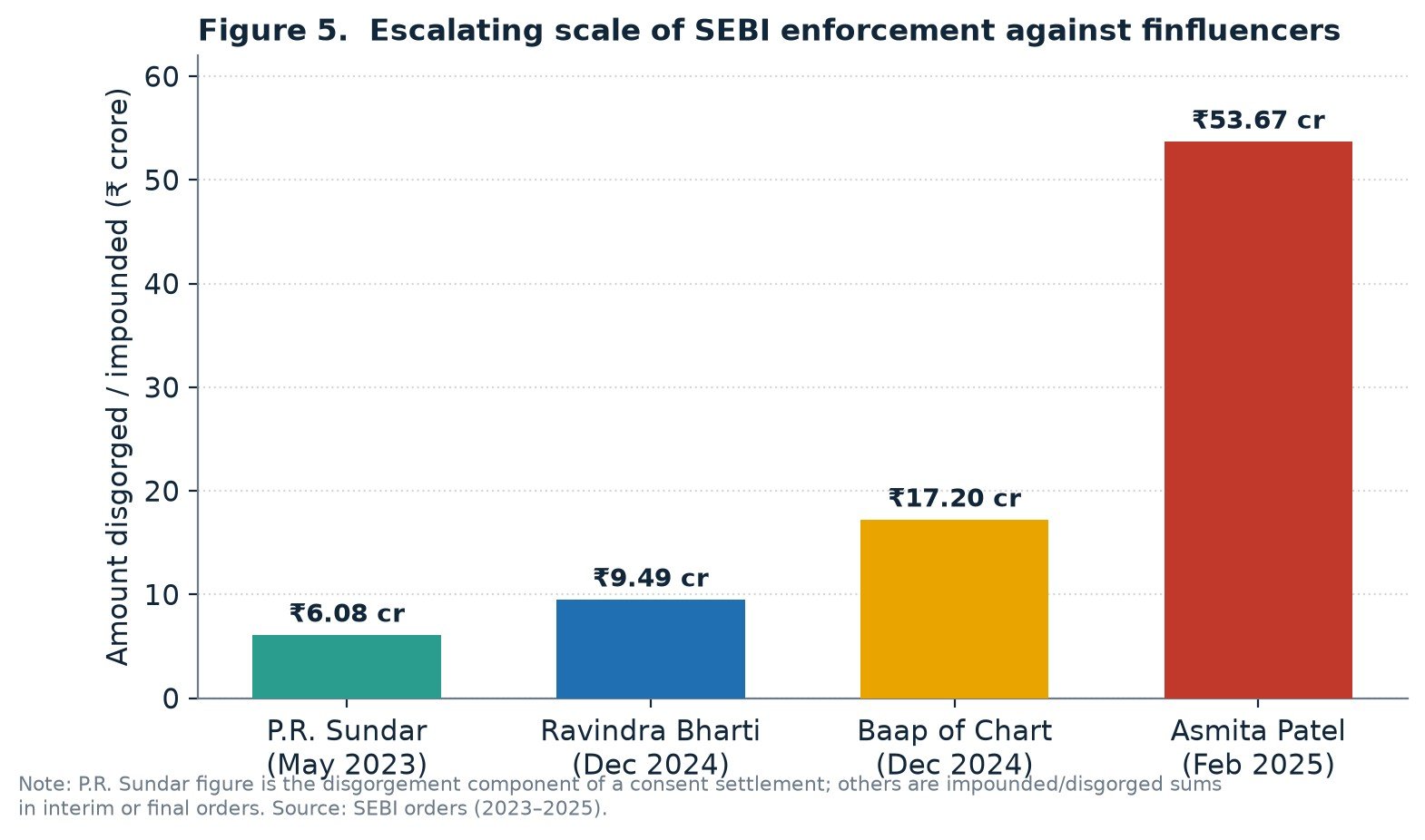
Figure
(Source: Authors’ construction from SEBI orders)
Figure 4. Escalating scale of disgorged and impounded sums across flagship cases
These matters demonstrate a learning loop. Sundar showed that fees taken for unregistered advice are liable to be given up regardless of audience size; Bharti and “Baap of Chart” established that the label “education” is not a shield; and Patel tested the rules that had just been made.
L. An analytical model of SEBI’s regulatory strategy
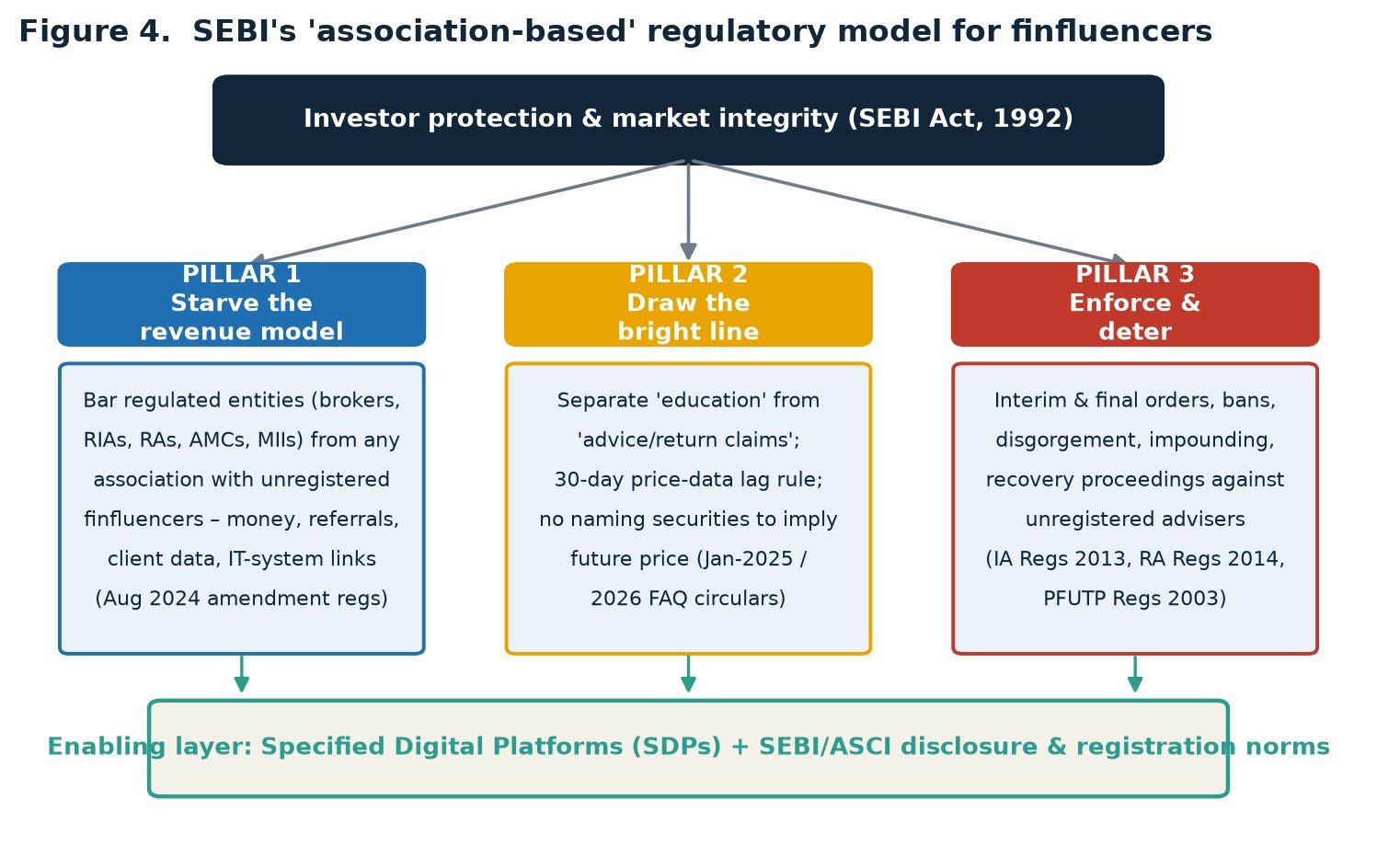
The instruments described above are best viewed as a single “association-based” model resting on three pillars beneath one statutory objective and supported by an enabling layer (Figure 5).
Figure
(Source: Authors’ construction, based on the regulatory analysis above)
Figure 5. The three-pillar ‘association-based’ model
• Pillar 1, starve the revenue model: cut off client-data flows, money, referrals and IT system connections between unregistered finfluencers and regulated entities, as the August 2024 amendments do. If the regulated ecosystem cannot pay or feed creators, the incentive for unethical conduct falls.
• Pillar 2, draw the bright line: use the price-data-lag rule in the January 2025 and 2026 circulars to establish a testable distinction between education on the one hand and advice or return claims on the other. This gives both SEBI and creators a workable perimeter.
• Pillar 3, enforce and deter: build credible deterrence by pursuing interim and final orders, restraints, disgorgement, impounding and recovery against the worst unregistered actors under the Investment Advisers, Research Analysts and PFUTP regimes.
The enabling layer, comprising Specified Digital Platforms together with SEBI and ASCI disclosure and registration standards, keeps the model from becoming purely prohibitive by providing an accountable channel for legitimate collaboration. The model’s ingenuity, and equally its drawback, is that it regulates finfluencers indirectly, relying on SEBI’s unquestioned jurisdiction over registered entities and market conduct instead of asserting a doubtful jurisdiction over speech.
M. Operationalising the bright line
Figure 6 presents the distinction between education and advice as a decision test that reflects the way SEBI now defines content. Giving advice, making claims about returns, or naming a security using price data less than 30 days old in a manner that indicates a future price will ordinarily turn “education” into regulated, and if unregistered unlawful, advisory activity. Without registration or SEBI permission, a creator must stay inside the perimeter.
Figure
(Source: Authors’ construction from SEBI circulars)
Figure 6. The education-versus-advice bright-line test
Findings
The rule-making record, the enforcement record and the analytical model set out above answer the three research questions posed at the outset.
A. RQ1: how SEBI’s regulatory reforms on finfluencers evolved (2013–2026)
Before 2023, finfluencers were regulated only indirectly, through the Investment Advisers Regulations 2013, the Research Analysts Regulations 2014 and the PFUTP Regulations 2003, supplemented from 2021 by ASCI’s self-regulatory disclosure codes.38 From August 2023 SEBI moved from this patchwork to a systematic, cumulative programme of rule-making: a consultation paper proposing to restrict association between regulated entities and finfluencers; Board approval of that framework in June 2024; three amendment regulations giving it legal force in August 2024; a consultation on Specified Digital Platforms in October 2024 that reopened a compliant channel for lawful cooperation; and, finally, the education and advice bright line, first set at a three-month price-data lag in January 2025 and narrowed to 30 days in 2026.39 The conclusion is that this evolution was not a single reform but a tight, self-correcting sequence in which each instrument filled a gap left by the last.
B. RQ2: which enforcement matters shaped that evolution, and what harm patterns they revealed
The empirical foundation of the rules came from four flagship matters (Table 2 and Figure 4). Sundar (2023) showed that fees collected for unregistered advice are themselves liable to be given up, regardless of the size of the following behind them.40 Ravindra Bharti and “Baap of Chart”, both decided in 2024, showed that labelling unregistered advice as “education” is no shield, and that recovering disgorged sums may require lengthy, multi-asset enforcement long after the original order.41 Asmita Patel (2025), the first significant matter taken up after the new rules came into force, tested the bright-line test as a practical basis for distinguishing instruction from advice in real conditions, although the proceedings remain pending.42 The recurrence across all four matters of the same harm channels, namely undisclosed conflicts, false claims about returns, advice presented as education, and the exploitation of a low-literacy, herd-prone retail base, confirms the harm framework set out in Figure 2.
C. RQ3: the underlying model explaining SEBI’s chosen instruments
The three-pillar, association-based model developed above provides the best explanation for the instruments described: starving the revenue model by cutting off funds, referrals and data flows between regulated entities and unregistered finfluencers; drawing a clear line that operationalises the distinction between education and advice through the price-data-lag rule; and enforcing and deterring through escalating orders, restraints and disgorgement. The Specified Digital Platforms framework serves as an enabling layer that keeps the model from becoming purely prohibitive. The central conclusion is one of design choice: instead of licensing speech directly, SEBI pursues its investor-protection objective indirectly, by regulating the conduct of advice and the relationship between creators and registered intermediaries. That choice is administratively lighter, but it leaves gaps at the edges of SEBI’s jurisdiction, as the critical analysis below shows.
Comparative Perspective
India’s approach forms part of a global regulatory wave, but its architecture is distinctive. The CFA Institute’s multi-market study documents rising concern across the United Kingdom, the United States and the European Union, and finds that finfluencer content frequently lacks adequate disclosure and rarely sits within a clear regulatory frame.43
Table 3. Comparative snapshot of finfluencer regulation (indicative).
| Jurisdiction | Primary approach | Distinctive feature |
|---|---|---|
| India (SEBI) | Indirect: restrict RE-finfluencer association; enforce IA/RA/PFUTP | Education/advice bright line + price-data lag; SDP enabling layer |
| United Kingdom (FCA) | Financial-promotions regime + Consumer Duty; criminal exposure for unauthorised promotions | Treats many finfluencer posts as regulated ‘financial promotions’ |
| United States (SEC/FINRA) | Anti-touting (§17(b)); disclosure of paid promotion; adviser registration | High-profile celebrity promotion settlements (e.g., crypto) |
| EU | MiFID II + Market Abuse Regulation; ESMA investor warnings | Investment-recommendation disclosure rules apply to online posts |
| Australia (ASIC) | Guidance that unlicensed finfluencer advice breaches the law | Explicit INFO-sheet warning creators and licensees |
(Source: Authors’ synthesis, based on the CFA Institute study and publicly available regulatory guidance from the FCA, the SEC and FINRA, ESMA and ASIC.44 Indicative comparison, not an exhaustive survey)
The comparison draws attention to a design decision. Where the United Kingdom and the European Union prefer to characterise the content as a regulated promotion or recommendation, India prefers to characterise the relationship between creators and regulated entities. India’s model is easier to enforce administratively against the regulated perimeter, but it relies largely on after-the-fact enforcement to reach purely unregistered, self-funded creators.
Critical Analysis: Gaps, Tensions and Unintended Effects
A. Jurisdiction over speech and platforms
Because SEBI regulates indirectly, a determined unregistered creator with no ties to regulated entities and with offshore hosting can carry on until an order lands. Platform cooperation, in the form of takedowns and verification, engages the intermediaries and the Information Technology Act ecosystem, which is essential but falls outside SEBI’s direct remit. The Specified Digital Platforms framework is promising, but its effectiveness depends on real-time preventive controls that are difficult to scale.45
B. Free expression versus investor protection
The price-data-lag rule is a crude proxy. A 30-day lag can obstruct timely and legitimate financial education and commentary, while a sophisticated bad actor may still communicate through code names or private channels. How to calibrate the bright line so as to limit manipulation without stifling genuine literacy content remains a matter of debate.46
C. Enforcement realities and recovery
Passing orders is easier than collecting on them. Disgorgement often requires lengthy recovery proceedings during which investor restitution remains uncertain, as the “Baap of Chart” matter shows: SEBI moved from a refund direction to attaching bank, demat and mutual fund assets, and escalated recovery beyond ₹18 crore.47
D. The literature gap
Academic work remains at an early stage and largely at the macro level. Systematic reviews report relatively little rigorous, India-specific research either on how short-form content alters risk perception psychologically or on the causal relationship between exposure to finfluencers and realised losses; research concentrates instead on financial literacy, credibility and legal questions.48 This is a live opportunity for empirical work using platform and brokerage data.
Conclusion
The development of India’s finfluencer rules is an example of practical, iterative rule-making. Faced with a new and viral form of unregulated intermediation riding a historic retail boom, SEBI chose not to license speech but to regulate the commercial relationships around it and the boundary between education and advice, supported by escalating enforcement. Each step, from the 2023 consultation paper through the 2024 amendment regulations, the Specified Digital Platforms framework and the 2025 and 2026 bright-line circulars, filled a void left by the step before. The matters involving P.R. Sundar, Ravindra Bharti, “Baap of Chart” and Asmita Patel were not merely instances of enforcement; they were the empirical foundation of the rules. The resulting three-pillar, association-based model is sophisticated and manageable, but it is incomplete: questions remain about its ability to reach actors who are purely unregistered and offshore, about how to balance literacy against manipulation, and about how reliable restitution really is. The credibility of the specified digital platform layer, the speed and certainty of enforcement, and the financial literacy of the tens of crores of investors the regime is meant to safeguard will together shape how the next phase of India’s finfluencer regime is judged.
Recommendations
• Make the enabling layer real by operationalising specified digital platform recognition through public reporting and measurable preventive and curative performance indicators, such as verification coverage and median takedown time.
• Strengthen registration signalling by publishing a real-time, searchable register and a simple in-app “verify this creator” check, so that investors can confirm registration before acting.
• Close the recovery gap by streamlining investor-restitution procedures and giving priority to prompt asset freezing and escrow at the interim-order stage, so that recovery is not the weak point.
• Invest in demand-side literacy by pairing the bright-line rules with sustained, platform-native investor education campaigns that inoculate audiences against return-claim heuristics.
• Coordinate across regulators by formalising cooperation between SEBI, ASCI and MeitY and by sharing information across borders, so that offshore-hosted actors are not unreachable in practice.
• Fund independent research by commissioning longitudinal studies that connect exposure to influencers with trading behaviour and outcomes, so that policy can move from the anecdotal to the evidential.
Limitations of the Study
The paper’s conclusions should be read in the light of three limitations.
• Reliance on secondary and public-record sources: the analysis rests on published SEBI instruments, orders and secondary commentary rather than on interviews with SEBI officials, regulated intermediaries or affected investors, and so it cannot address internal regulatory deliberation or unpublished enforcement activity.
• Purposive rather than exhaustive case selection: the four enforcement matters discussed above were selected for their illustrative and precedent-setting value. SEBI has pursued other, smaller finfluencer actions that are not examined here, and the harm patterns identified may not capture the full diversity of enforcement outcomes.
• A moving regulatory target: the findings on the most recent instruments, in particular the 30-day lag revision, rest on a shorter observation window and less enforcement history than the 2023 and 2024 measures, so their practical efficacy could not yet be assessed at the time of writing.
These limitations do not affect the paper’s principal contributions, namely the chronological account and the three-pillar analytical model. As the recommendations above note, however, claims about the effectiveness of enforcement and about investor outcomes should be treated as provisional until further empirical research is done.
*****
Footnotes
1. CFA Institute, The Finfluencer Appeal: Investing in the Age of Social Media (2024); CFA Institute & YouGov India, Clicks and Credibility: Understanding Finfluencers’ Role in Investment Decisions (2025). The survey reported that 82 per cent of investors exposed to social-media finance content acted on it, while only about 2 per cent of the finfluencers studied were registered with SEBI and about 63 per cent did not disclose sponsorships.
2. A. Borde, S. Borgave & P. Chugh, Finfluencers: Exploring the Rise, Risk and Regulations, vol. 13, at 110 (2024).
3. E. Henriques, R. Paes & V. Colaco, The Rise of Finfluencers in India: Evaluating Their Impact, Regulatory Response and Pathways for Advancement, 15 Indian Journal of Information Sources and Services 210 (2025).
4. A. Alam & N. Yusuf, The Impact of Financial Influencers (Finfluencers) on Retail Investment Behaviour in India, vol. 3, at 46 (2026).
5. D. Pande, Role of Finfluencers: Impact on Investment Choices and the Necessity for Regulation, 29 Academy of Marketing Studies Journal (Special Issue 5) (2025), presented at the 5th Annual International Research Conference on Securities Market 2024–25.
6. A. Warkar & T. Durai, Behavioural Biases in Gen Z’s Investment Decisions: Influence of Finfluencer Narratives, 27 IOSR Journal of Business and Management 37 (2025).
7. S. Rahayu & W. Ekawanti, The Influence of Finfluencer Credibility on the Quality of Individual Investors’ Investment Decisions: The Role of Information Overload Mediation and Financial Literacy Moderation, 4 Journal of Economics, Entrepreneurship, Management Business and Accounting 174 (2026).
8. R. Bhatia, A. Sethi & V. Panjwani, Role of Finfluencer Advice Across Behavioural Clusters in Shaping Sustainable Finance, 7 Discover Sustainability (2026).
9. V.C. Vu, B. Keating & S. Wang, #Finfluencers: Understanding the Role of Parasocial Relationships and Psychological Need Support, Australasian Conference on Information Systems (2025).
10. M. Akın, “Double Tap to Invest!”: How Finfluencers Shape Gen Z Users’ Behavioural Intentions on Instagram, 27 Cumhuriyet Üniversitesi İktisadi ve İdari Bilimler Dergisi 238 (2026).
11. M. Mölders, L. Bock, E. Barrantes & H. Zülch, Understanding Finfluencers: Roles and Strategic Partnerships in Retail Investor Engagement, 198 Journal of Business Research (2025).
12. H. Zülch, M. Mölders & C.P. Hoffmann, Navigating the Rise of Finfluencers: A Multidimensional Quality Framework for Strategic Partnerships, 31 Journal of Financial Services Marketing (2026).
13. Bhatia, Sethi & Panjwani, supra note 8; Zülch, Mölders & Hoffmann, supra note 12.
14. V.K. Badal & D. Sehgal, A Systematic Literature Review: The Impact of Finfluencers on Retail Investors and Risk Perception (Zenodo, 2026).
15. T. Chatterjee, Finfluencers, Social Media and Market Integrity in India (Zenodo, 2026).
16. SEBI (Prohibition of Fraudulent and Unfair Trade Practices Relating to Securities Market) Regulations, 2003; SEBI (Investment Advisers) Regulations, 2013; SEBI (Research Analysts) Regulations, 2014; ASCI, Guidelines for Influencer Advertising in Digital Media (May 2021, updated for the banking, financial services and insurance sector in Aug. 2023 and by Addendum 2 dated 7 Apr. 2025).
17. IBEF, Rise of Retail Investors and Domestic Funds Driving Growth in India (2024); reports on depository data in Business Standard and Financial Express (2024–2025). Depository figures show about 11.45 crore accounts at the end of FY 2022–23, about 15.14 crore at the end of FY 2023–24, an addition of roughly 3.69 crore in a single year, and about 18.53 crore at the end of calendar 2024.
18. The Finfluencer Phenomenon: Decoding Investment Behaviours of India’s Gen-Z and Millennial Retail Investors, 7 International Journal of Research Publication and Reviews (2026).
19. SEBI, Press Release, Updated SEBI Study Reveals 93% of Individual Traders Incurred Losses in Equity F&O between FY22 and FY24 (24 Sept. 2024). Aggregate losses over the three years exceeded ₹1.8 lakh crore.
20. SEBI (Investment Advisers) Regulations, 2013, supra note 16, reg. 3(1) (registration requirement); SEBI Act, 1992, s. 12(1). “Investment advice” is defined broadly in reg. 2(1) of those Regulations.
21. SEBI (Research Analysts) Regulations, 2014, supra note 16.
22. SEBI (Prohibition of Fraudulent and Unfair Trade Practices Relating to Securities Market) Regulations, 2003, supra note 16, regs. 3 and 4.
23. SEBI, Consultation Paper on Association of SEBI Registered Intermediaries/Regulated Entities with Unregistered Entities (Including Finfluencers) (25 Aug. 2023), which records the practice of finfluencers taking a registration number on rent from registered investment advisers; Cyril Amarchand Mangaldas, End of the Party for Sin (Fin) Fluencers? SEBI’s Regulatory Crackdown on Finfluencers, India Corporate Law (Sept. 2023).
24. ASCI, Guidelines for Influencer Advertising in Digital Media, supra note 16. The August 2023 update requires influencers giving advice on securities to be registered with SEBI and to state their name, registration number and qualifications; Addendum 2, dated 7 April 2025, tightened the qualification-disclosure requirements for health and finance creators.
25. Consultation Paper, supra note 23; Chandhiok & Mahajan, C&M E-Alert: SEBI Approves Guidelines for Regulating Association with Finfluencers (2024).
26. SEBI, Press Release No. PR 12/2024, SEBI Board Meeting (27 June 2024) (206th meeting of the Board); Conventus Law, India: From Likes to Licences: Regulating Finfluencers Amidst Stricter Norms (2024).
27. SEBI (Intermediaries) (Amendment) Regulations, 2024; Securities Contracts (Regulation) (Stock Exchanges and Clearing Corporations) (Fourth Amendment) Regulations, 2024; SEBI (Depositories and Participants) (Second Amendment) Regulations, 2024, published in the Official Gazette on 29 Aug. 2024. The first inserted reg. 16A into the SEBI (Intermediaries) Regulations, 2008, barring a person regulated by the Board, or its agent, from any direct or indirect association with a person who gives advice or recommendations on securities without being registered or otherwise permitted by the Board, or who makes claims of returns or performance without such permission.
28. SEBI, Association of Persons Regulated by the Board and Their Agents with Certain Persons (Circular, 22 Oct. 2024), requiring existing contracts with persons engaged in the prohibited activities to be terminated within three months of issue, that is, by 21 Jan. 2025.
29. SEBI, Consultation Paper on Recognition as Specified Digital Platform (22 Oct. 2024), comment period later extended to 26 Nov. 2024; Lexology, Specified Digital Platforms: SEBI’s New Playbook for Finfluencers (Nov. 2024).
30. SEBI, Circular No. SEBI/HO/MIRSD/MIRSD-PoD-1/P/CIR/2025/11, Details/Clarifications on Provisions Related to Association of Persons Regulated by the Board, MIIs and Their Agents with Persons Engaged in Prohibited Activities (29 Jan. 2025).
31. SEBI, Norms for Sharing and Usage of Price Data for Educational Purposes (Circular, 8 May 2026), effective 1 July 2026, prescribing a uniform 30-day lag for both the sharing and the usage of price data for educational purposes and retaining a one-day lag only for the simulation laboratory of the National Institute of Securities Markets.
32. SEBI, Settlement Order in Respect of Mansun Consultancy Private Limited, Mr P.R. Sundar and Ms Mangayarkarasi Sundar (25 May 2023). Being a settlement order, it contains no adjudicated finding of violation; the applicants settled without admitting or denying the findings of fact and conclusions of law.
33. SEBI, Order in the Matter of Ravindra Bharti Education Institute Private Limited (ex parte interim order, 5 Apr. 2024); SEBI, Order in the Matter of Ravindra Bharti Education Institute Private Limited (Dec. 2024); RegStreet Law Advisors, 24 Notable Securities and Exchange Board of India Orders in 2024 (2025).
34. SEBI, Interim Order cum Show Cause Notice in the Matter of Unregistered Investment Advisory Activities of Mohammad Nasiruddin Ansari/Baap of Chart (25 Oct. 2023); SEBI, Final Order No. WTM/AS/MIRSD/MIRSD-SEC-6/31009/2024-25, In the Matter of Mohammad Nasiruddin Ansari (“Baap of Chart”) and Others (Dec. 2024).
35. Reports on SEBI’s recovery proceedings in the “Baap of Chart” matter in The Economic Times, Moneylife and Fortune India (2024–2025); the recovery notices issued in 2025 sought about ₹18.14 crore from Ansari, Rahul Rao Padamati and Golden Syndicate Ventures Pvt Ltd.
36. SEBI, Interim Order cum Show Cause Notice in the Matter of Asmita Patel Global School of Trading Private Limited and Others (6 Feb. 2025). The order records prima facie findings only; show cause notices were issued on 7 Feb. 2025 and the matter had not been finally adjudicated at the time of writing.
37. Asmita Patel Global School of Trading Pvt Ltd v. Securities and Exchange Board of India, Appeal No. 465 of 2025 (Securities Appellate Tribunal, order dated 9 Jan. 2026) (directing disclosure of complainants’ identities and related correspondence, while declining wider production of internal file notings and holding a request for cross-examination premature).
38. PFUTP Regulations, 2003, Investment Advisers Regulations, 2013 and Research Analysts Regulations, 2014, supra note 16; ASCI Guidelines, supra note 24.
39. Consultation Paper, supra note 23; SEBI Board press release, supra note 26; amendment regulations, supra note 27; Specified Digital Platform consultation paper, supra note 29; Circular of 29 Jan. 2025, supra note 30; Circular of 8 May 2026, supra note 31.
40. Settlement Order, supra note 32.
41. Ravindra Bharti orders, supra note 33; “Baap of Chart” orders, supra note 34; recovery reports, supra note 35.
42. Asmita Patel interim order, supra note 36; SAT order, supra note 37.
43. CFA Institute, supra note 1.
44. Indicative comparison drawn from the financial promotions regime and Consumer Duty administered by the FCA (United Kingdom), the anti-touting rules administered by the SEC and FINRA (United States), ESMA investor warnings (European Union) and ASIC, Discussing Financial Products and Services Online (INFO 269) (Australia).
45. Specified Digital Platform consultation paper, supra note 29.
46. Circular of 8 May 2026, supra note 31; The Digital Age of Investor Protection: Assessing the Measures by SEBI on Misleading Financial Advice, Indian Journal of Legal Review (2026).
47. “Baap of Chart” orders, supra note 34; recovery reports, supra note 35.
48. Badal & Sehgal, supra note 14; Chatterjee, supra note 15; The Finfluencer Phenomenon, supra note 18.