

Introduction: the cartographic imperative
The democratic legitimacy of a republican state rests upon the mathematical precision of its representative framework. In the Indian context, this equilibrium is maintained by the periodic redrawing of electoral boundaries, a process known as delimitation, to ensure that each Member of Parliament represents a roughly equivalent number of citizens. However, since 1976, India has operated under a unique constitutional suspension of this principle. The April 2026 introduction and immediate failure of the Delimitation Bill brought this deferred question before Parliament. This analysis addresses the trigger mechanism embedded in Articles 82 and 170 of the Constitution, which requires that the allocation of seats and the territorial division of constituencies be re-evaluated after the first census published after the year 2026.1
The tension inherent in this exercise is not merely administrative; it is profoundly existential for the Indian federal structure. On one hand, the principle of isegoria, or equality of speech and representation, suggests that a voter in Uttar Pradesh and a voter in Tamil Nadu should possess equal weight in the Lok Sabha. On the other hand, the historical decision to freeze seat allocation was a deliberate policy tool to incentivise population control among southern states. As the 2026 horizon approaches, the divergence in total fertility rates across regions suggests that strict adherence to Article 81’s population-based proportionality would result in a substantial transfer of political capital from the South to the North.
The Delimitation Bill, 2026, must therefore navigate a landscape defined by frozen data and shifting demographics. Articles 330 and 332 further complicate recalibration because reserved seats must track the geography of Scheduled Caste and Scheduled Tribe populations. Article 329(a) restricts judicial intervention but does not impose a complete bar: constitutional courts retain a limited power to review manifestly arbitrary or constitutionally irreconcilable Commission orders. Statutory procedure, public participation, reasoned decision-making, and timing are therefore central to legitimacy.2
By way of legislative status, the Delimitation Bill, 2026 (Bill No. 108 of 2026) was introduced in the Lok Sabha on 16 April 2026 and became infructuous on 17 April 2026 after the Constitution (One Hundred and Thirty-First Amendment) Bill, 2026 was negatived. It was not enacted. This article distinguishes that verified package from the illustrative 753-seat scenario tested in the source essay.3
The genetic code of Indian delimitation: history, amendments, and the 2026 trigger
A. The constitutional framework: Articles 81, 82, and 170
The architecture of Indian representation is founded on the population-representation correlation. Article 81 of the Constitution establishes the composition of the Lok Sabha, specifying that the number of seats allotted to each state shall be fixed so that the ratio between the number of seats and the population of the state is, so far as practicable, the same for all states. This is the vertical dimension of representation. Article 82 provides the mechanism for horizontal adjustment: upon the completion of each census, the allocation of seats in the Lok Sabha to the states and the division of each state into territorial constituencies shall be readjusted by such authority and in such manner as Parliament may by law determine.4
Similarly, Article 170 governs the composition of Legislative Assemblies, mirroring the requirement for population-based proportionality. These articles are not static; they have been periodically modified by provisos that have fundamentally altered their operation. The population referred to in these articles is tied to the preceding census, but the definition of which census counts has itself been the subject of intense constitutional adjustment.
Articles 330 and 332 extend this logic to the reservation of seats. Article 330 requires that seats be reserved in the Lok Sabha for Scheduled Castes and Scheduled Tribes based on their population ratio in the state, and Article 332 does the same for state assemblies. In a future delimitation exercise, the realignment of these reserved seats becomes a secondary flashpoint, as the migration patterns of these communities may have shifted significantly since the last substantive redrawing of the map.5
B. The historical precedent: the 1952 to 1972 Commissions
In the early decades of the Republic, delimitation was a routine decadal affair. Following the 1951, 1961, and 1971 censuses, Delimitation Commissions were established under the Acts of 1952, 1962, and 1972 respectively. These Commissions were empowered to redraw boundaries and increase the total number of seats in the Lok Sabha to reflect the growing population. During this era, the Lok Sabha grew from 489 seats in 1951 to 543 seats by 1973.
The rationale was simple: as the population grew, the number of constituents per Member should remain manageable to ensure effective grievance redressal. The Commissions operated with a high degree of independence, chaired by a retired judge of the Supreme Court and including the Chief Election Commissioner. Their orders, once published in the Gazette of India, had the force of law and could not be called into question in any court, a protection codified in Article 329(a). The 1970s, however, marked the end of this routine cartographic practice.6
C. The great freeze: the 42nd and 84th Amendments
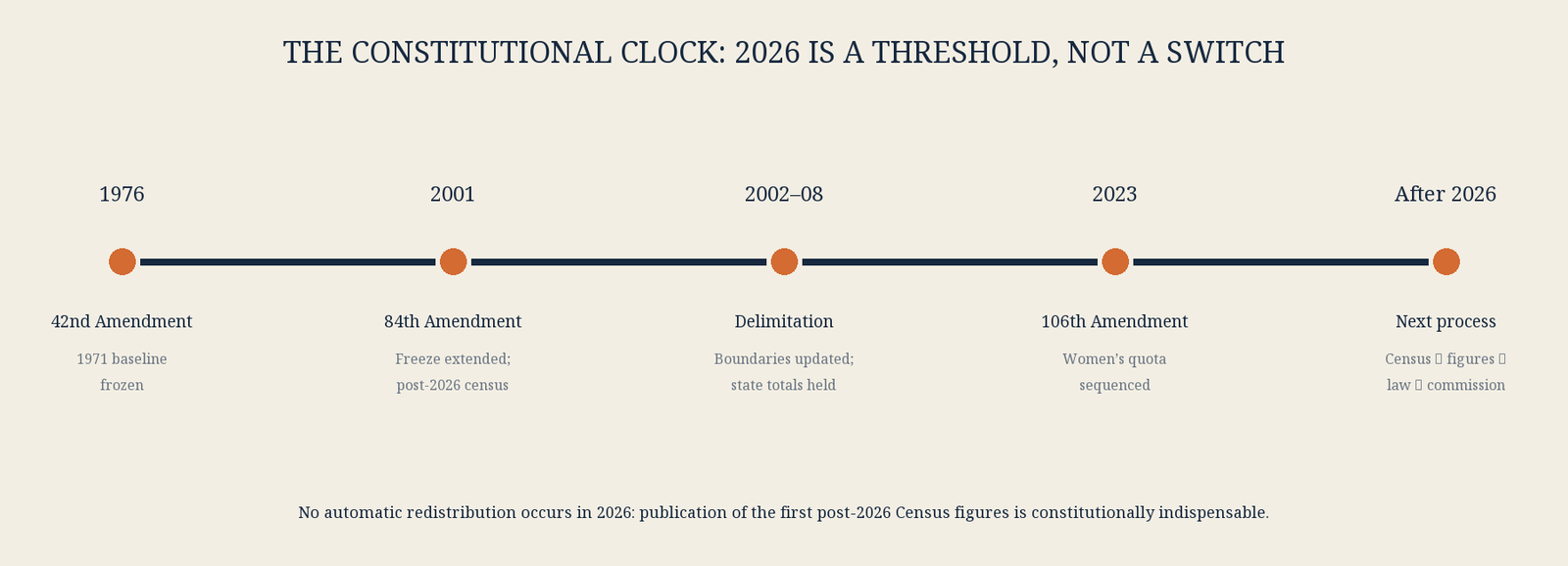
The trajectory of delimitation was interrupted by the Constitution (Forty-Second Amendment) Act, 1976. Faced with a burgeoning population and the implementation of the national population policy, the government recognised that states successful in curbing population growth, primarily in the South, would lose parliamentary influence to states with higher birth rates, primarily in the North. To prevent this penalty for performance, the 42nd Amendment inserted provisos into Articles 81 and 82, freezing the seat allocation based on the 1971 Census until the relevant figures for the first census taken after the year 2000 were published.
As the year 2000 approached, the demographic disparity had only widened. The Constitution (Eighty-Fourth Amendment) Act, 2001, extended this freeze for a further twenty-five years, specifying that the seat allocation would remain based on the 1971 Census until the first census after 2026.7 While the 84th Amendment allowed for a readjustment of territorial boundaries within states to account for intrastate population shifts (based on the 1991 Census, and later updated to the 2001 Census by the 87th Amendment in 2003), it strictly prohibited any change in the total number of seats assigned to each state.
The current electoral map of India is thus a ghost map, a twenty-first-century democracy operating on a 1971 demographic skeleton. In 1971, India’s population was roughly 548 million; today it exceeds 1.4 billion. The Eighty-Fourth Amendment created a time-lock keyed to publication of the first post-2026 Census figures. The 2026 Bill was a political choice, not a constitutional inevitability.8
D. The Delimitation Act, 2002: a half-measure
The Delimitation Act, 2002 was the legislative vehicle for the most recent redrawing exercise, completed in 2008. Because of the 84th Amendment’s freeze, this Commission, headed by Justice Kuldip Singh, was severely constrained. It could perform only internal delimitation. It could move the boundary of a constituency within Delhi or Rajasthan, but it could not increase the number of seats in those states, nor could it transfer a seat from a stagnant Kerala to a growing Bihar.
The 2002 Act established the template for the authority mentioned in Article 82. Article 329(a), read with Meghraj Kothari, gives strong finality to duly published delimitation orders so that elections are not indefinitely delayed. The Supreme Court’s later decision in Kishorchandra Chhanganlal Rathod v. Union of India confirms, however, that this is not complete immunity: constitutional courts may review a Commission order within a limited sphere where it is manifestly arbitrary or irreconcilable with constitutional values, a distinction that heightens the stakes for the 2026 framework.9
E. The 2026 trigger: why the first census after 2026 matters
The legal trigger for a new delimitation is not the year 2026 itself, but rather the publication of the census data gathered after 2026. The 84th Amendment stipulates that readjustment shall take place once the relevant figures for the first census taken after the year 2026 have been published. The announced Census 2027 has a reference date of 1 March 2027. Under the existing constitutional text, readjustment depends on publication of its relevant figures, not merely commencement of enumeration.10
The defeated 2026 package instead proposed to let Parliament determine the census used and to employ the latest published census when the Commission was constituted, which at that time was the 2011 Census. That proposal would have altered the constitutional trigger and repealed the Delimitation Act, 2002; its failure left the current post-2026-census framework intact.11
F. The federal stress-test: divergent demographics
The core of the stress-test lies in the stark divergence in demographic trends between the Empowered Action Group states in the North, such as Bihar, Uttar Pradesh, and Madhya Pradesh, and the southern states of Tamil Nadu, Kerala, Andhra Pradesh, Telangana, and Karnataka. Population projections based on the 2011 Census show substantial regional divergence, but they are not a substitute for the constitutionally relevant published census figures. The 2026 constitutional bill proposed a ceiling of 850 seats, comprising 815 from states and 35 from Union territories, without itself fixing the final House at that ceiling.12
Different apportionment methods produce different state totals. The legally salient point is that high-growth states would gain relative weight under renewed proportionality, while slower-growth states could lose relative share even if protected against an absolute seat loss. This creates a federal deficit. The southern states argue that they are being punished for their success in achieving the Union’s own policy goals of population stabilisation and socio-economic development. Conversely, voters in the North argue that their constitutional right to equal representation is being diluted, as a Member in North India currently represents nearly double the number of voters as a Member in the South.
The Delimitation Bill, 2026, must therefore resolve a conflict between two competing constitutional values: the principle of democratic equality through proportionality, and the principle of federal stability through the protection of state interests. The 1971 freeze was a temporary truce; 2026 is the constitutional threshold after which the relevant census may be taken, and publication remains indispensable. Any Bill introduced will have to decide whether to further extend the freeze, thereby deepening the democratic deficit, or to execute the expansion, potentially alienating the southern states and destabilising the federal compact.13
For fifty years, the Indian State has avoided the hard questions of electoral cartography by freezing the clock. The failed 2026 package was Parliament’s first concrete attempt in this cycle to reset it. Examined through the lens of modern demography, the forthcoming reapportionment is not merely a technical adjustment but a fundamental renegotiation of the Union’s political power dynamics. The following sections analyse the specific provisions of the proposed Bill and the potential for a national-consensus model to mitigate federal friction.
The great divergence: demographic asymmetry and the 2026 threshold
The foundational logic of a deliberative democracy rests upon the principle of isopoliteia: one person, one vote, one value. The suspension of seat readjustment through the 42nd and 84th Amendments, however, has transformed India’s electoral map into a palimpsest of historical legacies and modern demographic realities. As the 2026 threshold for the removal of the seat-freeze approaches, the divergence between the North and South has moved from a statistical nuance to a structural concern for federalism.14
A. Decadal shifts and national Commission projections
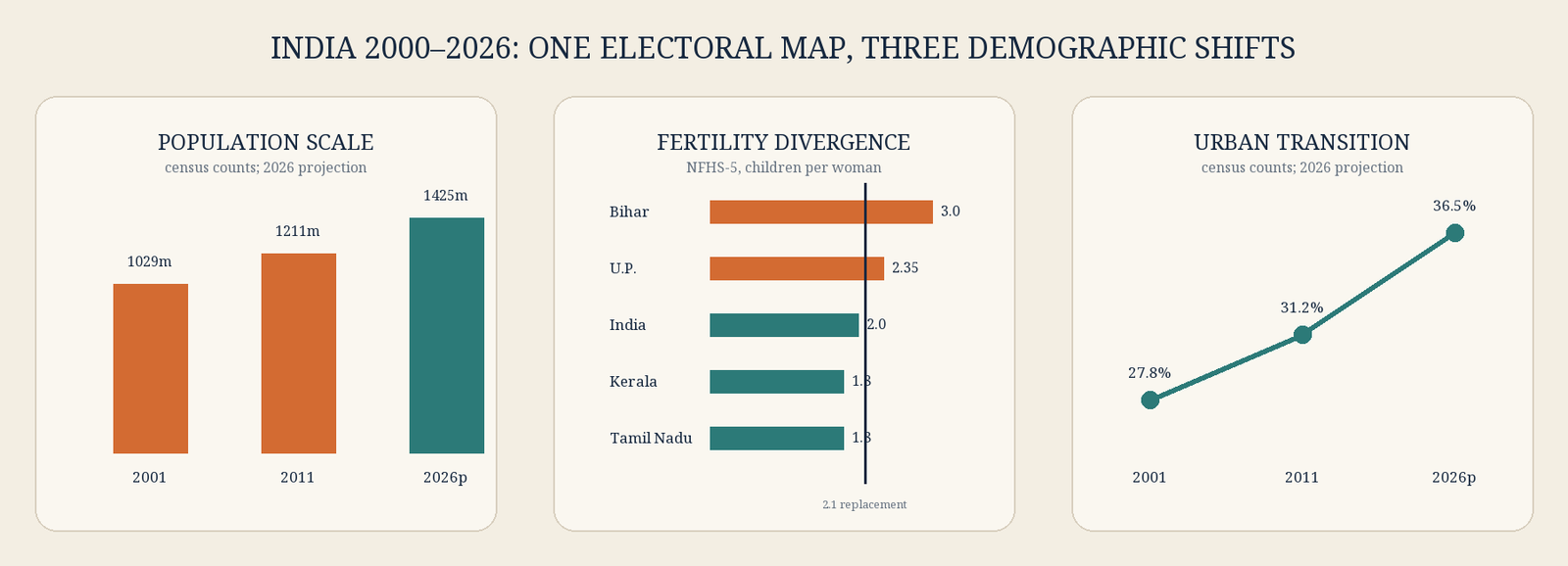
To understand the stakes of 2026, one must analyse the trajectory from the last enacted freeze in 1971 through the data captured in the 2001 and 2011 Censuses. While the 2001 Census recorded a national population of 1.02 billion, the 2011 Census saw it climb to 1.21 billion. The growth was not uniform. Between 2001 and 2011, states such as Bihar and Uttar Pradesh maintained decadal growth rates of 25.4 per cent and 20.2 per cent respectively, whereas Kerala at 4.9 per cent and Tamil Nadu at 15.6 per cent signalled an earlier transition toward demographic stability.15
The National Commission on Population projections for 2011 to 2036 provide the most rigorous framework for the upcoming delimitation. The Commission anticipates India’s population reaching approximately 1.52 billion by 2036. In this trajectory, five states, namely Uttar Pradesh, Bihar, Maharashtra, West Bengal, and Madhya Pradesh, are expected to account for nearly half of the total growth. Conversely, the southern states of Andhra Pradesh, Telangana, Karnataka, Kerala, and Tamil Nadu are projected to contribute only 9 per cent to the total population increase during the 2011 to 2036 period.16 If the 2026 Delimitation Bill utilised these 2030s-horizon figures, the Lok Sabha would undergo a tectonic tilt. Projections suggest the Hindi heartland could gain over thirty seats, while the South could face a proportional, if not absolute, dilution of legislative agency.
B. Fertility rates and the demographic-dividend penalty
The divergence is best explained through the total fertility rate data provided by the National Family Health Survey (NFHS-5, 2019 to 2021). Unlike raw counts, this rate illustrates the velocity of change. NFHS-5 reports a national total fertility rate of 2.0. Bihar at 3.0 and Uttar Pradesh at 2.4 remained above the replacement benchmark, while Tamil Nadu and Kerala each recorded 1.8.17
This creates a paradox of governance: southern states are, in effect, being penalised for their success in achieving the Union government’s stated goals regarding family planning and literacy. From a federalist perspective, the Delimitation Bill, 2026, acts as a stress-test because it threatens to decouple political power from socio-economic performance. If seats are allocated strictly on a population-to-representation ratio, the states that have contributed most to India’s human development indicators risk becoming secondary players in the national legislative process.18
Figure 1, on demographic divergence, distinguishes the 2001 and 2011 Census counts from the 2026 projection and labels the NFHS-5 fertility values as survey estimates.19,20
Habitat, urbanisation, and the micro-geography of representation
Beyond the regional North-South divide, the internal shifts within states, namely habitat change, peri-urbanisation, and the increasing workload of the individual representative, warrant separate attention. The 2026 delimitation is not merely about state totals; it is about redrawing the boundaries of how Indians live today compared with 1971.
A. The urban and peri-urban expansion
Since the last major delimitation, which only reshuffled boundaries within states based on the 2001 Census without changing state totals, India has undergone a radical spatial transformation. Urbanisation is no longer confined to municipal cores. Census towns, areas that are statistically urban but administratively rural, have proliferated. Between 2001 and 2011 their number increased sharply, illustrating how statistical urbanisation outpaced many administrative classifications.21
This desakota, or peri-urban, landscape creates a serious difficulty for electoral cartography. Traditional rural constituencies are being hived off into sprawling urban fringes, such as the corridors between Bengaluru and Mysuru, or the zones adjacent to the National Capital Region in Haryana and Uttar Pradesh. In these regions the infrastructure is rural, but the population density and socio-economic aspirations are intensely urban. The 2026 Bill must decide whether to privilege administrative boundaries or natural habitat clusters, which are currently obscured by outdated 2011 data.22
B. Migration as a representation variable
Internal migration, both seasonal and permanent, has surged. The Economic Survey 2016 to 2017 estimated that annual interstate labour mobility averaged five to six million people. The National Commission on Population projections suggest that states such as Maharashtra and Gujarat will see population increases driven largely by net in-migration from the Hindi heartland.
This introduces a representation paradox: does a migrant from Bihar residing in Mumbai count toward Maharashtra’s seat allocation or Bihar’s? Current delimitation logic counts residents. If large numbers of citizens are effectively disenfranchised for lack of portable voting rights, delimitation based on population rather than electors further skews the democratic legitimacy of the new boundaries.23
C. Constituency workload and administrative strain
The workload of a Member of Parliament in India is now arguably among the highest in the democratic world. In 1971, a Member represented roughly 1.03 million people. By 2021 that figure had grown to over 2.5 million in many constituencies. In states such as Rajasthan and Madhya Pradesh, certain Members represent geographic areas larger than small European nations.
The 2026 Delimitation Bill must address this governance deficit. If the House size is kept at 543, the ratio will exceed three million per Member by 2031, making constituent service and effective oversight of local development functionally difficult. Expanding the House beyond 800 members to lower the workload, however, triggers the federal stress described above, as the expansion disproportionately benefits the North.24
D. The shadow of census uncertainty
A critical caveat to all 2026 projections is the unprecedented delay of the 2021 Census. For the first time in 150 years, India missed its decadal census cycle. The introduced 2026 Bill specified the latest published census and would therefore have used 2011 figures; under the existing Constitution, the next interstate readjustment instead awaits publication of Census 2027 figures. This absence of a gold-standard dataset introduces the risk of distortion, not by intent but by statistical error. Relying on NFHS-5 or Employees’ Provident Fund data as proxies for population distribution is fraught with regional bias, as data quality varies significantly between states.25
Figure 2, on habitat transition, is illustrative; census counts and modelled projections are separately labelled, and no constituency-specific estimate is presented as an official count.26,27
E. Synthesis: the federal fault line
The Delimitation Bill of 2026 represents a clash between two types of equity: individual equity, that every citizen’s vote should weigh the same, and federal equity, that states as partners in a union should not be marginalised for their demographic success. As the data suggests, a purely mathematical approach based on the 2011, 2021, and 2031 continuum would lead to a Parliament dominated by a compact geographical bloc in the North.
To mitigate this, the Bill cannot merely be an exercise in electoral cartography; it must be a piece of constitutional statesmanship. Proposals such as weighting the value of a vote against human development markers, or expanding the Rajya Sabha’s powers to protect stagnant-population states, are no longer peripheral academic ideas but necessary safeguards for the 2026 stress-test. The coming years will reveal whether India’s electoral map can accommodate its demographic reality without fracturing its federal character.
The dialectics of representation: electoral equality versus federal equilibrium
The constitutional character of the Indian Republic resides in a precarious tension between two competing versions of democratic legitimacy: proportionality and stability. Under Article 81, the mandate for one person, one vote, one value suggests that the Lok Sabha must reflect the shifting demographic weight of the citizenry. The impending 2026 delimitation exercise, thawed after a decades-long freeze, threatens to transform this mathematical principle into a source of acute political conflict. The central difficulty is not merely technical but structural, set against the bedrock of the federal compact.
The principle of electoral equality implies that a citizen’s vote in Uttar Pradesh should carry the same weight as a vote in Kerala. In the status quo, however, a substantial disparity has emerged due to the disparate success of family-planning initiatives across states. As regional cohorts in the South and West achieved demographic stability, the North recorded higher growth. To enforce strict population parity now would, in effect, penalise states for their success in human development, concentrating political power in a geographically and linguistically compact northern bloc.28
This creates a representation-performance concern: states that achieved earlier fertility decline fear a reduction in relative parliamentary weight. Tax contribution does not purchase additional votes, and population-based representation cannot be displaced by a one-rupee, one-vote theory. The constitutional design problem is instead whether individual electoral equality can be restored without making slower-growing linguistic regions believe that participation in the Union carries a permanent loss of voice.29
Stress-testing the 753-seat expansion: the illusion of absolute gains
The source essay tests an illustrative expansion of the Lok Sabha to 753 seats; that number did not appear in the introduced 2026 bills, whose companion constitutional amendment instead proposed a ceiling of 850, an enlargement facilitated by the construction of the new Parliament House. The logic appears attractive: if the total number of seats is increased, losing states can retain their current absolute number of seats, or even gain a few, while the winning states gain many more. The 753-seat scenario is useful only as a model for testing relative state shares; it is not legislative history and should not be confused with the actual 2026 package.30
In this simulation, the absolute-seat fallacy is exposed by the reality of relative legislative power. A no-loss expansion can increase a state’s absolute delegation while reducing its relative share of the chamber. Because the source essay did not disclose a reproducible apportionment method, this article does not treat its state totals as verified projections. The stress-test concerns that relative-power mechanism rather than any asserted majority for a particular regional bloc.31
The stress-test reveals two primary failure points. First, the threshold of irrelevance: if a regional bloc’s relative weight rises substantially, national coalition incentives may change. That is a political risk, not a mathematically predetermined collapse of national competition. Second, deliberative dilution: a House of more than 700 members would require significant procedural adaptation, including revised speaking-time, committee, and chamber procedures, to preserve meaningful debate; physical capacity alone says nothing about deliberative quality. The 753-seat design is therefore not a settled federal compromise but an architectural response to a political problem, one that may inadvertently accelerate the marginalisation of the periphery while securing the appearance of stability.32
Legislative pathways and the constitutional conundrum
The path toward 2026 is paved with procedural complexities that challenge the conventional understanding of constitutional amendments. A prevailing view in legal commentary suggests that any change to seat distribution always requires ratification by half of the state legislatures under the proviso to Article 368(2). A more rigorous reading, however, suggests otherwise. Article 82, which provides for the readjustment of seats after each census, can be activated by a simple Act of Parliament, namely the Delimitation Act.33
While the freeze on delimitation was enacted through the 42nd and 84th Amendments, which used the Article 368 amendment process, a post-2026 delimitation that follows the existing constitutional formula might be argued to be a regular statutory adjustment. Any attempt to deviate from the census-proportionality rule to protect southern interests, by grandfathering seats, would almost certainly require a constitutional amendment. The legislative path is thus difficult: the government can either follow the law and trigger a federal crisis, or change the law, which requires the applicable special majority and, where a matter protected by the proviso to Article 368(2) is changed, ratification by at least half the states, thereby unsettling its own demographic power base in the North.34
A. The intersection of the 106th Amendment and SC and ST reservation
The complexity is compounded by the Nari Shakti Vandan Adhiniyam, the Constitution (One Hundred and Sixth Amendment) Act, 2023, which mandates a one-third reservation for women in the Lok Sabha. Crucially, the implementation of this reservation is tethered to the completion of the first census after the Act’s commencement and the subsequent delimitation. This creates a dual-lock scenario. The 2026 delimitation would not only redefine the boundaries between states but would also require the internal partitioning of seats for women, alongside the existing quotas for Scheduled Castes and Scheduled Tribes under Article 330.35
The stress-test indicates that a simultaneous one-third women’s reservation and a substantial seat increase would lead to a fragmentation of constituency identity. In states where Scheduled Caste and Scheduled Tribe populations are concentrated, the intersection of these quotas could result in more than half of the seats being reserved in some fashion. This changes the nature of electoral cartography from geographic representation to identity-based allocation. Furthermore, since reserved seat allocations are population-dependent, the northern states would see a disproportionate increase in reserved seats, further concentrating the leadership of marginalised communities within the Hindi belt and potentially altering the national landscape of Dalit and Adivasi politics.36
B. Fiscal federalism and the Finance Commission’s shadow
The delimitation question cannot be decoupled from the fiscal tensions mediated by the Fifteenth, and soon the Sixteenth, Finance Commission. The Fifteenth Finance Commission’s use of the 2011 Census, rather than the 1971 data, as a basis for tax devolution already signalled a move toward weighting population alongside performance. If the 2026 delimitation formally institutionalises this demographic weighting in Parliament, the fiscal-electoral nexus would be complete.37
Several southern states argue that changes in horizontal devolution and parliamentary weight could create a perceived double disadvantage. The Fifteenth Finance Commission partly answered the concern by assigning separate weight to demographic performance; that policy choice should be debated independently from voter equality.38 The 2026 delimitation is, in this sense, the ultimate stress-test for the Union of States. It asks whether India’s constitutional machinery can accommodate a substantial shift in the centre of political gravity without breaking the original federal promise. If the cartography of 2026 treats states merely as administrative units of a unitary population, rather than as distinct political partners, the electoral equality it seeks may come at the cost of the Union’s long-term integrity. The 753-seat model illustrates this struggle but was not the model enacted, or even proposed, in the verified 2026 bills.
Why the illustrative bill fails the parliamentary stress-test
To evaluate the robustness of the proposed illustrative bill, one may subject its provisions to a simulated parliamentary stress-test, an analytical heuristic designed to measure how the legislation would withstand the institutional pressures of the Indian federal architecture.39 This test moves beyond the arithmetic of seat distribution to scrutinise the normative and procedural integrity of the legislative process. At the threshold, the Bill falters on the ground of agenda legitimacy. In a high-stakes constitutional overhaul, the legitimacy of the legislative agenda is predicated on transparent deliberation. Where a Bill seeks to decouple the implementation of reservation from the immediate electoral cycle, contingent upon an uncertain future census, it introduces a temporal vacancy in sovereign accountability. This deferred activation bypasses the immediate scrutiny of the current electorate, failing the requirement that transformative constitutional changes possess a clear, proximate, and honest nexus to the democratic mandate they claim to serve.
A primary point of failure in this simulation is the information deficit exacerbated by the delayed census.40 Delimitation is not a prophylactic administrative exercise; it is an evidence-based realignment of political geography. By anchoring the Bill’s efficacy to a census that has been indefinitely postponed, the illustrative bill compels Parliament to legislate in an empirical vacuum. This deficit undermines the informed consent of the North-South coalition within the Union. The stress-test reveals a breakdown in coalitional incentives: the southern states, having successfully implemented population-control measures, face a structural disadvantage in a post-delimitation landscape. A Bill that fails to provide compensatory mechanisms or weighted federal protections invites a constitutional impasse, as the incentive for southern representatives to participate in a consensus-based amendment evaporates.
Furthermore, the Bill inadequately addresses the bicameral friction inherent in the Indian legislative process.41 While ordinary delimitation legislation might be passed by a simple majority under Articles 82 and 170, the actual constitutional bill proposed amendments to Articles 55, 81, 82, 170, 330, 332, 334A, and 356. The amendment process and any state-ratification requirement must be assessed from the provisions changed and the proviso to Article 368(2), not from the political importance of delimitation alone. Ordinary legislation cannot accomplish a constitutional amendment, but ordinary readjustment legislation authorised by Articles 82 and 327 is not invalid merely because its consequences are politically significant.42
Finally, one must address the fallacy of architectural determinism.43 The physical expansion of the Central Vista, resulting in an 888-seat capacity for the Lok Sabha, is a matter of civil engineering, not constitutional design. The stress-test demonstrates that physical capacity does not settle the normative questions of distributive justice. A larger chamber may accommodate more members, but it does not resolve the tension between representation per capita and representation of federal units. The illustrative bill fails to bridge this gap, treating the 888-seat limit as a justification for reapportionment rather than a site of constitutional conflict. In sum, the Bill lacks the procedural safeguards and federal sensitivity required to survive a genuine institutional crisis, and by underestimating the volatility of North-South electoral parity and the requirements of Article 368, it remains an aspirational document rather than a viable legislative instrument.
The institutional integrity of the Delimitation Commission: independence and the judicial bar
The impending delimitation exercise represents a tension between administrative finality and constitutional accountability. Under the Delimitation Act, the Commission is constituted as a high-powered body, typically chaired by a serving or former Supreme Court judge and composed of the Chief Election Commissioner or an Election Commissioner nominated by the Chief Election Commissioner, together with the relevant State Election Commissioner. Its orders enjoy strong statutory finality, but not absolute immunity from constitutional review.
Article 329(a) provides that the validity of laws relating to delimitation or allotment of seats, made or purporting to be made under Articles 327 or 328, shall not be called into question in court. In Meghraj Kothari v. Delimitation Commission, the Supreme Court emphasised the finality of gazetted orders and the need to prevent election schedules from being held up by serial litigation. But Kishorchandra Chhanganlal Rathod v. Union of India clarified in 2024 that Meghraj Kothari does not establish a complete prohibition on judicial review. A constitutional court may examine a Delimitation Commission order within a limited sphere and grant an appropriate remedy if the order is manifestly arbitrary or irreconcilable with constitutional values.44
The principle of one person, one vote is often invoked to justify seat redistribution based on the latest census, yet this can overlook the federal compact inherent in the Indian union. In Kuldip Nayar v. Union of India, the Court acknowledged that while representation is a basic feature, the specific manner of that representation, including the domicile requirements for the Rajya Sabha, could be altered by Parliament to suit the evolving needs of the federation.45 Applied to the 2026 delimitation, Kuldip Nayar suggests that Parliament possesses wide latitude in configuring electoral cartography, but it also underscores the fragility of state identity in the face of national majoritarianism.
The participation framework of the Commission further complicates this. While associate members, drawn from Members representing the respective states, are invited to deliberations, they lack voting rights, which often reduces state-level participation to a consultative formality. The absence of data transparency regarding the criteria for drawing lines, whether they follow natural boundaries, administrative units, or demographic clusters, remains contentious. Without a requirement for the Commission to provide a reasoned order for specific boundary shifts, the process risks being perceived as a black box, vulnerable to accusations of manipulation even where the Commission’s intent is neutral.46
Figure 3, illustrating the shield of Article 329(a), maps the legal lifecycle of a delimitation order. It contrasts the Commission’s objection process and the strong finality attached to Gazette publication with the narrow constitutional-review window preserved by Kishorchandra Chhanganlal Rathod for manifest arbitrariness or constitutional incompatibility. The result is judicial restraint, not a judicial bypass.
Design principles for a legitimate Commission
The impending delimitation exercise, tethered to the first census conducted after 2026, represents a transformative constitutional moment. To insulate this process from charges of manipulation or malapportionment, the institutional architecture of the Delimitation Commission must transcend mere procedural compliance and embody legitimacy through design. The following principles establish a framework for a Commission that satisfies the dual mandates of democratic fairness and constitutional stability.
A. Independence and structural insulation
The legitimacy of the Commission is contingent upon its perceived and actual independence from the executive. While the Delimitation Act, 2002, provides for a body chaired by a retired Supreme Court judge, the appointment process must be transparent to prevent executive packing. An independent secretariat, distinct from the Election Commission of India but working in coordination with it, ensures that the sensitive task of boundary-making is not treated as a mere administrative byproduct of election management. Institutional independence must be fortified by fiscal autonomy, preventing budgetary constraints from hampering necessary field surveys.47
B. Transparent datasets and reproducibility
In the digital age, the black-box approach to drawing boundaries is obsolete. The Commission should adopt a digital-first transparency mandate, entailing the release of granular census data and the Geographic Information System shapefiles used to draft proposed constituencies. For a Commission’s work to be legitimate, it must be reproducible; independent researchers and political stakeholders should be able to run the same datasets through standardised models to verify that the proposed boundaries are the most mathematically and geographically sound options. This transparency mitigates suspicions of manipulating the composition of specific voter blocks.
C. Harmonising linguistic and community boundaries
While Article 81 emphasises population parity, Section 9 of the Delimitation Act requires the Commission to consider geographical features, boundaries of administrative units, communication facilities, and public convenience. A legitimate Commission must treat these not as secondary concerns but as primary safeguards for communities of interest. Boundaries should avoid bifurcating cohesive linguistic enclaves or historical administrative units, such as tehsils or taluks, unless mathematically unavoidable. Respecting these organic boundaries ensures that the representative remains tethered to a distinct, culturally coherent constituency rather than an artificial numerical aggregate.
D. Rigorous population-deviation criteria
The principle of one person, one vote, one value is strained by India’s vast demographic variations. To curb malapportionment, the Commission should adopt a strict maximum deviation limit, for example plus or minus 10 per cent, from the state or national quota. While absolute parity is impossible, setting a predefined, narrow band of permissible deviation prevents the dilution of the franchise in high-growth urban corridors compared with stagnant rural zones. Any deviation beyond this threshold should require a specific, written justification based on extreme geographical exigencies.48
E. Public hearings and accessibility
Legitimacy is forged in the public square. The Commission must conduct extensive public hearings that are geographically accessible, moving beyond state capitals into regional hubs. Accessibility also implies linguistic inclusivity; all draft proposals, maps, and explanatory notes should be published in the regional languages of the affected areas. The Commission should also provide a digital portal for submitting objections, ensuring that high-technology transparency is matched by accessible, low-technology participation.
F. Reasoned orders and audit trails
A hallmark of arbitrary power is the unreasoned decree. Every final determination of a boundary should be accompanied by a reasoned order that addresses the major objections raised during public hearings. The Commission must maintain a comprehensive audit trail: a chronological record of how a boundary evolved from its initial draft to its final notification. This record demonstrates that changes were made in response to public input or evidentiary findings, rather than political pressure.49
G. Time-bound pre-notification review and Article 329(a)
Article 329(a) creates a significant hurdle, not an absolute bar. Kishorchandra Chhanganlal Rathod confirms that constitutional courts retain a limited power to test Commission orders for manifest arbitrariness or incompatibility with constitutional values. A mandatory, time-bound pre-notification review window would nevertheless reduce disruptive post-notification litigation: the full Commission should resolve credible objections through reasoned orders before Gazette publication, without purporting to replace or contract the constitutional jurisdiction of the High Courts.50
Comparative cartography: global lessons in federal equilibrium
The situation facing India in 2026 is not unique in the history of federalism, yet India remains an outlier in its lack of institutional safeguards for regions with slower demographic growth. A comparison with the United States, Canada, and Germany reveals alternative pathways for balancing population parity with regional integrity.
In the United States, the House of Representatives is capped at 435 members, with seats reapportioned every decade. The Senate, however, serves as the ultimate federal stabiliser, granting each state two seats regardless of population. This bicameral divergence ensures that while the House reflects demographic surges, benefiting states such as Texas and Florida, the Senate preserves the federal compact by giving smaller states significant weight over national policy.51 India’s Rajya Sabha, by contrast, is roughly proportional to population, meaning that a demographic decline in the South results in a simultaneous loss of relative power in both Houses of Parliament.
Canada offers perhaps the most salient constitutional protection for regional representation. Section 51 of the Constitution Act, 1867, contains the senatorial floor and the grandfather clause. The former ensures that no province can have fewer seats in the House of Commons than it has in the Senate, while the latter guarantees that a province cannot have fewer seats than it had in 1985.52 These mechanisms recognise that representation by population must be tempered by territorial justice. If India were to adopt a floor for seats, it would prevent the absolute diminution of southern influence while still allowing northern states to gain seats commensurate with their growth.
Germany’s Bundesrat, or Federal Council, provides a third model. Its members are not directly elected but are representatives of the state governments. Voting power is weighted, not strictly by population but in bracketed tiers, where even the smallest Länder hold a minimum of three votes and the largest are capped at six.53 This prevents any single demographic bloc from achieving a hegemony of numbers. The German model suggests that Indian federalism could be stabilised not merely by redrawing boundaries but by reforming the composition and functions of the second chamber to provide a genuine check on the Lok Sabha’s demographic volatility.
Figure 4, on global safeguards for regional representation, is a comparative matrix displaying the federal safety nets of four nations. It contrasts India’s proportional Rajya Sabha with the United States Senate’s absolute equality, Canada’s grandfather clause under Section 51, and Germany’s tiered weighting in the Bundesrat, highlighting India as a proportionality outlier that lacks the institutional buffers protecting minority regional interests in other major federations.
Proposing a renewed federal compact: a roadmap for stability
The federal stress-test of 2026 cannot be resolved through cartographic adjustments alone; it requires a renewed social and constitutional understanding. To prevent a schism in which the North wields political power while the South generates a disproportionate share of national wealth, the government should consider a renewed federal compact.
First, the de-linking of representation from finance is paramount. The Fifteenth Finance Commission’s use of 2011 Census data has already been perceived as penalising states that successfully implemented family planning. A future compact should ensure that increased political representation for certain states is matched by greater fiscal autonomy for others. If the North is to have more seats, the South must have more control over its tax revenues to ensure that its development model is not submerged by the priorities of the federal centre.54
Second, a hybrid expansion model should be considered. Rather than a zero-sum redistribution, Parliament could expand the total number of seats in the Lok Sabha, as suggested by the capacity of the new Parliament building. This expansion without extinction would allow the North to gain seats reflecting its population growth while ensuring that the South does not lose its current absolute number of representatives. To maintain federal parity, this should be accompanied by a constitutional amendment to Article 81, creating a regional-weightage factor that recognises human development indices alongside population.55
Third, the empowerment of the Rajya Sabha is essential. If the Lok Sabha becomes dominated by a specific geographic cluster, the Rajya Sabha must be transformed into a genuine house of states. This would involve moving away from proportional representation in the Upper House toward a model of either equal representation for all states, as in the United States, or a weighted-cap model, as in Germany. Furthermore, the Rajya Sabha’s powers over money bills, currently limited, should be strengthened to allow the states a say in the national budget, ensuring that a delimitation dividend for the North does not become a fiscal drain for the South.56
Finally, the institutionalisation of an Inter-State Council with strengthened constitutional powers could serve as the deliberative body for resolving delimitation disputes. Currently underutilised as a consultative organ, an elevated Council functioning as a federal clearing house would allow political negotiation to precede or accompany the technical work of the Delimitation Commission.57,58
The habitat transition from 2000 to 2026: urbanisation as a delimitation variable
India’s electoral map inherited from the last nationwide delimitation cannot be evaluated only through state population totals. Between 2001 and 2011, urban population rose from about 286 million to 377 million, while the number and physical reach of statutory towns, census towns, peri-urban corridors, and metropolitan regions expanded. Habitat change alters the practical meaning of territorial representation: a constituency may contain a compact high-density municipal core, a dispersed rural hinterland, or a rapidly converting edge where residents use urban labour markets but remain governed through rural institutions.
This transition strengthens the case for a new delimitation exercise after publication of the first post-2026 census. Constituency equality depends on current population figures, but administrability also depends on roads, rivers, district boundaries, communication networks, and recognisable communities. The Commission must therefore use population parity as the controlling norm while recording reasons whenever geographic continuity or administrative cohesion justifies a departure. Unexplained deviations would convert flexibility into discretion and deepen suspicion that boundary design serves partisan ends.
The habitat question also has a federal dimension. Metropolitan growth is not confined to one linguistic region; migration redistributes citizens within states and across state borders. Delimitation cannot count migrants as lesser residents merely because their social origin lies elsewhere. The constitutional unit is population, not domicile-based political worth. Updated census enumeration, transparent geospatial layers, and public access to draft maps are accordingly prerequisites for credible cartography.
Representation ratios and the equality deficit
The central democratic argument for delimitation is straightforward: prolonged reliance on an old population base produces unequal constituency sizes. Yet equality is not achieved by a single national quotient mechanically imposed without regard to constitutional structure. Article 81 speaks through both allocation among states and territorial constituencies within states, while the provisos introduced by constitutional amendment postpone interstate readjustment until the relevant post-2026 census figures are published. The sequencing is legally important because 2026 itself does not automatically redraw a single boundary.
A defensible method should publish three calculations. First, it should disclose each state’s population-to-seat ratio under the existing allocation. Second, it should state the ideal quotient produced by any proposed House size. Third, it should quantify deviations for every constituency and explain those beyond a predetermined tolerance. Publication would make political disagreement measurable and allow citizens to distinguish unavoidable geographical departures from arbitrary malapportionment.
Equality must nevertheless be read with federal prudence. States that achieved earlier fertility decline reasonably fear a loss of relative voice, while residents of faster-growing states reasonably object to underrepresentation. Neither claim can simply erase the other. The stress-test failed politically because the legislative package did not secure a sufficiently broad settlement on this distributive conflict before attempting constitutional change. A durable law should pair representational correction with institutional assurances that demographic performance will not be treated as a political penalty.
Why the 2026 package failed the parliamentary stress-test
The parliamentary failure was not proof that delimitation had become unnecessary. It demonstrated that necessity and political legitimacy are separate questions. A delimitation statute may provide machinery, but a constitutional amendment determines the permissible architecture within which that machinery operates. Where the proposed amendment is negatived, an accompanying ordinary bill that depends upon it loses its operative premise. The rapid collapse of the 2026 package thus exposed insufficient coalition-building around the distribution of future power.
Three anxieties converged. The first was numerical: southern and some eastern states feared relative seat loss after a successful fertility transition. The second was procedural: members required clarity about census timing, House size, allocation formula, and safeguards against partisan mapmaking. The third was institutional: the women’s reservation framework adopted in 2023 is expressly connected to a future delimitation, making sequencing consequential for both territorial and gender representation.
Parliament therefore confronted more than a technical bill. It confronted a constitutional bargain whose winners and losers could be forecast regionally. The lesson is that a second attempt should begin with a published options paper, state consultation, and formula simulations rather than a compressed floor strategy. Federal consent need not mean a legal veto for every state, but deliberative legitimacy requires that major regional objections be answered with reasons and institutional compensation, not merely with arithmetic majorities.
A two-stage formula for federal reconciliation
A workable settlement can separate expansion from redistribution. At the first stage, Parliament may enlarge the Lok Sabha so that faster-growing states receive additional representation without immediately reducing the absolute number of seats held by states that completed the demographic transition earlier. This no-absolute-loss principle does not preserve every state’s relative share, but it reduces the symbolic severity of reform and uses the physical capacity created by the new Parliament building.
At the second stage, a transparent allocation formula should operate after publication and validation of census figures. The formula should identify the population base, rounding method, treatment of Union territories, and maximum constituency deviation. Simulations must be released before enactment. A neutral secretariat should publish reproducible tables and machine-readable boundary files so that academics, parties, and citizens can verify each result.
This model is not a permanent escape from population equality but a transition device. A sunset clause could require review after two general elections, by which time fertility convergence and improved census data may reduce the interregional shock. The design should also preserve the constitutional role of the Rajya Sabha rather than attempting to transform the Lok Sabha into a chamber of states. Federal protection is strongest when institutions perform distinct functions: the lower House reflects people, the upper House voices states, and fiscal transfers follow constitutionally disclosed criteria.
Reserved constituencies and intersectional cartography
Any post-census delimitation must simultaneously revisit seats reserved for Scheduled Castes and Scheduled Tribes under Articles 330 and 332. Reservation is not an appendage to territorial design; it is part of the constitutional map. Population movement, urbanisation, district reorganisation, and uneven community concentration may make the existing pattern increasingly detached from present settlement. Updated enumeration is therefore essential to determine both the number and the location of reserved constituencies.
The method should avoid treating reservation as a purely statistical label. Contiguity remains necessary, and rotation or reassignment should not fragment communities in ways that undermine effective representation. Draft orders should separately disclose the demographic basis for each reservation decision. Public hearings must be accessible to affected communities, with maps and explanatory materials available in relevant regional languages and in formats usable by persons with disabilities.
The relationship with the constitutional women’s reservation provisions requires careful sequencing. Articles 330A, 332A, and 334A connect implementation to delimitation after the relevant census. Parliament should state clearly how women’s reservation, Scheduled Caste and Scheduled Tribe reservation, and territorial boundaries will interact. Ambiguity could postpone representation or provoke avoidable litigation. A reasoned schedule, published before final orders, would allow parties to prepare candidates while allowing citizens to test whether overlapping guarantees have been implemented faithfully.
Institutional independence, data integrity, and public reason
The credibility of delimitation depends as much on process as on final numbers. The Commission’s statutory independence must be supported by an auditable data chain. Population tables, administrative boundaries, reservation inputs, and geospatial layers should be versioned and publicly archived. If a district boundary changes during the exercise, the Commission should identify the date and legal instrument used, preventing silent substitution of geographic assumptions.
Public participation must occur before positions harden. Draft proposals should be accompanied by plain-language explanations, deviation tables, and searchable maps. Hearings should be geographically distributed and live-streamed where practicable. Written objections should receive issue-based responses in the final order. This need not require an individualised answer to every submission, but it does require the Commission to confront material alternatives and explain why they were accepted or rejected.
Article 329(a) protects the finality and continuity of elections, yet finality should not be confused with opacity. The Supreme Court’s delimitation jurisprudence recognises the special status of Commission orders while leaving constitutional space for exceptional review. Strong procedure reduces the need for litigation: reasoned orders, disclosed evidence, and equal hearing opportunities make arbitrariness less likely and judicial restraint more defensible.
Fiscal federalism as context, not a substitute for votes
Debate about delimitation often invokes tax contribution, devolution, and fiscal transfers. These considerations matter politically because states fear that a reduced parliamentary share may weaken their influence over national expenditure. Constitutionally, however, fiscal contribution cannot determine voting weight in the House of the People. Democratic representation attaches to persons; it is not purchased by higher gross state domestic product or tax receipts.
The appropriate response is institutional coordination rather than conversion of fiscal performance into extra seats. Finance Commission criteria can recognise demographic performance, income distance, area, forest cover, and other constitutionally relevant considerations. Intergovernmental forums can provide states with a structured voice on implementation. The Rajya Sabha can scrutinise the federal consequences of reform within its constitutional powers. These mechanisms mitigate distributive anxiety without violating population-based representation.
A federal compact should therefore include a published statement that delimitation will not mechanically alter finance-sharing principles. It should also explain that future Finance Commissions remain constitutionally independent. This separation of questions improves deliberation: constituency equality can be debated on representational grounds, while fiscal equity is assessed through the institutions designed for revenue distribution. Collapsing both into one contest makes agreement harder and obscures the distinct constitutional values at stake.
Comparative lessons without constitutional transplantation
Comparative systems illuminate choices but cannot supply a ready-made Indian solution. The United States combines population-based apportionment in the House of Representatives with equal state representation in the Senate. Canada permits limited departures from strict population parity to protect communities and geography. Germany embeds state participation through the Bundesrat. Each arrangement reflects a different constitutional history and cannot be transplanted without regard to India’s text, scale, and party system.
The useful comparative lesson is methodological. Mature redistricting systems disclose population calculations, invite objections, and provide rules for acceptable deviation. India can adopt these transparency practices while retaining its independent Delimitation Commission and constitutional allocation scheme. Comparative experience also warns that boundary drawing becomes fragile when elected incumbents control granular map design. Institutional insulation is therefore not merely desirable; it protects the equality norm from self-interested manipulation.
India’s distinctive challenge is that interstate allocation has remained frozen for decades while fertility and migration patterns diverged. Few comparisons reproduce that combination. The appropriate approach is constitutional adaptation: House expansion to moderate immediate losses, a clear population formula, robust state consultation, and published reasons for all departures. Comparison sharpens these tools but does not displace the Indian Constitution as the controlling source.
Conclusion: passing the next federal stress-test
The demographic and habitat changes since 2000 make renewed delimitation a constitutional requirement in substance, even though the legal trigger depends on publication of the first census figures after 2026. Population growth, interstate divergence, urban expansion, migration, and the changing geography of Scheduled Caste and Scheduled Tribe communities have weakened the descriptive accuracy of inherited boundaries. Continuing indefinitely with frozen allocation would deepen vote-value inequality and detach representation from contemporary India.
The 2026 legislative package failed because Parliament was asked to settle a distributive constitutional bargain before sufficient consensus existed on its formula, sequence, and safeguards. The failure should be read neither as a defence of federalism nor simply as resistance to equality. It was a warning that arithmetic legitimacy cannot survive without procedural legitimacy. States and citizens must be able to see the data, test the scenarios, and understand the consequences before irreversible choices are made.
The next bill should therefore combine a post-census trigger, House expansion, protection against absolute seat loss during transition, transparent deviation rules, integrated treatment of reserved constituencies, and a genuinely independent public process. It should be accompanied by simulations and an implementation calendar. Such a settlement will not eliminate political disagreement, but it can transform disagreement into constitutional reason-giving. India will pass the stress-test only when electoral equality and federal trust are treated as mutually sustaining commitments rather than rival absolutes.
A ten-point legislative roadmap
First, await publication and validation of the first census figures taken after 2026 before interstate readjustment. Second, publish alternative House-size and state-allocation simulations before introducing the replacement legislative package. Third, use transitional House expansion to prevent an immediate absolute reduction in any state’s existing Lok Sabha seats. Fourth, disclose the population quotient, rounding rule, constituency deviation, and written justification for every exceptional departure. Fifth, integrate Scheduled Caste, Scheduled Tribe, and women’s reservation sequencing into one publicly explained implementation calendar.
Sixth, provide machine-readable population tables and geospatial boundary files, with version histories and accessible regional-language maps. Seventh, hold distributed public hearings and publish issue-based responses to material objections before finalising Commission orders. Eighth, protect Commission independence through transparent appointments, conflict disclosures, and an adequately resourced neutral secretariat. Ninth, keep fiscal devolution analytically distinct from vote allocation while using constitutional federal institutions to address distributional anxiety. Tenth, include a review clause after two general elections so that Parliament can assess equality, administration, and federal consequences using observed evidence.
A. Citation note
This version was audited against primary constitutional, statutory, legislative, demographic, and judicial materials. The audit corrected the Bill’s status, distinguished the actual 850-seat ceiling proposal from the 753-seat illustrative scenario, corrected the fertility values, removed unsupported apportionment calculations, and narrowed the case-law propositions.
*****
Footnotes
1. India Const. arts. 82, 170; Constitution (Eighty-Fourth Amendment) Act, 2001, §§ 3–4 (India).
2. India Const. art. 329(a); Meghraj Kothari v. Delimitation Comm’n, (1967) 1 S.C.R. 400, 407–09 (India); Kishorchandra Chhanganlal Rathod v. Union of India, 2024 INSC 579, ¶¶ 5–10 (India).
3. The Delimitation Bill, 2026, Bill No. 108 of 2026, Statement of Objects and Reasons & cl. 1 (India); PRS Legislative Research, The Delimitation Bill, 2026 (Apr. 17, 2026).
4. India Const. arts. 81–82.
5. India Const. arts. 170, 330, 332.
6. Delimitation Act, No. 33 of 2002, §§ 3, 9–10, India Code (2002).
7. Constitution (Eighty-Fourth Amendment) Act, 2001, §§ 3–6 (India).
8. Id.; PRS Legislative Research, Issues for Consideration: Delimitation Bills of 2026, at 1–2 (Apr. 16, 2026).
9. India Const. art. 329(a); Meghraj Kothari v. Delimitation Comm’n, (1967) 1 S.C.R. 400, 407–09 (India); Kishorchandra Chhanganlal Rathod v. Union of India, 2024 INSC 579, ¶¶ 5–10 (India).
10. The Constitution (One Hundred and Thirty-First Amendment) Bill, 2026, Bill No. 107 of 2026, cls. 4–5 (India); The Delimitation Bill, 2026, Bill No. 108 of 2026, cls. 2, 4, 24.
11. The Constitution (One Hundred and Thirty-First Amendment) Bill, 2026, Bill No. 107 of 2026, cls. 3–5 (India); The Delimitation Bill, 2026, Bill No. 108 of 2026, cls. 2, 4, 24 (India).
12. The Constitution (One Hundred and Thirty-First Amendment) Bill, 2026, Bill No. 107 of 2026, cl. 3 (India); PRS Legislative Research, supra note 8, at 2.
13. India Const. arts. 81–82, 170; Constitution (Eighty-Fourth Amendment) Act, 2001, §§ 3–6 (India).
14. Registrar Gen. & Census Comm’r, India, Census of India 2001: Provisional Population Totals (2001).
15. Registrar Gen. & Census Comm’r, India, Census of India 2011: Provisional Population Totals (2011).
16. Nat’l Comm’n on Population, Population Projections for India and States 2011–2036, at 25–83 (2020).
17. Int’l Inst. for Population Scis. & ICF, National Family Health Survey (NFHS-5), 2019–21: India, vol. I, at 4–6 & state fact sheets (2022).
18. Nat’l Comm’n on Population, supra note 16, at 25–83.
19. Registrar Gen. & Census Comm’r, India, Census of India 2001: Provisional Population Totals (2001); Registrar Gen. & Census Comm’r, India, Census of India 2011: Provisional Population Totals (2011); Nat’l Comm’n on Population, supra note 16, at 25–83.
20. Int’l Inst. for Population Scis. & ICF, supra note 17, vol. I, at 4–6 & state fact sheets.
21. Registrar Gen. & Census Comm’r, India, Census of India 2011: Primary Census Abstract (2011).
22. Registrar Gen. & Census Comm’r, India, Census of India 2011: Migration Tables, D-Series (2011).
23. Gov’t of India, Economic Survey 2016–17, vol. I, ch. 12, at 264–84 (2017).
24. Delimitation Act, No. 33 of 2002, §§ 7, 9 (India).
25. PRS Legislative Research, supra note 8, at 1–2.
26. Registrar Gen. & Census Comm’r, India, Census of India 2011: Primary Census Abstract (2011).
27. Registrar Gen. & Census Comm’r, India, Census of India 2011: Migration Tables, D-Series (2011).
28. India Const. art. 81(2).
29. Kuldip Nayar v. Union of India, (2006) 7 S.C.C. 1, 58–74 (India).
30. The Delimitation Bill, 2026, Bill No. 108 of 2026; The Constitution (One Hundred and Thirty-First Amendment) Bill, 2026, Bill No. 107 of 2026, cl. 3.
31. Parliament of India, New Parliament Building (Lok Sabha capacity 888) (last visited June 14, 2026).
32. India Const. art. 368(2) & proviso.
33. India Const. arts. 82, 327; Delimitation Act, No. 33 of 2002.
34. India Const. art. 368(2) & proviso.
35. Constitution (One Hundred and Sixth Amendment) Act, 2023, §§ 3–6 (India); India Const. arts. 330A, 332A, 334A.
36. PRS Legislative Research, The Constitution (One Hundred and Twenty-Eighth Amendment) Bill, 2023 (Sept. 20, 2023).
37. Fifteenth Fin. Comm’n, Finance Commission in COVID Times: Report for 2021–26, vol. I, ch. 6, tbl. 6.1 (2020).
38. Fifteenth Fin. Comm’n, supra note 37, vol. I, ch. 6, tbl. 6.1.
39. India Const. arts. 80–82, 280.
40. Delimitation Act, No. 33 of 2002, §§ 7–10, India Code (2002).
41. India Const. art. 329(a); Meghraj Kothari v. Delimitation Comm’n, (1967) 1 S.C.R. 400, 407–09 (India).
42. Kishorchandra Chhanganlal Rathod v. Union of India, 2024 INSC 579, ¶¶ 5–10 (India).
43. Delimitation Act, No. 33 of 2002, §§ 3, 5, 7–10 (India).
44. Delimitation Act, No. 33 of 2002, §§ 3, 5, 7–10; Meghraj Kothari v. Delimitation Comm’n, (1967) 1 S.C.R. 400, 407–09 (India); Kishorchandra Chhanganlal Rathod v. Union of India, 2024 INSC 579, ¶¶ 5–10 (India).
45. India Const. art. 329(a).
46. Meghraj Kothari, (1967) 1 S.C.R. at 407–09.
47. Delimitation Act, No. 33 of 2002, § 9(1).
48. Id. §§ 7–9.
49. Id. § 9(1)(a)–(d).
50. India Const. art. 329(a); Meghraj Kothari, (1967) 1 S.C.R. at 407–09; Kishorchandra Chhanganlal Rathod, 2024 INSC 579, ¶¶ 5–10.
51. Kuldip Nayar, (2006) 7 S.C.C. at 58–74.
52. U.S. Const. art. I, § 2, cl. 3; art. I, § 3, cl. 1; 2 U.S.C. § 2a (2018).
53. Constitution Act, 1867, 30 & 31 Vict., c. 3, § 51 (U.K.), as amended; Constitution Act, 1985 (Representation), S.C. 1986, c. 8 (Can.).
54. Grundgesetz [GG] [Basic Law], arts. 50–51 (Ger.).
55. Constitution Act, 1867, § 51 (U.K.); Constitution Act, 1985 (Representation), S.C. 1986, c. 8 (Can.).
56. Kuldip Nayar v. Union of India, (2006) 7 S.C.C. 1, 58–74 (India).
57. U.S. Census Bureau, Congressional Apportionment (last visited June 14, 2026).
58. India Const. art. 263.