
INTRODUCTION
This case analysis primarily pertains to the Designs Act, 2000, with a focus on key provisions such as Section 19 (Cancellation of Registration), Section 4 (Prohibition of Registration of Certain Designs), and Section 22 (Piracy of Registered Design). Other relevant provisions briefly addressed include Section 11 (Copyright on Registration) read with Section 2(c) (Definition of Copyright), and Section 7 (Publication of Particulars of Registered Designs). Additionally, Section 29 of the Trade Marks Act, 1999 has been referenced to draw parallels and aid interpretation where necessary.
Both of the aforementioned cases involve situations where the defendants allegedly copied the registered design and manufactured products similar to those of the plaintiffs. The first case concerns a musical keyboard, while the second involves a washing machine. Although the provisions invoked in both cases are largely the same, the legal arguments presented and the questions of law involved differ significantly.
It is noteworthy that in neither case did the defendants dispute that their products were identical to those of the plaintiffs. In the first case, the defense argued that the plaintiff’s design lacked novelty and was therefore liable to be cancelled under Section 19, leaving the plaintiff without a valid claim. In the second case, the contention was that, since the defendants themselves were registered owners of the design, no action for infringement could be maintained against them.
The case analysis also seeks to highlight the evolution of judicial interpretation on the subject over the period from 2014 to 2023.
FACTS
1. Case 1: Casio Keisanki Kabushiki Kaisha v. Riddhi Siddhi Retail Venture1
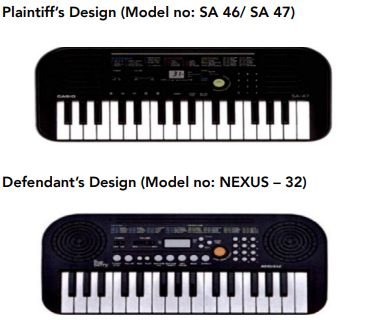
The plaintiff is a well-known manufacturer of musical keyboards. They have a registered “Electronic Keyboard” design, valid until September 2, 2024, certified by the Controller of Designs for its unique shape and configuration. The plaintiff produces keyboards with this design under Model Nos. SA-46 and SA-47, differing only in the base color.
To strengthen its claim of goodwill and reputation, the plaintiff has provided sales data for products featuring this design from 2011 to 2020-21 in India. The defendant does not dispute the plaintiff’s reputation. The plaintiff states that this design has become strongly associated with their keyboards over time, and the public identifies it with the plaintiff. The plaintiff is upset that the defendants have adopted an almost identical design for their keyboard sold under the brand name Nexus32, using their registered trademark Blueberry.
The plaintiff highlights several similarities between their keyboards and the defendants’ keyboards:
i. The placement of the Piano-Organ key, along with a horizontal line dividing the panel into two segments, is identical.
ii. The shape and configuration of the numeric keys are the same.
iii. The power button is placed in the same location and has the same shape and configuration.
iv. Likewise, the Volume button is placed identically and has the same shape and configuration.
v. The display board’s placement and shape are identical.
vi. The tone keys are placed in a triangular shape, matching the registered design in shape and configuration.
vii. There is an identical engraved line at the top of the keyboard, outlining the board.
viii. Keys below the horizontal line in the Nexus32 are mirror images of the plaintiff’s product with the same design.
ix. The Piano Organ keys on the Nexus 32 have the same circular shape and configuration as those on the plaintiff’s Casio product, with a shallow depth in the center.
x. The rear view of the Nexus 32 is an exact replica of the plaintiff’s Casio product.
xi. The infringing goods have copied the shape and configuration of the plaintiff’s goods.
2.  Case 2: Videocon Indus. Ltd. v. Whirlpool of India Ltd2

Whirlpool’s Washing Machine3 Videocon’s Washing Machine
The plaintiff had secured two design registrations, which were initially valid for ten years starting from July 15, 2009, with the possibility of extending for an additional five years. In June 2012, the plaintiff discovered a washing machine produced and sold by the defendant under the brand “Videocon Pebble.” This washing machine closely resembled the design and features of the plaintiff’s product and registered designs.
The plaintiff argued that a simple examination of the defendant’s product revealed it as a direct copy of the plaintiff’s designs. The shape and configuration of the defendant’s washing machine were nearly identical to those of the plaintiff. The defendant had replicated the precise and unique combination of elements, including the circular wash area, the compact right-aligned control panel, and the distinctive rectangular drying area.
Not only were individual features and components copied, but the defendant also mimicked the combination of these elements. It wasn’t just a matter of copying the shape, pattern, and configuration; the defendant also adopted the plaintiff’s distinct color scheme or two-tone combination. The defendant applied the same colors in the same way and replicated the pattern and placement of these rival colors. Consequently, at first glance, the two products would appear virtually indistinguishable.
ISSUES
1. Case 1
• Whether there existed a lack of novelty in the registered design of the plaintiff?
• Whether the word “publication” under Section 19 included within its ambit on articles or even documents?
2. Case 2
• Whether a suit for infringement can lie against a Defendant who is also a registered proprietor?
• Whether Controller has the exclusive jurisdiction to entertain a challenge to a registered proprietor’s design.
ARGUMENTS
1. Case 1
Mr. Bansal, the attorney for the plaintiff, has sought an injunction restraining the defendants and all persons acting on their behalf from manufacturing or selling keyboards that replicate the design in question, or any other design that is deceptively similar. The plaintiff also seeks an account of profits, the surrender of infringing goods, reimbursement of legal costs, and damages. The plaintiff firmly contests the allegations and maintains that their design was novel, innovative, and original, asserting that the defendants’ case is without merit.
Mr. Arnav Goyal, representing the defendants, relies on Sections 22(3) and 19(1)(b) and (c) of the Designs Act, along with Section 4(a), (b), and (c). The primary argument advanced is that the plaintiff’s design lacks novelty and closely resembles designs of numerous other keyboards. The defendants have submitted additional evidence, including listings from various e-commerce websites showing similar keyboards, to substantiate their claim of prior publication and lack of originality. They contend that, under Sections 19 and 4, any design that is not novel or is based on prior publication—whether in India or abroad—is liable to be cancelled.
2. Case 2
Following were the contentions made on behalf of the plaintiff with respect to the issue/ question of law
i. Section 22 of the Act, especially subsections (1) and (2), clearly applies to any person.
ii. The term ‘any person’ in Sections 17, 19, and 41 of the Act should be interpreted broadly.
iii. It’s illogical to allow the Court to examine the validity of the Plaintiff’s registration but not the Defendant’s.
iv. The Act treats registration as prima facie evidence of validity, and the Court can assess its validity in any situation, whether used offensively or defensively.
v. The Trade Marks Act (both the 1958 and 1999 versions) explicitly excludes registered proprietors from the definition of infringement under Section 29. Had the Legislature intended to provide a similar protection to registered proprietors under the Designs Act, it would not have used the term “any person” in Section 22. Consequently, Section 22 permits action for design infringement against any person, including a registered proprietor.
This construction is more equitable, logical, does not produce any anomalies and places both litigants on equal footing.
Following were the contentions made on behalf of the defendant with respect to the issue/ question of law
i. According to Section 11 and Section 2(c) of the Act, the Defendant has the exclusive right to use their registered design. This means that the term ‘any person’ should exclude the ‘registered proprietor,’ and no infringement case can be brought against the registered proprietor.
ii. The legislature distinguishes between ‘any person’ and the ‘registered proprietor,’ as seen in Section 22(1)(a). It requires ‘any person’ to obtain a license or written consent from the registered proprietor. Only someone other than the registered proprietor can obtain such a license or consent.
iii. Even though the Act lacks a provision similar to Section 30(2)(e) of the Trade Marks Act, 1999, it’s irrelevant because Section 11 along with Section 2(c) of the Act grants exclusive usage rights to the registered design’s proprietor. This right can only be revoked by the law itself.
iv. The Act treats prior and subsequent registrations of a design equally. In other words, a party with an earlier registration cannot claim a higher status than one with a later registration.
JUDGEMENT
1. Case 1
The court first delved into the jurisprudence of the term “design”, stating as follows:
i. The Supreme Court drew a brief understanding from Dover Ltd v. Nurnberger4 as Design refers to the concept or idea of a shape, picture, device, or arrangement that can be applied to an article through manual, mechanical, or chemical means. It’s an idea, not the physical article itself, that can be registered. It’s a suggestion of form or ornament for a physical object.
ii. Further it went on to state that: A design eligible for registration must not be just a concept or two-dimensional representation of features. It should represent those features as they appear on the actual article, created through an industrial process. To register a design, an applicant must provide a visual representation of their new or original idea. In essence, a design is a specific concept conceived by a designer and then reproduced in an identifiable way for application to an article. Registration requires both the design itself and the intention to apply it to an article to be considered together.
iii. The court further observed that there was no doubt regarding the similarity between the designs of the plaintiff’s and the defendant’s products.
iv. Sections 22(3) and 19(1) of the Designs Act work together. Lack of novelty or originality can be a defense against design piracy and a reason to cancel a design’s registration. This assessment is based on the design’s novelty and originality when it was registered.
v. If a design was novel and original at the time of registration, subsequent copying by others does not justify canceling its registration. The evaluation of novelty and originality should focus on the registration date, not later developments or similar designs in the market.
vi. Defendants claiming a lack of novelty or originality must provide evidence to support their defense. In this case, the defendants presented a screenshot showing a keyboard for sale on a website. However, the screenshot’s reference to “since 2008” pertains to the website’s membership status and doesn’t prove that the keyboard was available before 2008.
vii. The claim that the suit design lacks novelty and originality is unfounded. Since this is the only argument from the defendants and their design is clearly a copy of the plaintiff’s design, the plaintiff is granted a temporary injunction until the case is resolved. This confirms the interim injunction issued on June 25, 2021.
2. Case 2
In determining whether Videocon’s design infringed Section 22 (Piracy of Registered Design) of the Act, the court conducted a physical comparison of both washing machines. The objective was to assess whether Videocon’s machine constituted an obvious or fraudulent copy of Whirlpool’s registered design. Through a visual inspection, the court observed that both machines shared a distinct shape and were strikingly similar, with Videocon’s machine closely resembling Whirlpool’s design. Consequently, the court upheld the trial judge’s decision. It is noteworthy that machines from both brands were present in court throughout the hearing.
In addition to the infringement claim, Whirlpool also alleged passing off against Videocon. Passing off is a legal remedy designed to protect a trader’s goodwill and reputation from misrepresentation. It prevents a person from falsely presenting their goods or services as those of the claimant, thereby misleading the public and causing harm to the claimant’s business reputation.
In this case, the court held that, although Videocon may not have directly misrepresented its product to consumers, it had knowingly created a deceptively similar product, and was therefore guilty of passing off.
CONCLUSION
Therefore, it can be observed that, unlike copyright, where novelty is not a requirement and protection is granted as long as the expression of an idea is original, the same principle does not apply to designs under the Designs Act. In design cases, the novelty of the design is central. The defendants in the cases under discussion primarily relied on Sections 4 and 19 to challenge the novelty of the plaintiff’s design, which, if successful, could nullify claims for damages, injunctions, and other remedies.
The role of judicial interpretation is significant in these cases, with courts frequently referring to rules such as the literal rule and the purposive rule to guide their decisions. The judiciary has continued to develop the jurisprudence in this area. For instance, in the first case, the court provided detailed clarification on terms such as “prior publication” and “design”. While these definitions were not strictly necessary for the immediate dispute, they were crucial for the evolution of intellectual property law in India.
*****
Footnotes
1. Casio Keisanki Kabushiki Kaisha v. Riddhi Siddhi Retail Venture, 2023 SCC OnLine Del 677.
2. Videocon Indus. Ltd. v. Whirlpool of India Ltd., Appeal (L) No. 554 of 2012 (Bom. HC).
3. Excelon IP, Design Infringement Comparison (2022), https://excelonip.com/wp-content/uploads/2022/06/02-1.png.
4. Dover Ltd. v. Nurnberger Celluloidwaren Fabrik, (1910) 2 Ch. 25 (Eng.).