
INTRODUCTION
Forced displacement isn’t something that hits everyone the same way just because they’re fleeing danger, it’s far from gender-neutral. In plain terms, “gender-neutral” would mean the hardships of leaving home, losing everything, and surviving conflict or persecution affect men, women, and children equally, with no extra layers shaped by whether you’re male or female.1 But the reality is brutally different. While every refugee carries the same raw pain of separation, lost livelihoods, and deep trauma, women and girls shoulder additional, often far heavier burdens because of the way societies have long treated them as lesser, more controllable, and more exploitable. These extra threats don’t appear once in a while; they follow them like shadows through every single stage of the journey.
Right from the start, in the countries they’re forced to leave, the persecution is rarely random, it’s tailored to their gender. Women flee domestic violence in places where police, courts, or laws simply refuse to protect them, treating beatings or worse as a “private family matter.” Many escape female genital mutilation, the painful, lifelong scarring of a girl’s body done in the name of tradition or purity. Others run from forced or early marriage, where girls as young as 12 or 13 are handed over to much older men, stripping away any chance at childhood, school, or choice. And then there are the so-called “honor killings”-perhaps the most chilling of all. 2These aren’t random murders; they’re deliberate executions carried out by a woman’s own father, brothers, uncles, or even mother, because the family believes she has “shamed” them. The “dishonor” can be something as serious as refusing an arranged marriage, falling in love with the “wrong” person, being raped (making her no longer “pure”), getting divorced, or even something as minor as being seen talking to a man who isn’t family. In many cultures, especially across parts of South Asia, the Middle East, North Africa, and beyond family reputation and male control are considered more valuable than a girl’s life. The killers often face little or no punishment; police look the other way, courts call it “cultural,” and the community stays silent. This isn’t ancient history-it still happens thousands of times a year, pushing countless women onto the road with nothing but the clothes on their backs.
A devastating modern example is Afghanistan under Taliban rule since 2021. Girls have been banned from secondary school and university, women barred from almost all jobs, forbidden to travel without a male “guardian,” and erased from public life-no parks, no voices, no future. Experts have rightly labelled this gender apartheid: a systematic, state-enforced segregation and oppression based solely on being female, designed to erase women from society entirely. The same gendered cruelty plays out in other conflict zones, Sudan’s chaos, Myanmar’s targeting of Rohingya women with mass rape and ethnic cleansing, and the Democratic Republic of Congo, where armed groups weaponized sexual violence to destroy communities and break the will of entire populations.
On the road itself, whether trekking through the snake-filled, criminal-controlled Darién Gap in Latin America or clinging to overcrowded, sinking boats in the Mediterranean the dangers multiply. Women and girls are not just fleeing war; they become targets. Smugglers, armed gangs, border guards, fellow migrants, and even some aid workers see them as prey. Sexual assault becomes a constant threat. Many are trafficked into forced labour or prostitution. Others, stripped of money and options, turn to “survival sex”, trading their bodies for a meal, a safe place to sleep, or the next leg of the journey. Reports from aid groups working these routes show that somewhere between one in four and two in five women endure some form of gender-based violence along the way, with the Darién Gap standing out as especially horrific: up to 20 percent of the women and girls who survive the crossing report having been sexually assaulted.
And even when they finally reach a host country, crowded camps, slum apartments, or detention canters, the nightmare doesn’t end; it just changes shape. Reproductive healthcare is often non-existent, leaving pregnancies untreated and infections untreated. Menstrual hygiene products? Many go months without pads, forced to use rags or nothing at all, risking painful infections and constant shame. Safe, private toilets and showers are rare, turning basic needs into moments of terror. Confidential support for survivors of violence is scarce or non-existent. Poverty pushes countless women into dangerous informal work or transactional sex just to feed their children. Stigma, fear of deportation, and lack of legal papers keep most silent, they don’t report abuse because the system offers no protection and plenty of punishment. On top of everything, in 2025 drastic cuts to humanitarian funding left millions of refugee women and girls without the life-saving gender-based violence services they desperately needed, counselling, safe shelters, medical care, legal help, turning an already desperate situation into something even more crushing.
The truth is simple and painful: forced displacement was never equal. Until the world stops pretending it is gender-neutral and starts building real protection, safety, and justice for women and girls at every step, the most vulnerable will keep paying the highest price. And then there’s the punishment, or more accurately, the shocking lack of it in so many cases. This is where the cruelty really digs in deep: even when these killings happen, the people who carry them out often walk away with little or no real consequences, because laws, police, courts, and entire communities treat them as something understandable, almost forgivable, rather than cold-blooded murder.
The 1951 Convention Relating to the Status of Refugees, often simply called the Refugee Convention, and its 1967 Protocol are the absolute bedrock of the entire international refugee protection system. Signed in Geneva on 28 July 1951 and entering into force on 22 April 1954, the Convention was born straight out of the horrors of the Second World War. 3Millions of Europeans had been displaced, and the world needed a clear, binding legal framework to stop countries from simply turning people away or sending them back to danger. At first, though, it was deliberately narrow: it only covered people fleeing “events occurring before 1 January 1951” and mostly in Europe. That made sense at the time, governments didn’t want an open-ended obligation for future crises.
The heart of the Convention is Article 1A(2), which gives the single most important definition of a “refugee” still used today: someone who has a well-founded fear of being persecuted for reasons of race, religion, nationality, membership of a particular social group, or political opinion, and who is outside their country of nationality (or habitual residence if stateless) and cannot or will not return because of that fear. This definition is deliberately broad enough to evolve with the times, but it also sets strict limits, no economic migrants, no general violence alone, only persecution on one of those five grounds.
The single most sacred principle is non-refoulement, spelled out in Article 33: no state that has signed the Convention may expel or return (“refoule”) a refugee to a place where their life or freedom would be threatened. This rule has become so fundamental that even countries that never signed the Convention usually respect it as customary international law. The Convention then goes on to spell out the actual rights refugees must receive once they arrive, everything from access to courts and identity papers, to the right to work, education, housing, public relief, and social security, usually at the same level as nationals or at least as favourable as other foreigners. States also promise not to punish refugees for illegal entry (Article 31) if they come directly from a place of persecution and present themselves promptly.
Then came the 1967 Protocol. Adopted on 31 January 1967 and entering into force on 4 October 1967, this short but revolutionary document simply ripped out the old time limit (“before 1 January 1951”) and the geographic restriction (“in Europe”). Suddenly the Convention became truly universal applicable to refugees fleeing anywhere, anytime. That one change turned a Europe-focused treaty into a global shield. Today, as of the end of 2025, 149 countries are parties to either the Convention, the Protocol, or both. Only a handful of major countries (including India) have stayed outside.4
Crucially, neither document mentions gender even once. The drafters in 1951 simply didn’t think in those terms. But over the decades, United Nations High Commissioner for Refugees (UNHCR) – created in 1950 precisely to supervise the Convention, has filled that gap through guidance and practice. Starting with the 1991 Guidelines on the Protection of Refugee Women, and then the landmark 2002 Guidelines on Gender-Related Persecution, UNHCR made it crystal clear that gender-based claims fit under “membership of a particular social group.” Domestic violence, FGM, forced marriage, honour killings, sexual violence as a weapon of war, or Taliban-style bans on education and work can all qualify as persecution when the home government either participates in it or fails to protect women from it. UNHCR also insists on gender-sensitive asylum procedures: private interviews, female interpreters and decision-makers whenever possible, trauma-informed questioning, and no penalising women who don’t disclose abuse immediately.
UNHCR’s role goes far beyond writing guidelines. Article 35 of the Convention (and Article II of the Protocol) legally obliges every state party to cooperate with UNHCR and let it supervise how the treaty is actually applied. 5That means UNHCR can monitor refugee status determination, advise governments, run its own refugee registration in countries that lack systems (like India), and step in with protection when states fall short.
The Convention and Protocol are not perfect, they contain no enforcement court, no automatic right to resettlement, and no obligation to grant asylum (only non-refoulement). Many countries still interpret “persecution” narrowly or add heavy reservations. Funding crises, like the drastic cuts in 2025, further weaken the safety net. Yet for seventy-five years these two short documents have remained the gold standard: the reason millions of people have been able to say “I have a right not to be sent back to die” and actually be heard. Without them, the entire conversation about protecting refugee women and girls, from Afghanistan to the Rohingya camps to the Darién Gap would have no legal foundation at all.
HISTORICAL BACKGROUND
Historical Background of Refugee Rights for Women for most of human history, the idea of protecting refugees was not a matter of international law or universal rights it was a patchwork of religious mercy, royal favour, or simple human kindness that could be granted or withheld at will. In ancient times, temples and sacred cities offered asylum to those fleeing war or punishment, and medieval Europe saw churches sheltering fugitives under the concept of “sanctuary.” The most famous early example came in the 17th century when thousands of Protestant Huguenots fled Catholic France after the revocation of the Edict of Nantes in 1685; sympathetic rulers in England, the Netherlands, and Prussia took them in. Yet these protections were entirely discretionary and almost completely gender-blind. No one asked whether a woman’s reasons for fleeing were different. A woman escaping brutal domestic violence, forced marriage, “honour” crimes, or sexual exploitation in her community had no recognised claim. She was simply invisible. Her bodily integrity, her right to equality, and even her basic access to safety were routinely ignored. Left isolated, economically dependent on male relatives or strangers, and with no legal recourse against, Gender Based Violence (GBV), countless women endured layers of suffering that men rarely faced. There were no binding rules, only sporadic charity that could disappear overnight, leaving women with nothing but the clothes on their backs and the trauma they carried.6
By the 1920s and 1930s, the world took its first tentative steps toward a formal system. The unimaginable displacement after the First World War led the League of Nations to appoint the first High Commissioner for Refugees in 1921 and introduce the famous Nansen passports in 1922, internationally recognised travel documents for stateless Russians and Armenians. These were genuine breakthroughs, but they remained painfully narrow: focused almost exclusively on specific European groups and still completely silent on gender. Statelessness caused by discriminatory marriage laws (where a woman automatically lost her nationality if she married a foreigner) was quietly accepted as “normal.” Non-refoulement, the principle that you cannot send someone back to danger, was only beginning to take shape, and non-discrimination was little more than a vague promise. Women refugees suffered family separations, extreme poverty that pushed many into exploitation or survival sex, and rampant GBV inside makeshift camps. Everything was ad hoc, group-specific, and lacked any universal enforcement mechanism. The only rights they could claim were basic travel documents and minimal welfare support, far short of real protection.
The 1940s and 1950s marked the birth of the modern refugee regime. The devastation of the Second World War produced millions more displaced people, leading to the creation of UNHCR in 1950 and the adoption of the 1951 Refugee Convention. The Universal Declaration of Human Rights in 1948 added moral weight. Yet even this landmark treaty carried a deep “exilic bias”, it was written with male political dissidents and war victims in mind. The Convention’s famous definition of a refugee made no mention of gender, and its temporary and Europe-only scope (later fixed by the 1967 Protocol) left gender-based persecution unrecognised. At the time, women and children already made up roughly 80 per cent of the world’s refugee population, yet their specific suffering, intimate-partner violence, sexual exploitation in camps, total economic dependency, was treated as private misfortune rather than persecution. Implementation was crippled by strict temporal and geographic limits, fierce defence of state sovereignty, and Cold War politics that favoured certain refugees over others. What women did receive were the core rights written into the Convention: non-refoulement under Article 33, basic non-discrimination under Article 3, and access to work, education, and welfare under Articles 17 to 24. Important on paper, but often hollow in practice for women whose claims did not fit the male mould.7
The 1960s through the 1980s brought real global expansion. The 1967 Protocol finally removed the 1951 time and geographic restrictions, opening the door to refugees from decolonisation wars, the Vietnam exodus, and the Bangladesh liberation crisis. The adoption of the Convention on the Elimination of All Forms of Discrimination Against Women (CEDAW) in 1979 injected the first strong international language against sex discrimination. Human-rights thinking was booming, and for the first time, people began noticing how race, gender, and displacement intersected.8 Still, non-refoulement remained fragile in mass refugee flows, and bodily integrity was under constant attack as GBV surged. Protracted displacement became the new normal; girls faced child marriage and FGM in camps, while women struggled with reproductive-health emergencies and no medical care. Cold War biases, the huge number of non-signatory states, and UNHCR’s growing overload meant policies stayed ad hoc. What women gained, at least on paper, was a global right to asylum, an explicit ban on sex discrimination through CEDAW, and the emerging recognition that GBV itself demanded protection.
The 1990s and 2000s finally saw gender step into the spotlight. UNHCR issued its ground-breaking Guidelines on the Protection of Refugee Women in 1991, followed by the 2002 Guidelines on Gender-Related Persecution. The horrors of the Yugoslav and Rwandan genocides, where rape was used as a deliberate weapon of war, shocked the world into acknowledging GBV as a protection issue. Work began on what would become the Istanbul Convention in 2011. This was the first explicit shift toward gender-sensitive refugee protection. Yet implementation still lagged badly. Freedom from violence and the right to participate in camp decision-making remained distant dreams. Intimate-partner violence affected more than 20 per cent of women in many settings, trafficking networks thrived, trauma went untreated, and chronic funding shortages left gaps everywhere. Guidelines were non-binding, visa and carrier sanctions blocked safe routes, and survivors rarely reported abuse because systems punished honesty. The rights women could now claim, gender-sensitive asylum interviews, trauma-informed procedures, and non-refoulement for gender-based persecution, were revolutionary in theory but uneven in reality.9
From the 2010s through today (2026), the picture has become both more hopeful and more urgent. CEDAW’s General Recommendation No. 32 in 2014 explicitly linked gender to refugee status, asylum, and statelessness. The Global Compact on Refugees in 2018 promised more equitable responsibility-sharing and meaningful participation by refugee women themselves. Massive crises in Syria, Ukraine, Sudan, and among the Rohingya have kept the world’s attention on displacement, while climate change and post-COVID pressures have added new layers. Persistent GBV rates, reaching as high as 48 per cent in some protracted situations, along with the 2025–2026 humanitarian funding cuts, have stripped away life-saving services for millions. Health and education access have suffered, restrictive policies have rolled back equality gains, and digital divides have left women further behind in aid distribution. Pushbacks at borders, arbitrary detentions, and the ad hoc approaches of non-signatory states continue to undermine protection. Yet the entitlements have never been clearer: intersectional, gender-sensitive safeguards under CEDAW GR 32; real empowerment and leadership roles under the Global Compact; and guaranteed access to services regardless of legal status. The challenge now is turning these hard-won rights into a daily reality for the women and girls who need them most.10
ROLE OF JUDICIARY (NATIONAL/INTERNATIONAL)
Judiciaries serve as dynamic interpreters of refugee law, filling gaps where legislation or international conventions remain silent or ambiguous on emerging vulnerabilities, particularly those tied to gender. In the context of refugee claims, courts progressively expand the 1951 Refugee Convention’s grounds for persecution especially “membership of a particular social group” (PSG), to recognize gender-specific risks. These include gender-based violence (GBV) such as domestic abuse, sexual violence, forced marriage, honor-based harm, and systemic discrimination that undermines women’s dignity, autonomy, and access to education, work, healthcare, or mobility.
This interpretive role draws on complementary human rights instruments (e.g., CEDAW, the Istanbul Convention, and UNHCR guidance) to treat GBV not as “private” or cultural matters but as forms of persecution when states fail to protect or actively enable such harm. Courts emphasize gender-sensitive assessments: women (or subgroups of women) can qualify as a PSG based on innate characteristics (being female), immutable beliefs/backgrounds (e.g., identification with gender equality), or societal perceptions of distinct identity. Where systemic or cumulative harms exist, individualized risk proof may not always be required. This approach shifts asylum jurisprudence from male-centric norms toward holistic protection, ensuring subsidiary protection (if refugee status thresholds are unmet) for those facing real risks of serious harm from non-state actors (family, community) or state-tolerated violence. Challenges remain in consistent national implementation, evidentiary burdens, and proving “genuine” identification or systemic persecution.
Chronological and Authentic Account of the 2024 CJEU Rulings
In 2024, the Court of Justice of the European Union (CJEU) delivered three landmark judgments interpreting the EU Qualification Directive (2011/95/EU). These rulings advanced gender-sensitive asylum law by clarifying how GBV and gender-related persecution fit within the PSG ground (Article 10(1)(d)), the concept of persecution (Article 9), and obligations to interpret EU law consistently with international human rights standards like CEDAW and the Istanbul Convention (to which the EU acceded in 2023). The sequence reflects an evolving framework: from domestic violence as persecution, to identity-based subgroups, to broad systemic discrimination.
16 January 2024: WS v Intervyuirasht organ na Darzhavna agentsia za bezhantsite pri Ministerskia savet (C-621/21, Grand Chamber)
This case involved a Turkish woman of Kurdish origin who fled domestic violence, forced marriage, and feared honor-based harm in Türkiye. The CJEU ruled that women exposed to physical, mental, or sexual violence (including domestic abuse) on account of their gender in their country of origin can constitute a PSG. Being female is an innate characteristic satisfying the first limb of Article 10(1)(d); women as a whole, or subgroups sharing additional traits (e.g., those refusing forced marriage or ending abusive ones), may qualify if societal norms expose them to violence and stigmatization.
The Directive must be interpreted in light of CEDAW and the Istanbul Convention, which recognize GBV as persecution. Even if a Member State has not ratified the Istanbul Convention, its standards inform EU law. If refugee status criteria are not fully met, subsidiary protection applies where there is a real risk of serious harm from family or community actors due to transgression of gender norms. No additional “private-sphere” exclusion applies; state failure to protect is key. This marked a pivotal shift, influencing practices in several Member States (e.g., granting status to Afghan women in appeals).
11 June 2024: K.L. v Staatssecretaris van Justitie en Veiligheid (C-646/21, Grand Chamber)
The case concerned two Iraqi teenage sisters in the Netherlands who had adopted a “westernized” lifestyle (autonomy in education, work, relationships, and daily choices reflecting gender equality) and feared persecution upon return to Iraq. The CJEU held that women (including minors) who genuinely identify with the fundamental value of equality between women and men can form a PSG, depending on country-of-origin circumstances.
“Fundamental” refers to the right’s inherent nature (not the degree of personal attachment). It suffices that women wish to enjoy equality in everyday life; this can constitute an unchangeable common background, especially if formed during formative years in the host state (a sur place element). The ruling aligns with CEDAW’s non-discrimination emphasis and requires individualised, gender-sensitive assessments. It does not demand proof of immutable “Westernisation” but protects against forced renunciation of such beliefs. Post-judgment, Dutch policy was updated to reflect this, though critics noted implementation challenges around evidencing “genuine identification.”11
4 October 2024: AH & FN v Bundesamt für Fremdenwesen und Asyl (Joined Cases C-608/22 & C-609/22, Third Chamber)
This involved two Afghan women in Austria denied refugee status (granted only subsidiary protection) despite the Taliban’s return to power in 2021. The CJEU ruled that Afghan women and girls constitute a PSG facing systemic persecution solely on the basis of gender combined with nationality. Cumulative discriminatory measures, denial of education, employment, healthcare, mobility restrictions, forced marriage risks, dress codes, and exclusion from public life, amount to acts of persecution under Article 9(1) by undermining human dignity (Charter Article 1).
When such systemic factors are established via country-of-origin information (aligning with UNHCR 2023 guidance), no individualized risk assessment is needed for the specific applicant; the general situation suffices. This enables broader recognition of refugee status (rather than subsidiary protection) for Afghan women. The judgment influenced Austria and other states to grant status more readily to this group. It reinforces that state-imposed or tolerated discrimination can equate to persecution without requiring proof of additional personal targeting. These rulings form a cohesive progression in 2024: starting with recognition of GBV (including private/domestic violence) as persecution linked to PSG (WS), extending to identity formed in exile (K.L.), and culminating in acceptance of widespread, gender-based systemic harm without strict individualization (AH & FN). They mandate gender-sensitive interpretations across the EU, reduce reliance on subsidiary protection in clear cases, and integrate external human rights standards. National implementation varies, with ongoing debates around evidentiary standards and consistency, but the CJEU has provided clearer tools for authorities and courts to address women’s compounded vulnerabilities in asylum claims. UNHCR guidance and EUAA reports have supported this evolution.1213
NATIONAL LEGISLATION AND JUDICIAL APPROACH IN INDIA
India lacks a dedicated national law for refugees. Instead, it treats them under general laws governing foreigners and immigration. The Foreigners Act, 1946, long served as the primary legislation, allowing the central government broad discretion over entry, stay, detention, and deportation of non-citizens. In 2025, Parliament enacted the Immigration and Foreigners Act, 2025 (assented on April 4, 2025, and effective from September 1, 2025). This new Act consolidates and repeals several older laws, including the Foreigners Act, 1946; the Passport (Entry into India) Act, 1920; the Registration of Foreigners Act, 1939; and the Immigration (Carriers’ Liability) Act, 2000.
The 2025 Act strengthens executive powers for regulating immigration, imposes stricter registration and monitoring requirements, and expands authority to detain and deport foreigners, often with limited judicial oversight or procedural safeguards. It maintains an executive-driven approach without introducing refugee-specific protections, such as a formal determination process or explicit incorporation of the principle of non-refoulement (prohibiting return to places of persecution). Subsequent rules and orders under the Act (notified in September 2025) further detail these powers, raising concerns about potential arbitrary actions and reduced transparency.
In the absence of specific legislation, Indian courts have relied on the Constitution of India to extend limited protections. Article 14 (equality before the law) and Article 21 (right to life and personal liberty) apply to all “persons” on Indian territory, not just citizens. Supreme Court interpretations have incorporated elements of international human rights norms, including non-refoulement (drawn from the Universal Declaration of Human Rights and the International Covenant on Civil and Political Rights), while often balancing them against national security and sovereignty concerns. Courts have generally shown deference to the executive, leading to variable outcomes that sometimes risk refoulement, particularly for vulnerable groups like women and girls facing gender-based violence (e.g., domestic abuse, sexual violence, or honour crimes).
Chronological Evolution of Judicial Approach
1996: National Human Rights Commission v. State of Arunachal Pradesh This landmark case involved Chakma refugees (displaced from Bangladesh) facing threats and persecution in Arunachal Pradesh. The Supreme Court (bench including Chief Justice A.M. Ahmadi) held that fundamental rights under Articles 14 and 21 extend to non-citizens. The state has a duty to protect the life and personal liberty of every person, including refugees, from harm, arbitrary eviction, or deportation. The Court directed protection from organized threats and proper processing of citizenship applications where applicable. It emphasized human dignity and rule of law, indirectly bolstering safeguards for vulnerable refugees, including women, by stressing safety and non-arbitrary state action. This judgment laid an early foundation for constitutional protections in the absence of refugee legislation.14
2021: Mohammad Salimullah v. Union of India In this writ petition concerning Rohingya refugees (a persecuted Muslim minority from Myanmar, where women and girls face extreme risks of gender-based violence, including rape as a weapon of war), the Supreme Court (three-judge bench led by Chief Justice S.A. Bobde) addressed an interlocutory application seeking release from detention in Jammu and a halt to deportations. The Court refused blanket interim relief or a stay on deportations, noting India’s non-signatory status to the 1951 Refugee Convention and its 1967 Protocol. It clarified that the right to reside and settle (Article 19(1)(e)) applies only to citizens, and foreigners (including refugees) can be deported following prescribed procedures under existing law. However, it directed that deportations must follow due process under Article 21. The main petition remains pending, but the order highlighted tensions between humanitarian concerns and executive discretion on national security grounds.15
May 2025: Mohammad Ismail v. Union of India (and related petitions) Petitions alleged unlawful deportation of Rohingya groups, including claims of around 43 individuals (women, children, elderly) being detained under the pretext of biometric updates and then abandoned at sea or pushed back. The Supreme Court expressed scepticism toward some allegations, describing certain claims (e.g., sea abandonments) as “fanciful” or lacking prima facie evidence. It upheld that deportation is permissible if individuals are classified as foreigners/illegal entrants, but reiterated that Articles 14 and 21 apply and procedures must be followed. In July 2025, the Court framed broader issues for consideration in tagged Rohingya matters, including: legal status of Rohingya (refugees vs. illegal entrants), legality of deportations, conditions in detention camps, access to basic amenities under Article 21, and indefinite detention. Hundreds of UNHCR-registered Rohingya (around 676 detained as of mid-2025, nearly 50% women and children) faced scrutiny over arbitrary detention and camp conditions. The Court continued to balance protections with executive classification powers.16
May 2025: Issuance of Deportation Guidelines The government issued an Office Memorandum (dated around May 2, 2025) outlining procedures for deportation of illegal migrants (including verification of nationality, coordination with the country of origin, documentation at each stage, and public disclosure on an official portal). Courts have since referenced these guidelines when examining compliance in habeas corpus and other petitions.17
December 2025: Habeas Corpus Petitions, including Rita Manchanda v. Union of India Multiple habeas corpus petitions alleged “custodial disappearances” of Rohingya families during deportation drives, including a specific case filed by activist Rita Manchanda concerning five family members (including a minor) detained in Delhi in May 2025 under the pretext of biometric correction. Petitioners sought disclosure of records to verify procedural compliance and prevent extra-legal expulsions. The Supreme Court (bench including Chief Justice Surya Kant) scrutinized government actions, emphasized adherence to the May 2025 guidelines and due process under Article 21, and granted the Union government two weeks to respond/file an affidavit (hearing extended into December 16, 2025). It examined records for violations but also questioned whether “intruders” or illegal entrants merit extraordinary protections, stressing India’s sovereignty and resource constraints. Reports indicated around 192 Rohingya expelled to Bangladesh amid allegations of mistreatment. The Court did not halt deportations outright but stressed procedural safeguards. These matters were listed for further hearing (e.g., January 2026) alongside other tagged Rohingya cases.18
INTERNATIONAL LEGISLATION AND FRAMEWORKS
At the international level, a robust body of binding treaties, soft-law instruments, and regional frameworks has evolved to protect refugees, with an increasing emphasis on the distinct experiences of women and girls facing gender-based persecution and violence. This development reflects a progressive integration of gender-sensitive approaches into refugee law, guided by the principle of non-refoulement and the recognition of gender-related claims under “membership of a particular social group” (PSG).
The foundational instrument remains the 1951 Convention Relating to the Status of Refugees (adopted 28 July 1951, entered into force 22 April 1954) and its 1967 Protocol (adopted 31 January 1967, entered into force 4 October 1967). These form the cornerstone of the international refugee protection regime, establishing the core principle of non-refoulement (Article 33) and guaranteeing refugees’ rights to work, education, housing, and welfare. Although the Convention does not explicitly reference gender, UNHCR interpretive guidance has long recognised that women fleeing gender-based persecution, such as female genital mutilation (FGM), domestic violence, forced marriage, honour killings, or sexual violence, may qualify for refugee status when their state of origin fails to provide effective protection, by interpreting “membership of a particular social group” (Article 1A(2)) to encompass gender-specific harms.1920
Building on this foundation, the Convention on the Elimination of All Forms of Discrimination Against Women (CEDAW) was adopted on 18 December 1979 and entered into force on 3 September 1981. As the central global treaty on women’s rights, CEDAW obliges states to eliminate all forms of discrimination against women. Its General Recommendation No. 32 (2014) on the gender-related dimensions of refugee status, asylum, nationality, and statelessness is landmark: it mandates gender-sensitive asylum procedures, requires protection from gender-based violence (GBV) in host countries, prohibits refoulement to situations of GBV, and positions women as active rights-holders rather than passive victims. It explicitly incorporates intersectionality (considering overlapping factors such as age, ethnicity, disability, and socio-economic status). Subsequent recommendations further reinforce these standards, General Recommendation No. 38 (2020) addresses trafficking of women and girls in the context of migration, while General Recommendation No. 39 (2022) focuses on the rights of Indigenous women and girls, including in displacement scenarios.21
In parallel, the Office of the United Nations High Commissioner for Refugees (UNHCR) has provided operational and policy guidance since the early 1990s. The seminal Guidelines on the Protection of Refugee Women (issued July 1991, following the UNHCR Policy on Refugee Women adopted by the Executive Committee in 1990) marked the first comprehensive institutional framework for gender mainstreaming in refugee protection. These guidelines (regularly updated and supplemented by later instruments such as Guidelines on International Protection) promote trauma-informed interviewing techniques, the appointment of female adjudicators where possible, gender-sensitive reception and status determination procedures, and the explicit recognition of GBV as a form of persecution. They emphasise the need for individualised assessments that account for the specific protection risks faced by refugee women and girls.22
A major regional milestone came with the Council of Europe Convention on Preventing and Combating Violence Against Women and Domestic Violence (Istanbul Convention), adopted on 11 May 2011 and entered into force on 1 August 2014. This treaty is the first to explicitly recognise gender-based violence as a valid ground for asylum. Article 60 requires states to adopt gender-sensitive interpretations of refugee and asylum claims, while Article 61 prohibits the refoulement of victims of violence against women (VAW). The European Union acceded to the Convention on 1 October 2023 (following Council decisions in June 2023), making its asylum- and non-refoulement-related provisions binding across EU member states within the scope of EU competence. This accession was complemented by the EU Directive on Combating Violence Against Women and Domestic Violence (adopted in 2024), which harmonises criminal-law standards and strengthens asylum protections for survivors of VAW, including through improved identification, support services, and procedural safeguards.23
At the EU level, two key instruments of the Common European Asylum System (CEAS) further operationalise these gender-sensitive obligations. The Qualification Directive (recast Directive 2011/95/EU, adopted 13 December 2011) sets uniform standards for granting refugee status and subsidiary protection, explicitly requiring consideration of gender-related persecution and vulnerability. The Reception Conditions Directive (recast Directive 2013/33/EU, adopted 26 June 2013; with a further recast in 2024) mandates early identification of applicants with special reception needs, particularly women and girls at risk of GBV, and requires tailored, gender-sensitive reception measures, including safe accommodation, psychological support, and vulnerability assessments.
Collectively, these instruments, spanning from the 1951 Refugee Convention to the 2024 EU Directive, create a comprehensive, chronologically layered, and increasingly gender-responsive legal architecture.While their normative strength is significant, effective protection ultimately depends on consistent state implementation, judicial interpretation, and ongoing feminist jurisprudence that continues to evolve the application of international refugee law to the lived realities of refugee women.24
INTERNATIONAL HUMAN RIGHTS LAW PERSPECTIVE
Beyond specific refugee law, broader international human rights law (IHRL) intersects with refugee protection to reinforce the rights of displaced women. Universal Declaration of Human Rights (UDHR), Article 14: Recognises the right to seek and enjoy asylum from persecution, forming a moral and foundational basis for all refugee claims.25
International Covenant on Civil and Political Rights (ICCPR) and International Covenant on Economic, Social and Cultural Rights (ICESCR): These core treaties guarantee non-discrimination (ICCPR Article 2), the right to life and security of person (ICCPR Articles 6 and 9), and the right to health (ICESCR Article 12) for everyone within a state’s jurisdiction. In 2024, the UN Human Rights Committee urged states to address gender-based violence in displacement situations and strictly apply non-refoulement.26
Non-refoulement as Customary International Law: This principle has become binding on all states even non-signatories to the 1951 Convention and explicitly applies to risks of gender-based persecution, including honour crimes, FGM, sexual violence, and domestic abuse. From a human rights perspective, refugee women are not merely victims but rights-holders entitled to dignity, agency, participation in decisions affecting them, and empowerment. UNHCR’s Age, Gender and Diversity (AGD) approach and the Global Compact on Refugees (2018) stress accountability, meaningful involvement of women refugees, and holistic responses. However, major challenges persist: drastic funding cuts in 2025 left millions without essential GBV services, and some states (including India, which has not acceded to the 1951 Convention) continue to rely on ad hoc policies. Displacement often magnifies existing gender inequalities, making it essential that protection responses are intersectional, trauma-informed, and centred on women as active agents rather than passive recipients of aid.This separation makes the distinctions between national practices in India, dedicated international refugee and women’s rights legislation, and the wider human rights law framework much clearer and easier to follow.27
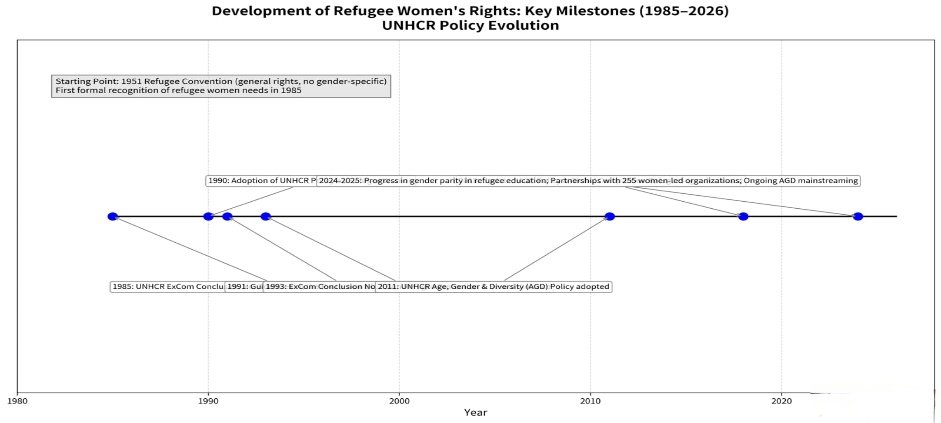 Graph: Key Milestones
CONCLUSION AND SUGGESTIONS
The plight of refugee women and girls stands as one of the most harrowing intersections of forced displacement and deep-rooted gender inequality. Across every stage , from the moment of flight in countries torn by conflict or systemic oppression, through perilous journeys marked by exploitation, to life in host countries or camps , they confront amplified dangers that go far beyond the universal hardships of exile. Gender-based violence (GBV) shadows them relentlessly: domestic abuse where states offer no protection, “honour” killings that families justify in the name of reputation, female genital mutilation, forced or early marriage, and sexual violence deployed as a weapon of war. These threats compound with barriers to education and livelihoods, untreated reproductive health crises, lack of menstrual hygiene, and profound exclusion from decision-making. The global scale is staggering: at the end of 2024, forced displacement reached a record 123.2 million people, easing only slightly to around 122.1 million by April 2025 and 117.3 million by mid-2025. Women and girls comprise roughly half of this population, yet in many protracted settings , particularly in Africa , GBV prevalence climbs as high as 48 per cent. Conflicts in Sudan, Afghanistan, and Ukraine have intensified what many describe as “wars on women,” with reports of conflict-related sexual violence surging by nearly 50 per cent and overwhelmingly affecting female victims.International legal frameworks have gradually evolved to address this reality. The 1951 Refugee Convention and 1967 Protocol, though originally gender-neutral, now incorporate gender-related persecution through UNHCR guidelines and judicial interpretation, particularly under the ground of “membership of a particular social group.” Landmark rulings, such as the CJEU’s 2024 decision in WS v State Agency for Refugees (Bulgaria), have affirmed that women facing domestic violence, honour crimes, or systemic gender-based harm can qualify as a protected social group, opening pathways to refugee status or subsidiary protection. Complementing this are powerful human rights instruments: CEDAW General Recommendation No. 32 (2014) demands fully gender-sensitive asylum procedures, trauma-informed approaches, intersectional analysis, and non-refoulement where GBV risks exist; the Istanbul Convention explicitly recognises violence against women as grounds for asylum; and broader covenants like the ICCPR and ICESCR impose due-diligence obligations to protect life, dignity, and health. These developments shift the paradigm from viewing women as passive dependents to recognising them as rights-holders with agency, entitled to participation and empowerment.In India, a significant non-signatory host to tens of thousands of refugees (including substantial numbers of Rohingya and Afghan women and girls), the picture is more fragmented. Without dedicated refugee legislation, authorities rely on the restrictive Immigration and Foreigners Act 2025 (which replaced the 1946 Foreigners Act), granting wide deportation powers with limited oversight. Judicial activism through constitutional Articles 14 (equality) and 21 (life and personal liberty) has provided crucial safeguards, extending non-refoulement and dignity protections to non-citizens, as affirmed in National Human Rights Commission v. State of Arunachal Pradesh (1996) and reinforced in 2025 Rohingya habeas petitions that scrutinised due process, arbitrary detentions, and allegations of mistreatment during expulsions. Yet ad hoc policies, executive deference on security grounds, and inconsistent application continue to expose women to heightened risks , from limited reproductive autonomy and GBV in camps to potential refoulement to situations of targeted violence in Myanmar or gender apartheid under the Taliban in Afghanistan. The 2025 funding shortfalls in global humanitarian programmes exacerbated these vulnerabilities, leaving millions , including an estimated 36 million displaced women and girls , without essential GBV services such as psychosocial support, safe shelters, medical care, or legal aid.
Despite these challenges, pockets of progress offer hope: increasing female leadership in some UNHCR-supported programmes (reaching 46 per cent in certain areas), growing involvement of women-led organisations, and calls for intersectional responses. However, these gains remain fragile amid ongoing conflicts, climate pressures, democratic backsliding, and chronic underfunding. The 2025 humanitarian cuts not only slashed GBV programming but also widened gaps in education, livelihoods, and protection, underscoring that displacement does not erase gender inequality , it often magnifies it.
A transformative response requires moving beyond patchwork measures to a holistic, gender-centred approach grounded in international standards and lived realities. India should urgently enact comprehensive refugee legislation that embeds non-refoulement as customary law, mandates gender-sensitive asylum procedures (including trauma-informed interviews by trained personnel and recognition of GBV as persecution), and establishes an independent national refugee authority with gender expertise. This law could draw from successful models like Bangladesh’s Rohingya response or the EU Qualification Directive, while aligning with CEDAW GR 32 to ensure non-discriminatory access to services, independent claims for women, and intersectional safeguards.
Domestic policies must be harmonised with CEDAW GR 32 and related recommendations, extending protections under laws like the Domestic Violence Act to refugees through targeted amendments. This includes training border officials, interpreters, and adjudicators on gender risks, creating confidential reporting mechanisms to combat stigma-driven underreporting, and guaranteeing access to reproductive healthcare, menstrual hygiene, and survivor-centred GBV support , priorities made even more urgent by the 2025 funding crisis.
Collaboration must deepen between UNHCR, host states, and women-led organisations (WLOs). Expanding UNHCR registration in India (currently covering around 50,000 refugees, half women and girls) to include WLOs in camp governance, GBV documentation, and programme design would foster culturally sensitive, community-driven solutions. Globally, scaling partnerships with the over 250 WLOs already engaged by UNHCR, coupled with dedicated funding to offset recent cuts, would boost refugee women’s participation and leadership.
Judicial training programmes should become standard, equipping judges with knowledge of evolving international norms , from CJEU gender jurisprudence to UNHCR guidelines and the Istanbul Convention , to promote consistent, trauma-informed rulings that balance security with rights and reduce risks of refoulement in GBV cases.
Empowerment initiatives must prioritise education, livelihoods, and governance participation. Vocational training, skills programmes, and integration into national education systems for Rohingya and Afghan women can break poverty cycles, while ensuring refugee women sit on camp committees would enhance decision-making power and reduce violence.
Additional critical steps include integrating the climate-gender nexus into protection policies, as environmental displacement disproportionately harms women through resource scarcity and heightened GBV risks; establishing independent monitoring bodies (involving national human rights commissions and civil society) for deportations, detention conditions, and rights compliance; expanding safe legal pathways and resettlement quotas targeted at women and girls facing acute dangers; and securing sustainable, multi-year funding for GBV prevention with earmarked support for WLOs, as highlighted in UNHCR’s appeals.
Finally, states should pursue global responsibility-sharing under the Global Compact on Refugees, ratify instruments like the Istanbul Convention where possible, and address root causes through the Women, Peace and Security agenda to promote inclusive conflict resolution and prevention.
Upholding the rights of refugee women and girls is not an optional humanitarian gesture , it is a fundamental affirmation of shared human dignity in an uncertain world. By centring gender in every layer of protection, from law and policy to funding and practice, the international community and nations like India can convert profound vulnerability into genuine empowerment. This shift would not only shield millions from harm but also build more resilient, equitable societies capable of weathering the displacements of tomorrow. The time for half-measures has passed; bold, coordinated action grounded in law, compassion, and justice is the only path forward.
*****
Footnotes
1. 1 Forced displacement disproportionately affects women and girls due to gender-based persecution, including honour killings and crimes of “dishonour,” which challenge the gender-neutral framing of refugee law. See UNHCR, Guidelines on International Protection No. 1: Gender-Related Persecution (HCR/GIP/02/01, 7 May 2002).
2. 2 Honour killings and dishonour-based violence are recognised as forms of gender-related persecution under “membership of a particular social group.” UNHCR, Guidelines on the Protection of Refugee Women (July 1991).
3. 3 Convention relating to the Status of Refugees (adopted 28 July 1951, entered into force 22 April 1954) 189 UNTS 137.
4. 4 1951 Convention & 1967 Protocol, https://www.unhcr.org/sites/default/files/2025-02/1951-refugee-convention-1967-protocol.pdf
5. 5 UNHCR 2002 Guidelines: https://www.unhcr.org/sites/default/files/legacy-pdf/3d58ddef4.pdf
6. 6 UNHCR, Guidelines on International Protection No. 1: Gender-Related Persecution (HCR/GIP/02/01, 7 May 2002).
7. 7 UN General Assembly, Universal Declaration of Human Rights, Res. 217 A (III), 10 December 1948
8. 8 CEDAW: United Nations Treaty Series (UNTS), vol. 1249
9. 9 UNHCR 1991 Guidelines: https://www.unhcr.org/sites/default/files/legacy-pdf/3d4f915e4.pdf
10. CEDAW/C/GC/32 (UN Treaty Body Reports, 2014) – official UN compilations.
11. Case C-621/21 WS v Intervyuirasht organ na Darzhavna agentsia za bezhantsite pri Ministerskia savet [2024] ECLI:EU:C:2024:47., Case C-646/21:, Case C-646/21 K.L. v Staatssecretaris van Justitie en Veiligheid [2024] ECLI:EU:C:2024:480
12. CJEU C-621/21 (16 Jan 2024): https://curia.europa.eu/juris/document/document.jsf?text=&docid=281302& doclang=EN
13. Court of Justice of the European Union, Judgment of 4 October 2024, AH & FN v Bundesamt für Fremdenwesen und Asyl (Joined Cases C-608/22 and C-609/22, Third Chamber) ECLI:EU:C:2024:7006
14. (1996) 1 SCC 742 (Supreme Court of India).National Human Rights Commission v. State of Arunachal Pradesh
15. Mohammad Salimullah v. Union of India, Writ Petition (Civil) No. 793 of 2017 (Supreme Court of India, interim order dated 8 April 2021).
16. Mohammad Ismail v. Union of India, Writ Petition (Criminal) No. 204 of 2025 (Supreme Court of India, order dated 16 May 2025).
17. Office Memorandum issued by the Ministry of Home Affairs (Government of India) dated 2 May 2025
18. Rita Manchanda v Union of India Writ Petition (Criminal) [2025] INSC
19. 1951 Convention: Convention Relating to the Status of Refugees (adopted 28 July 1951, entered into force 22 April 1954) 189 UNTS 137, arts 1A(2) and 33., 1967 Protocol: Protocol Relating to the Status of Refugees (adopted 31 January 1967, entered into force 4 October 1967) 606 UNTS 267.
20. UNHCR, Guidelines on the Protection of Refugee Women (Geneva: UNHCR, July 1991); UNHCR, Guidelines on International Protection No. 1: Gender-Related Persecution within the context of Article 1A(2) of the 1951 Convention and/or its 1967 Protocol relating to the Status of Refugees (HCR/GIP/02/01, 7 May 2002).
21. The Convention: 1249 UNTS 13 (CEDAW) General Recommendation No. 32:, CEDAW Committee,UN Doc CEDAW/C/GC/32., General Recommendations No. 38 and 39:, CEDAW Committee,CEDAW Committee, ‘General Recommendation No 39 on the rights of Indigenous women and girls’ (31 October 2022) UN Doc CEDAW/C/GC/39.
22. UNHCR, Policy on Refugee Women (1990); UNHCR, Guidelines on the Protection of Refugee Women (July 1991). These were supplemented by later instruments, including the 2002 Gender Guidelines.
23. Council of Europe
24. Directive (EU) 2024/1385 of the European Parliament and of the Council of 14 May 2024 on combating violence against women and domestic violence.
25. UDHR: https://www.un.org/en/about-us/universal-declaration-of-human-rights
26. ICCPR & ICESCR: https://www.ohchr.org/en/instruments-mechanisms/instruments
27. Global Compact on Refugees: https://www.unhcr.org/global-compact-refugees