
INTRODUCTION
In India, the criminal justice system is an essential institutional tool that the government uses to uphold public order, enforce the law, and defend individual rights. The system, which consists of the police, prosecution, courts, and jail administration, must work together to guarantee efficiency, justice, and constitutional compliance. However, ongoing structural flaws have made the criminal justice system more and more ineffectual, raising worries about delays, overcrowding in jails, poor investigations, and a decline in public confidence. These flaws represent deeper institutional, legal, and policy flaws ingrained in the system rather than being discrete operational errors. The ideals of due process, equality before the law, and the rule of law, which are mainly expressed in Articles 14 and 21 of the Indian Constitution, regulate criminal justice administration at the constitutional level. Article 21 has been interpreted by judges to include procedural justice, a prompt trial, and the humane treatment of inmates.1 The lived reality of criminal justice is nonetheless characterized by drawn-out trials, frequent pre-trial detention, and unequal access to justice, especially for socially and economically marginalized groups, notwithstanding this broad constitutional objective.
The colonial heritage of criminal laws is a major cause of systemic failure. Rather than promoting a rights-oriented justice system, the Indian Penal Code, 1860 and the procedural framework under the Code of Criminal Procedure, 1973 were largely created to uphold colonial order. Although these laws have undergone recurrent amendments, scholars contend that its structural orientation is still punitive and state-centric, with little focus on victim justice, rehabilitation, or proportionality.2 Coercive policing techniques and an over-reliance on incarceration are the results of this. These shortcomings are made worse by institutional fragmentation. The judiciary, police, prosecution, and jail administration sometimes operate independently with little accountability or collaboration. The Law Commission of India has frequently emphasized that inadequate investigation, feeble prosecution, and judicial backlog are interrelated shortcomings that together impede the administration of justice.3 According to scholarly research, one of the main causes of systemic inefficiency is the lack of an integrated “justice chain” approach.4
The inequity ingrained in the administration of criminal justice is another crucial factor. The poor, minorities, and other vulnerable populations bear a disproportionate amount of the burden of systematic delays and severe procedural processes, according to empirical and academic research. Criminal procedure becomes a tool of social exclusion rather than justice due to undertrial imprisonment, the inability to get bail, and restricted access to knowledgeable legal counsel.5 The constitutional guarantee of equal protection under the law is compromised by this institutional prejudice. Piecemeal remedies are insufficient, as courts, expert panels, and academics have increasingly acknowledged in recent decades. Comprehensive legal reform, institutional capacity building, and policy-level reorientation based on factual facts and constitutional ideals which are necessary to address systemic weaknesses. With an emphasis on trial delays, jail overcrowding, and police reforms, this work critically explores these shortcomings from legal, institutional, and policy perspectives and suggests methods to create a criminal justice system that is more effective, compassionate, and respectful of human rights.
DELAY IN CRIMINAL TRIALS: LEGAL CAUSES AND INSTITUTIONAL BOTTLENECKS
Trial delay within the criminal justice system of India constitutes one of the most significant systemic flaws within the Indian legal system and contributes directly to the denial of justice assured within the Indian Constitution itself. It has also accordingly become well-acknowledged within Indian society as well as within Indian case law and legal scholarship as a systemic failure as opposed to a one-time anomaly within the Indian legal system as well as within the Indian justice delivery system itself. From a constitutional foundation, it has been unequivocally clarified that a right to a speedy trial is a part of the right to life and liberty6 enshrined under Article 21 of the Indian Constitution by the Supreme Court of India in a series of landmark decisions known as Hussainara Khatoon Cases7, which highlighted the grim truth of a large number of under-trials languishing in jails for years without being adjudged, thereby recognizing delay, which was previously considered a mere administrative convenience, as a violation of constitutional rights.8
From the legal perspective, the main cause of delay is the procedural complexity involved in criminal trials. The adversary process, as important as it is for the integrity of the process, sometimes leads to gratuitous adjournments. The Code of Criminal Procedure of 1973 (Bharatiya Nagarik Suraksha Sanhita, 2023) still retains the practice of frequent adjournments and prolonged cross-examinations. The Law Commission has lamented this practice of frequent adjournments and expressed the view that “procedural law has become the instrument for deferment of decision rather than decision.”9 The cause for this has largely been attributed to institutional factors such as the shortage of judges and this has become a significant bottleneck. The trial courts, especially the magistrate courts, are working under enormous pressures with respect to criminal appeals as they handle hundreds of pending cases at the same time. It has been established by empirical research that the judge-population ratio and lack of court infrastructure can hamper the handling of cases effectively.10 The Law Commission has also held that without increasing the judicial staff, the right to speedy trial would remain illusory.11
Delay is further aggravated by unfruitful investigation and weak prosecution. Unfruitful investigation translates to charge sheets that are not complete, the loss of evidence, and testimonies by witnesses. According to academic literature, delays in investigations and trials not only extend the timeframe but also shift the responsibilities of failure in the justice chain.12 In that regard, the lack of harmonization between law enforcers and prosecutors in conducting trials further worsens the situation since trials are escalated while lacking adequate attention at pre-trial.
The cumulative effects of delays in cases are most apparent in the growing number of persons languishing as undertrials, with the potential to be held behind bars longer than the merits of the offense would warrant. This state of affairs causes the criminal process to become punitive, thereby diminishing the presumption of innocence that should be the hallmark of any criminal justice system.13 It is contended that these delays are symptomatic of the crisis of governance that pervades the country, where the inefficiency of the system hits the poor hardest.14 The issue of postponements of criminal cases goes beyond being a technical problem in the justice system and has become a structural issue requiring a complete overhaul and proactive judicial and prosecutorial management.
JUDICIAL PENDENCY AND INSTITUTIONAL CAPACITY CONSTRAINTS:
One of the most pervasive structural flaws in India’s criminal justice system is judicial pendency. Pendency demonstrates a deeper structural inability of courts to absorb, process, and resolve criminal litigation within an acceptable time frame, whereas trial delay appears at the level of individual cases. The functional validity of criminal adjudication is at risk due to the growing number of unresolved cases in trial courts, High Courts, and the Supreme Court. Scholars have frequently pointed out that pendency is a consequence of structural underinvestment, bad governance, and a lack of systematic planning in court administration rather than just an increase in crime or litigation.
The Supreme Court has recognized that excessive pendency weakens public trust in the court and directly threatens the constitutional right to prompt justice under Article 21. Since independence, Law Commission reports have repeatedly cautioned that procedural and legislative changes will remain mainly ineffectual until institutional capacity restrictions are addressed. According to scholarly research, court delay is not a legal need but rather a governance failing.15
Institutional Constraints Contributing to Judicial Pendency:
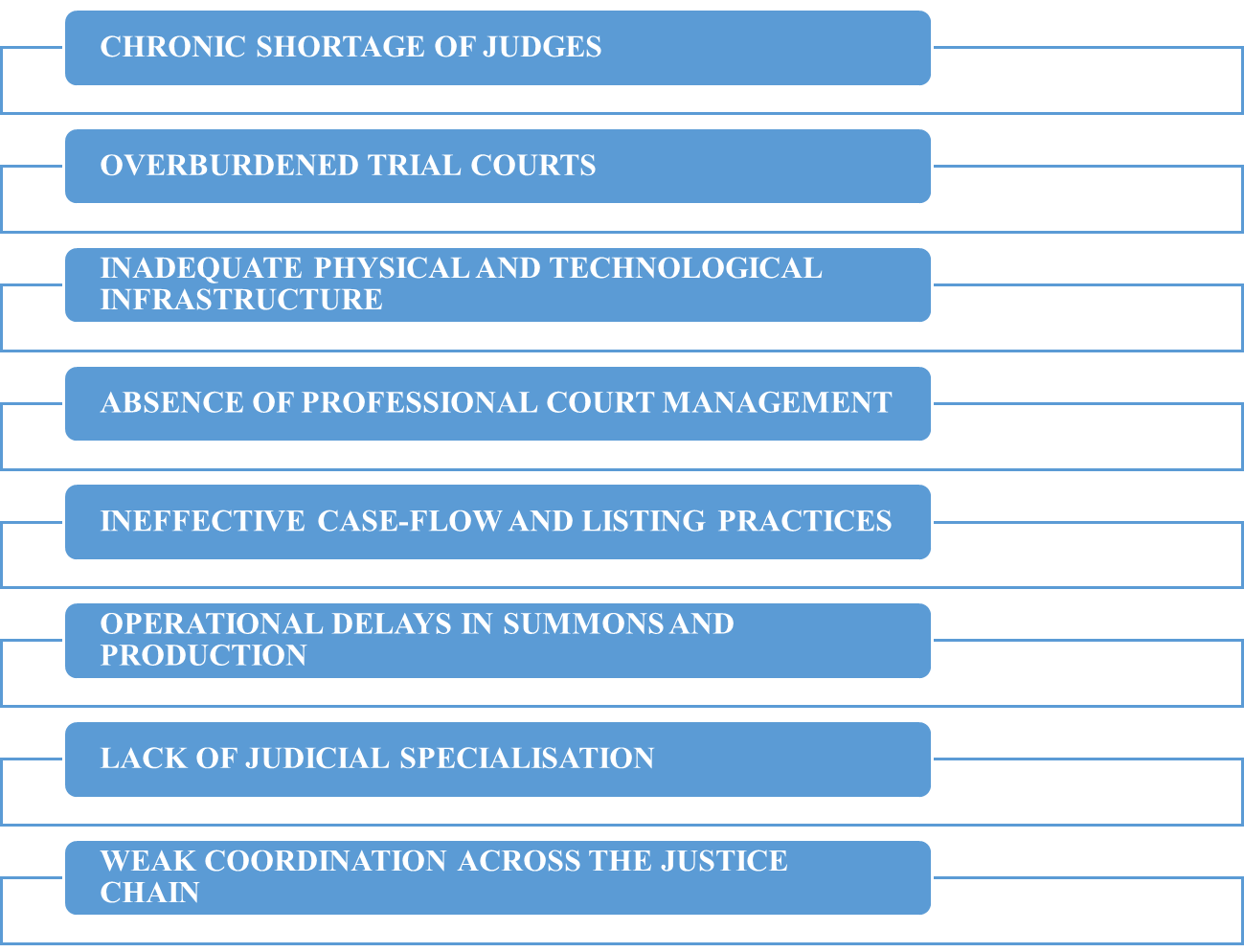
Fig. I
1. Chronic Shortage of Judges: Compared to similar constitutional democracies, India’s judge-to-population ratio is still far lower. The Law Commission has consistently emphasized that the single biggest factor contributing to the backlog of criminal cases is insufficient judicial power, especially at the subordinate court level. Scholars contend that rather than being a result of financial inability, this deficit is a reflection of a lack of political prioritization of justice delivery.16
2. Overburdened Trial Courts: Sessions and Magistrates Judges sometimes oversee hundreds of criminal cases at once, which leads to disjointed hearings and lengthy adjournments. Such workload demands significantly restrict court deliberation and case monitoring, as empirical judicial studies show.17
3. Inadequate Physical and Technological Infrastructure: Inadequate courtrooms, a dearth of digitized documents, subpar archive facilities, and a lack of qualified court employees plague many criminal courts. According to Chandrachud, infrastructure deficiencies compound pendency by turning simple procedural tasks into laborious exercises.
4. Absence of Professional Court Management: Judges are primarily responsible for overseeing both administrative and adjudicatory duties in Indian courts. The lack of qualified court managers is a significant barrier to effective case-flow management, according to comparative research.18
5. Ineffective Case-Flow and Listing Practices: There are no formal procedures in place for courts to prioritize cases that are past due, cases that are under trial, or major offenses. The lack of time restrictions and random listing, according to academics, allow pendency to spread institutionally.
6. Operational Delays in Summons and Production: Delays in obtaining witness attendance, delivering accused from jails, and serving summonses continue to be common reasons for adjournments. Rather than being solely the result of judicial discretion, these failures are the result of poor inter-institutional cooperation.
7. Lack of Judicial Specialisation: Without sufficient training or expertise, trial judges must decide a wide range of technically challenging cases, from cybercrime to economic offenses. Scholars contend that this weakens the uniformity and efficiency of adjudication.19
8. Weak Coordination Across the Justice Chain: Evidence production and witness examination are frequently delayed as a result of the division between courts, police, prosecution, forensic labs, and jail authorities. To solve this structural gap, academics support an integrated “justice chain” strategy.20
PRISON OVERCROWDING AND UNDERTRIAL CRISIS
Prison overcrowding, which is mostly caused by the high percentage of undertrial inmates, is one of the most glaring examples of systemic failure in India’s criminal justice system. In addition to placing a burden on basic infrastructure, overcrowding in jails violates internationally recognized principles of human dignity and constitutional rights. With a disproportionately high number of people detained in pre-trial custody and ongoing overcapacity, current data shows that this situation is dynamic rather than static.
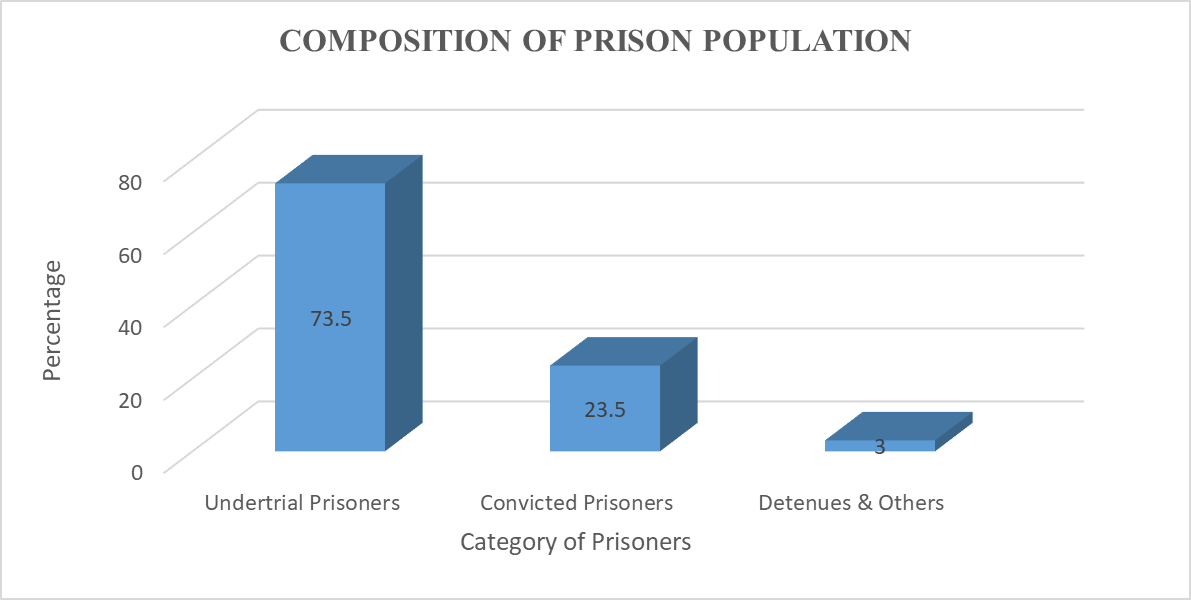
Fig. II
The most recent Prison Statistics India report (2023) states that there were over 5.30 lakh (530,000) inmates in India, spread among 1,332 jails across the country. Approximately 73.5% of this group were undertrial detainees, meaning that nearly three-fourths of the convicts were awaiting trial rather than having been found guilty by a court.21 Despite a little decrease from previous numbers (e.g., 75.8% in 2022), this ratio is still quite high.22 Approximately 74% of female detainees are in pre-trial status, making undertrials a similarly high rate among female inmates.23
Socio-legal analysis reveals that judicial pendency has a disproportionate social effect. The landmark thesis of Galanter reveals that judicial delay provides an advantage to repeat players in terms of resources. At the same time, it harms disadvantaged and marginalized plaintiffs.24 In addition, it has also been reported that increasing judicial delays make the criminal justice process a tool of structural inequality. Access to timely justice depends upon social and economic resources. In this regard, enhancing systemic capacity for handling these cases instead involves improving this capacity through appointments to the judiciary, infrastructure development, professional management, as well as evidence-based planning.
The problem of overcrowding is further demonstrated by prison occupancy rates. According to national estimates, prisons were operating at around 120.8% of their authorized capacity in 2023, which means that the typical jail was housing a lot more people than it was intended to. Its Overcrowding is even more severe in other areas: numerous district and central prisons were reported to be 149% or more over capacity, while metropolitan jails in the National Capital Region reported occupancy rates above 200%.25 Anecdotal evidence suggests that many institutions, such as Delhi’s Tihar Jail, held over 14,000 prisoners despite having a 5,200-person sanctioned capacity.26
The state-level statistics further accent the problem that in the state of Uttar Pradesh, over 77% of the jail population consists of undertrials as of early 2025, with the major prisons having significantly more people than intended.27 In the state of Andhra Pradesh, the number of undertrials exceeds the number of convicts by a conservative two to one. Thousands of undertrial prisoners in various states have spent several years in jail, including prisoners detained beyond the time limit of three to five years.
The social costs of overcrowding include reduced health care, degrading living conditions, increased exposure to infectious diseases, and mental strain. Recent observations point towards restricted health care services within the prison system, with a few prisoners (approximately 1.7%) identified with mental problems.28 It is generally observed by scholarly discussions on the matter that these figures are a result of not just negligence but a flawed system, which expects a high level of imprisonment but lacks pre-trial measures to cater to this end, which results in overcrowding as a consequent effect, as observed in the case among the poor and marginalized. A holistic approach towards addressing overcrowding in prisons must, therefore, involve bail reform, increased legal aid, case management, mechanisms for review of under-trials, and investment in infrastructure, but more importantly, a paradigm shift away from default detention and towards more rights-oriented and proportionate approaches in pre-trials.
| Country | Undertrial / Pre-trial Prisoners (%) | Key Characteristic |
|---|---|---|
| India | 73–75% | Trial delays; restrictive bail; high pendency |
| United States | 20–22% | High incarceration, faster trials |
| United Kingdom | 15–18% | Strong bail system; case management |
| Germany | 20% | Speedy trials; strict remand review |
| Japan | 10–12% | Low incarceration; rapid adjudication |
| Brazil | 30–35% | Delays exist, but lower than India |
Table I: Comparative Perspective: India and International Prison Systems29
An analysis of the correctional systems of various nations shows that the problem of prison overcrowding in India stands out not merely for the numbers involved but for the remarkably large number of undertrial prisoners. While numerous nations face the challenge of high incarceration rates, the problem that India faces stands out as it is procedural rather than punitive.30
HUMAN RIGHTS AND CONSTITUTIONAL JURISPRUDENCE ON PRISONS
The Indian jail administration is constitutionally obligated to maintain the dignity, freedom, and rights of convicts in the face of losing personal liberty. It has uniformly been held in the decisions of the Indian Supreme Court that the loss of personal liberty does not result in the loss of basic rights following imprisonment. The scope of the basic rights of convicts, under the Indian Constitution, lies within the framework of Article 21.31
The role played by judicial intervention in the humanization of prison conditions has been nothing short of transformative. In the case of Sunil Batra v. Delhi Administration32, the Supreme Court clearly held that convicts are in no way deprived of their rights. It termed practices such as solitary confinement and custodial violence as violative of the guarantees of the Constitution. In Charles Sobhraj v. Superintendent, Central Jail33, another important case, it was held that discipline in jail should be maintained in harmony with the concept of human dignity. It can be said that the Court brought about a transition between the punitive and rights-based approaches in the correctional administration.
The Court has also dealt with system-related issues involving prison overcrowding, undertrial imprisonment, and inhuman conditions of life. In the landmark case of Hussainara Khatoon v. State of Bihar34, the Court declared prolonged undertrial imprisonment to be unconstitutional, leading to the recognition of the right to speedy trial and humane imprisonment. According to scholarly literature, the above-mentioned cases reflect efforts to strike a balance between control of crime and constitutional morality, though there are implementation deficits at the administrative level.35
The Indian courts have increasingly harmonized the jurisprudence of prisons within the domestic legal system with the international human rights norms, with special focus on the Standard Minimum Rules for the Treatment of the Prisoners (United Nations), also referred to as the Nelson Mandela Rules.36 This despite the fact that they have non-binding force.37
Nonetheless, research indicates continued disregard for the rights of prisoners, especially undertrials and marginalized sections of society. It has also been suggested that despite their strong legal foundations, the judgments are institutionally weak and lack administrative adherence and accountability.38 Hence, for prison reforms to take place in India, it is not only important for the judiciary to remain vigilant but also for the laws to be well defined at the administrative and policy levels to make these principles a reality.
POLICE REFORMS: ACCOUNTABILITY, AUTONOMY AND PROFESSIONALISM
Police reform is an essential aspect of overcoming the weaknesses of the criminal justice system in India, where the police are the main law enforcers in the country. There are structural weaknesses in the law enforcement bodies in the Indian political and legal systems, which are shown by political intervention in the police, lack of accountability, inadequate training of law enforcement officers, or violation of human rights. It is generally believed that without reforming the law enforcement bodies, reforming the criminal justice system is incomplete.39 One of the major issues is related with the lack of functional autonomy. The random transfer of cops, political interference during investigations, and control of police administration by the executive affects neutral law and order enforcement. The Indian Supreme Court, in Prakash Singh vs. Union of India40, has acknowledged such shortcomings and has given directions regarding fixed terms for high-ranking officials, a division between investigations and law & order, and a Police Complaints Authority. Even after this, there has been inconsistent implementation of such directions in States.41
Another issue of similar importance is that of accountability and custodial violence. Court decisions make it clear that custodial torture and death constitute an infringement of Article 21 of the Constitution.42 But research indicates that internal accountability and external oversight bodies remain inefficacy ridden. An author suggests that this gives way to a culture of impunity, thus undermining constitutional governance.43 Another domain which warrants attention is professional competence. It is observed that Indian policing is heavily dependent on the confession method of investigation, to the extent that forensic, cyber, and scientific means are not adequately emphasized. There are certain deficiencies in training, manpower, and working conditions that, according to literature, contribute towards the inefficiency of the investigation process and violations of rights. It has been seen in certain research studies that rights-based policing, in conjunction with training, contributes towards better control over crime, as well as better legitimacy.44 In conclusion, in order for police reform to be effective, a delicate balance must be struck that shields the organization’s operational efficiency while at the same time ensuring that the institution embraces accountability and adheres to the norms enshrined in human rights laws.
INVESTIGATION, PROSECUTION, AND FORENSIC DEFICITS
The efficiency of the criminal justice system largely depends on its investigation and prosecution. In India, the lack of efficiency in these two areas can be said to be a major reason for the delays in trials and convictions in serious offenses. It has been ascertained that a weak investigation is the weakest link in the chain of justice.45
Investigations conducted by the police often get marred by improper handling of crime scenes, poor collection of evidence, overdependence on confession statements, and delay in forensic analysis. Not only does it lead to prolongation of trials, but it also affects the reliability of evidence. The Supreme Court has often held that improper investigation affects the right to a fair trial under Article 21, despite the accused being proved to be guilty.46 It has also been observed in academic literature that trial courts are plagued by the inefficiency of investigations, which forces the trial courts to make up for it through repeated adjournments.
However, a similar set of problems pertain to prosecution services too. It often happens that the prosecution appears before an overburdened judicial setup with insufficient preparation on the part of the prosecution. The lack of proper coordination between investigation officers and prosecution leads to charges being prepared in a defective manner, failing to place all the facts before the judiciary. The Malimath Committee pointed out that failure to involve the prosecution in the investigation process can damage the results in a trial.47
Another key chokepoint is forensic infrastructure. Even as science and digital evidence are increasingly relied upon, forensic services are faced with human capacity constraints and backlogs. It is contended that without forensic support and standardized evidence practices, reforms in procedures would fail to impact positively on adjudication.48 Improving investigations, prosecutions, and forensic services is essential to making the criminal justice process more efficient.
VICTIM JUSTICE, WITNESS PROTECTION AND LEGAL AID
The concern for the victims/witnesses falls into the margins within which the criminal justice system operates in India; it has been traditionally criminal-offender focused. The view has been raised concerning lack of appropriate participation for the victims and inadequate protection for witnesses, which impact largely on the conviction rates as well as the time involved in disposing these criminal cases.49
Court interventions have acknowledged the need for victim-centred justice. In the case of Zahira Habibullah Sheikh v. State of Gujarat50, the Supreme Court made it clear that the right to a free trial is also applicable to victims as well as to society. The establishment of victim compensation schemes under the Code of Criminal Procedure, 1973 is a positive development towards restorative justice.51
Hostility towards witnesses is a prevalent issue that still exists until now. The existence of a Witness Protection Scheme, approved by the Supreme Court, is a major development, but commentators observe that insufficient funding and support affects its efficacy.52 The facilities offered for legal aid, specifically for under-trials and victims belonging to marginalized sections, are marred with a dearth of quality and outreach programs.
LEGAL AND POLICY REFORMS: THE WAY FORWARD
The remediation of these shortcomings in the criminal justice system in India would require an integrated approach to reforms at the legal level, moving ahead from the current ad hoc measures being taken.53 Among these, the biggest priority would be bailing reforms, with the judiciary following a philosophy of liberty, wherein incarceration would be an exception rather than the rule, especially in non-violent crimes like economic offenses. Improving case management practices, rationalization of time standards for investigative and trial phases, as well as augmenting the judiciary’s strength, are critical for pendency reductions.54
The focus of the policies must also change to address non-custodial approaches like probation, community service, and plea-bargaining arrangements for petty offenses. Reforms in the police department must be made operational through the proper implementation of judicial orders to ensure autonomy, accountability, and professionalization. Enhancement of the forensic infrastructure and digital case management information technology network is required to increase the quality of evidence and the efficiency of trials. It has been argued by academicians that the required changes must take place in the justice chain, involving the police, prosecution, judiciary, and prison departments according to a rights and evidence-driven framework.
CONCLUSION
Today, the Indian criminal justice system is at a crossroads when the longstanding fault lines in the system can’t be remedied through piecemeal or stand-alone reforms. The fact is, as made apparent through the analysis in this article, the issue of delay in criminal trials, pendency, crowded jails, inefficient investigation and prosecution, victimization/witness issues, and lack of accountability in the police is a constellation of problems rather than discrete problems. These problems contribute to the denial of the liberties guaranteed by the constitution.”
The linkage which persists in these gaps is the over-reliance on the prison system and procedural formalism rather than efficiency, proportionality, and dignity. The over-representation of under-trials in prisons is a national issue wherein the process rather than the punishment becomes the sentence, in which the disadvantaged and marginalized sections of society are deprived of proper legal aid and are denied bail. Again, the delay in the judicial system highlights the weakness of the justice system which has not developed in accordance with the growing complexity of society and crime patterns rather than remaining aligned with technology upgradation.
This, too, reflects the fact that reform needs to go beyond the judicial and penal systems and include the police, prosecution, and victims support systems. In this regard, effective and accountable policing has a crucial role to play in ensuring credible investigations, and the need for effective prosecution and forensic services cannot be overstated if timely and accurate trial adjudication is to be ensured. What is equally significant is the need for a shift in focus of the criminal justice system, from one that sees victims and witnesses only as a source of evidence to one that sees these persons as rights-bearing participants.
Looking ahead, effective reform must adopt a holistic approach that takes into account values enshrined in the constitution. The proposed reform must place liberty at the forefront, address unnecessary criminalization, improve non-custodial sentencing options, develop judicial capacity, improve forensics, and facilitate a smooth chain reaction in the justice system. Data-driven decision-making, accountability, and political commitment must facilitate efforts aiming at implementing reform values.
*****
Footnotes
1. Maneka Gandhi v. Union of India AIR 1978 SC 597.
2. K.N. Chandrasekharan Pillai, R.V. Kelkar’s Criminal Procedure 12–15 (Eastern Book Company, Lucknow, 6th edn., 2017).
3. Law Commission of India, “14th Report on Reform of Judicial Administration” (1958).
4. Abhinav Chandrachud, Justice Delayed: A Comparative Study of Speedy Trial 22–25 (Oxford University Press, New Delhi, 2019).
5. Marc Galanter, “Why the ‘Haves’ Come Out Ahead” 9 Law & Society Review 95 (1974).
6. Supra note 1.
7. Hussainara Khatoon v. State of Bihar AIR 1979 SC 1369.
8. A.R. Antulay v. R.S. Nayak (1992) 1 SCC 225.
9. Law Commission of India, “77th Report on Delay and Arrears in Trial Courts” (1978).
10. Supra note 4 at 61-65.
11. Law Commission of India, “245th Report on Arrears and Backlog: Creating Additional Judicial Manpower” (2014).
12. Supra note 2 at 503-507.
13. Supreme Court Legal Aid Committee v. Union of India (1994) 6 SCC 731.
14. Upendra Baxi, “Access to Justice and the Crisis of the Indian Legal System” 33 Journal of the Indian Law Institute 271 (1991).
15. S.P. Sathe, Judicial Activism in India 112–115 (Oxford University Press, New Delhi, 2nd edn., 2003).
16. Pratiksha Baxi, “Justice Is a Secret: Compromise, Custody and Criminal Justice” 40 Journal of Indian Law Institute 34 (1998).
17. Nick Robinson, “Judicial Architecture and Capacity” 6 NUJS Law Review 1 (2013).
18. Malcolm Feeley, Court Reform on Trial 55–59 (Basic Books, New York, 1983).
19. M.P. Jain, Indian Constitutional Law 1402–1406 (LexisNexis, Gurugram, 8th edn., 2018).
20. Malimath Committee, “Report of the Committee on Reforms of Criminal Justice System” 89–94 (Ministry of Home Affairs, 2003).
21. National Crime Records Bureau, Prison Statistics India 2023 (Ministry of Home Affairs, Government of India) (approx. data as per NCRB reporting).
22. “74% of Prisoners Are Undertrials,” Times of India (Oct. 2025).
23. “Undertrials Comprise 74% of Prison Population,” Meghalaya Monitor (Oct. 2025).
24. Malimath Committee, “Report of the Committee on Reforms of Criminal Justice System” 89–94 (Ministry of Home Affairs, 2003).
25. India Justice Report 2025 and state jail overcrowding figures.
26. “Tihar Jail Overcrowding,” Wikipedia, Tihar Prisons (Dec. 2023).
27. “Jails in Noida & Ghaziabad Overcrowded (UP 77% Undertrial),” Times of India (Aug. 2025).
28. “1.7% of Jail Inmates Faced Mental Health Issues,” Times of India (Oct. 2025).
29. United Nations Office on Drugs and Crime, World Prison Population List (13th edn., 2021) (estimates of incarceration rates, pre-trial detainee proportions, global comparisons).
30. Institute for Crime & Justice Policy Research, World Prison Brief (London) (data accessed 2025).
31. Maneka Gandhi v. Union of India AIR 1978 SC 597.
32. AIR 1978 SC 1675.
33. AIR 1978 SC 1514.
34. AIR 1979 SC 1369.
35. Upendra Baxi, “The Supreme Court and Prisoners’ Rights” 10 Journal of Indian Law Institute 129 (1968).
36. United Nations, Standard Minimum Rules for the Treatment of Prisoners (Nelson Mandela Rules), UN Doc. A/RES/70/175 (17 Dec. 2015).
37. Inhuman Conditions in 1382 Prisons, In re, (2016) 3 SCC 700.
38. V. Venkatesan, “Prison Reforms and the Indian Constitution” 51 Journal of the Indian Law Institute 123 (2009).
39. David H. Bayley, Police for the Future 15–18 (Oxford University Press, New York, 1994).
40. (2006) 8 SCC 1.
41. Commonwealth Human Rights Initiative, Status of Police Reforms in India 22–25 (New Delhi, 2020).
42. D.K. Basu v. State of West Bengal AIR 1997 SC 610.
43. Pratiksha Baxi, “Police, Courts and Custodial Violence” 40 Journal of Indian Law Institute 56 (1998).
44. Jerome H. Skolnick & David H. Bayley, Community Policing: Issues and Practices Around the World 33–36 (U.S. Department of Justice, 1988).
45. Upendra Baxi, The Crisis of the Indian Legal System 67–70 (Vikas Publishing House, Delhi, 1982).
46. Zahira Habibullah Sheikh v. State of Gujarat, (2004) 4 SCC 158.
47. Government of India, “Report of the Committee on Reforms of Criminal Justice System” 125–128 (Ministry of Home Affairs, 2003).
48. M.P. Singh & R.P. Sinha, Administration of Criminal Justice in India 243–246 (Eastern Book Company, Lucknow, 2017).
49. Pratiksha Baxi, “Victims, Witnesses and Criminal Justice” 44 Journal of Indian Law Institute 120 (2002).
50. (2004) 4 SCC 158.
51. The Code of Criminal Procedure, 1973, s. 357A. (s. 396 of BNSS, 2023)
52. Mahender Chawla v. Union of India (2019) 14 SCC 615.
53. Arnesh Kumar v. State of Bihar (2014) 8 SCC 273.
54. Law Commission of India, “245th Report on Arrears and Backlog: Creating Additional Judicial Manpower” (2014).