The role of the police in rape cases cannot be overstated. Rape is a heinous crime, and it is the police who come into immediate contact with the victim in its aftermath. The manner in which a rape case is handled by the police is among the most contested issues in criminal justice systems across the world, and the role and duties of the force in such cases invite numerous questions.1,2 An investigation into rape is a critical assignment for a police officer, who has to deal at once with the victim, the perpetrator and the case itself.3
Research from the United States, Australia, the United Kingdom, South Korea and Norway has documented contrasting approaches among male and female police officers towards rape victims, and has found that some officers hold negative attitudes towards complainants. Sleath and Bull’s systematic review synthesises this body of work on police officers’ attributions of blame to rape victims, their assessments of victim credibility and their acceptance of rape myths, and examines whether those attitudes affect investigative decision-making in rape cases.4 Wentz and Archbold, surveying 100 patrol officers in a Midwestern agency in the United States, found no significant difference between male and female officers in their perceptions of sexual assault victims, although their qualitative material lent some support to the intra-female gender hostility thesis, which posits that female officers subscribe to rape myths and victim blaming to a greater degree than their male colleagues.5 Venema’s grounded-theory study of officers in a mid-sized department in the Great Lakes region found that officers sort reported sexual assaults into schemas of real rape, ambiguous cases and false reports, and the officers themselves described how these perceptions may or may not influence their response to a case.6 Vulnerability and victim blaming are inseparable from the handling of a rape complaint. Vik and colleagues, comparing Norwegian police investigations of rape against women with and without vulnerability factors, found vulnerability present in 68 per cent of victims and reported an adjusted odds ratio of 2.1 for a low-quality police investigation where the victim was vulnerable, while cautioning that the results do not establish that rape myths existed among the officers concerned.7
To trace the course of a rape case, one has to ask sequentially how it moves through the different layers of investigation. Kaithwas and Pandey attribute the incompetence of the police in investigating rape cases in India to a lack of proper training and infrastructure, and identify patriarchal attitudes, hierarchy and political pressure as challenges confronted during both the registration of the first information report and the investigation that follows. Officers interviewed in that study reported that seniors often neglected or declined to register a first information report for rape, and the authors locate part of the responsibility for the high level of reported sexual violence across Indian states in police negligence and a weak investigation system.8
The English word ‘rape’ dates from the fourteenth century,9 whereas the term entered Indian legal usage considerably later. Sexual humiliation and sexual assault are, however, old practices on the Indian subcontinent. Rape was recognised as an offence in Indian statute law with the enactment of the Indian Penal Code, 1860, which came into force on 1 January 1862; the first Code of Criminal Procedure was Act XXV of 1861. As enacted, the Penal Code dealt with the offence in sections 375 and 376 alone. Sections 376A, 376B, 376C and 376D are separate sections rather than sub-sections of section 376, and they were inserted into the Penal Code by the Criminal Law (Amendment) Act, 1983.10 Sections 376AB, 376DA and 376DB were inserted into the Penal Code, and not into the Indian Evidence Act, 1872, by the Criminal Law (Amendment) Act, 2018.11 The Code of Criminal Procedure was recast in 1973 with revised provisions bearing on rape, and the Protection of Children from Sexual Offences Act, 2012 was enacted as a standalone special statute for sexual offences against children, operating alongside the amended provisions of the Penal Code.12 Dedicated women’s police stations, designed to handle crimes against women, are a recent addition in West Bengal: data of the Bureau of Police Research and Development record no women’s police station in the state in 2011 and the first ten a year later.13
The Criminal Law (Amendment) Act, 2018 made three changes of note to section 376. In sub-section (1) it substituted ten years for seven years as the minimum term of rigorous imprisonment. Clause (i) of sub-section (2), which dealt with rape of a woman under sixteen years of age, was omitted and that case was relocated to a new sub-section (3) carrying a minimum of twenty years, the remaining clauses of sub-section (2) being left in place. Section 376AB was inserted after section 376A, and sections 376DA and 376DB after section 376D. Section 376E, which provides for repeat offenders, was already in force, having been inserted by the Criminal Law (Amendment) Act, 2013.14 The punishments prescribed under section 376 and its allied sections are set out in Table 1.
| Section of the Penal Code | Criminal act | Bail | Punishment |
|---|---|---|---|
| 376 | (a) Rape; (b) rape by a police officer, public servant, member of the management or staff of a jail, remand home or hospital, relative, guardian or person in a position of trust; (c) rape of a woman under sixteen years of age | (a) Non-bailable; (b) non-bailable; (c) non-bailable | (a) Rigorous imprisonment for not less than ten years, extendable to imprisonment for life, and fine; (b) rigorous imprisonment for not less than ten years, extendable to imprisonment for life meaning the remainder of natural life, and fine; (c) rigorous imprisonment for not less than twenty years, extendable to imprisonment for life meaning the remainder of natural life, and fine |
| 376A | Rape causing death or resulting in a persistent vegetative state of the victim | Non-bailable | Rigorous imprisonment for not less than twenty years, extendable to imprisonment for life meaning the remainder of natural life, or death |
| 376B | Sexual intercourse by a husband with his wife during separation | Bailable | Imprisonment for not less than two and not more than seven years, and fine |
| 376C | Sexual intercourse by a person in a position of authority | Non-bailable | Rigorous imprisonment for not less than five and not more than ten years, and fine |
| 376D | Gang rape | Non-bailable | Rigorous imprisonment for not less than twenty years, extendable to imprisonment for life meaning the remainder of natural life, and fine payable to the victim |
| 376E | Repeat offender previously convicted of an offence under section 376, 376A, 376AB, 376D, 376DA or 376DB | Non-bailable | Imprisonment for life meaning the remainder of natural life, or death |
| 376AB | Rape of a woman under twelve years of age | Non-bailable | Rigorous imprisonment for not less than twenty years, extendable to imprisonment for life meaning the remainder of natural life, and fine, or death |
| 376DA | Gang rape of a woman under sixteen years of age | Non-bailable | Imprisonment for life meaning the remainder of natural life, and fine |
| 376DB | Gang rape of a woman under twelve years of age | Non-bailable | Imprisonment for life meaning the remainder of natural life, and fine, or death |
Table 1: Sections of the Indian Penal Code, 1860 on rape and the punishments prescribed, as amended to 2018
The criminal justice system operates as a stimulus and response mechanism within society, and both rape and policing are embedded in Indian culture under different names and forms. Historians locate the origin of the Indian policing system in the early Vedic period, the Rig Veda and the Atharva Veda reflecting several categories of crime.15 A uniform policing system was established across British India by the Police Act, 1861, and the Indian Police Commission of 1902 to 1903, known as the Fraser Commission, was appointed to review its working. The West Bengal State Police is among the oldest forces in India, having been raised under the Police Act, 1861, and the state policing apparatus was later divided into two major arms, the West Bengal Police and the Kolkata Police.
The Kolkata Police, formerly the Calcutta Police, has functioned as an autonomous force since 1866 under the Calcutta Police Act, 1866 and the Calcutta Suburban Police Act, 1866.16 During the period of fieldwork the force listed eighty police stations, eight of them women’s police stations, under its headquarters at Lalbazar, along with a number of specialised units; the number of stations has since changed. Rape cases are chiefly dealt with by the Women Grievance Cell at Lalbazar. The West Bengal Police is organised into six major divisions. The Armed Police, trained with heavy weapons, is divided into the State Armed Police Force and the India Reserve Battalion. The District Police covers twenty-eight police districts, four of which are Government Railway Police districts, and maintains law and order across the state. Six police commissionerates, at Asansol-Durgapur, Barrackpore, Bidhannagar, Chandannagar, Howrah and Siliguri, cover the principal urban agglomerations. The Disaster Management Group deals with natural and manmade disasters; women’s police stations are designed to address crimes against women and to provide support to complainants; and the remaining units include the village police, the intelligence branch, the state crime records bureau and the civic volunteers. The district police are distributed across the police stations of West Bengal, so that ground-level officers deal with criminal offences and are directly involved in the investigation of rape. Women’s police stations perform the same function.
In the compilation of national figures published by World Population Review, which draws on data reported to the United Nations Office on Drugs and Crime, Brazil records the largest number of reported rapes among the countries with recent figures, while the latest figure the compilation gives for India dates from 2013, at 2.6 reported rapes per 100,000 population; figures drawn from different years and different recording practices are not strictly comparable.17 Within India, the incidence of reported rape has fluctuated from year to year and declined over the period as a whole, while the picture in respect of conviction is different. The conviction rate in a jurisdiction depends on the working of its criminal justice system. According to data released by the National Crime Records Bureau, the conviction rate in rape cases in India was 39.3 per cent in 202018 and 27.8 per cent in 2019.19 The same data reveal a striking ratio between the cases that enter the system and those that end in conviction.20,21 Of the 43,143 rape cases available for investigation in 2020, 23,693 were charge-sheeted, and of the trials completed that year 3,814 ended in conviction.22 The number of rape cases registered in India was 33,356 in 2018, 32,033 in 2019, 28,046 in 2020 and 31,677 in 2021.23
For West Bengal, the number of rape cases registered was 1,069 in 2018, 1,069 in 2019, 1,128 in 2020 and 1,123 in 2021; the repetition of the 2018 figure for 2019 reflects the carrying forward of the state’s 2018 data in the 2019 volume.24 The conviction rate in rape cases in the state fell from 16.1 per cent in 2018 to 9.5 per cent in 2019 and 3.1 per cent in 2020, and in 2021 West Bengal recorded the lowest conviction rate among the states for crimes against women taken as a whole, 2.5 per cent, with 98.1 per cent of such cases pending trial at the end of the year.25
These figures raise questions about the role of the police in West Bengal, and in particular about the measures taken during the investigation of rape. Public discussion of such cases is also shaped by the way they are reported: experimental work on the newspaper portrayal of rape victims shows that the framing of a report measurably shifts readers’ attribution of blame.26 The police administration is frequently held responsible for the handling of rape cases. To form a clearer view, the exact procedure for the investigation of rape and the way in which cases are dealt with by the police have to be examined.
The objectives of this paper are:
1. to understand the procedure followed by the police in the investigation of rape in India, together with its strengths and weaknesses;
2. to examine the flexibility exercised between law and action by police personnel during investigation; and
3. to identify the primary intentions behind rape as perceived by police officers through the lens of their working experience.
The empirical qualitative data for this research were drawn from ground-level police officers posted at different police stations in West Bengal. A schedule prepared for the purpose was approved by the West Bengal Police headquarters, and data were collected through that approved schedule. After the necessary ethical permission was obtained from the headquarters, respondents were identified by snowball sampling. Of 192 police personnel initially and purposively identified as having experience of investigating rape, 110 gave verbal consent to take part, and those 110 constitute the study population. They belong to different ranks: junior constables, who form part of the investigating team; senior constables and head constables, who record the first information report; assistant sub-inspectors, who interrogate the accused and other suspected persons; and sub-inspectors, who prepare the charge sheet. The ranks span both the Kolkata Police and the West Bengal Police. Male officers made up 74.5 per cent and female officers 25.5 per cent of the sample. The fieldwork covered 43 police stations across West Bengal between June 2022 and March 2023. The statements of the officers were subjected to narrative analysis in order to draw out the underlying meanings relating to law and order and their perception of rape against contemporary social developments. The study was approved by the Institutional Ethical Committee of the University of Calcutta vide Ref. No. CUI EC/01/10/2022-2023.
The socio-demographic profile set out in Table 2 shows that 39.09 per cent of the respondents have between one and five years of working experience and 8.18 per cent between sixteen and twenty years. Officers of the West Bengal Police outnumber those of the Kolkata Police in the studied group. The largest group of participants, 49.09 per cent, falls in the age band of 28 to 37 years, while 6.36 per cent are between 38 and 47. In terms of educational attainment, 64.54 per cent have passed higher secondary, 25.45 per cent are graduates and 10.0 per cent hold a master’s degree. Most of the officers are Hindu (82.72 per cent), the remainder Muslim (10.90 per cent) and Christian (6.36 per cent). As to marital status, 60.0 per cent are unmarried, 33.63 per cent married, 4.54 per cent divorced and 1.81 per cent separated.
| Variable | Category | Number | Percentage |
|---|---|---|---|
| Sex | Male | 82 | 74.55 |
| Female | 28 | 25.45 | |
| Age | 18 to 27 years | 49 | 44.54 |
| 28 to 37 years | 54 | 49.09 | |
| 38 to 47 years | 7 | 6.36 | |
| Educational status | Higher secondary | 71 | 64.54 |
| Graduation | 28 | 25.45 | |
| Post-graduation | 11 | 10.00 | |
| Designation | Junior police constable | 69 | 62.72 |
| Senior police constable or head constable | 7 | 6.36 | |
| Assistant sub-inspector | 11 | 10.00 | |
| Sub-inspector | 19 | 17.27 | |
| Inspector | 4 | 3.63 | |
| Working area | Kolkata Police | 27 | 24.55 |
| West Bengal Police | 83 | 75.45 | |
| Working experience | 1 to 5 years | 43 | 39.09 |
| 6 to 10 years | 31 | 28.18 | |
| 11 to 15 years | 27 | 24.54 | |
| 16 to 20 years | 9 | 8.18 | |
| Marital status | Unmarried | 66 | 60.00 |
| Married | 37 | 33.63 | |
| Divorced | 5 | 4.54 | |
| Separated | 2 | 1.81 | |
| Widowed | 0 | 0.00 | |
| Religious community | Hinduism | 91 | 82.72 |
| Islam | 12 | 10.90 | |
| Christianity | 7 | 6.36 |
Table 2: Socio-demographic profile of the studied police personnel (n = 110)
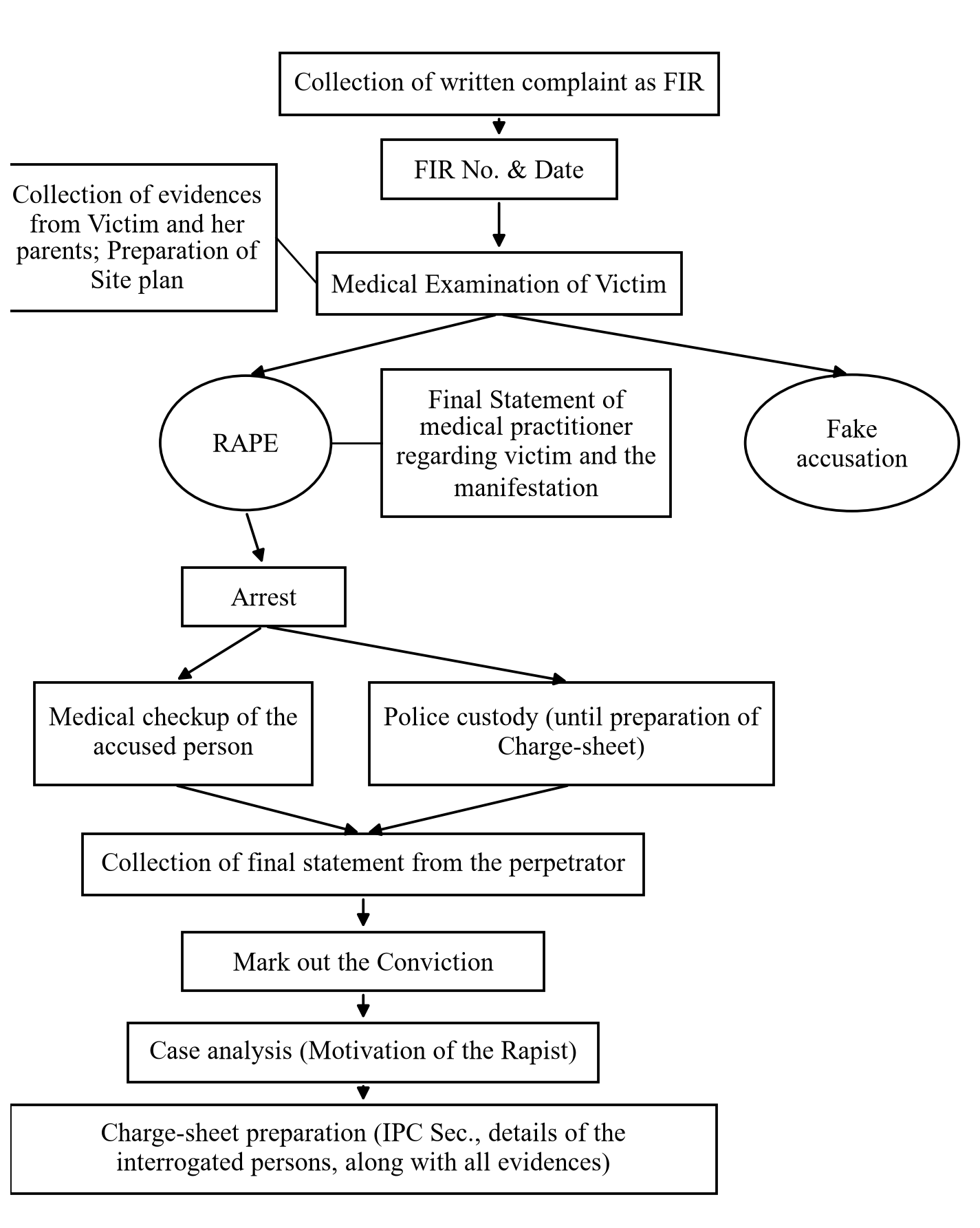
The Manual of Human Rights for Police Officers (2011) highlights two aspects of the investigation of rape cases by the Indian police: that the case be handled sensitively, and that the victim and the accused be referred for medical examination promptly after the information is recorded. Both requirements were reflected in sections 164A and 53A of the Code of Criminal Procedure, 1973, which was the Code in force throughout the period of this study.27 The investigation of a rape case has to pass through a number of stages within a stipulated time frame. The sequence is set out in Figure 1.
Figure 1: Investigation process from FIR to charge sheet.
Information about a crime reaches the police from a variety of sources.28 This study found that the first intimation of a rape case comes from an eyewitness, hospital staff, traffic police, a truck or bus driver, the victim herself, or a patrolling team. According to the officers interviewed, hospital staff play a vital part: gynaecological examination or treatment of a victim has brought to light cases that were otherwise unreported. Eyewitnesses matter particularly in gang rape and stranger rape, since they are often the first to reach the victim and call the police. Of the 110 officers, the largest groups identified hospital staff (26.09 per cent) and eyewitnesses (17.39 per cent) as the primary source, apart from the victim herself (18.84 per cent). Officers also identified relatives of the victim (11.59 per cent), a truck or bus driver (13.04 per cent), traffic police (5.80 per cent) and a patrolling team (7.25 per cent) as informants.
The first information report is the first step in initiating an investigation into a cognizable offence. Under section 154(1) of the Code of Criminal Procedure, 1973, information relating to the commission of a cognizable offence, if given orally to the officer in charge of a police station, was to be reduced to writing by him or under his direction, read over to the informant, and signed by the informant; there was no requirement that the informant hand in a written complaint.29 The first proviso to section 154(1) further required that where the information related to an offence under section 326A, 326B, 354, 354A, 354B, 354C, 354D, 376, 376A, 376AB, 376B, 376C, 376D, 376DA, 376DB, 376E or 509 of the Penal Code, it be recorded by a woman police officer or any woman officer.30 Section 154 ordinarily contemplated that the report be lodged at the police station within whose territorial jurisdiction the offence was committed. The practice of the zero first information report allows the information to be recorded at any police station and then transferred to the station having jurisdiction; it rests on section 154 read with section 156(2) of the Code, which bars any challenge to an investigation on the ground that the officer lacked territorial competence, as applied by the Supreme Court in Satvinder Kaur v. State (Government of NCT of Delhi), and on the holding in Lalita Kumari v. Government of Uttar Pradesh that registration is mandatory where the information discloses a cognizable offence.31
According to the officers, a victim usually comes to the police station nearest her residence with her parents or neighbours; where she is severely injured or unconscious, the police must go to her to record the information. In cases of child rape the officers said that the report is attended to by the victim’s parents and a senior woman constable records her statement, while in other rape cases the senior head constable, male or female, records it. No time limit is fixed for lodging a first information report, and a victim may report the offence when she is ready to seek justice.32 Delay is nonetheless material at trial, where the prosecution is expected to explain it. That expectation is a judge-made evidentiary principle rather than a requirement of section 154, which says nothing about time. Inordinate delay may cast doubt on the medical evidence and on the identification of the accused, but it is not by itself fatal to the prosecution: in Ashok Surajlal Uike v. State of Maharashtra the Supreme Court held that a short delay in lodging the report was of very little significance in a rape case, the family’s sense of shame explaining it, and upheld the conviction although the medical examination, conducted three days after the incident, found nothing to suggest rape and the doctor could give no definite opinion.33
According to 65.22 per cent of the respondents, no first information report for rape had been lodged at their police station during the previous three years, while 26.9 per cent had dealt with between one and five such reports a year. The data show that officers of the Kolkata Police recorded more cases than those of the West Bengal Police; eleven Kolkata officers had recorded an average of three cases over the preceding three years. The level of documentation reflects the willingness of victims to come forward. A substantial number of rape cases nonetheless go unreported, because of anxiety about medical examination and about repeated interrogation at the police station and in the courtroom.34 Diya Das of the West Bengal Police (name changed), posted at Jalangi police station in Murshidabad district, observed that ‘sex is an issue of the chastity of a woman, and people are frightened to make it public’. How large the unreported share is cannot be established from official statistics, since the Crime in India series records only registered offences and publishes no estimate of the level of under-reporting.35
Several officers of the West Bengal Police prefer to record a general diary entry before a first information report, in order to guard against false accusations. Sanjib Pathak (name changed) of the West Bengal Police, posted in South 24 Parganas, stated that ‘sometimes rape has been used as a weapon to defame someone else, especially in case of political affairs or any property issue of a family... hence a GD will help to initiate a primary investigation whether rape has been committed or not with that person.’ The practice stands in tension with the mandatory registration requirement noted above.
The investigation of a crime turns on identifying the factors that help to solve it. Once a first information report has been lodged, the officer in charge, generally an inspector, calls an in-house meeting to form a core investigating team. The team is usually composed of one or two experienced male sub-inspectors, a woman sub-inspector, whose presence is mandatory, two or three constables and some civic volunteers, and its composition is the same in the Kolkata Police and the West Bengal Police. Once the team is constituted the police begin the investigation and initiate the process of invoking the appropriate provisions of the Penal Code, or of a special or local law, against the accused.36
After the investigating team is formed, the first task of the police is to send the victim for medical examination. Without it, distinguishing rape from a false accusation is difficult. Section 164A of the Code governed the medical examination of a rape victim and required that she be sent to a registered medical practitioner within twenty-four hours from the time the information relating to the offence was received, the examination being conducted with her consent or the consent of a person competent to give it on her behalf.37 Eyewitness testimony is rare in such cases, so the medical report is the first evidentiary step. Bathing or washing may diminish the physical evidence of rape.38 For the same reason the examination should be held within three days if its findings are not to become uncertain.39 Subir Poria (name changed) of Jagachha police station in Howrah district said that ‘for a child, parents do not allow them to undergo medical examination... even after lodging an FIR, they withdraw the cases apprehending fear and scandals’. Anita Jana (name changed) of Sreerampur police station in Hooghly district said that ‘a few medical practitioners intentionally delay handing over medical reports to the police... various influential factors are responsible for this.’ Difficulties may also arise on the part of the victim. Where a woman is sexually experienced, vaginal injury may be absent, and in the absence of other injuries the possibility of the complaint being treated as false increases.
Section 53A of the Code provided for the medical examination of a person accused of rape. The examination by a registered medical practitioner was to record marks of injury, if any, on the person of the accused, a description of the material taken from him for DNA profiling, and other material particulars in reasonable detail, and the report was to state precisely the reasons for each conclusion arrived at.40
A site plan helps to visualise the context of the crime, and must be drawn by the investigating officer, usually immediately after the first information report is lodged and, according to West Bengal Police respondents, within a day. The site plan reflects the details of the report and must correspond to the statement of the eyewitness or of the victim. Delay in preparing it can create difficulty later: spot evidence may be manipulated, and the delay may be used to argue that the report was not lodged when it is said to have been.41
An arrest is made on the charge of a criminal offence. In gang rape the arrest of all the accused may take time; according to the officers, offenders usually leave the place immediately after the offence and sometimes assume a different identity.
Arrest must be made in accordance with the Code: section 60A provided that no arrest was to be made except in accordance with the provisions of the Code or of any other law providing for arrest.42 Clear identification of the offender is needed, and a memorandum of arrest, attested by at least one witness and countersigned by the arrested person, must be prepared.43 Asis Bera (name changed) of Dhakuria police station in Kolkata described the practice: ‘usually we arrest the person by holding his collar of the shirt or by catching his hand and throwing him into police custody’. Section 46 sets out the manner of arrest. Its proviso presumes a woman’s submission to custody on an oral intimation of arrest and bars the officer from touching her unless the circumstances otherwise require or unless the officer is herself a woman; it does not confine the power of arresting a woman to women officers.44 Officers of the West Bengal Police said that a team of five to eight personnel commonly surrounds a suspected area to arrest an absconding accused, and that where the perpetrator is known to the victim the arrest is easier. Rape under section 376 of the Penal Code is a cognizable and non-bailable offence, so the accused is ordinarily arrested without a warrant under section 41; where a warrant is issued, section 70 prescribes its form, signature, seal and duration.45 Once arrested, the accused is taken into custody for medical examination and identification.
A great deal of interrogation takes place between the first information report and the charge sheet, and corroboration or conflict between statements gives a case its shape. After the report is recorded the first round of questioning involves the victim, her parents, any eyewitness, neighbours and anyone else the investigating officer considers necessary. Investigating officers interrogate the victim, the accused and others suspected of complicity.46 In taking a statement from an accused the police must keep within limits: coercive or intimidating questioning is impermissible, and third degree methods are prohibited by Article 20(3) of the Constitution, by section 24 of the Indian Evidence Act, 1872 and by the directions of the Supreme Court in D.K. Basu v. State of West Bengal.47
Statements made to the police in the course of investigation were recorded under sections 161 and 162 of the Code. Section 281 governs a different record, that of the examination of the accused by a Magistrate or Court: the whole of the examination, including every question put and every answer given, is recorded in the language in which the accused is examined or, where that is not practicable, in the language of the court, and the record is shown or read to him, or interpreted to him in a language he understands, so that he may explain or add to his answers, before it is signed by him and by the Magistrate or presiding judge.48 The field material illustrates the practice: in FIR No. 236/13 at Nischinda police station in Howrah district, registered under section 376(2) of the Penal Code, the written statement of the accused was taken in Hindi and later rendered into Bengali and English, with his signature and consent recorded.
Accused persons do not always give a statement readily, and interrogation can become protracted. Techniques such as the polygraph, narcoanalysis and brain mapping exist, but the Supreme Court has held in Selvi v. State of Karnataka that their involuntary administration is unconstitutional.49 No officer in this study group had used any of these techniques in a rape investigation. Statements of witnesses, parents, neighbours and suspected persons are also recorded in writing, and may either contradict the prosecution case or support it.50,51 The victim’s statement is taken twice during the investigation, first in the form of the first information report and again after her medical report is received; the two must be consistent with each other and with the circumstantial evidence. Copies of all these statements are annexed to the charge sheet along with the report and the medical reports of the victim and the accused.
Evidence such as the clothes and jewellery worn by the victim at the time of the offence is collected and sent for forensic examination, including for the fingerprints of the victim and of the accused. The record of this seizure and observation is known as the panchnama.
The case diary is the day-to-day record of the investigation and its timetable, covering everything from the first information report to the charge sheet.52 Section 172 of the Code required the investigating officer to enter the proceedings of the investigation in a diary, and section 172(1A) expressly required that the statements of witnesses recorded under section 161 be inserted in it.53 Sanatan Basu (name changed) of Bally police station in Howrah district described what his station enters: ‘we only mention the FIR copy, site plan, medical reports of both victim and rapist, forensic report of the collected evidence and date of arrest, and most importantly, the prepared charge-sheet. We have to submit this “chapter cell” to the DM (District Magistrate) to make the crime cognizable’.
Section 173 provided that on completion of the investigation the officer in charge of the police station forwards a report in the prescribed form to the Magistrate empowered to take cognizance, and it is on the submission of that report, commonly called the charge sheet, that the investigation is treated as complete for the time being.54 For offences under sections 376, 376A, 376AB, 376B, 376C, 376D, 376DA, 376DB and 376E of the Penal Code, section 173(1A) required the investigation to be completed within two months from the date on which the information was recorded by the officer in charge of the police station.55
That period is not always observed. In Anath Bandhu Kundu v. State of West Bengal the statement giving rise to the case was recorded at Jorasanko police station in Kolkata in December 1989, and the charge sheet under sections 376 and 506 of the Penal Code was submitted only on 31 January 1994. The appeal was ultimately allowed and the accused acquitted, the High Court holding that it had not been established that the prosecutrix was under sixteen years of age and finding her account undermined by improbabilities and by the inordinate delay in lodging the first information report.56
The investigation of rape is complicated, and delay in submitting the charge sheet prolongs the ordeal of the victim. The conviction rate is closely linked to the volume of pending cases, and a long gap between the first information report and judgment reflects the pace at which rape cases move through the courts of the state. In the authors’ view the conviction rate might have been different had the West Bengal Police discharged its investigative duties more actively, although that rate also reflects the length of trial proceedings and the rate of disposal. Investigating teams have rarely received recognition for the speed with which they complete a charge sheet, particularly in cases under the POCSO Act.
This study set out to record the ground-level facts and the shortcomings of the investigation procedure in cases under section 376 of the Penal Code. Every case has its own situation on the ground, and officers act differently in different situations. The distinction between the act and the action is central to what the material shows, since actions are the product of a person’s own understanding and perception. Mead’s account of social experience and the act treats the two as interrelated phenomena, and identifies four phases running from impulse through perception and manipulation to consummation.57 In a rape investigation the police first receive information through the first information report, which produces an actualisation of the occurrence, that is, perception. Impulse is the immediate response of the individual, and demonstrates both his choice and his capacity to decide. Here the choice is the mode of documentation, the general diary entry or the first information report, and the decision reflects the officer’s reading of the situation and of the environment of the case. Impulse propels a person towards perception. Once inquiry begins, the case moves into investigation, and various factors and elements are uncovered in the course of it. For Mead, perception is related to time and to the elements of a phenomenon by which an individual’s action is framed.58 Through perception a person analyses the whole situation and acts accordingly, so that the mental script may suggest a decision that contradicts the earlier one. Through the lens of their investigating experience, the officers in this study identified plausible social and psychological factors behind rape. Medical examination and the detail of interrogation generally reveal whether rape has taken place. Where the accusation is false, manipulation of facts and evidence predominates, and false evidence is itself part of what the investigation has to sort out. This perceived knowledge is gained either through visual experience or through the consummatory act.
The low conviction rate in West Bengal cannot be laid at the door of the police department alone: lengthy court proceedings and a large volume of pending cases contribute to it as well. This study records the effort of the West Bengal police force in rape cases, and the ratio between charge sheets filed and convictions obtained gives a picture of how such crimes are handled. In tracing the offender and preventing recurrence, police personnel largely confine themselves to the legal framework and the rules laid down, and their commitment to that duty deserves recognition. Submitting the charge sheet within the stipulated time is not an easy task for the police administration. A complete investigation exposes the turns of a case, including any manipulation of the material. This paper has set out the details of the investigation proceedings in cases under section 376 of the Penal Code. The fieldwork and the legal analysis relate throughout to the Indian Penal Code, 1860 and the Code of Criminal Procedure, 1973, both of which have since been replaced, with effect from 1 July 2024, by the Bharatiya Nyaya Sanhita, 2023 and the Bharatiya Nagarik Suraksha Sanhita, 2023; the provisions discussed here are renumbered in the new codes, and the findings describe practice under the earlier ones.
The documents used in this research were taken from resolved cases. The authors record their gratitude to the West Bengal Police for assistance in obtaining rape case records and related material.
The authors declare that there is no conflict of interest.
*****
1. N.V. Paranjape, Criminology and Penology with Victimology 264, 437–50 (15th ed., Central Law Publications 2012).
2. A.K. Jain, Criminology, Penology and Victimology: Leading Cases and Materials 83–97 (Ascent Publications 2019).
3. Usha Venkitakrishnan & Sunil George Kurien, Rape Victims in Kerala (Kerala Research Programme on Local Level Development, Centre for Development Studies 2003).
4. Emma Sleath & Ray Bull, Police Perceptions of Rape Victims and the Impact on Case Decision Making: A Systematic Review, 34 Aggression & Violent Behav. 102 (2017), https://doi.org/10.1016/j.avb.2017.02.003.
5. Ericka Wentz & Carol A. Archbold, Police Perceptions of Sexual Assault Victims: Exploring the Intra-Female Gender Hostility Thesis, 15 Police Q. 25 (2012), https://doi.org/10.1177/1098611111432843.
6. Rachel M. Venema, Police Officer Schema of Sexual Assault Reports: Real Rape, Ambiguous Cases, and False Reports, 31 J. Interpersonal Violence 872, 872–99 (2016), https://doi.org/10.1177/0886260514556765.
7. Bjarte Frode Vik, Kirsten Rasmussen, Berit Schei & Cecilie Therese Hagemann, Is Police Investigation of Rape Biased by Characteristics of Victims?, 2 Forensic Sci. Int’l: Synergy 98 (2020), https://doi.org/10.1016/j.fsisyn.2020.02.003.
8. Manisha Kaithwas & Neelam Pandey, Incompetency and Challenges of Police in Rape Cases, 7 Soc. Work Chron. 52, 52–71 (2018).
9. A Most Detestable Crime: New Philosophical Essays on Rape 14–16 (Keith Burgess-Jackson ed., Oxford University Press 1999).
10. The Criminal Law (Amendment) Act, 1983, No. 43, Acts of Parliament, 1983 (India) (inserting sections 376A to 376D into the Indian Penal Code, 1860, with effect from 25 December 1983).
11. The Criminal Law (Amendment) Act, 2018, No. 22, Acts of Parliament, 2018 (India). The Indian Evidence Act, 1872 contains no section in the 376 series. See also S.N. Misra, The Indian Penal Code 767–821 (21st ed., Central Law Publications 2018).
12. The Protection of Children from Sexual Offences Act, 2012, No. 32, Acts of Parliament, 2012 (India).
13. Anuprova Ghose & Ayswarya Murthy, Have West Bengal’s Women Police Stations Led to Better Crime Reporting?, FactChecker (Nov. 28, 2020), https://www.factchecker.in/fact-check/have-west-bengals-women-police-stations-led-to-better-crime-reporting-695403 (citing data of the Bureau of Police Research and Development).
14. The Criminal Law (Amendment) Act, 2018, No. 22, Acts of Parliament, 2018 (India), § 4 (effective Apr. 21, 2018); The Indian Penal Code, 1860, No. 45, Acts of Parliament, 1860 (India), § 376(1)–(3). Section 376E was inserted by the Criminal Law (Amendment) Act, 2013, No. 13, Acts of Parliament, 2013 (India).
15. Anupam Sharma, Police in Ancient India, 65 Indian J. Pol. Sci. 101, 101–10 (2004), https://www.jstor.org/stable/41855800.
16. The Calcutta Police Act, 1866 (Bengal); The Calcutta Suburban Police Act, 1866 (Bengal).
17. Rape Statistics by Country 2026, World Population Review, https://worldpopulationreview.com/country-rankings/rape-statistics-by-country (last visited Oct. 2, 2026).
18. National Crime Records Bureau, Crime in India 2020 (2021) (3,814 convictions in 9,713 completed rape trials); NCRB: At 39% and 41%, Rape & Murder See Poor Conviction Rate, Times of India (Sept. 16, 2021).
19. National Crime Records Bureau, Crime in India 2019 (2020) (4,640 convictions in 16,701 completed rape trials); Karan Sarda, Under 30 Per Cent Conviction Rate in Rape Cases in India, Says NCRB Data, New Indian Express (Oct. 3, 2020).
20. See Preeti Pratishruti Dash, Rape Adjudication in India in the Aftermath of Criminal Law Amendment Act, 2013: Findings from Trial Courts of Delhi, 4 Indian L. Rev. 244, 244–66 (2020), https://doi.org/10.1080/24730580.2020.1768774 (finding, in 1,635 rape judgments of the trial courts of Delhi delivered between 2013 and 2018, a conviction rate of 16.11 per cent in cases decided under the pre-2013 law and 5.72 per cent in cases decided under the Criminal Law (Amendment) Act, 2013).
21. Sarda, supra note 19.
22. Crime in India 2020, supra note 18; NCRB: At 39% and 41%, Rape & Murder See Poor Conviction Rate, supra note 18.
23. National Crime Records Bureau, Crime in India 2018 (2019); Crime in India 2019, supra note 19; Crime in India 2020, supra note 18; National Crime Records Bureau, Crime in India 2021, tbl. 3A.2(i) (2022).
24. Crime in India 2018, supra note 23, tbl. 3A.2(i); Crime in India 2019, supra note 19, tbl. 1C.2; Crime in India 2020, supra note 18; Crime in India 2021, supra note 23, tbl. 3A.2(i). The 2019 volume records that West Bengal’s data for that year were not received in time and that the figures furnished for 2018 were used in their place.
25. Ministry of Home Affairs, Rape Cases Registered in the Country, Rajya Sabha Unstarred Question No. 1634, annex. I (answered Mar. 16, 2022) (State/UT-wise cases registered and conviction rate under rape (sec. 376 IPC), 2018–2020, compiled from National Crime Records Bureau data; West Bengal: 16.1, 9.5 and 3.1 per cent; the annex gives 1,068 cases for West Bengal in 2019), https://www.mha.gov.in/MHA1/Par2017/pdfs/par2022-pdfs/RS16032022/1634.pdf; Crime in India 2021, supra note 23, tbl. 3A.8 (West Bengal: conviction rate of 2.5 per cent and pendency of 98.1 per cent for crimes against women in 2021).
26. Amanda Fountain, It’s All in the Words: Determining the Relationship Between Newspaper Portrayal of Rape Victims and Reader Responses, 4 Undergraduate Rev. 33, 33–38 (2008), https://vc.bridgew.edu/undergrad_rev/vol4/iss1/10/.
27. The Code of Criminal Procedure, 1973, No. 2, Acts of Parliament, 1973 (India), §§ 53A, 164A. The Code of Criminal Procedure, 1973 and the Indian Penal Code, 1860 were replaced with effect from July 1, 2024 by the Bharatiya Nagarik Suraksha Sanhita, 2023 and the Bharatiya Nyaya Sanhita, 2023 respectively, and the Indian Evidence Act, 1872 by the Bharatiya Sakshya Adhiniyam, 2023 from the same date. The provisions discussed in this paper are renumbered in the new codes; all references here are to the codes as they stood during the fieldwork period, June 2022 to March 2023.
28. Venkitakrishnan & Kurien, supra note 3.
29. Code of Criminal Procedure, 1973, § 154(1). A first information report records, among other particulars, the name of the complainant, her date of birth and address, the name of the police station, the report number and date, the Act and sections invoked, the day of occurrence and the particulars of the accused.
30. Code of Criminal Procedure, 1973, § 154(1), first proviso, as inserted by the Criminal Law (Amendment) Act, 2013 and amended by the Criminal Law (Amendment) Act, 2018. A second proviso makes special provision for an informant who is temporarily or permanently mentally or physically disabled.
31. Satvinder Kaur v. State (Gov’t of NCT of Delhi), (1999) 8 SCC 728; Lalita Kumari v. Government of Uttar Pradesh, (2014) 2 SCC 1; Code of Criminal Procedure, 1973, §§ 154, 156(2), 170.
32. Paranjape, supra note 1.
33. Ashok Surajlal Uike v. State of Maharashtra, (2011) 15 SCC 174.
34. Venkitakrishnan & Kurien, supra note 3.
35. National Crime Records Bureau, Crime in India 2015 (2016), http://web.archive.org/web/20190719025039/http://ncrb.gov.in/StatPublications/CII/CII2015/FILES/CrimeInIndia2015.pdf. The series tabulates registered offences only and carries no estimate of unreported crime.
36. Priyanka Rawal et al., The Role of Police and the Use of Forensic Tools in the Investigation of Sexual Assault Cases (Bureau of Police Research & Development).
37. Code of Criminal Procedure, 1973, § 164A(1), (4), (7). The section required the report to record the name and address of the woman and of the person who brought her, her age, a description of the material taken for DNA profiling, marks of injury if any, her general mental condition and other material particulars in reasonable detail. The detailed anatomical proforma used in practice, covering the development of the breast, nipples and areola, the genitalia and the labia majora and minora, the condition of the hymen and any vaginal injury or infection, derives from the medico-legal guidelines rather than from the Code: see Ministry of Health and Family Welfare, Guidelines and Protocols: Medico-legal Care for Survivors and Victims of Sexual Violence (2014).
38. Venkitakrishnan & Kurien, supra note 3.
39. S.N. Misra, The Code of Criminal Procedure 221 (22d ed., Central Law Publications 2020).
40. Code of Criminal Procedure, 1973, § 53A(2), (4). The report also records the name and address of the accused and of the person who brought him, his age, and the time at which the examination began and ended. As with the examination of the victim, the detailed physical checklist used in practice, covering height, weight, dentition, the structure of the lips, axillary hair, gait, voice, the genitalia and the urethral swab and smear, comes from the medico-legal proforma and not from the Code: see Ministry of Health and Family Welfare, supra note 37.
41. S.N. Misra, The Indian Penal Code 204 (21st ed., Central Law Publications 2020).
42. Code of Criminal Procedure, 1973, § 60A, inserted by the Code of Criminal Procedure (Amendment) Act, 2008.
43. Code of Criminal Procedure, 1973, § 41B.
44. Code of Criminal Procedure, 1973, § 46(1), proviso. Section 46(4) separately restricts the arrest of a woman between sunset and sunrise save in exceptional circumstances and with the prior permission of a Judicial Magistrate obtained on the written report of a woman police officer.
45. Code of Criminal Procedure, 1973, §§ 41, 70.
46. Paranjape, supra note 1, at 439–40.
47. D.K. Basu v. State of West Bengal, (1997) 1 SCC 416; India Const. art. 20(3); The Indian Evidence Act, 1872, No. 1, Acts of Parliament, 1872 (India), § 24; Paranjape, supra note 1, at 440.
48. Code of Criminal Procedure, 1973, §§ 161, 162, 281.
49. Selvi v. State of Karnataka, (2010) 7 SCC 263; see also Paranjape, supra note 1, at 440.
50. Misra, supra note 39, at 296–99, 479.
51. Paranjape, supra note 1, at 437–50.
52. Misra, supra note 39, at 296–97, 479.
53. Code of Criminal Procedure, 1973, § 172(1), (1A). Sub-section (1A) was inserted by the Code of Criminal Procedure (Amendment) Act, 2008.
54. Code of Criminal Procedure, 1973, § 173(1), (2). Section 173(2)(i) required the report to state the names of the parties, the nature of the information, the names of the persons who appear to be acquainted with the circumstances of the case, whether an offence appears to have been committed and by whom, whether the accused has been arrested, whether he has been released on bond and whether he has been forwarded in custody; sub-sections (5) and (6) governed the documents and statements to be forwarded, and clause (h) of sub-section (2)(i), inserted by the Code of Criminal Procedure (Amendment) Act, 2008, required the report to state whether the report of the medical examination of the woman had been attached in cases of rape. The standard charge sheet form additionally carries the charge sheet number and date, the report number and date, the Act and sections, the particulars of property seized, the date of arrest, the date of forwarding to court, the particulars of witnesses and the result of forensic examination.
55. Code of Criminal Procedure, 1973, § 173(1A).
56. Anath Bandhu Kundu v. State of West Bengal, (1996) 2 CALLT 293 (Cal.) ¶¶ 2, 6, 16, 19–24. The judgment gives the date of the statement variously as 6.12.89 (¶ 2) and as 12.12.89 and 16.12.89 (¶¶ 16, 19), and records that the police challan bears the date 13.8.93 although the charge sheet is stated to have been submitted on 31.1.94 (¶ 6).
57. George Herbert Mead, The Philosophy of the Act 8, 23 (University of Chicago Press 1938).
58. Mead, supra note 57, at 8, 23.