The employment relationship in India has entered a new legal phase. The Union Government brought the four Labour Codes, dealing with wages, industrial relations, social security and workplace safety, into operation on 21 November 2025,1 and the central rules under all four Codes were notified in May 2026.2 The reform consolidated a large body of earlier labour statutes into four instruments, and it has been presented as a simplification of compliance for employers and an extension of protection to workers. It is therefore pertinent to ask which workers the new framework actually sees.
Neurodivergent workers constitute one group whose visibility in this framework remains doubtful. The term neurodiversity, which Singer introduced into the disability discourse,3 refers to natural variation in human neurocognitive functioning, and it now serves as an umbrella for autism, dyslexia, dyspraxia, Tourette syndrome, attention deficit hyperactivity disorder (ADHD) and allied profiles. Doyle described the characteristic “spiky profile” of neurominorities, in which executive function difficulties coexist with neurocognitive strengths, and observed that diagnosis and legal protection vary considerably across jurisdictions.4 Kapp et al. found support for understanding autism as difference as well as deficit,5 a position that has direct consequences for how law defines the protected person.
The scale of the issue in India is not trivial. In a population-based study across five regions, Arora et al. estimated that neurodevelopmental disorders affected 9.2% of children aged two to under six years and 13.6% of those aged six to nine years, with learning disorders among the common conditions and ADHD assessed in the older group.6 These children will enter the labour market during the life of the new Codes. Management scholarship has meanwhile argued that neurodivergent talent can be a source of competitive advantage when organisations adapt recruitment, supervision and work design,7 although Doyle and McDowall cautioned that the research base on neurodiversity at work remains thin.8
The statute that speaks most directly to this population is the Rights of Persons with Disabilities Act, 2016 (RPwD Act),9 which Parliament passed after India ratified the United Nations Convention on the Rights of Persons with Disabilities (CRPD) on 1 October 2007.10 The RPwD Act and the four Labour Codes were drafted separately, by different ministries and for different purposes. Their interaction has received little scholarly attention, and no study known to the author has examined it from the standpoint of neurodivergent employees. The present paper addresses this gap. Its objectives are, first, to identify which neurodivergent conditions the RPwD Act recognises and on what terms; second, to audit the four Labour Codes for provisions relevant to disability and neurodivergence; third, to map the combined coverage of these instruments across the employment cycle; and fourth, to propose legislative and organisational measures that would reduce the gaps identified.
The employment difficulties of neurodivergent adults have been documented across several conditions. Hedley et al. reviewed employment programmes for autistic adults and found that the evidence base was small but that structured support was associated with improved outcomes.11 Adamou et al. reported a consensus that adults with ADHD face occupational impairments and that occupational health services are seldom used to make positive workplace changes.12 Tomczak argued that changes to the physical and social setting of work can improve how autistic staff fare.13 Taken together, these studies suggest that the barriers faced by neurodivergent employees are located as much in work design as in the individual.
A further feature of neurodivergence is its frequent invisibility. Santuzzi et al. explained that employees with invisible disabilities face a distinctive dilemma of disclosure, because accommodation usually requires disclosure while disclosure exposes the employee to stigma.14 Colella argued that the acceptance of accommodations depends on how co-workers judge their fairness.15 LeFevre-Levy et al. accordingly proposed that neuroatypicality should be treated as a form of diversity within organisational practice rather than only as a medical category.16 These insights imply that legal protection for neurodivergent workers must address recognition, disclosure, accommodation and fair treatment together.
The RPwD Act adopted a social model of disability. Under Section 2(s), the protected person is one with “long term physical, mental, intellectual or sensory impairment which, in interaction with barriers, hinders his full and effective participation in society equally with others”.17 Section 2(r) carves out a narrower class, the person with benchmark disability, requiring “not less than forty per cent. of a specified disability” as certified by the certifying authority.18 The conditions that count are named in the Schedule, and official guidelines govern how their severity is measured.19
The Act also imported the CRPD concept of reasonable accommodation. Section 2(y) defines it as “necessary and appropriate modification and adjustments, without imposing a disproportionate or undue burden in a particular case, to ensure to persons with disabilities the enjoyment or exercise of rights equally with others”, and Section 2(h) counts the “denial of reasonable accommodation” as discrimination.20 The CRPD Committee’s sixth General Comment takes the same position, regarding a refusal to adjust as discriminatory in itself.21 The Mental Healthcare Act, 2017 operates alongside the RPwD Act for persons with mental illness,22 and Narayan and John asked, in the title of their critique, whether the RPwD Act “address[es] the needs of the persons with mental illness and their families”.23
Each Code covers one field: pay, collective relations, social protection and workplace safety.24 The Industrial Relations Code (Amendment) Act, 2026, which received the President’s assent on 16 February 2026, substitutes Section 104(1) of the Industrial Relations Code to make clear that the Trade Unions Act, 1926, the Industrial Employment (Standing Orders) Act, 1946 and the Industrial Disputes Act, 1947 stand repealed, and it is “deemed to have come into force from the 21st day of November, 2025”.25 Because the Codes reach public and private employers alike, subject to headcount thresholds, they shape day-to-day private employment far more closely than the disability statute does.
A doctrinal approach was adopted, which in the account of Hutchinson and Duncan entails locating the governing rules, reading them closely and appraising them critically,26 and it was paired with a structured gap analysis. The primary sources were the Gazette texts of the four Codes, the 2026 amending Act, the RPwD Act, the Rights of Persons with Disabilities Rules, 2017,27 the assessment guidelines of 2018 and 2024, the CRPD and General Comment No. 6. Judgments were traced through the disability department’s case compilations, law reports and online judgment databases, and were included when they interpreted the RPwD Act in relation to employment, examinations or conditions associated with neurodivergence.
The analysis proceeded in three steps. First, the full text of each Code was searched for twelve terms, namely disability, disabled, disablement, handicapped, divyang, persons with disabilities, reasonable accommodation, discrimination, mental, psychosocial, grievance and medical examination, and every occurrence was read in context. Second, nine domains of the employment cycle were derived from Article 27 of the CRPD and Chapter IV of the RPwD Act:28 recognition of the condition, assessment and certification, recruitment and selection, reasonable accommodation, non-discrimination in conditions of employment and promotion, grievance redressal, discipline and termination, occupational health and psychosocial safety, and social security. Third, each instrument was coded for each domain as explicit where a provision directly addresses the domain for persons with disabilities, partial where a provision addresses the domain only in part or only for a subset of establishments or conditions, and absent where no provision addresses it. The RPwD Act was coded separately for Government and private establishments, because its obligations differ between them. The central and state rules made under the Codes were not coded, and the findings therefore concern the primary legislation.
The RPwD Act recognises some neurodivergent conditions explicitly but omits others. Under the heading of intellectual disability, the Schedule describes specific learning disabilities as “a heterogeneous group of conditions wherein there is a deficit in processing language, spoken or written” that “includes such conditions as perceptual disabilities, dyslexia, dysgraphia, dyscalculia, dyspraxia and developmental aphasia”.29 Autism spectrum disorder, listed under the same heading, is described as a condition that “significantly affects a person’s ability to communicate, understand relationships and relate to others”.30 Mental illness appears under its own item. ADHD and Tourette syndrome, by contrast, find no place in the Schedule, whose category of chronic neurological conditions names only two conditions, multiple sclerosis and Parkinson’s disease.31 Table 1 summarises the resulting position.
| Condition | Status in the Schedule | Route to benchmark disability | Principal employment consequence |
|---|---|---|---|
| Autism spectrum disorder | Specified (intellectual disability, item 2(b)) | Assessment under official guidelines; forty per cent threshold | Eligible for the shared one per cent reservation under Section 34(1)(d) |
| Dyslexia, dysgraphia, dyscalculia | Specified within specific learning disabilities (item 2(a)) | Clinical and psychometric assessment; certification from age eight | Eligible for the shared reservation; accommodation in examinations recognised by courts |
| Dyspraxia | Specified within specific learning disabilities (item 2(a)) | As for specific learning disabilities | As above |
| Mental illness | Specified (item 3) | Assessment under official guidelines | Eligible for the shared reservation; Section 20 protection in Government establishments |
| ADHD | Not specified | No certification route; falls back on Section 2(s) | No reservation; protection depends on judicial extension of Sections 2(s) and 3 |
| Tourette syndrome | Not specified | No certification route; Section 2(s) only | No reservation; courts must extend protection |
Table 1: Legal status of selected neurodivergent conditions under the RPwD Act, 2016
Note. Compiled by the author from the Schedule and Sections 2, 20 and 34 of the RPwD Act, the assessment guidelines and the judgments discussed below.32 The reservation under Section 34(1) is not less than four per cent of vacancies, of which one per cent is shared between clause (d) and clause (e).
The omission of ADHD is significant because ADHD is among the neurodevelopmental conditions most often associated with occupational difficulty in adulthood.33 A person with ADHD may still fall within the general definition in Section 2(s) if the impairment is long term and interacts with barriers, but such a person cannot obtain a benchmark disability certificate and therefore cannot access reservation. The Schedule thus draws a line within the neurodivergent population that corresponds to diagnostic history rather than to functional need.
The second gap concerns the conversion of neurodevelopmental conditions into a percentage. Section 2(r) sets the bar at “not less than forty per cent. of a specified disability”, and Section 34 reserves posts only for persons with benchmark disabilities.34 For specific learning disabilities, the 2018 guidelines provided, and the 2024 guidelines that superseded them retain, that certification will be done only for children aged eight years and above, that intelligence is first tested and that specific psychometric tests are then used to diagnose the condition and, in the 2018 text, to give it a severity scale.35 A percentage scale sits uneasily with conditions that are defined by uneven profiles of strength and difficulty rather than by uniform loss of function.36
The consequences of this design surfaced in Vikash Kumar v. Union Public Service Commission, where the medical board had assessed the appellant’s dysgraphia at six per cent.37 The Supreme Court ruled that “[t]he concept of a benchmark disability under Section 2(r) cannot be conflated with the notion of disability under Section 2(s)” and that “a failure to provide reasonable accommodation constitutes discrimination”.38 In Omkar Ramchandra Gond v. Union of India, a case on admission to a medical course, the Court added that “mere existence of benchmark disability of 40% or above . . . will not disqualify a candidate from being eligible for the course applied for”, and it directed Disability Assessment Boards to record positively whether the disability would come in the way of the candidate pursuing the course.39 Both judgments move the law from a percentage towards a functional assessment, but neither amends the statutory threshold on which reservation continues to depend.
The third gap arises from the way the RPwD Act distributes its employment obligations. Section 20 forbids discrimination in employment, obliges the employer to provide “reasonable accommodation and appropriate barrier free and conducive environment”, states that “[n]o promotion shall be denied to a person merely on the ground of disability” and shields staff who acquire a disability in service, yet sub-sections (1), (2) and (4) are expressly addressed to Government establishments alone, and the promotion bar in sub-section (3) sits within that Government-facing provision.40 Section 23, which requires a Grievance Redressal Officer, is likewise limited to Government establishments.41 Private employers are touched mainly by Section 21, under which “[e]very establishment shall notify equal opportunity policy”, by the record-keeping rule in Section 22 and by Section 35, which promises incentives to private employers to ensure that “at least five per cent. of their work force is composed of persons with benchmark disability”.42
The Rules soften this asymmetry only to a limited extent. Rule 8 states that “[e]very establishment shall publish equal opportunity policy for persons with disabilities”, and where the employer is “a private establishment having twenty or more employees” the policy must cover facilities and amenities, identified posts, the manner of selection, training, transfer and posting preference, special leave, assistive devices and barrier-free access, and the appointment of a liaison officer.43 A private establishment with fewer than twenty employees need only state the facilities and amenities to be provided.44 The policy is a disclosure obligation rather than an enforceable individual right to accommodation, and the Act contains no private-sector equivalent of the Grievance Redressal Officer. For neurodivergent employees, whose needs are often met by adjustments to supervision, communication and scheduling rather than by physical access, this asymmetry is likely to be decisive.
The fourth and central finding is that the Labour Codes are almost entirely silent on disability. Table 2 reports the keyword audit. None of the four Codes uses the expression “persons with disabilities”, none refers to reasonable accommodation and none cross-refers to the RPwD Act or the Mental Healthcare Act. Where the word disability appears, it carries a different meaning: a disadvantage within a trade union, a legal incapacity in the compensation provisions, the outcome of an accident or injury, or a contingency covered by a welfare scheme.
| Term searched | Wages Code | IR Code | Social Security Code | OSH Code |
|---|---|---|---|---|
| Persons with disabilities | Absent | Absent | Absent | Absent |
| Reasonable accommodation | Absent | Absent | Absent | Absent |
| Reference to RPwD Act, 2016 | Absent | Absent | Absent | Absent |
| Disability or disabled | Absent | Trade union sense only (Sections 15(3) and 93(1)) | Disability cover in welfare schemes (Sections 7, 109 and 114); rehabilitation of disabled insured persons (Sections 26 and 33); legal disability in the compensation provisions (Sections 81 and 89) | Accident or dangerous occurrence outcome only (Sections 11 and 35) |
| Disablement | Temporary disablement from accident (Section 28) | Temporary disablement from accident (Section 66) | Defined as permanent partial, permanent total and temporary disablement from employment injury | Absent |
| Discrimination | Gender and sex only (Section 3) | Trade union and victimisation contexts (Second Schedule) | Absent | Absent |
| Mental | Absent | Absent | Child infirm by physical or mental abnormality, in the definition of family (Section 2(33)) only | Absent |
| Grievance | Absent | Committee where 20 or more workers (Section 4) | Scheme-level redress for unorganised workers (Section 109) | Absent |
Table 2: Results of the keyword search across the Codes
Note. Compiled by the author from the enacted texts.45 Every occurrence of each term was read in context. The central and state rules made under the Codes were not included in the audit.
The Code on Wages illustrates the pattern. Its Section 3 provides that “[t]here shall be no discrimination in an establishment or any unit thereof among employees on the ground of gender in matters relating to wages”, and it extends the bar on discrimination on the ground of sex to recruitment and conditions of employment.46 The provision is the only anti-discrimination clause in the Code, and it does not extend to disability. The Code on Social Security uses disablement in the sense of loss of earning capacity caused by employment injury, which is a compensation concept rather than an equality concept.47 A neurodevelopmental condition that is present from childhood cannot, by definition, be an employment injury.
The Industrial Relations Code creates two mechanisms that bear directly on neurodivergent employees but adapts neither of them. Section 4 lays down that “[e]very industrial establishment employing twenty or more workers shall have one or more Grievance Redressal Committees”, and it requires adequate representation of women workers while saying nothing about workers with disabilities.48 Chapter IV applies standing orders where “three hundred or more than three hundred workers” are employed, and the matters listed in the First Schedule include attendance and late coming, termination of employment, and acts or omissions which constitute misconduct.49 Neurodivergent traits such as difficulty with time management, literal communication or sensory overload may be read as lateness, insubordination or misconduct unless the standing orders provide otherwise, and nothing in the Code requires them to do so. Section 2(zh) further excludes from retrenchment the termination of a worker on the ground of continued ill-health, which leaves such terminations outside the retrenchment safeguards.50
The OSH Code is built around material hazards. Section 6 obliges the employer to ensure that the workplace “is free from hazards which cause or are likely to cause injury or occupational disease to the employees” and to maintain “a working environment that is safe and without risk to the health of the employees”, while Section 18 speaks of “physical, chemical, biological and any other hazards”.51 The words mental, psychosocial and stress do not appear. The open wording of “any other hazards” could support a psychosocial reading, but such a reading would require interpretation or rule-making that has not yet occurred. The Code’s provisions on medical examination to ascertain fitness for dangerous operations and hazardous processes may, in the absence of disability safeguards, operate as a screening barrier.52
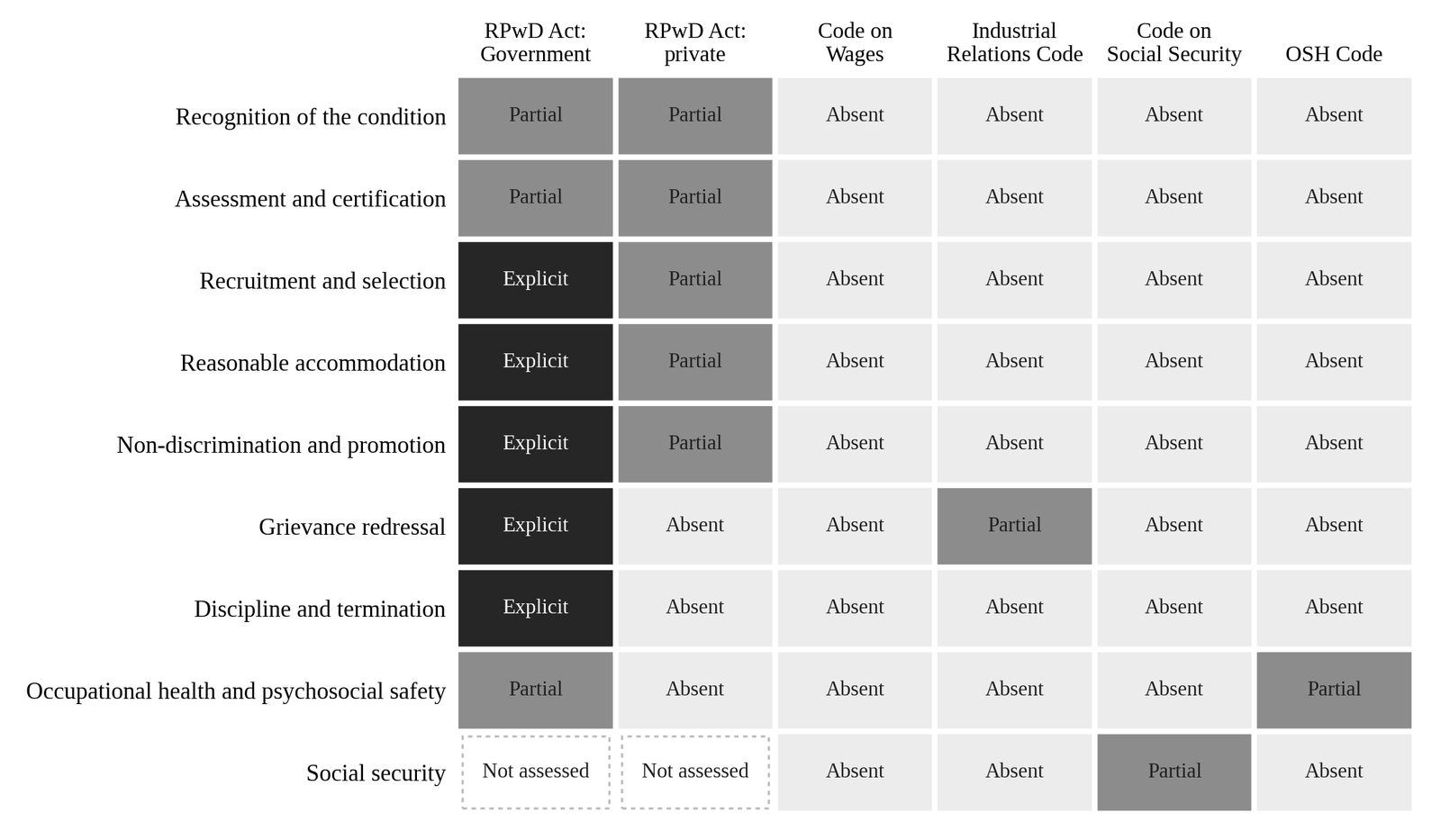
Table 3 and Figure 1 combine these findings into a single matrix. Of the fifty-four cells, five were coded explicit, all of them in the RPwD Act as it applies to Government establishments, eleven were coded partial, thirty-six were coded absent and two were not assessed. The four Labour Codes together contain no explicit provision in any domain, and their partial provisions arise only incidentally, through general grievance machinery, general safety duties and compensation for employment injury.
| Domain | RPwD Act: Government | RPwD Act: private | Code on Wages | IR Code | SS Code | OSH Code |
|---|---|---|---|---|---|---|
| Recognition of the condition | P | P | A | A | A | A |
| Assessment and certification | P | P | A | A | A | A |
| Recruitment and selection | E (Ss. 33, 34) | P (S. 35; Rule 8) | A | A | A | A |
| Reasonable accommodation | E (S. 20(2)) | P (S. 21; Rule 8) | A | A | A | A |
| Non-discrimination and promotion | E (S. 20(1), (3)) | P (Ss. 2(h), 3) | A | A | A | A |
| Grievance redressal | E (S. 23) | A | A | P (S. 4) | A | A |
| Discipline and termination | E (S. 20(4)) | A | A | A | A | A |
| Occupational health and psychosocial safety | P (S. 20(2)) | A | A | A | A | P (Ss. 6, 18) |
| Social security | n.a. | n.a. | A | A | P (Ss. 2, 109, 114) | A |
Table 3: Coverage of nine employment stages by the RPwD Act and the Codes
Note. E: explicit, meaning that a provision directly addresses the domain for persons with disabilities. P: partial, meaning that coverage is limited to some establishments or conditions or rests on general wording. A: absent, meaning that no provision addresses the domain. n.a.: not assessed, because the welfare provisions of the RPwD Act are not tied to employment. Coding by the author.
Figure 1: Gap matrix of statutory coverage across nine domains of the employment cycle
The matrix shows two features. First, explicit protection is concentrated in a single column, the RPwD Act as it applies to Government establishments. Second, the private-sector column of the RPwD Act contains no explicit entry, and the Labour Codes, which govern the private employment relationship in detail, do not fill the space. The neurodivergent employee of a private firm is thus protected mainly by a published policy and by the general equality principle of Section 3, without an establishment-level grievance officer or an enforceable statutory duty to accommodate.
The courts have narrowed some of these gaps through interpretation. In Jeeja Ghosh v. Union of India, the Supreme Court anchored disability rights in dignity.53 Vikash Kumar extended reasonable accommodation to persons with disability under Section 2(s), without requiring benchmark disability,54 and in Avni Prakash v. National Testing Agency an examinee with dysgraphia was found to have been unfairly denied her extra hour in a national entrance test.55 Ravinder Kumar Dhariwal v. Union of India concerned an Assistant Commandant of the Central Reserve Police Force with obsessive compulsive disorder and secondary major depression; the Court recalled that “[t]he disabled employee also has a right to reasonable accommodation and to access a workplace without barriers” and set aside the disciplinary proceedings arising from the first enquiry against him.56 The Madras High Court in Monisha v. National Testing Agency extended reasonable accommodation to a candidate whose condition was not listed in the Schedule.57
The most recent decisions address neurodivergent employment directly. In Shritij Mohan Shrivastava v. Reserve Bank of India, the Bombay High Court held that a candidate certified with autism spectrum disorder together with a learning disability (dyslexia and dysgraphia) could not be disqualified from an officer post on the ground of the additional learning disability, and it directed his appointment.58 A writ petition before the Delhi High Court, which questions why autistic candidates and those with learning or psychosocial conditions are kept out of the reserved quota in the Civil Services Examination, was pending when this paper was written.59 These judgments are significant, but they concern public employers and public examinations, they depend on individual litigation and they cannot by themselves impose duties on private employers that the statute does not impose.
The analysis indicates that the neurodiversity blind spot is structural rather than accidental. The RPwD Act was designed as a rights statute with its strongest employment duties directed at the State, while the Labour Codes were designed as consolidations of pre-existing labour statutes that never addressed disability. Each instrument appears to assume that the other covers the ground. The result is that the domain in which most employment takes place, the private establishment, is governed in detail by instruments that do not see disability and only in outline by the instrument that does.
The blind spot is sharper for neurodivergent employees than for other persons with disabilities. Their conditions are frequently invisible,60 their difficulties arise in communication, organisation and sensory processing rather than in physical access,61 and their needs are therefore met by changes in supervision, scheduling, instructions and work design.62 These are precisely the matters that the Labour Codes regulate through standing orders, grievance committees and working conditions, and precisely the matters on which the Codes are silent. The benchmark threshold and the omission of ADHD and Tourette syndrome add a second layer of exclusion, since reservation and certification are unavailable to a part of the neurodivergent population whatever its functional need.
From a human resource management perspective, the absence of statutory duties has practical consequences. Without a legal duty to accommodate, accommodation in private firms depends on managerial discretion, and Colella argued that the acceptance of accommodation is shaped by co-workers’ judgements of fairness.63 Without a disability-aware grievance mechanism, neurodivergent employees must bring disputes about unmet needs to a Grievance Redressal Committee whose composition and mandate make no reference to disability. Without disability-sensitive standing orders, behaviour associated with a condition may be processed as misconduct. Organisations that wish to benefit from neurodivergent talent, as Austin and Pisano advocated,64 therefore have to build these safeguards voluntarily.
A comparative note clarifies the scale of the gap. British law obliges employers in general to make adjustments for disabled staff,65 while the United States federal statute extends its accommodation duty to private employers above a minimum size.66 Both statutes define disability functionally rather than by a list of named conditions with a percentage threshold. India’s CRPD commitments point in the same direction,67 and the Supreme Court’s reasoning in Vikash Kumar and Omkar Ramchandra Gond already reflects a functional approach.68 The legislative framework has not yet followed.
The findings support the following measures, which are directed at the legislature, the appropriate Governments and employers.
• Cross-referencing the Codes: both the IR Code and the OSH Code should borrow, by express reference, the RPwD Act’s meanings of disability and reasonable accommodation, so that duties under the Codes are read with disability in view.
• Extending the accommodation duty: Section 20 of the RPwD Act, or an equivalent provision in the Codes, should apply the duties of non-discrimination and reasonable accommodation to private establishments above a stated size, with a proportionality defence consistent with Section 2(y).
• Updating the Schedule: ADHD and Tourette syndrome should be considered for inclusion, and the assessment of neurodevelopmental conditions should move from a percentage threshold to a functional assessment of the kind endorsed in Omkar Ramchandra Gond.
• Reforming standing orders and grievance machinery: model standing orders should require that conduct connected with a disability be considered before misconduct is found, and Grievance Redressal Committees should include or consult a trained disability liaison officer.
• Recognising psychosocial risk: rules under the OSH Code should specify psychosocial hazards and require workplace adjustments for employees whose conditions increase their exposure to such hazards.
• Organisational practice: pending legislative change, employers should adopt equal opportunity policies that go beyond Rule 8, provide confidential disclosure channels, train supervisors in neuroinclusive management and audit recruitment tests for unnecessary barriers.
The present study examined whether India’s new Labour Codes and the RPwD Act, read together, protect neurodivergent employees. The analysis indicates that they do so only partially and unevenly. The RPwD Act recognises autism, specific learning disabilities and mental illness but omits ADHD and Tourette syndrome, ties reservation to a percentage threshold and directs its strongest employment duties at Government establishments. The four Labour Codes, which govern the private employment relationship in detail, do not mention persons with disabilities, reasonable accommodation or the RPwD Act. Courts have extended protection in individual cases, but judicial relief cannot substitute for statutory duties. Closing this blind spot will require the Codes and the RPwD Act to be read, and eventually amended, as a single framework for inclusive employment. The analysis was limited to primary legislation and selected judgments; future research should examine the rules under the Codes, state-level practice and the experiences of neurodivergent employees and employers in Indian organisations.
No grant was received for this study, and the author has no competing interests to declare.
*****
1. Press Release, Ministry of Labour & Employment, Press Information Bureau, Government Makes the Four Labour Codes Effective to Simplify and Streamline Labour Laws (Nov. 21, 2025), https://www.pib.gov.in/PressReleseDetailm.aspx?PRID=2192463.
2. PRS Legislative Research, Monthly Policy Review: May 2026 (2026), https://prsindia.org/policy/monthly-policy-review/may-2026.
3. Judy Singer, “Why Can’t You Be Normal for Once in Your Life?” From a “Problem with No Name” to the Emergence of a New Category of Difference, in Disability Discourse 59 (Mairian Corker & Sally French eds., 1999).
4. Nancy Doyle, Neurodiversity at Work: A Biopsychosocial Model and the Impact on Working Adults, 135 Brit. Med. Bull. 108 (2020), https://doi.org/10.1093/bmb/ldaa021.
5. Steven K. Kapp et al., Deficit, Difference, or Both? Autism and Neurodiversity, 49 Developmental Psych. 59 (2013), https://doi.org/10.1037/a0028353.
6. Narendra K. Arora et al., Neurodevelopmental Disorders in Children Aged 2–9 Years: Population-Based Burden Estimates Across Five Regions in India, 15 PLOS Med. e1002615 (2018), https://doi.org/10.1371/journal.pmed.1002615.
7. Robert D. Austin & Gary P. Pisano, Neurodiversity as a Competitive Advantage, Harv. Bus. Rev., May–June 2017, at 96; Anna Krzeminska et al., The Advantages and Challenges of Neurodiversity Employment in Organizations, 25 J. Mgmt. & Org. 453 (2019), https://doi.org/10.1017/jmo.2019.58.
8. Nancy Doyle & Almuth McDowall, Diamond in the Rough? An “Empty Review” of Research into “Neurodiversity” and a Road Map for Developing the Inclusion Agenda, 41 Equal., Diversity & Inclusion 352 (2022), https://doi.org/10.1108/EDI-06-2020-0172.
9. The Rights of Persons with Disabilities Act, No. 49 of 2016, India Code (2016) [hereinafter RPwD Act].
10. Convention on the Rights of Persons with Disabilities, Dec. 13, 2006, 2515 U.N.T.S. 3 [hereinafter CRPD].
11. Darren Hedley et al., Employment Programmes and Interventions Targeting Adults with Autism Spectrum Disorder: A Systematic Review of the Literature, 21 Autism 929 (2017), https://doi.org/10.1177/1362361316661855.
12. Marios Adamou et al., Occupational Issues of Adults with ADHD, 13 BMC Psychiatry 59 (2013), https://doi.org/10.1186/1471-244X-13-59.
13. Michał T. Tomczak, How Can the Work Environment Be Redesigned to Enhance the Well-Being of Individuals with Autism?, 44 Emp. Rels. 1467 (2022), https://doi.org/10.1108/ER-12-2021-0535.
14. Alecia M. Santuzzi et al., Invisible Disabilities: Unique Challenges for Employees and Organizations, 7 Indus. & Org. Psych. 204 (2014), https://doi.org/10.1111/iops.12134.
15. Adrienne Colella, Coworker Distributive Fairness Judgments of the Workplace Accommodation of Employees with Disabilities, 26 Acad. Mgmt. Rev. 100 (2001), https://doi.org/10.5465/amr.2001.4011984.
16. Rose LeFevre-Levy et al., Neurodiversity in the Workplace: Considering Neuroatypicality as a Form of Diversity, 16 Indus. & Org. Psych. 1 (2023), https://doi.org/10.1017/iop.2022.86.
17. RPwD Act, supra note 9, § 2(s).
18. Id. § 2(r).
19. RPwD Act, supra note 9, § 2(zc), sched.; Ministry of Social Justice & Empowerment, Notification S.O. 76(E), Guidelines for the Purpose of Assessing the Extent of Specified Disability in a Person Included Under the Rights of Persons with Disabilities Act, 2016, Gazette of India, Extraordinary, pt. II sec. 3(ii) (Jan. 4, 2018) [hereinafter 2018 Guidelines]; Ministry of Social Justice & Empowerment, Notification S.O. 1338(E), Guidelines for the Purpose of Assessing the Extent of Specified Disabilities in a Person, Gazette of India, Extraordinary, pt. II sec. 3(ii) (Mar. 12, 2024) (published Mar. 14, 2024) [hereinafter 2024 Guidelines].
20. RPwD Act, supra note 9, §§ 2(y), 2(h).
21. Committee on the Rights of Persons with Disabilities, General Comment No. 6 (2018) on Equality and Non-Discrimination, U.N. Doc. CRPD/C/GC/6 (Apr. 26, 2018).
22. The Mental Healthcare Act, No. 10 of 2017, India Code (2017).
23. Choudhary Laxmi Narayan & Thomas John, The Rights of Persons with Disabilities Act, 2016: Does It Address the Needs of the Persons with Mental Illness and Their Families?, 59 Indian J. Psychiatry 17 (2017), https://doi.org/10.4103/psychiatry.IndianJPsychiatry_75_17.
24. The Code on Wages, No. 29 of 2019, India Code (2019) [hereinafter Code on Wages]; The Industrial Relations Code, No. 35 of 2020, India Code (2020) [hereinafter IR Code]; The Code on Social Security, No. 36 of 2020, India Code (2020) [hereinafter SS Code]; The Occupational Safety, Health and Working Conditions Code, No. 37 of 2020, India Code (2020) [hereinafter OSH Code].
25. The Industrial Relations Code (Amendment) Act, No. 1 of 2026, India Code (2026), §§ 1(2), 2.
26. Terry Hutchinson & Nigel Duncan, Defining and Describing What We Do: Doctrinal Legal Research, 17 Deakin L. Rev. 83 (2012), https://doi.org/10.21153/dlr2012vol17no1art70.
27. The Rights of Persons with Disabilities Rules, 2017, G.S.R. 591(E), Gazette of India, Extraordinary, pt. II sec. 3(i) (June 15, 2017) [hereinafter RPwD Rules].
28. CRPD, supra note 10, art. 27; RPwD Act, supra note 9, ch. IV.
29. RPwD Act, supra note 9, sched. item 2(a).
30. Id. sched. item 2(b).
31. Id. sched. items 3, 4(a).
32. Id. §§ 2, 20, 34, sched.; 2018 Guidelines, supra note 19; 2024 Guidelines, supra note 19.
33. Adamou et al., supra note 12.
34. RPwD Act, supra note 9, §§ 2(r), 34(1).
35. 2018 Guidelines, supra note 19, ¶¶ 22.3, 22.6; 2024 Guidelines, supra note 19, ¶¶ 22.3, 22.5.
36. Doyle, supra note 4.
37. Vikash Kumar v. Union Public Service Commission, (2021) 5 SCC 370, ¶ 9.
38. Id. ¶¶ 29, 49.
39. Omkar Ramchandra Gond v. Union of India, 2024 INSC 775, ¶¶ 48, 53.
40. RPwD Act, supra note 9, § 20.
41. Id. § 23.
42. Id. §§ 21, 22, 35.
43. RPwD Rules, supra note 27, r. 8(1), (3).
44. Id. r. 8(4).
45. Code on Wages, supra note 24; IR Code, supra note 24; SS Code, supra note 24; OSH Code, supra note 24.
46. Code on Wages, supra note 24, § 3.
47. SS Code, supra note 24, § 2(55), (56), (83).
48. IR Code, supra note 24, § 4(1), (4).
49. Id. § 28(1), sched. I.
50. Id. § 2(zh)(v).
51. OSH Code, supra note 24, §§ 6(1)(a), (d), 18(2)(a).
52. Id. §§ 82(c), 85(c).
53. Jeeja Ghosh v. Union of India, (2016) 7 SCC 761.
54. Vikash Kumar, (2021) 5 SCC 370, ¶ 29.
55. Avni Prakash v. National Testing Agency, (2023) 2 SCC 286.
56. Ravinder Kumar Dhariwal v. Union of India, (2023) 2 SCC 209, ¶¶ 6, 41, 107.
57. Monisha v. National Testing Agency, 2024 SCC OnLine Mad 956.
58. Shritij Mohan Shrivastava v. Reserve Bank of India, Writ Petition (L) No. 7619 of 2026, ¶¶ 3, 14–15 (Bom. HC Aug. 5, 2026).
59. Siddhant Tomar v. Union of India, W.P.(C) No. 3028 of 2026 (Del. HC) (notice issued Mar. 25, 2026) (pending).
60. Santuzzi et al., supra note 14.
61. Doyle, supra note 4.
62. Tomczak, supra note 13; Krzeminska et al., supra note 7.
63. Colella, supra note 15.
64. Austin & Pisano, supra note 7.
65. Equality Act 2010, c. 15, §§ 6, 20, 39(5) (UK).
66. Americans with Disabilities Act of 1990, Pub. L. No. 101-336, 104 Stat. 327 (codified as amended at 42 U.S.C. §§ 12101–12213), amended by ADA Amendments Act of 2008, Pub. L. No. 110-325, 122 Stat. 3553; see 42 U.S.C. §§ 12102(1), 12111(5)(A), 12112(b)(5)(A).
67. CRPD, supra note 10, art. 27; Committee on the Rights of Persons with Disabilities, supra note 21.
68. Vikash Kumar, (2021) 5 SCC 370, ¶ 29; Omkar Ramchandra Gond, 2024 INSC 775, ¶ 48.