Navigating India’s patent law calls for both a grasp of its historical context and an appreciation of present difficulties. The evolution of intellectual property law in India can be traced through a series of discrete legislative interventions. The Patents Act, 1970, for example, was directed at the development of Indian industry and at the protection of Indian traditional knowledge.1 Some of the later changes to the Act, however, have attracted criticism and created problems of adaptation for applicants. The cumulative effect of those changes has contributed to a perception that the patenting system is bureaucratically obstructive, that it produces delay, and that it deters innovators. The length of the approval process has proved an intractable barrier even in sectors where rapid invention and commercialisation are essential.
The rigid prescription of documentation and the stipulation of particular formats burden a process that ought to be relatively simple. Applicants within the Indian patenting system must deploy considerable skill, knowledge and experience to negotiate a laborious array of requirements, and the result is a high degree of frustration, particularly for small and medium sized enterprises and individual inventors who have neither the capacity nor the resources to withstand so elaborate a regulatory system.2 The Government of India has acknowledged that a developed and optimally functioning patenting system is the foundation of a knowledge based economy. The Traditional Knowledge Digital Library, the first significant effort to record India’s traditional knowledge in a form that protects it from misappropriation while assisting the examination of patent applications, illustrates that commitment.
The Traditional Knowledge Digital Library helps prevent the unauthorised patenting of India’s traditional medicinal knowledge and offers a remedy against exploitative practice in that field. The interface between protection and innovation in the patenting of traditional knowledge nevertheless raises questions about the integrity of the patent system, which requires careful examination of applications so that the distinction between a genuine invention and a trivial advance is maintained. The Technical Expert Group on Patent Law Issues chaired by R.A. Mashelkar likewise called for the prevention of the evergreening of patents.3 The Patents (Amendment) Rules, 2024, notified on 15 March 2024, are intended to bring positive change to the Indian patent system and to harmonise it more closely with international practice.4
Such changes will benefit Indian applicants and should also help to encourage foreign direct investment. They are directed at the unnecessary complexity of the system and promise clearer, more transparent and simpler procedures. While the changes are an improvement, the complexity of the reformed system may itself hinder implementation. In a regime whose bureaucratic difficulties remain unresolved, the expected changes may not deliver the intended goal of bringing the system into line with international standards.5
The patent application process in India is therefore undergoing an attempt at strengthening and reform, but the challenges are multifaceted. Small inventors and small and medium sized enterprises face obstacles that large organisations do not, and the effect is felt at the grassroots of innovation. Where reform protects the small inventor, it establishes a framework that enhances creativity and promotes further innovation within India, creating opportunity and growth for the country on the global stage.6 Improved patent laws give inventors greater freedom, protect their rights, and promote creativity with fewer of the restrictions that the older law imposed.
As intellectual property rights in India are gradually reformed, the process for filing a patent application has become one of the clearest measures of a nation’s innovative capacity. The applicant conveys a clear understanding of the invention by preparing the technical documentation and identifying the possible uses of the invention. In preparing that documentation the applicant must ensure that the novelty and the utility of the invention are clearly set out, since this may determine whether the patent is granted.7 Difficulties arise at each stage of filing, examination and grant, and each of them bears on the overall effectiveness of the patent system in India.
An applicant must first submit the application to the Indian Patent Office. The application is then subjected to an initial check for statutory compliance and to a check of the inventor and the invention. A patent is a creature of statute, and the right arises only once an application made to the Indian Patent Office has been accepted under the Patents Act, 1970 and the Patents Rules, 2003 as amended, most recently by the Patents (Amendment) Rules, 2024.
After the initial submission the application undergoes substantive examination, though examination is significantly backlogged. The Patent Office checks the documents for novelty, inventive step and industrial applicability, which demands a high level of precision in the application. The stage matters because pre-grant and post-grant opposition allow third parties to contest the validity of the application.8 Opposition is directed at preventing the grant of patents for trivial advances, and its outcome affects the quality of the patents granted in India. The interface between applicants and examiners is often complex and requires precision in communication, and it too contributes to delay in reaching a decision.
Indian patent practice requires a background in both law and technology, so inventors are well advised to enlist professional help. That is particularly so given the complexity of the rules governing traditional knowledge and biological resources, which derive in part from international obligations. A patent is granted once examination has been completed successfully, and it gives the inventor the exclusive right to work the invention commercially for a specified period. The patent holder, however, bears the whole responsibility for securing the patent and for its commercial viability, and must therefore have a thorough plan for protection and enforcement.
Patents are essential to the protection of inventors’ rights and to the encouragement of innovation. The application process is nevertheless difficult and enforcement is harder still. The paradox is that a system meant to encourage innovators is cumbersome enough to dissuade them from applying at all, leaving inventions unprotected.9
An innovation is recognised in law as protectable property only if it is patentable. In India the process begins with the filing of an application at the Indian Patent Office, and the initiation of the process is itself complicated enough to deter potential applicants. The system therefore tends to favour larger corporations with greater financial resources over smaller ones, and to that extent it may stifle innovation.10 Applicants and commentators frequently complain of refusals that appear arbitrary and that are issued without an adequate explanation of the reasons for denial. Such complaints aggravate the position of Indian innovators and erode confidence in the patent system.
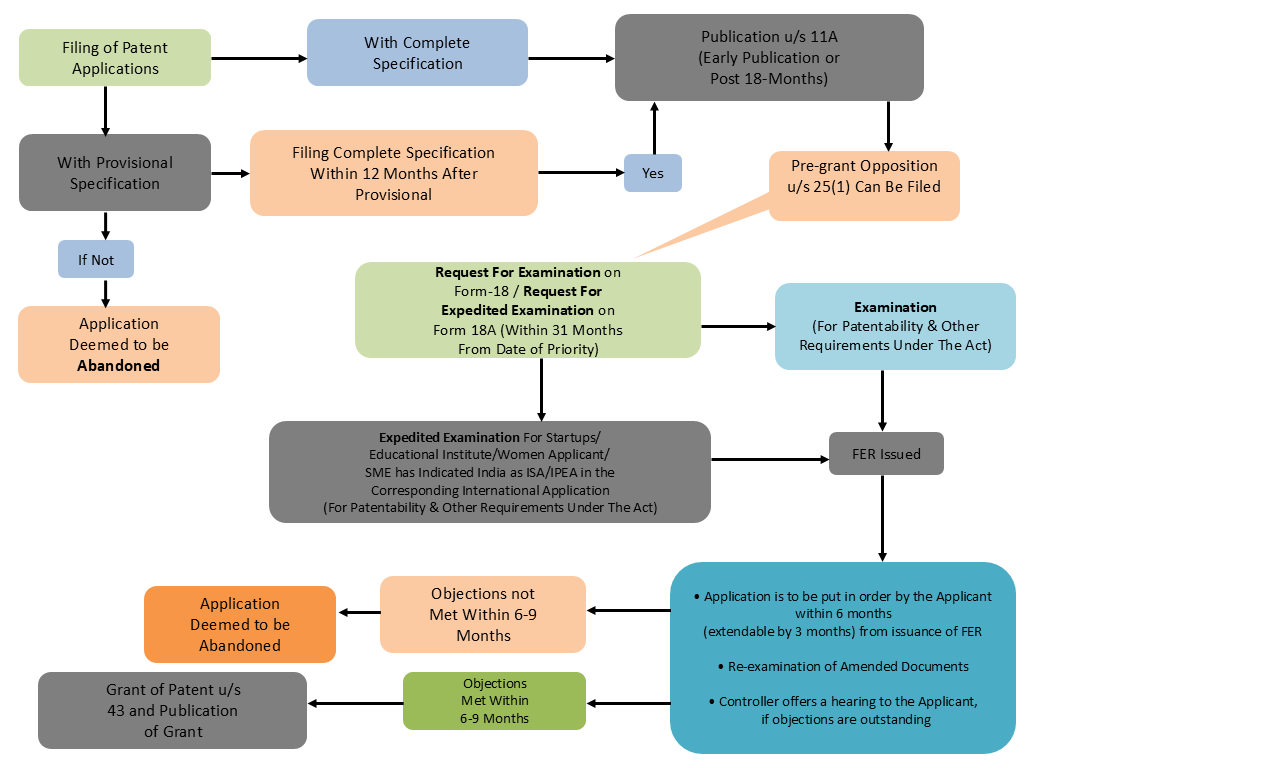
Figure 1: Patent application process in India.
An innovation is commercially patentable only if it satisfies the criteria set by the applicable legislation, which in India is the Patents Act, 1970 read with the Patents Rules, 2003 as amended in 2024. Recognition abroad for commercially patentable innovation reflects the growing commercial and economic interest in the field worldwide.
There is value in solving these problems that goes beyond the improvement of administrative process. Innovation, economic development and the viability of intellectual property in an era of rapid change all depend on the challenges being addressed. As India seeks to become a major participant in the world knowledge economy, a strong patent system will attract both international and domestic investment in research and development.
A knowledge driven economy requires an advanced and well integrated patent system. Long processing times, red tape and inconsistent examination limit the inventor’s ability to obtain protection. The harm is felt most acutely in time sensitive industries, where delay in approval affects the ability to profit from the invention.11
A cumbersome approval process affects many potential innovators, especially in fast moving industries. Mismanagement of applications also leads to inadvertent refusal, which is dispiriting and restricts the financial potential of startups and small and medium sized enterprises that lack the resources to navigate the system.12
| Financial year | Applications filed | Patents granted | Source |
|---|---|---|---|
| 2018-19 | 50,659 | 15,283 | Annual Report 2022-23, at 5 |
| 2019-20 | 56,267 | 24,936 | Annual Report 2022-23, at 5 |
| 2020-21 | 58,503 | 28,385 | Annual Report 2024-25, at 9 |
| 2021-22 | 66,440 | 30,073 | Annual Report 2024-25, at 9 |
| 2022-23 | 82,811 | 34,134 | Annual Report 2024-25, at 9 |
| 2023-24 | 92,168 | 103,057 | Annual Report 2024-25, at 9 |
| 2024-25 | 110,375 | 33,504 | Annual Report 2024-25, at 9 |
Table 1: Patent applications filed and patents granted in India, financial years 2018-19 to 2024-25. Every figure is as published by the Office of the Controller General of Patents, Designs and Trade Marks and is stated on a financial year basis; the calendar year counts reported by other compilers are not comparable and are not used here.
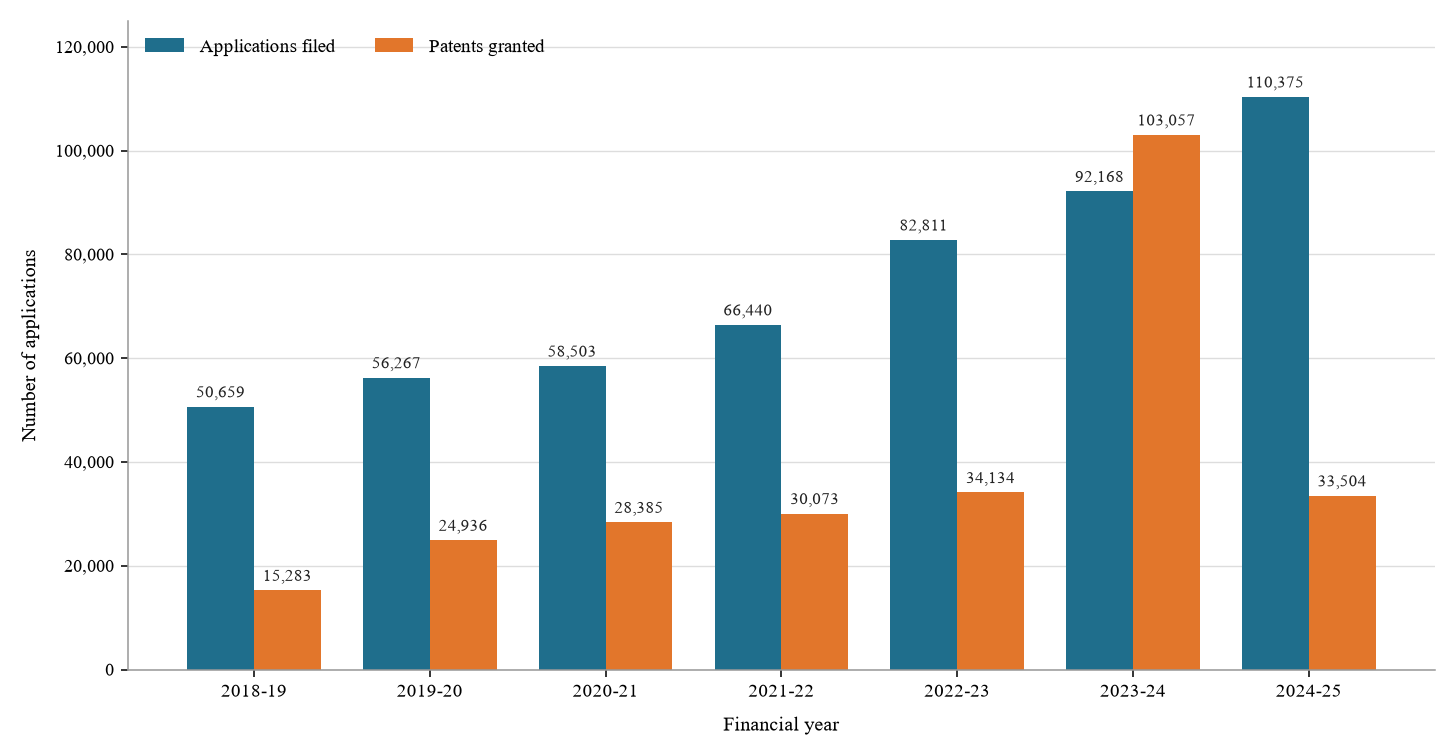
Figure 2: Patent applications filed and patents granted in India, financial years 2018-19 to 2024-25, plotted from the data and the sources given in Table 1.
The filing data describe a system that takes in far more than it can process. Applications filed rose from 50,659 in 2018-19 to 110,375 in 2024-25, more than double in seven years,13,14 while the number of applications examined fell from 49,961 in 2022-23 to 18,438 in 2023-24 and to 15,726 in 2024-25.15 Grants have moved with examination rather than with filing. They climbed steadily to 34,134 in 2022-23, leapt to 103,057 in 2023-24, and then fell to 33,504 in 2024-25, a fall of about two thirds in a single year that returned the annual figure to roughly its 2022-23 level even though filings had meanwhile risen by a third.16 The record year is best explained by the disposal of applications examined in earlier years rather than by any lasting increase in examining capacity, since only 18,438 applications were examined in 2023-24, far fewer than the number granted in it. Once that stock was cleared the underlying rate reasserted itself. This is precisely the pattern that a shortage of examiners predicts, and it is the strongest single piece of evidence for the argument advanced in this paper. Taken as a whole the figures indicate that India has made noteworthy progress in improving its intellectual property system, but significant problems remain, particularly in the accessibility and the efficiency of patent services.17
Several issues are apparent in the Indian patent filing system: long timelines, high costs, a backlog of applications, and difficulties with enforcement. A shortage of examiners compounds the delay. The particulars are as follows.18
• Delays. The examination and grant process is long and time consuming, and significant delay is the norm.
• Backlog. A high volume of pending applications contributes to that delay.
• Shortage of manpower. A serious shortage of examiners at the Indian Patent Office lengthens the wait further.
• High costs and financial burden. The cost of filing and maintaining a patent is a significant obstacle for many individual inventors.
• Legal costs. Drafting an application and prosecuting it to grant is expensive.
• Enforcement costs. Enforcing patent rights is costly, particularly for holders of patents of modest commercial value.
• Patent quality and examination. Concerns persist about the quality of granted patents and about inconsistent examination standards.
• Overly broad or weak patents. Some commentators argue that overly broad or weak patents are granted, creating scope for litigation.
The continuing backlog of pending applications has produced long and dispiriting waiting periods that blunt the incentive to innovate.19 Average pendency for first office actions and final decisions has been reported at close to fifty months as at May 2025, considerably longer than in more developed patent jurisdictions such as the United States; the same source records 221 examiners at the Indian Patent Office in 2023, against 8,180 examiners at the United States Patent and Trademark Office.20
That is detrimental to inventors and startups who lack the resources to sustain long waiting periods, and it also harms the wider ecosystem of productivity and innovation.
The 2024 amendments are intended to shorten the period within which examination must be requested and to reduce the lag in the system. Their practical effect is not yet known. Many of them bring Indian patent processing closer to the standards observed in other countries.21 The improvements are expected to benefit the Indian economy by attracting foreign investment and by encouraging multinational corporations to file in India. Closer scrutiny of patent claims through pre-grant and post-grant opposition strengthens the system, but it also creates additional barriers for applicants.
Competitors tend to use opposition proceedings to challenge patents, and the result is delay and unpredictability in the grant process. Meeting those challenges demands advanced legal and administrative effort, which adds cost and difficulty for small and medium sized enterprises that lack legal support. The quality of applications is an equally serious problem.22
A striking number of patent applications in India are reportedly refused for failure to meet formal requirements, which signals a clear need for better education and better resources for applicants. Many applicants, particularly in sectors with little patenting experience, struggle with the requirements, the documentation and the legal language that a successful Indian application demands.
The situation may create a discouraging environment for potential inventors and leave particular industries short of protected innovation.23 Uneven access to resources also impedes equitable protection. High growth sectors, especially technology and pharmaceuticals, command the legal and financial resources needed to patent their inventions, whereas sectors supporting traditional crafts or localised innovation do not. Where skilled legal support is unavailable, the cost of the application and of advice deters inventors from seeking protection at all.
The evidence therefore suggests that although the Indian patent system has improved and has moved closer to international practice, several systemic problems require urgent attention. Balancing the extent of patent protection against the need to avoid undue delay to innovation remains the central concern.
Making the patent system easier to reach involves improving the understanding of those who use it and increasing its accessibility for small and medium sized enterprises and for traditional sectors. The quality and the speed of the application process will remain critical to a competitive innovation ecosystem in India, and will require sustained reform.24
The difficulty of collecting patent data in India illustrates the complexity of the application process.
Accurate and comprehensive patent data matter because they form the basis of any analysis or evaluation of the system and are essential to evidence based policymaking directed at reform. Filing is very unevenly distributed across fields of invention, though not always in the direction commentators assume. Of the 82,811 applications filed in 2022-23, computer science and electronics accounted for 20,355, the largest single field, followed by mechanical engineering with 14,582 and chemical inventions, which in that year included pharmaceuticals, with 11,715; biotechnology, bio-chemistry and bio-medical inventions together accounted for a further 12,418.25 Software and computing are therefore not the thinly patented corner of the Indian system they are often taken to be; on the official numbers they lead it.
The discrepancies in filing activity, and the unusual manner in which patent data are presented, call for a closer understanding of innovative activity in particular segments of the economy.26 Success rates, the types of patent sought and the duration of the process are reported at a high level of aggregation and are therefore devoid of useful detail. The quality of the documentation and the methods of presenting patent data have far reaching effects on the process itself. Reliance on outdated indicators, especially for sectors that consider themselves under represented in the patent system, will ultimately stifle innovation.
As India develops as a technology hub, it must improve the way it presents patent information in order to strengthen its capacity. A country moving towards a knowledge driven economy needs a patent system that functions at an advanced level.
India’s patent filing system is complicated, and its difficulties must be examined for their effect on innovation and on the economy. The complexity of the application process is a major concern, particularly for small and medium sized enterprises.
The process demands extensive resources and a high level of technical knowledge, and it stretches over a long period before approval, which creates anxiety and uncertainty for innovators.27
That uncertainty impedes investment in research and development and so retards economic growth. The requirement that applications be drafted with precision and legal accuracy compounds the difficulty, since it can impede communication and add to the backlog. Poor translation and the absence of settled terminology add further uncertainty for users of the system.28 Despite these challenges it is essential to create a more innovative and equitable environment, and the legal system must support a better understanding of its own complexity. The flexibility of the law governing intellectual property creates both challenges and opportunities for patents grounded in traditional knowledge.29
The Traditional Knowledge Digital Library strengthens protection against the misuse of indigenous knowledge systems. The Library and comparable initiatives balance the protection of traditional knowledge against the evolution of the market.30 They remove legal and substantive impediments to the protection of inventions while answering the demands of the market. Opposition systems, whether pre-grant or post-grant, may improve patent quality, but they must be designed so that the applicant’s own rights are not obstructed.
A modern and efficient patent system is one of the basic requirements of a knowledge based economy.
Policymakers must work closely with stakeholders to ensure that the Indian system offers greater transparency, support and equitable treatment. Only then will it realise its potential to advance the economy and the technological capacity of the country.31
Managing the range of challenges the modern system presents will require continuing engagement, flexibility and the framing of law suited to an integrated system of invention.32
The right to an invention matters because of the competitive advantage the invention attracts. Patenting may be the only way to secure legal support for an innovation, yet the obstacles to obtaining a patent can stifle further innovation. Patents are an important means of improving participation in the economy and in technology. Research indicates that the backlog at the Indian Patent Office conveys the impression of a disorganised, inefficient and under resourced system. The absence of clear and codified criteria of patent eligibility, particularly in the software and biotechnology sectors, together with weak process, creates a bewildering position for those who wish to patent their inventions.33
These difficulties weigh most heavily on small and medium sized enterprises, which lack the resources to see the process through. The result is a loss of trust in the system and a disincentive to apply. A further finding is that understanding of the application process differs considerably between segments of the population.
Apprehension about apparently arbitrary refusal has a definite negative effect on the confidence of small and medium sized enterprises, particularly those that cannot navigate the process and therefore do not attempt to obtain patents at all.34 Differences in awareness across social groups further complicate the position.
Large companies usually have the resources to manage complex patent portfolios, while smaller companies often cannot keep pace because they do not fully understand the legal framework for making an application. That makes it all the more important to create educational programmes directed specifically at the patenting process. Addressing these findings enables India to build a process that supports innovation.
The difficulties in the Indian patent application process call for a review of policy and practice, so that new approaches to protecting intellectual property rights and to supporting innovators can be adopted. One implication is the need for administrative transparency and simplification in order to manage the uncertainties of examination and enforcement. Applicants routinely have trouble with the legal criteria of patentability set out in the Patents Act, 1970, which admit of varying interpretation by examiners and so prevent consistent outcomes.35
To reduce those difficulties, policy must define firm frameworks and provide adequate accreditation standards and training for examiners.
The Technical Expert Group chaired by R.A. Mashelkar emphasised the importance of eradicating the evergreening of patents and took the view that minor changes to existing products should not sustain a patent application. Innovation of a greater degree should be the basis of an application. The Indian system, offering both pre-grant and post-grant opposition, provides a robust mechanism for screening applications and granted patents, and permits third party participation. It is that architecture which supports the aim of protecting valid inventions.
The meaning of significant modification can be made clearer, and the criteria of originality and applicability can be improved, which would strengthen the system as a whole and create room for genuine innovation. The concerns of the expanding digital economy should also be addressed, since the line between traditional and non traditional innovation is increasingly blurred. India has taken concrete steps here through ventures such as the Traditional Knowledge Digital Library, which protects indigenous knowledge from biopiracy by making that knowledge readily searchable by patent examiners.36 Filings are now made digitally, and examination should improve in speed and accuracy through technologies including artificial intelligence. Their integration would help the patent office clear the large backlog that presently deters prospective applicants.
Obstacles nevertheless remain in securing patent rights in the digital era. Rapid advances in digital technology and artificial intelligence are outpacing the development of settled and consistent standards of assessment, which creates uncertainty about eligibility, scope and enforceability. Where the Patents Act leaves gaps in the exclusion of computer related inventions, outcomes are often unpredictable and prosecution lengthy.
While digitalisation improves access and transparency, inadequate infrastructure, the uneven distribution of examiner expertise in new technologies, and procedural delay continue to demotivate applicants, especially innovators, startups and small and medium sized enterprises. These difficulties underline the urgent need to develop patent frameworks for the digital era, in India and elsewhere, that balance legal certainty against technological change so that patent rights remain effective, enforceable and protective of innovation.37
In practical terms, small and medium sized enterprises need enhanced support to overcome the barriers of the filing system. Better access will improve competitiveness and growth in that sector directly. Filing grants, training and dedicated patent mentors would each improve accessibility. Faster and better methods of resolving patent disputes are also needed. Streamlining dispute resolution and adopting alternative dispute resolution would ease the burden on the courts and give patent holders more opportunity to defend their rights. Collaboration between government, the private sector and academia is likewise necessary if a comprehensive patent ecosystem is to develop.
Involvement in the making of policy that anticipates and confronts coming challenges will be critical. Information campaigns about patent rights, and the provision of patent information, would help inventors understand their rights and navigate the system.38 The interaction between broader economic policy and intellectual property will assist in creating an ecosystem that values innovation. The implications for policy and practice in Indian patent applications point to the need for reform towards a more efficient, transparent and integrated system that values and protects the rights of inventors. Such an approach will help India strengthen its position as a country that values innovation while producing sustainable, responsible and commercially applicable technology.
The filing of a patent application in India is a complex and multi-faceted process that frustrates and dissuades inventors and carries negative consequences for the economy. As this study has shown, many factors impede filing: bureaucratic inefficiency, a slow and protracted approval system, and indeterminate patent law that creates direct obstacles for many stakeholders. The process dissuades inventors, and especially small and medium sized enterprises, which lack the time and the operational means to manage it. Patent protection is necessary to the promotion of invention, yet obstacles within the protective system stifle invention and discourage investment in innovative activity. Refusals that applicants perceive as arbitrary, and avoidable procedural friction, compound the inefficiency.
The need for an efficient and predictable system of patent protection is clear, since a developed and fully operational system is an essential building block of a knowledge economy. The amendment of the Patents Rules, 2003 by the Patents (Amendment) Rules, 2024 represents progress, but it has drawn mixed responses. The establishment of the Traditional Knowledge Digital Library is a positive development, though concerns about communication within the patent process remain.
The study indicates that difficulties in filing patent applications in India affect the internal structure of individual businesses and the growth of the country’s innovation ecosystem alike. Stakeholders must press for legal change that simplifies the process, removes unnecessary delay and produces more consistent outcomes. Creating a legal environment that helps Indian innovators protect their ideas contributes to the social and economic development of the country and strengthens the patent system in its primary purposes of promoting invention and protecting the social interest.
The following recommendations follow from the analysis.
• Establish a framework that provides a timetable for the examination and refusal of a patent application.
• Provide expert opinion and counselling to the applicant, including an examination of the underlying idea of the proposed patent.
• Streamline the opposition process by curbing frivolous pre-grant oppositions that delay examination, while retaining substantive pre-grant and post-grant opposition as essential quality checks. That balance ensures that genuine third party concerns are heard without undermining efficiency.
• Specify the reasons for delay in the examination and refusal of a patent application, both before and after grant.
• Refine and enhance the artificial intelligence models used in the post-grant assessment of patent applications.
• Create a robust patent ecosystem under the amended legislation and provide a transparent system of consultation on the proposed patent model.
*****
1. Vishnu S. Warrier, Understanding Patent Law 26 (1st edn., LexisNexis 2016).
2. Sushil Kumar Barolia, Patent Application Procedure and Preparation for Filing in India, ResearchGate, https://www.researchgate.net/publication/345978680 (last visited May 28, 2025).
3. Kalyan C. Kankanala, Arun K. Narasani & Vinita Radhakrishnan, Indian Patent Law and Practice 61 (Oxford University Press 2012).
4. The Patents (Amendment) Rules, 2024 (India), notified 15 Mar. 2024, amending the Patents Rules, 2003.
5. Kankanala et al., supra note 3, at 61.
6. Kankanala et al., supra note 3, at 61.
7. Elizabeth Verkey, Law of Patents 84 (2nd edn., Eastern Book Company 2012).
8. Adarsh Ramanujan, Ramanujan’s Patent Law: A Comprehensive & Analytical Commentary 74 (1st edn., OakBridge 2024).
9. Kankanala et al., supra note 3, at 81.
10. Kankanala et al., supra note 3, at 81.
11. D.P. Mittal, Law of Patents and Trade Secret 96 (Commercial Law Publishers (India) Pvt. Ltd. 2022).
12. Mittal, supra note 11, at 98.
13. Office of the Controller General of Patents, Designs and Trade Marks, Annual Report 2022-23, at 5 (Trends in Patent Applications), https://ipindia.gov.in/storage/uploads/media/1_114_1_ANNUAL_REPORT_202223_English.pdf.
14. Office of the Controller General of Patents, Designs and Trade Marks, Annual Report 2024-25, at 9 (Trends in Patent Applications), https://ipindia.gov.in/storage/uploads/media/English_Annual_Report_2024-25.pdf.
15. Office of the Controller General of Patents, Designs and Trade Marks, Annual Report 2024-25, supra note 14, at 9.
16. Id.
17. Prathiba M. Singh, Patent Law vol. 1, 115 (Thomson Reuters 2024).
18. Kankanala et al., supra note 3, at 82.
19. Mathew Thomas, Patent Prosecution: Practice and Procedure 153 (Eastern Book Company 2019).
20. Debajyoti Chakravarty, Current Trends in India’s Patenting Landscape, Observer Research Foundation Issue Brief No. 806 (May 2025), https://www.orfonline.org/research/current-trends-in-india-s-patenting-landscape.
21. Kankanala et al., supra note 3, at 85.
22. Mohamad Taleuzzaman & Iqra Rahat, Patent Application Preparation and Filing, in Intellectual Property Rights - Patent (Sakthivel Lakshmana Prabu et al. eds., IntechOpen 2020).
23. Warrier, supra note 1, at 121.
24. Siva Prasad Bose & Joy Bose, Introduction to Patents and Patent Law in India 123 (Three Trees Books 2022).
25. Office of the Controller General of Patents, Designs and Trade Marks, Annual Report 2022-23, supra note 13, at 38 (Appendix-E and Appendix-E1, patent applications filed from 2018-19 to 2022-23 under major and other fields of inventions).
26. Amol Verma & Shaurya Shukla, How to Obtain a Patent in India: A Critique, 3(3) Int’l J.L. Mgmt. & Human. 479, 481 (2020).
27. Muhammad Zaheer Abbas, An Evaluation of the Indian Legislative Framework for Patent Opposition Mechanism: Merits and Demerits of the Procedural Safeguard, 4(2) J. Intell. Prop. Stud. 62, 64 (2021).
28. Sonal Ode et al., Patents and Publications: In Indian Perspective, 2(2) World J. Biological & Pharm. Rsch. 13 (2022).
29. Kankanala et al., supra note 3, at 96.
30. Vindhya S. Mani, Divyanshu Srivastava, Mukundan Chakrapani & Jay Erstling, The India Patent System: A Decade in Review, 8 Cybaris Intell. Prop. L. Rev. 1 (2017).
31. Shalini Singh & Abhilash Arun Sapre, Elevating India’s Patent System: Strategic Approaches to Boost Innovation and Global Competitiveness, 28(3) J. World Intell. Prop. 869 (2025).
32. Kankanala et al., supra note 3, at 115.
33. B.P. Abraham & S.D. Moitra, Innovation Assessment Through Patent Analysis, 21 Technovation 245, 248 (2001).
34. Kankanala et al., supra note 3, at 75.
35. Aparna Kareer & Sneha Agarwal, Too Much Information or Not Quite Enough? Experimental Data in Indian Patent Applications, Managing Intell. Prop. (Oct. 2022).
36. Council of Scientific and Industrial Research & Ministry of Ayush, Traditional Knowledge Digital Library (joint initiative established 2001).
37. Office of the Controller General of Patents, Designs and Trade Marks, Guidelines for Examination of Computer Related Inventions (CRI) (2017).
38. Muhammad Zaheer Abbas, India’s Distinct but Opposing Patent Model Is Under Pressure: Prospects and Challenges in the Global Arena, 80(1) India Quarterly 117 (2024).