“Democracy demands that the religiously motivated translate their concerns into universal, rather than religion-specific, values. It requires that their proposals be subject to argument, and amenable to reason. I may be opposed to abortion for religious reasons, but if I seek to pass a law banning the practice, I cannot simply point to the teachings of my church or evoke God’s will. I have to explain why abortion violates some principle that is accessible to people of all faiths, including those with no faith at all.”
– Barack Obama, keynote address to the Call to Renewal conference, Washington, D.C., 28 June 20061
The word ‘abortion’ derives from the Latin aboriri, meaning ‘to miscarry’. Abortion has been defined as the ‘expulsion of the fetus from the uterus (womb) at any time before its term of gestation is complete’.2 Abortions can happen naturally, which is referred to as a miscarriage, or they can be brought about by intervention, which is referred to as an induced abortion. For medico-legal purposes, abortion has been divided into three categories:
• Spontaneous abortion: often referred to as a “miscarriage”, this type of abortion occurs without intervention, as a result of complications of the pregnancy.
• Therapeutic abortion: performed when the mother’s life is in danger or the unborn child will be disabled.
• Criminal abortion: an unlawful interruption of pregnancy by the mother or any other person.
The World Health Organization (WHO) describes induced abortion as “the deliberate interruption of an ongoing pregnancy by medical or surgical means”. It regards abortion as a safe health-care intervention when it is carried out with a method the WHO recommends for the stage of the pregnancy, by a person who has the necessary skills. Abortion is unsafe when it is performed by people who lack the information or skills required, or in surroundings below minimal medical standards, and unsafe abortion is, in the WHO’s words, “an important preventable cause of maternal deaths and morbidities”.3
Depending on the circumstances in which it is sought, abortion has also been divided into traumatic and elective abortion:
• Traumatic abortion refers to the decision to end a pregnancy when carrying the fetus to term would endanger the pregnant person’s life, when the pregnancy is the result of rape or incest, or when there is a strong likelihood of a severe or life-threatening fetal abnormality.
• Elective abortion refers to the decision to have an abortion for any other reason (for example, financial difficulty, or because the individual does not want to carry the pregnancy to term).
Abortion is one of the most debated questions of the present day. There are two main camps: one supports the right of women over their own bodies (the pro-choice position) and the other supports the rights of the unborn (the pro-life position).
The pivotal issue in abortion cases is the woman’s right to privacy, which includes her right to terminate a pregnancy, weighed against the right to life of the fetus and the state’s interest in the mother’s health and in potential human life.
The pro-choice camp maintains that women have sole rights over their bodies and that no institution or state can compel them to continue a pregnancy. Human Rights Watch, for instance, regards abortion bans as violating the rights to be free from violence, to privacy, to family, to health and even to life.4 It states that it “believes that reproductive rights are human rights, including the right to access to abortion”, and that “States have the obligation to provide women, girls, and other pregnant people with access to safe and legal abortion as part of their core human rights responsibilities.”5
The pro-life camp maintains that the fetus is a living person and that the termination of a pregnancy is therefore a crime. Article 3 of the Universal Declaration of Human Rights provides that “[e]veryone has the right to life, liberty and security of person.”6
No two nations share the same history of abortion law.
References to abortion appear in some of the earliest legal and medical records: the Egyptian Ebers Papyrus, of about 1550 BCE, records methods of ending a pregnancy, and the Middle Assyrian Laws made it a capital offence for a woman to procure her own miscarriage.7 Early Christian teaching condemned the practice; the Didache (2.2), of about 100 CE, states: “Do not murder a child by abortion or kill a new-born infant.” Roman law under the Severan emperors punished a woman who procured an abortion with temporary exile.8
In the colonial period the law of each colony generally followed that of the governing European power, and by the close of the nineteenth century Britain, France, Spain, Portugal and Italy had imposed their own restrictive abortion laws on their colonies.9
Until the mid-nineteenth century, abortion in the United States was generally lawful until quickening, that is, until the movement of the fetus could be felt. As a 2022 history published by the Johns Hopkins Bloomberg School of Public Health recounts, the American Medical Association began a letter-writing campaign in 1857 urging state legislatures to ban the practice, claiming that medical opinion placed the beginning of life at conception, not quickening; the effort worked, and at least forty anti-abortion laws were enacted between 1860 and 1880.10 The same account, drawing on the historian of medicine Mary Fissell, records that some physicians nevertheless continued to perform abortions, especially during the Depression, and that in the 1920s and 1930s many cities had doctors who specialised in the procedure, to whom other doctors referred patients; that this leniency faded after the Second World War, when renewed emphasis on women’s domestic roles brought more prosecutions of doctors and drove abortion underground and into less skilled hands; and that safe abortion remained largely available to the well-to-do and out of reach for single, Black, working-class women.11
Illegal abortions in the United States in the 1950s and 1960s have been put at between 200,000 and 1.2 million a year, and as late as 1965 illegal abortion was still responsible for 17 per cent of all deaths from pregnancy and childbirth.12 The rubella (German measles) epidemic of 1963 to 1965, which could cause severe birth defects when contracted in pregnancy, led medical authorities to endorse therapeutic abortions.13 Women who could afford to do so went to court to obtain hospital abortions, and others obtained approval on a physician’s certification that continuing the pregnancy would endanger their life or their physical or mental health; these cases prompted a series of reform bills in state legislatures.14 By the time Roe v. Wade was decided in 1973, abortion was already lawful in seventeen states, and not only to save a woman’s life.15
English law first refers to abortion in the thirteenth century. Abortion was acceptable until quickening, because quickening was believed to be the moment at which the soul entered the fetus.16
In the nineteenth and early twentieth centuries the scope of lawful abortion was narrowed, and women resorted to back-street abortions, which were very dangerous: between 1923 and 1933, illegal abortion accounted for fifteen per cent of maternal deaths. The Abortion Law Reform Association (ALRA), founded in 1936, campaigned for abortion to be made legal.17
In 1974 a private member’s bill introduced by James White and backed by an anti-abortion organisation threatened the Abortion Act 1967. ALRA and other pro-choice groups came together to resist this bill and later attempts to restrict the Act: ALRA and others lobbied formally, while women’s groups held demonstrations and meetings at which many carried wire coat-hangers, a symbol of the dangers of back-street abortion. Out of this campaign came the National Abortion Campaign (NAC), formed in 1975, which held its first meeting in the House of Commons on 10 March.18
The Human Fertilisation and Embryology Act 1990 regulated new techniques developed to help infertile couples and research on embryos. Although some sought to use it to curtail abortion rights, the 1990 Act in fact reduced the general time limit for abortion from 28 to 24 weeks, the currently accepted point of viability, and clarified when abortion is lawful at a later stage.19 Abortion in England, Scotland and Wales remains governed by the Abortion Act 1967 as so amended.20
Abortion in India is as old as Indian civilisation itself. As Hirve records, the Indian Penal Code (enacted in 1860 and in force from 1862) and the Code of Criminal Procedure of 1898, both modelled on the English Offences against the Person Act 1861, punished abortion in the woman and in the person who performed it alike, unless it was done to save her life. Europe and the Americas liberalised their abortion laws in the 1960s and 1970s, and much of the rest of the world followed in the 1980s. In India, reform began in 1964, prompted by the high toll of maternal deaths from unsafe abortion: doctors were often treating women who were gravely ill or dying after unsafe procedures by unskilled practitioners, and they saw that most women who sought abortions were married and had no social or cultural reason to hide a pregnancy, so that decriminalisation would encourage women to seek abortion in legal and safe settings.21
Set up by the Government of India in 1964 under the chairmanship of Shantilal Shah to study the question of legalising abortion, the Shah Committee reviewed its social, cultural, legal and medical aspects and in 1966 recommended that abortion be legalised to protect women’s health and lives from unnecessary risk.22 Although some States regarded the proposed legislation as a means of slowing population growth, the Committee expressly disclaimed any such aim. The term “Medical Termination of Pregnancy” (MTP) was chosen to soften the resistance of social and religious groups opposed to liberalising the abortion law, and the Medical Termination of Pregnancy Act was passed by Parliament in 1971.23
Yet many years after the passing of this liberal legislation, safe abortion remains out of reach for many women in India.24
Religions shape culture, and they also play a vital role in shaping the ethics and public policy of a nation-state. Different religions take different positions on abortion, and the relationship between religion and abortion is often assumed to reflect the theology of each faith regarding the personhood of the fetus.
| Religions that strongly oppose abortion | Religions that allow abortion | Religions that hold ambiguous positions on abortion |
|---|---|---|
| Hinduism; Zoroastrianism; Roman Catholic Church; African Methodist Church | Presbyterian Church; Conservative Judaism; United Church of Christ | Islam; Buddhism; Sikhism |
Table 1: Positions of selected religions on abortion
Hinduism is one of the oldest religions in the world. It holds that every creature is a manifestation of the Supreme Being, Brahman. The fetus is therefore regarded as a conscious living person, and abortion as violence against the fetus; the killing of a fetus has been compared to the sin of killing one’s parents.
Hinduism upholds the doctrine of ahimsa (non-violence), under which abortion is regarded as violence against the fetus, and it generally opposes abortion. Classic Hindu texts treat abortion as a sin, although it has also been suggested that for Hindus abortion was more a social than a moral transgression.
The classical texts address abortion as follows:25
• The Atharva Veda treats abortion as among the most heinous of crimes; women who procure abortions are termed ‘embryo slayers’ who must bear suffering and sin.
• The Parashara Smriti holds the killing of a fetus to be a sin twice as great as the killing of a Brahmana, for which there is no atonement.
• The Vishnu Dharma Sutra likewise equates abortion with the killing of a Brahmana.
Abortion has been forbidden on the following grounds:
• it disturbs the natural cycle of birth and karma;
• it infringes upon the individual’s prospect of enlightenment and liberation;
• it is contrary to the doctrine of ahimsa; and
• it goes against the notion of jivan mukti.
Manu forbids the offering of ancestral water libations to a woman who is promiscuous or who has harmed an embryo or her husband (Manusmriti 5.90). Hindu philosophy may thus be said to regard abortion as paapa, that is, a sin.
The official position of the Roman Catholic Church is that abortion in any circumstance is a sin and is therefore prohibited.
Catholic Christians believe that all life is sacred from conception until natural death, and that the taking of an innocent human life, born or unborn, is morally wrong. The Church teaches that “[h]uman life is sacred because from its beginning it involves the creative action of God and it remains for ever in a special relationship with the Creator, who is its sole end. God alone is the Lord of life from its beginning until its end: no one can under any circumstance claim for himself the right directly to destroy an innocent human being.”26
The 1983 Code of Canon Law provided, in canon 1398, that “[a] person who procures a completed abortion incurs a latae sententiae excommunication”, that is, an automatic excommunication; since the revision of Book VI of the Code in 2021, the rule appears, in amended form, in canon 1397 § 2.27
In 2019 Pope Francis said that abortion “is never the answer that women and families are looking for”, even where a fetus is gravely ill. He urged that babies expected to die at or shortly after birth be accompanied with care rather than abandoned, described the selective use of prenatal diagnosis as the expression of “an inhumane eugenic mentality”, criticised the presentation of abortion as a form of “prevention”, and argued that opposition to abortion is a human question that has nothing to do with faith in the first place. The Church’s teaching, he said, is that “human life is sacred and inviolable.”28
Islam is the youngest of the three major Abrahamic monotheistic religions. Most of Islamic law is based on the Qur’an and the teachings of the Prophet Muhammad (SAW).
According to a 2019 statement of the Australian National Imams Council, Islamic law permits abortion in the following circumstances:
• abortion is allowed at whatever stage the pregnancy has reached, even beyond 120 days, where continuing it gravely endangers the mother, as where her life is seriously at risk, provided that a qualified and trustworthy medical report confirms the danger;
• before 120 days (about four months) of gestation, abortion is considered case by case in the light of these rules; it may be permissible where the mother’s health is in danger or where the fetus is diagnosed with an abnormality that will prove fatal or cause severe disability.
Otherwise, abortion remains a major sin (haram) for which one should repent and seek Allah’s forgiveness. The Qur’an says: “And do not kill the soul which Allah has forbidden, except by right.”29
Sunni Muslims believe that the fetus acquires life only after 120 days, when Allah breathes the spirit into it. Before 120 days the mother has greater rights than the fetus; thereafter the mother and the fetus have equal rights. Even so, where the mother’s life is at stake, abortion is considered the lesser wrong because:
• the mother is the originator of the fetus;
• the mother has responsibilities and duties towards her family; and
• the death of the mother would also kill the fetus.
In Iran, a 1997 ruling (fatwa) by Ayatollah Ali Khamenei permitted the abortion, before ensoulment, of a fetus with a certain diagnosis of the genetic blood disorder thalassaemia major, and religious rulings are understood to permit such abortions before the sixteenth week of gestation.30 Abortion is not expressly permitted in Islam, but in some circumstances, such as rape or incest, or where the mother’s health is in danger, it may be acceptable according to various scholars’ interpretations of the Qur’an.
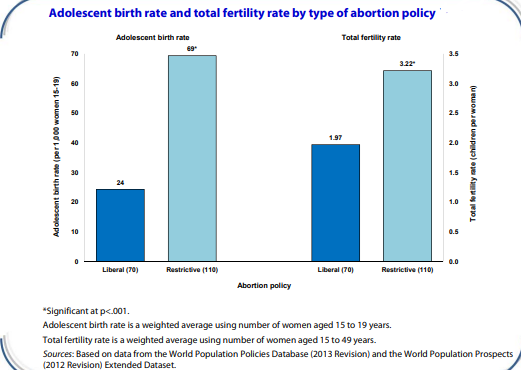
For the purposes of its analysis, the Population Division of the United Nations Department of Economic and Social Affairs categorises countries that allow abortion on request or on economic or social grounds as having “liberal” abortion policies, and all other countries as having “restrictive” abortion policies.31
Figure 1: Adolescent birth rate and total fertility rate by type of abortion policy, 2013. Source: United Nations Department of Economic and Social Affairs, Population Division, Abortion Policies and Reproductive Health around the World 14 (2014).
On average, countries with restrictive abortion policies had in 2013 an adolescent birth rate about three times that of countries with liberal policies: 69 births per 1,000 women aged 15 to 19, against 24. Women in countries with restrictive policies also had significantly more children on average in 2013 (a total fertility rate of 3.22 children per woman) than women in countries with liberal policies (1.97).32
The report attributes this link between restrictive policies and higher fertility largely to development: less developed countries tend both to have higher fertility and to restrict abortion more.33
In 2011 unsafe abortion was, on average, more than four times as common in countries with restrictive abortion policies (26.7 unsafe abortions per 1,000 women aged 15 to 44) as in countries with liberal policies (6.1 per 1,000). A similarly strong association was found within the developing regions, where the vast majority of unsafe abortions occur: the average unsafe abortion rate there was 26.9 per 1,000 women aged 15 to 44 in countries with restrictive policies, against 7.8 in countries with liberal policies.34
The report explains this association largely by development: countries in the developing regions tend to combine weaker health-care systems, with less ability to offer safe abortion services, with more restrictive abortion policies, so that higher unsafe abortion rates partly reflect poorer access to safe services. Restrictive laws may also raise unsafe abortion rates directly, by narrowing the safe options open to a woman who wants to end an unwanted pregnancy.35
On average, countries with restrictive abortion policies had in 2013 a maternal mortality ratio three times that of countries with liberal policies: 223 maternal deaths per 100,000 live births, against 77. Within the developing regions, the ratio was 227 maternal deaths per 100,000 live births in countries with restrictive policies, against 97 in countries with liberal policies.36
Here too the report points chiefly to development: developing countries tend to have both more restrictive abortion laws and weaker health-care systems, especially for obstetric and maternal care, so that higher maternal mortality partly reflects poorer access to good maternal health care. Restrictive laws may also add directly to the risk of maternal death, by narrowing the safe options for ending an unwanted pregnancy.37
Researchers have examined how attitudes towards abortion have changed over time. In the United States, women’s employment, earnings and educational attainment rose substantially from 1970, although England, Levine and Mishel find that progress toward gender equality has slowed, and on some indicators stalled, in recent decades.38 Osborne and colleagues, reviewing the literature and analysing several large cross-sectional and longitudinal datasets, report that support for abortion in the United States has increased modestly over time. They found that support for abortion in traumatic circumstances remained strong and stable, while support for elective abortion, though lower, increased slowly, and that participants consistently showed greater support for traumatic than for elective abortion.39
The landmark case Roe v. Wade (1973) introduced the “trimester framework” for abortion law. Under this framework, the decision whether to have an abortion in the first trimester was left to the pregnant woman and her doctor. In the second trimester, the State could regulate abortion in ways reasonably related to maternal health, and from the point of viability, in recognition of its interest in the “potentiality of human life”, it could restrict or prohibit abortion except where necessary to preserve the life or health of the mother.40
Following Roe, some States, particularly those with Republican-majority legislatures, adopted increasingly restrictive interpretations of what constituted “reasonable” regulation to protect maternal health. This led to the emergence of TRAP (Targeted Regulation of Abortion Providers) laws, which impose stringent requirements on abortion providers.
One example was the Pennsylvania Abortion Control Act of 1982 which, as amended in 1988 and 1989, required a married woman seeking an abortion to notify her husband (with limited exceptions) and required minors to obtain parental consent or a judicial bypass.
These restrictions led to the 1992 Supreme Court case Planned Parenthood v. Casey, in which the Court rejected Roe’s rigid trimester framework and introduced the “undue burden” standard, allowing States to regulate abortion so long as the regulation did not place a substantial obstacle in the path of a woman seeking an abortion before fetal viability.41
In 2018 Mississippi tested the limits of this standard by enacting the Gestational Age Act, which banned abortions after fifteen weeks of gestation except in cases of medical emergency or severe fetal abnormality.42 Because the law imposed a direct pre-viability ban, it was, on its face, inconsistent with the Casey standard.
Nevertheless, in Dobbs v. Jackson Women’s Health Organization (2022) the Supreme Court not only upheld the Gestational Age Act but also overruled Roe and Casey, holding that the Constitution does not confer a right to abortion. The decision left the States free to regulate or prohibit abortion at any stage of pregnancy.43
With Roe overruled, state legislatures regained full control over abortion policy. Some States had protective laws in place to preserve pre-Dobbs access to abortion, while others had “trigger laws” designed to impose strict restrictions as soon as Roe was reversed. The ruling fundamentally altered the legal framework, placing responsibility for abortion law on state legislatures and governments rather than the federal judiciary.
Notably, nearly half of all pregnancies in the United States (45 per cent in 2011) are unintended, which highlights the broader public health and socio-economic implications of restrictive abortion laws.44
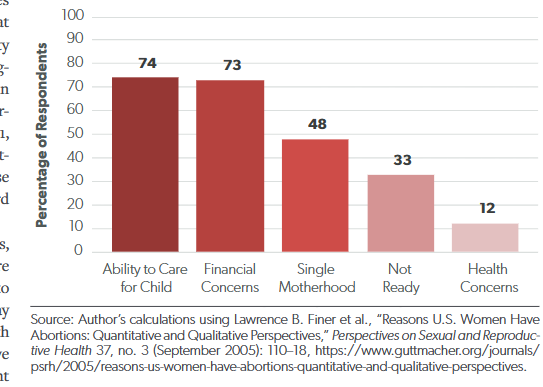
Figure 2: Reasons given by women in the United States for having an abortion (percentage of respondents). Source: data from Lawrence B. Finer et al., Reasons U.S. Women Have Abortions: Quantitative and Qualitative Perspectives, 37 Perspectives on Sexual and Reproductive Health 110 (2005).
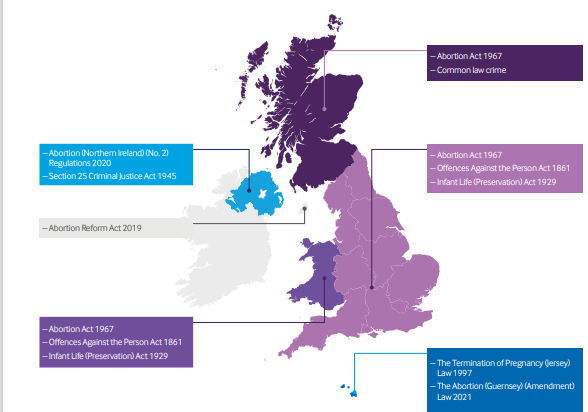
Figure 3: The law on abortion in the United Kingdom and the Crown Dependencies. Source: British Medical Association, The Law and Ethics of Abortion: BMA Views 5 (September 2020, updated March 2025).
In 1938, R v. Bourne set a significant precedent in UK abortion law. Dr Aleck Bourne performed an abortion on a fourteen-year-old girl who had been raped by several soldiers, and was charged with unlawfully procuring a miscarriage under section 58 of the Offences Against the Person Act 1861. He was acquitted after Macnaghten J directed the jury that an abortion performed to preserve the woman’s life could be lawful, and that preserving her life could extend to preventing her from becoming a physical or mental wreck. The judgment widened the understanding of what made an abortion “unlawful”, allowing for exceptions beyond an immediate threat to life.45
The Abortion Act 1967, as amended by the Human Fertilisation and Embryology Act 1990, governs abortion in England, Scotland and Wales, and provides exceptions to the crimes of administering or procuring an abortion.46
Under the Abortion Act, a registered medical practitioner may lawfully terminate a pregnancy in an NHS hospital or in a place approved for the purpose if two registered medical practitioners are of the opinion, formed in good faith:47
• that the pregnancy has not exceeded its twenty-fourth week and that the continuance of the pregnancy would involve risk, greater than if the pregnancy were terminated, of injury to the physical or mental health of the pregnant woman or any existing children of her family; or
• that the termination is necessary to prevent grave permanent injury to the physical or mental health of the pregnant woman; or
• that the continuance of the pregnancy would involve risk to the life of the pregnant woman, greater than if the pregnancy were terminated; or
• that there is a substantial risk that if the child were born it would suffer from such physical or mental abnormalities as to be seriously handicapped.
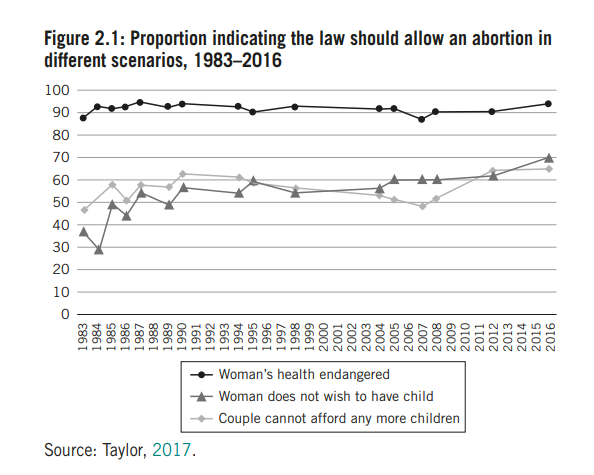
Figure 4: Proportion of respondents in Britain saying the law should allow an abortion in different scenarios, 1983–2016. Source: data from Kirby Swales & Eleanor Attar Taylor, Moral Issues, in British Social Attitudes 34 (NatCen Social Research 2017).
Women undergoing an early medical abortion formerly had to attend a clinic or hospital to take both medications. In December 2018 the Department of Health and Social Care approved a woman’s home as a place where the second medication could be taken, for pregnancies of up to nine weeks and six days, after the first had been taken at a clinic.48
In March 2020 the Department of Health and Social Care issued a temporary approval permitting women, after a consultation with a clinician, to take both medications for an early medical abortion at home for up to ten weeks of pregnancy. It was made to keep abortion services safe and to reduce the risk of spreading COVID-19.49
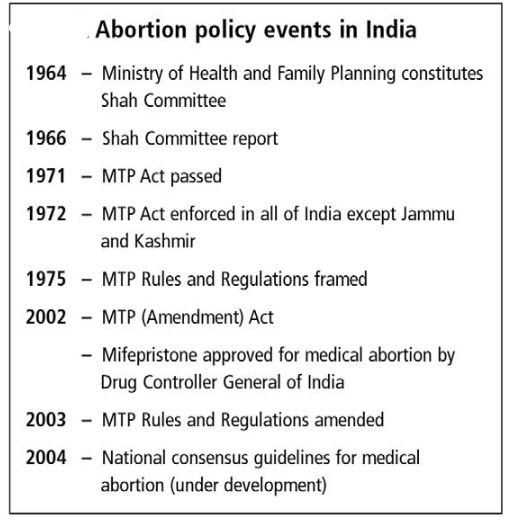
Figure 5: Abortion policy events in India, 1964–2004. Source: Siddhivinayak S. Hirve, Abortion Law, Policy and Services in India: A Critical Review, 12 Reproductive Health Matters (Supp. 24) 114 (2004), Box 1.
In India, abortion is regulated by the Medical Termination of Pregnancy Act, 1971 and by the rules and guidelines made under it, which are periodically revised. Beyond the statute, the Supreme Court has recognised a woman’s right to make reproductive choices as a dimension of the personal liberty guaranteed by Article 21 of the Constitution,50 and in State of Punjab v. Mohinder Singh Chawla it held that the right to health is part of the right to life under Article 21.51 Under section 3 of the MTP Act, only a registered medical practitioner may terminate a pregnancy. The Act was amended in 2021, bringing commendable changes to the country’s abortion law.52 Neither the patient nor the doctor may decide to end a pregnancy at will; the legislation fixes the periods within which a pregnancy can be terminated. Under the Act as amended:
• a pregnancy that has not exceeded twenty weeks may be terminated on the opinion of one registered medical practitioner;
• a pregnancy that has exceeded twenty weeks but not twenty-four weeks may be terminated, for the categories of women prescribed by the rules, on the opinion of two registered medical practitioners.
In either case the practitioners must be of the opinion, formed in good faith, that continuing the pregnancy would involve a risk to the life of the pregnant woman or of grave injury to her physical or mental health, or that there is a substantial risk that the child, if born, would suffer from a serious physical or mental abnormality. The pregnancy of an adult woman cannot be terminated without her consent. The categories of women eligible for termination between twenty and twenty-four weeks are set out in rule 3B of the MTP Rules, as amended in 2021:53
1. survivors of sexual assault, rape or incest;
2. minors, that is, women under eighteen years of age;
3. women whose marital status changes during the ongoing pregnancy, through widowhood or divorce;
4. women with physical disabilities, and women who are mentally ill, including those with intellectual disabilities;
5. cases of fetal malformation carrying a substantial risk of being incompatible with life, or of the child, if born, being seriously handicapped; and
6. women with pregnancies in humanitarian settings, disasters or emergencies declared by the Government.
India’s abortion law has been shaped significantly by judicial interpretation, reflecting the nation’s evolving stance on women’s reproductive rights. Over the years, Indian courts have played a pivotal role in interpreting and expanding the scope of the law, as the following decisions show.
Issue: whether a woman in custody, whose application to terminate her pregnancy had been rejected by the Chief Judicial Magistrate, could be permitted to terminate a pregnancy that had resulted from forced prostitution.
The High Court of Madhya Pradesh treated the forced sexual intercourse as rape for the purposes of the MTP Act, observed that a victim of rape or forced sex cannot be forced to give birth to the child of the rapist, and, on the opinion of two registered medical practitioners and with the woman’s consent, permitted the termination.54
In Suchita Srivastava v. Chandigarh Administration, the Supreme Court, staying and disapproving the orders of the High Court of Punjab and Haryana, upheld a woman’s autonomy to decide whether to continue her pregnancy. It held unequivocally that a woman’s right to make reproductive choices, including the choice to procreate, is a dimension of the personal liberty protected by Article 21, and that her privacy, dignity and bodily integrity must be respected.55
Issue: whether, where a minor’s pregnancy results from an offence also prosecuted under the Protection of Children from Sexual Offences (POCSO) Act, 2012, the State must apply to a court before the pregnancy is terminated.
The High Court of Punjab and Haryana held that “[t]he State need not have applied to the magistrate”; the State could have helped the victim to obtain the necessary medical certification and admitted her to a government hospital for the procedure. An application to the court would be needed only where there was a conflict, for instance between the opinions of the two medical practitioners.56
This case concerned rule 3B of the MTP Rules, which allows the categories of women it lists to terminate a pregnancy between twenty and twenty-four weeks. The rule did not expressly mention unmarried women, and the question was whether a single woman could rely on it. Applying a purposive interpretation, the Supreme Court held that the object of the provision, which is to allow abortion where a woman’s material circumstances change, must be given effect; there was no justification for excluding single women, and doing so would violate the right to equality under Article 14. The Court further held that Article 21 secures a woman’s reproductive autonomy, dignity and privacy, including the choice whether or not to bear children, so that the Act and the Rules could not be given a narrow reading that would defeat their purpose.57
The woman whose pregnancy was in question was an orphan, abandoned by her parents when she was young, who had grown up in the care of the Missionaries of Charity in New Delhi. She was later placed in Chandigarh’s Government Institute for Mentally Retarded Children (Sector 32) and then in Nari Niketan, a welfare home in Sector 26, before being moved in March 2009 to Ashreya, a new welfare institution; both homes were run by the Chandigarh Administration. In May 2009 she showed signs of nausea and abdominal pain, and a pregnancy test proved positive.58
A medical board of two gynaecologists and a radiologist then put the pregnancy at eight to ten weeks. An ossification test on 20 May 2009 put her bone age at about nineteen to twenty years. A three-member board under the Chairperson of the hospital’s Department of Psychiatry assessed her mental condition as one of ‘mild mental retardation’. A further multi-disciplinary board (a gynaecologist, a paediatrician, a psychiatrist and a radiologist) was asked for its opinion on the consequences of continuing the pregnancy and the woman’s capacity to cope with it, and recommended termination.59
The Chandigarh Administration then approached the High Court of Punjab and Haryana for a judicial determination. The High Court took note of the multi-disciplinary board’s opinion but directed the constitution of an expert body, independent of the Chandigarh Administration, whose findings would enable the Court to ascertain the woman’s ‘best interests’.60 Although the expert body’s findings favoured continuing the pregnancy, since she had expressed her willingness to continue it, the High Court directed its termination, having regard to her lack of understanding of the sexual act and to doubts about her capacity to carry the pregnancy to term and to assume maternal responsibilities. The appellants then challenged this order of the Division Bench in the Supreme Court.
Overturning the decision of the High Court, the Supreme Court stated:
“We disagree with this conclusion since the victim had clearly expressed her willingness to bear a child. Her reproductive choice should be respected in spite of other factors such as the lack of understanding of the sexual act as well as apprehensions about her capacity to carry the pregnancy to its full term and the assumption of maternal responsibilities thereafter. We have adopted this position since the applicable statute clearly contemplates that even a woman who is found to be ‘mentally retarded’ should give her consent for the termination of a pregnancy.”61
The Supreme Court also observed that termination was not in the woman’s best interests, since by the time the matter was heard she had been pregnant for more than nineteen weeks and the statutory limit of twenty weeks was fast approaching, when an abortion would carry significant risks to her physical health.62 The Court directed that she be given the best available medical facilities, with proper care and supervision throughout the pregnancy and after the birth.
“It seems to me clear as daylight that abortion would be a crime.”
– Mahatma Gandhi63
In law, an induced abortion is the deliberate expulsion of the fetus, which may be procured at any time before the child’s natural birth. In medical usage, by contrast, abortion denotes the premature delivery of a fetus before it is viable, and a fetus has traditionally been regarded as viable from the twenty-eighth week of pregnancy.
The Government of India appointed a committee to study the subject and, in the light of its recommendations, introduced a Bill in the Rajya Sabha. Its provisions can be summarised as follows:64
• a registered medical practitioner who terminates a pregnancy in accordance with the Bill is not guilty of any offence under the Indian Penal Code or any other law;
• a registered medical practitioner may terminate a pregnancy if, in his opinion formed in good faith, its continuance would endanger the mother’s life or harm her physical or mental health, or that there is a substantial risk that the child, if born, would be seriously handicapped by physical or mental abnormalities;
• where the woman alleges that the pregnancy was caused by rape, “the anguish caused by such pregnancy” is presumed to constitute a grave injury to her mental health;
• where a pregnancy results from the failure of any device or method used by a married woman or her husband to limit the number of children, “the anguish caused by such unwanted pregnancy” may be presumed to constitute a grave injury to the woman’s mental health;
• in determining whether continuing the pregnancy would risk injury to health, account may be taken of the pregnant woman’s “actual or reasonably foreseeable environment”;
• where the pregnancy does not exceed twelve weeks, the opinion of one registered medical practitioner is sufficient; where it exceeds twelve weeks but not twenty weeks, the opinion of two practitioners is required; beyond twenty weeks the Bill does not apply; and
• the consent of the woman is required, and the termination may be carried out only in a Government hospital or another place approved by the Government.
The Indian Penal Code, 1860, the Code of Criminal Procedure, 1973 and the Indian Evidence Act, 1872 have been replaced by three new laws passed by Parliament: the Bharatiya Nyaya Sanhita, 2023 (BNS), the Bharatiya Nagarik Suraksha Sanhita, 2023 and the Bharatiya Sakshya Adhiniyam, 2023, which came into force on 1 July 2024.65 Replying to the debate in the Lok Sabha on 20 December 2023, the Union Home Minister said that the new laws were in consonance with the spirit of the Constitution.66
Section 312 of the Indian Penal Code, now section 88 of the BNS, sets out the core of the criminal law on abortion. It makes it an offence voluntarily to cause a woman with child to miscarry, punishable with imprisonment of up to three years, or up to seven years if the woman is quick with child, and its explanation makes clear that a woman who causes herself to miscarry also commits the offence. Section 313 (now section 89 BNS) punishes causing a miscarriage without the woman’s consent, whatever the stage of pregnancy, with imprisonment for life or for up to ten years. Sections 314 to 316 (now sections 90 to 92 BNS) deal with variations of the offence, prescribing different penalties according to whether the woman or the unborn child dies. The only exception to section 312 is a miscarriage caused in good faith for the purpose of saving the life of the woman.67,68
The MTP Act was passed by Parliament in August 1971 and came into force on 1 April 1972.69 Approximately five million terminations were performed in India each year before the Act was passed, three million of them unlawfully.70 The Supreme Court has observed that the MTP Act was largely modelled on the United Kingdom’s Abortion Act of 1967, and that “[t]he legislative intent was to provide a qualified ‘right to abortion’ and the termination of pregnancy has never been recognised as a normal recourse for expecting mothers”.71 When the Shah Committee was set up, around fifteen countries had already legalised medical termination of pregnancy and other nations were working to liberalise their abortion laws.72
India amended the MTP Act, 1971 in an effort to widen access to comprehensive abortion care. According to the World Health Organization, the Medical Termination of Pregnancy (Amendment) Act, 2021 widens the therapeutic, eugenic, humanitarian and social grounds on which safe and legal abortion can be obtained, and will help to end preventable maternal mortality and to meet Sustainable Development Goals 3.1, 3.7 and 5.6.73 The Amendment Act received the President’s assent on 25 March 2021 and came into force on 24 September 2021.74
Shortage of trained providers: a 2018 Guttmacher Institute study found that in Uttar Pradesh only 24 per cent of primary health centres offered any abortion-related care, and that public facilities offering only post-abortion care most often cited a lack of trained staff and of equipment or supplies as the reason for not providing induced abortion.75 Such gaps push women towards unsafe alternatives. The World Health Organization identifies unsafe abortion, including abortion by persons lacking the necessary skills, as “an important preventable cause of maternal deaths and morbidities”.76
Legal ambiguity and fear of prosecution: the coexistence of the MTP Act with the penal provisions criminalising abortion, formerly in the Indian Penal Code and now in the BNS, creates confusion among healthcare providers, and this ambiguity often makes them reluctant to offer abortion services for fear of legal consequences.
Consent and reporting requirements: the POCSO Act requires healthcare providers to report sexual offences against children, including where a minor seeks an abortion.77 This requirement can deter adolescents from seeking safe abortions because of concerns about confidentiality and legal consequences.
Stigma and socio-cultural barriers: deep-seated social norms and the stigma surrounding abortion discourage women from seeking legal and safe procedures. In many communities abortion is not discussed at all, which drives women to clandestine and unsafe methods.
Economic and geographic disparities: women from marginalised communities or remote areas face additional obstacles, including a lack of transport and financial constraints, which further limit their access to authorised abortion services.
Addressing these challenges requires comprehensive strategies, including stronger healthcare infrastructure, clearer legal frameworks, community sensitisation and better awareness among women of their reproductive rights.
The abortion laws of the UK, the USA and India differ significantly in their legal framework, gestational limits, grounds for abortion and accessibility, as the following comparison shows.
• UK: governed by the Abortion Act 1967, which permits abortion under specified conditions, as modified by the Human Fertilisation and Embryology Act 1990.
• USA: previously protected under Roe v. Wade (1973); Dobbs v. Jackson Women’s Health Organization (2022) overruled Roe, leaving each State to regulate abortion.
• India: regulated by the Medical Termination of Pregnancy Act, 1971, significantly amended in 2021 to expand access.
• UK: up to 24 weeks with the agreement of two doctors; beyond this, only where termination is necessary to save the woman’s life or to prevent grave permanent injury to her health, or where there is a substantial risk of serious fetal abnormality.
• USA: varies by State; some allow abortion until viability (around 24 weeks), while others impose stricter bans, including near-total prohibition.
• India: up to 20 weeks on the opinion of one doctor; up to 24 weeks on the opinion of two doctors for specified categories of women (for example, survivors of rape or incest, and minors); beyond 24 weeks only in cases of substantial fetal abnormality diagnosed by a Medical Board, or where termination is immediately necessary to save the woman’s life.
• UK: risk to the woman’s life, risk to her physical or mental health, fetal abnormality, and socio-economic factors taken into account in assessing the risk to health.
• USA: depends on state law; some States permit abortion only in cases of rape, incest or life-threatening conditions, while others allow elective abortion.
• India: risk to the woman’s physical or mental health, rape or incest, fetal abnormality, and contraceptive failure (extended to unmarried women by the 2021 amendment).
• UK: requires the approval of two doctors but is generally easily accessible through the National Health Service (NHS).
• USA: access varies; in some States waiting periods, parental consent requirements and restrictions on abortion pills limit access.
• India: no spousal or parental consent is required for adult women, but access remains limited in rural areas because of gaps in medical infrastructure and social stigma.
Social and cultural attitudes towards abortion in the UK, the USA and India are shaped by historical, religious, political and social factors. While the legal framework provides a structure for access, cultural perceptions significantly affect how abortion is viewed and accessed in each country.
• Attitudes are generally liberal and accepting, especially in England, Scotland and Wales.
• Abortion is seen as a healthcare issue rather than a moral or religious one.
• Northern Ireland, historically more conservative, decriminalised abortion only in October 2019, with a framework for lawful services in place from 2020, reflecting past resistance.78
• Stigma exists, but is significantly lower.
• Opinion is highly polarised between pro-choice views, dominant in liberal States, and pro-life views, dominant in conservative States.
• There is a deep political divide: Democratic-led States generally favour abortion rights, while Republican-led States have imposed restrictions.
• The Dobbs decision (2022) intensified the divide, leading to mass protests, legal battles and travel across state lines for abortion services.
• The law is progressive, but the culture is conservative, especially in rural areas.
• Abortion is often linked to gender and honour, which affects its social acceptance.
• Women may face shame, secrecy and judgement even when legally entitled to an abortion.
• A preference for male children has led to sex-selective abortions, prompting stricter regulation under the Pre-Conception and Pre-Natal Diagnostic Techniques (Prohibition of Sex Selection) Act, 1994 (PCPNDT Act).
| Factor | UK | USA | India |
|---|---|---|---|
| Overall acceptance | High | Highly divided | Moderate to low |
| Legal influence on society | Normalised via the NHS | Politicised and contested | Legal but culturally stigmatised |
| Religious influence | Weak | Strong in conservative States | Strong, especially in rural areas |
| Women’s autonomy | Recognised | Contested | Often restricted by family and society |
| Abortion as a healthcare issue | Widely accepted | Debated | Legally yes, socially no |
Table 2: Key differences in social and cultural attitudes towards abortion in the UK, the USA and India
From ancient times to the present there have been many laws protecting mothers, yet no specific law recognises rights of the fetus as such. This may be because, in India and across the world, the significance of the fetus has not been adequately recognised in legal frameworks. Moreover, despite the existence of standards for safe abortion, unsafe and botched abortions continue to cause preventable deaths. To benefit society, the State should enact specific legislation addressing this issue.
In framing abortion law, special attention must be given to marginalised women, particularly those who are poor, uneducated or living in rural areas. The Government should formulate comprehensive rules, regulations and awareness campaigns to address these issues, in line with international standards. Unsafe abortion is a major and preventable cause of maternal mortality and ill health, disproportionately affecting poor, uneducated, rural and young women in low- and middle-income countries. Promoting autonomous, informed decision-making is essential.
In recent years, the Indian courts have faced numerous petitions for permission to terminate pregnancies beyond the statutory limits, and these contributed to the introduction of the Medical Termination of Pregnancy (Amendment) Act, 2021. Given the growing significance of population issues, policymakers and social scientists must collaborate more extensively, and such collaboration requires greater investment in reproductive studies and related research to develop appropriate “supply” and “demand” regulation.
Whether such efforts will materialise remains uncertain. Legal education initiatives should aim to enhance the role of lawyers and legal scholars in shaping and evaluating population policies. These programmes must prioritise training in policy analysis and emphasise empirical social science research on the relevant policy issues.
There is at present no societal consensus that fully justifies abortion. Women’s perspectives on abortion reflect deeply personal moral decisions, compounded by social stigma. A proactive strategy must confront societal biases, create safe spaces in which women can build support networks, and provide life-skills education. A positive outlook towards abortion, where it is necessary, can be encouraged through a supportive family environment, awareness campaigns aimed at young men, and healthcare professionals who advocate for reproductive rights.
Nevertheless, it is commendable that India’s abortion legislation, now more than fifty years old, remains more progressive than that of many other countries. The law is secular in nature: it does not ground the position of the fetus in religious belief. The MTP Act was a practical and necessary measure in the interest of maternal health when it was enacted.
Reforms of abortion law have frequently been driven by public health concerns, particularly the need to reduce maternal mortality and unsafe abortion. Studies indicate that restrictive abortion laws do not necessarily result in fewer abortions; instead, they drive the practice underground and increase the risk of unsafe procedures. Conversely, legal frameworks that provide access to safe abortion and comprehensive reproductive healthcare have significantly improved maternal outcomes and empowered women to make informed choices.
As Justice Ruth Bader Ginsburg observed at her confirmation hearing: “The decision whether or not to bear a child is central to a woman’s life, to her well-being and dignity. It is a decision she must make for herself. When Government controls that decision for her, she is being treated as less than a fully adult human responsible for her own choices.”79
*****
1. Barack Obama, Keynote Address at the Call to Renewal’s Building a Covenant for a New America Conference, Washington, D.C. (June 28, 2006), reprinted in Obama’s 2006 Speech on Faith and Politics, N.Y. Times (June 28, 2006), https://www.nytimes.com/2006/06/28/us/politics/2006obamaspeech.html; see also R. Albert Mohler, Jr., Secularism with a Smile, AlbertMohler.com (June 30, 2006), https://albertmohler.com/2006/06/30/secularism-with-a-smile/ (commenting on the address).
2. Russell S. Fisher, Criminal Abortion, 42 J. Crim. L., Criminology & Police Sci. 242 (1951), https://doi.org/10.2307/1139896.
3. World Health Org., Abortion (Fact Sheet), https://www.who.int/news-room/fact-sheets/detail/abortion (last visited Oct. 11, 2026).
4. Human Rights Watch, Reproductive Rights, https://www.hrw.org/topic/womens-rights/reproductive-rights (last visited Oct. 11, 2026).
5. Human Rights Watch, Q&A: Access to Abortion Is a Human Right (June 24, 2022), https://www.hrw.org/news/2022/06/24/access-abortion-human-right.
6. Universal Declaration of Human Rights, G.A. Res. 217 (III) A, art. 3 (Dec. 10, 1948), https://www.un.org/sites/un2.un.org/files/2021/03/udhr.pdf (last visited Jan. 27, 2023).
7. See John M. Riddle, Contraception and Abortion from the Ancient World to the Renaissance (Harvard Univ. Press 1992); Middle Assyrian Laws, Tablet A, § 53, in Martha T. Roth, Law Collections from Mesopotamia and Asia Minor (2d ed. 1997).
8. Didache 2.2, in Early Christian Fathers 171, 172 (Cyril C. Richardson ed. & trans., 1953); Dig. 48.19.39 (Tryphoninus); see also Dig. 47.11.4 (Marcian).
9. See Marge Berer, Abortion Law and Policy Around the World: In Search of Decriminalization, 19 Health & Hum. Rts. J. 13 (2017).
10. Annalies Winny, A Brief History of Abortion in the U.S., Hopkins Bloomberg Pub. Health Mag. (Oct. 26, 2022), https://magazine.publichealth.jhu.edu/2022/brief-history-abortion-us.
11. Id. (quoting Mary Fissell, historian of medicine, Johns Hopkins University).
12. Rachel Benson Gold, Lessons from Before Roe: Will Past Be Prologue?, Guttmacher Rep. on Pub. Pol’y, Mar. 2003, https://www.guttmacher.org/gpr/2003/03/lessons-roe-will-past-be-prologue.
13. Winny, supra note 10; see also Leslie J. Reagan, Rashes, Rights, and Wrongs in the Hospital and in the Courtroom: German Measles, Abortion, and Malpractice Before Roe and Doe, 27 Law & Hist. Rev. 241 (2009), https://www.cambridge.org/core/journals/law-and-history-review/article/abs/rashes-rights-and-wrongs-in-the-hospital-and-in-the-courtroom-german-measles-abortion-and-malpractice-before-roe-and-doe/EB3150D6498CD74A028567CEEC245DDF.
14. Winny, supra note 10.
15. Roe v. Wade, 410 U.S. 113 (1973); Winny, supra note 10.
16. Abortion Rights, History of Abortion Law in the UK, https://abortionrights.org.uk/history-of-abortion-law-in-the-uk (last visited Mar. 2, 2024).
17. Id.
18. Id.
19. Id.
20. Human Fertilisation and Embryology Act 1990, c. 37, § 37 (UK).
21. Siddhivinayak S. Hirve, Abortion Law, Policy and Services in India: A Critical Review, 12 Reprod. Health Matters (Supp. 24) 114 (2004), https://doi.org/10.1016/S0968-8080(04)24017-4.
22. Gov’t of India, Ministry of Health & Family Planning, Report of the Committee to Study the Question of Legalization of Abortion (1966).
23. Hirve, supra note 21.
24. Id.
25. See generally Harold G. Coward, Julius J. Lipner & Katherine K. Young, Hindu Ethics: Purity, Abortion, and Euthanasia (1989).
26. Catechism of the Catholic Church ¶ 2258 (2d ed. 1997).
27. Code of Canon Law c. 1398 (1983); Pope Francis, Apostolic Constitution Pascite Gregem Dei (May 23, 2021) (revising Book VI of the Code of Canon Law).
28. Pope Francis, Address to Participants in the Conference “Yes to Life! Taking Care of the Precious Gift of Life in Its Frailty”, Clementine Hall (May 25, 2019), https://www.vatican.va/content/francesco/en/speeches/2019/may/documents/papa-francesco_20190525_yes-to-life.html.
29. Qur’an 17:33; Australian National Imams Council, The Islamic Position on Abortion (Aug. 16, 2019), https://anic.org.au/wp-content/uploads/2024/12/The-Islamic-Position-on-Abortion.pdf.
30. Fatemeh Godrati et al., Epidemiological Study of Legal Abortion due to Fetal Defects in the Files Referred to Fars Province Forensic Medicine Centers from 2007 to 2013, 17 Shiraz E-Med. J. e40023 (2016), https://doi.org/10.17795/semj40023 (quoting the 1997 ruling); Mehran Karimi et al., Termination of Pregnancy Due to Thalassemia Major, Hemophilia, and Down’s Syndrome: The Views of Iranian Physicians, 9 BMC Med. Ethics 19 (2008), https://doi.org/10.1186/1472-6939-9-19.
31. United Nations Department of Economic and Social Affairs, Population Division, Abortion Policies and Reproductive Health around the World 14, U.N. Doc. ST/ESA/SER.A/343, U.N. Sales No. E.14.XIII.11 (2014), https://www.un-ilibrary.org/content/books/9789210568371.
32. United Nations Department of Economic and Social Affairs, Population Division, supra note 31, at 14.
33. Id.
34. United Nations Department of Economic and Social Affairs, Population Division, supra note 31, at 15.
35. Id.
36. United Nations Department of Economic and Social Affairs, Population Division, supra note 31, at 16.
37. Id.
38. Paula England, Andrew Levine & Emma Mishel, Progress Toward Gender Equality in the United States Has Slowed or Stalled, 117 Proc. Nat’l Acad. Sci. 6990 (2020), https://doi.org/10.1073/pnas.1918891117.
39. Danny Osborne et al., Abortion Attitudes: An Overview of Demographic and Ideological Differences, 43 Pol. Psych. (Supp. 1) 29 (2022), https://doi.org/10.1111/pops.12803.
40. Roe, 410 U.S. at 164–65.
41. Planned Parenthood of Se. Pa. v. Casey, 505 U.S. 833, 873, 877–78 (1992).
42. Miss. Code Ann. § 41-41-191 (2018).
43. Dobbs v. Jackson Women’s Health Org., 597 U.S. 215 (2022).
44. Lawrence B. Finer & Mia R. Zolna, Declines in Unintended Pregnancy in the United States, 2008–2011, 374 New Eng. J. Med. 843 (2016), https://doi.org/10.1056/NEJMsa1506575.
45. R v. Bourne [1939] 1 KB 687 (Eng.).
46. British Medical Association, The Law and Ethics of Abortion: BMA Views 5 (Sept. 2020, updated Mar. 2025), https://www.bma.org.uk/media/eckhdfvf/the-law-and-ethics-of-abortion-guidance.pdf.
47. Abortion Act 1967, c. 87, § 1 (UK).
48. Dep’t of Health & Soc. Care, Approval of Home Use for the Second Stage of Early Medical Abortion (Dec. 27, 2018), https://assets.publishing.service.gov.uk/government/uploads/system/uploads/attachment_data/file/768059/Approval_of_home_use_for_the_second_stage_of_early_medical_abortion.pdf.
49. Dep’t of Health & Soc. Care, Temporary Approval of Home Use for Both Stages of Early Medical Abortion (Mar. 30, 2020), https://www.gov.uk/government/publications/temporary-approval-of-home-use-for-both-stages-of-early-medical-abortion--2.
50. Suchita Srivastava v. Chandigarh Admin., (2009) 9 SCC 1, ¶ 11 (India).
51. State of Punjab v. Mohinder Singh Chawla, (1997) 2 SCC 83 (India), AIR 1997 SC 1225.
52. The Medical Termination of Pregnancy Act, 1971, No. 34, Acts of Parliament, 1971 (India), § 3, amended by The Medical Termination of Pregnancy (Amendment) Act, 2021, No. 8, Acts of Parliament, 2021 (India).
53. The Medical Termination of Pregnancy Rules, 2003, r. 3B (India), as inserted by The Medical Termination of Pregnancy (Amendment) Rules, 2021, G.S.R. 730(E) (Oct. 12, 2021).
54. Hallo Bi v. State of Madhya Pradesh, W.P. No. 408 of 2013, 2013 Cri. L.J. 2868 (M.P. High Ct. Jan. 16, 2013) (India).
55. Suchita Srivastava, (2009) 9 SCC 1, ¶ 11.
56. Bashir Khan v. State of Punjab, AIR 2014 P&H 150, ¶¶ 5, 9 (P&H High Ct. Aug. 2, 2014) (India).
57. X v. Principal Sec’y, Health & Fam. Welfare Dep’t, Gov’t of NCT of Delhi, [2022] 7 SCR 686, 2022 SCC OnLine SC 1321 (India) (decided Sept. 29, 2022).
58. Suchita Srivastava, (2009) 9 SCC 1, ¶¶ 5–6.
59. Id. ¶¶ 6–7.
60. Id. ¶ 8.
61. Id. ¶ 10.
62. Id. ¶¶ 3–4, 23–24.
63. M.K. Gandhi, All Men Are Brothers: Life and Thoughts of Mahatma Gandhi as Told in His Own Words ch. XI (Krishna Kripalani comp. & ed., UNESCO 1958) (reproducing M.K. Gandhi, Women and Social Injustice 87 (Navajivan 1954)).
64. Law Comm’n of India, Forty-Second Report: Indian Penal Code 246–47 (1971).
65. The Bharatiya Nyaya Sanhita, 2023, No. 45, Acts of Parliament, 2023 (India) (in force July 1, 2024, by Notification S.O. 850(E) (Feb. 23, 2024)).
66. New Criminal Law Bills in Consonance with Spirit of Constitution: Amit Shah in Lok Sabha, ANI (Dec. 20, 2023), https://aninews.in/news/national/general-news/ciminal-law-amendment-bills-in-consonance-with-spirit-of-constitution-amit-shah-in-lok-sabh20231220155613/.
67. K.D. Gaur, Textbook on Indian Penal Code 935 (7th ed. 2020).
68. The Bharatiya Nyaya Sanhita, 2023, §§ 88–92.
69. The Medical Termination of Pregnancy Act, 1971, No. 34, Acts of Parliament, 1971 (India) (assented to Aug. 10, 1971; in force Apr. 1, 1972); Hirve, supra note 21.
70. Prachi Dutta, Women and the Law: An Analysis on the Medical Termination of Pregnancy Law in India vis-à-vis the Medical Termination of Pregnancy Act, 1971 and the Medical Termination of Pregnancy (Amendment) Bill, 2020, SCC Online Blog (Jan. 9, 2021), https://www.scconline.com/blog/post/2021/01/09/women-and-the-law-an-analysis-on-the-medical-termination-of-pregnancy-law-in-india-vis-a-vis-the-medical-termination-of-pregnancy-act-1971-and-the-medical-termination-of-pregnancy-amendment-bill/.
71. Suchita Srivastava, (2009) 9 SCC 1, ¶ 11.
72. Dutta, supra note 70.
73. World Health Org. India, India’s Amended Law Makes Abortion Safer and More Accessible (Apr. 13, 2021), https://www.who.int/india/news/detail/13-04-2021-india-s-amended-law-makes-abortion-safer-and-more-accessible.
74. The Medical Termination of Pregnancy (Amendment) Act, 2021, No. 8, Acts of Parliament, 2021 (India) (assented to Mar. 25, 2021); Ministry of Health & Family Welfare, Notification S.O. 3906(E) (Sept. 15, 2021) (appointing Sept. 24, 2021 as the date of commencement).
75. Guttmacher Inst., Abortion and Postabortion Care in Uttar Pradesh, 2015 (Nov. 2018), https://www.guttmacher.org/fact-sheet/abortion-postabortion-care-uttar-pradesh-india.
76. World Health Org., supra note 3.
77. The Protection of Children from Sexual Offences Act, 2012, No. 32, Acts of Parliament, 2012 (India), §§ 19, 21.
78. Northern Ireland (Executive Formation etc) Act 2019, c. 22, § 9 (UK); Abortion (Northern Ireland) Regulations 2020, SI 2020/345 (UK).
79. Nomination of Ruth Bader Ginsburg, to Be Associate Justice of the Supreme Court of the United States: Hearings Before the S. Comm. on the Judiciary, 103d Cong. 207 (1993) (statement of Judge Ruth Bader Ginsburg).