The rapid evolution of digital technologies has brought remarkable changes to economic, social and administrative life across the globe. Governments increasingly use digital platforms, artificial intelligence, big data, cloud computing, mobile applications, digital identification, interoperable databases and automated systems to administer public services and conduct their operations. Digital government has therefore come to mean more than the automation of administrative processes: it now involves changes to governmental structures, processes, relationships and decision-making mechanisms.1
Digital transformation must accordingly be distinguished from digitization and digitalization. Digitization normally describes the conversion of information from analogue to digital format, while digitalization describes the use of digital technologies to improve existing organizational processes. Digital transformation is a more holistic process that touches the organization itself, its operations, the provision of services, institutional culture, and relations with stakeholders and citizens. According to Mergel, Edelmann and Haug, digital transformation in the public sector is not just a move to online platforms but a change in the culture and attitudes of an organization.2
Digital government has also passed through several stages of development. Janowski’s typology traces a shift from simple digitization, through transformation and engagement, to a contextualized digital governance.3 This evolution shows that technology can help shape the relationship between governments, citizens, businesses and other social actors, and does not merely support internal governmental operations.
Political systems today face growing pressure to administer efficiently, respond quickly to social and economic needs, act more transparently, serve citizens better and offer them more opportunities to interact with governmental bodies. Digital technologies can help meet these expectations by making information more readily available and more easily processed, improving coordination across public institutions, reducing administrative delays and opening new avenues for public engagement. According to the OECD, digital technologies and data are becoming key elements of public-sector performance, and digital government can make government more effective, open, transparent, innovative, participatory and trusted. The OECD also stresses that adopting these technologies requires a combination of leadership, coordination, institutional capacity, legal frameworks, security, privacy protection and inclusion.4
The expansion of digital government is also visible internationally in the United Nations E-Government Survey. The 2024 Survey measured digital-government development across all 193 UN Member States and found that progress continues worldwide, but with marked differences in performance between countries and regions.5 This variance shows that the availability of technology alone cannot account for digital-government performance; institutional capacity, economic resources, infrastructure, human capital and governance conditions also matter.
Decision-making is another area significantly affected by digital transformation. Conventional governmental decision-making can rely on hierarchical structures, reporting requirements, siloed data and slow procedures. Digital technologies allow governmental institutions to gather and analyze far more information, which may help them identify policy problems sooner and devise more evidence-informed solutions. Big-data analytics, artificial intelligence, predictive models, geographic information systems and real-time information platforms can support decision-makers in fields such as transportation, health administration, disaster management, economic planning, environmental management and public-service delivery. Automated or algorithm-supported decision-making, however, raises concerns about privacy, transparency and accountability, about the proper balance between human judgment and automation, and about bias and cybersecurity.
This tension is reflected in the OECD’s Digital Government Outlook 2026. The report finds considerable progress across participating countries in digital infrastructure, data policy and AI policy, but more limited progress in assessing how these policies are implemented and what outcomes they deliver across government.6
Digital transformation is therefore not only a matter of modernizing technology but also of changing mindsets. Its effect on the functioning of the political system depends on the interplay of technology, institutions, legislation, organizational structure, human resources, public trust and social conditions. This study accordingly investigates the connection between digital transformation and the performance of contemporary political systems, focusing on two interrelated dimensions: governance and decision-making.7
Despite the growth of digital technologies within public institutions, the link between their adoption and the performance of the political system is far from straightforward. Many governments have created advanced electronic-service platforms, databases, digital identity systems, open-data systems and artificial-intelligence programs. Technological availability, however, does not by itself ensure better governance or better political decisions. The benefits of digital transformation may go unrealized where institutions are fragmented, data governance is weak, digital literacy is limited, the legal position is uncertain, cybersecurity risks are high, access to technology is unequal or accountability is insufficient. The central research question is therefore formulated as follows: to what extent can digital transformation enhance the performance of contemporary political systems, specifically in governance and decision-making, and what institutional, technological and societal prerequisites does this require?
The principal research question is: how does digital transformation influence the performance of contemporary political systems in governance and decision-making?
The study addresses the following subsidiary questions:
1. What is meant by digital transformation in contemporary political and governmental systems?
2. How does digital transformation differ from the traditional digitization of administrative and governmental processes?
3. How do digital technologies affect institutional efficiency and governmental responsiveness?
4. What is the relationship between digital transformation, transparency and accountability?
5. What opportunities and challenges do digital platforms present for citizen involvement in governance?
6. How can data analytics and artificial intelligence influence governmental decision-making?
7. What institutional conditions enable successful digital transformation?
8. What are the main risks of digital governance?
9. How does the digital divide affect the inclusiveness of digital political systems?
10. What governance mechanisms are required for an accountable and human-centered digital transformation?
The primary purpose of this research is to examine the effects of digital transformation on contemporary political systems. Specifically, the study aims to:
1. build a conceptual understanding of digital transformation in political and governmental organizations;
2. examine its relationship to governance effectiveness;
3. discuss how it may be used in governmental decision-making;
4. discuss the connection between digital transformation, transparency and accountability;
5. discuss citizen–government interaction through digital platforms;
6. discuss how data and artificial intelligence are applied in public decision-making;
7. identify the institutional and organizational requirements for successful transformation;
8. discuss cybersecurity, privacy, inequality and ethical issues;
9. construct an analytical link between technological change and political-system performance; and
10. make policy recommendations for responsible digital governance.
The study relies primarily on secondary data from:
• peer-reviewed journal articles;
• academic books;
• OECD publications;
• United Nations reports;
• World Bank publications;
• governmental digital-transformation strategies;
• international digital-government indicators;
• and relevant institutional and policy reports.
The primary unit of analysis is the contemporary political-administrative system, with particular attention to governmental institutions and their relationships with citizens and other stakeholders.
Political-system performance is analyzed through the dimensions set out in Table 1.
| Dimension | Possible indicators |
|---|---|
| Institutional efficiency | Time, administrative cost, coordination |
| Government responsiveness | Speed and adaptability of responses |
| Public-service performance | Accessibility, integration and quality |
| Transparency | Availability and accessibility of information |
| Accountability | Auditability and institutional oversight |
| Citizen participation | Digital consultation and participation |
| Decision-making | Data availability, speed and analytical capability |
| Inclusiveness | Accessibility across different social groups |
| Institutional resilience | Capacity to maintain services during crises |
| Trust and legitimacy | Responsible data use and institutional reliability |
Table 1: Dimensions and possible indicators of political-system performance
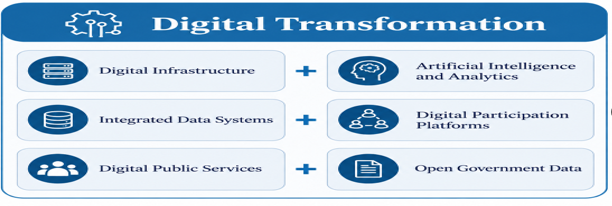
The proposed conceptual relationship is expressed through three components, shown in Figures 1 to 3.
Figure 1: Components of digital transformation in the proposed conceptual framework
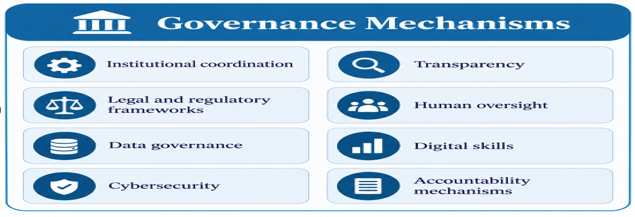
Figure 2: Governance mechanisms mediating digital transformation and political-system performance
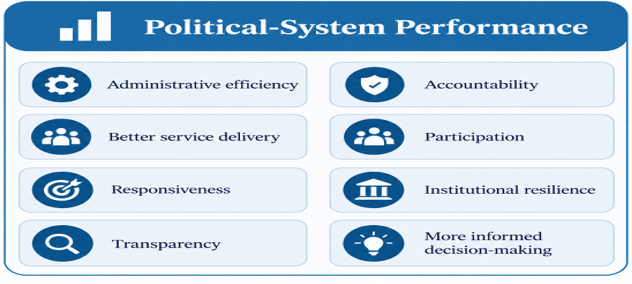
Figure 3: Performance dimensions of contemporary political systems in the proposed framework
Early e-government initiatives focused mainly on transferring government information and administrative services to electronic platforms. Websites, electronic forms, databases and online payment systems were among the earliest expressions of digital public administration.
Later work places more emphasis on integration, institutional change, data sharing and citizen engagement.8
Janowski identifies four stages in the evolution of digital government:9
1. Digitization;
2. Transformation;
3. Engagement; and
4. Contextualization.
His model shows how digital government gradually moves beyond technological modernization towards changes in the structure of government and in its relationships with citizens and other stakeholders. This evolution matters because it implies that the political significance of digital technology becomes evident only when it begins to affect institutional relationships, and not merely administrative processes.
Mergel, Edelmann and Haug make one of the important conceptual contributions to understanding public-sector digital transformation. Drawing on interviews with experts involved in government digital-transformation projects, they argue that digital transformation should be regarded as a holistic organizational process rather than simply the introduction of new technological tools.10
Their analysis indicates that transformation may influence:
• organizational processes;
• institutional culture;
• public services;
• interactions with citizens;
• stakeholder relationships;
• and organizational effectiveness.
This perspective provides an important foundation for the present study because it connects digital transformation with institutional performance rather than with technology alone.
Governance refers broadly to the processes, institutions, rules and relationships through which collective affairs are managed. Digital transformation can affect governance by changing:
• information flows;
• communication between institutions;
• government–citizen interaction;
• service-delivery mechanisms;
• monitoring systems;
• the availability of public data;
• and coordination among governmental agencies.
The OECD argues that successful digital government requires institutional arrangements, coordination mechanisms, strategies, regulation, financing mechanisms and effective leadership. Its governance framework identifies contextual factors, institutional models and policy levers as the key elements of successful public-sector digital transformation.11 Digital governance therefore cannot be reduced to the online delivery of services. It requires institutional change in the way technology is selected, managed, regulated, monitored and evaluated.
Administrative efficiency is among the most commonly cited advantages of digital transformation.12 Integrated digital systems can substantially reduce:
• redundant paperwork;
• manual data entry;
• duplicated administrative workflows;
• delays in communication;
• fragmented databases;
• and unnecessary physical interactions.
Shared databases and interoperable systems may allow governmental organizations to share information more efficiently. Efficiency gains, however, depend on successful implementation: a poorly connected digital system can simply reproduce existing bureaucratic inefficiencies in electronic form. This is a central concern of the OECD’s 2026 analysis, which finds that, although participating governments have improved their digital infrastructure and data governance, implementation, evaluation, investment management and workforce capabilities still require attention.13 Technological investment should therefore not be taken as a proxy for better governmental performance.
Decision-making is one of the areas potentially most affected by technological transformation. A conventional governmental decision-making process can be represented as follows:
Problem identification → Information collection → Policy alternatives → Evaluation → Decision → Implementation → Monitoring
Digital transformation can potentially influence every stage of this process.14
Governments increasingly draw on administrative databases, sensors, statistical systems, geographic information, digital-service records and other sources. Interoperability can enable data from various public agencies to be integrated, subject to the necessary legal, privacy and security safeguards.
Analytical technologies can help policymakers detect patterns and evaluate possible scenarios.
Artificial intelligence may support activities such as:
• forecasting;
• classification;
• anomaly detection;
• resource allocation;
• administrative automation;
• and the analysis of large datasets.
AI is increasingly incorporated into government strategies, but governance frameworks have not always kept pace with adoption. The OECD therefore emphasizes evaluation, transparency mechanisms, risk assessment and appropriate institutional safeguards.15 In high-impact governmental contexts, AI should accordingly be viewed primarily as a decision-support mechanism rather than as an unquestioned substitute for institutional responsibility and human judgment.
Digital technologies can increase governmental transparency16 by expanding public access to:
• budgets;
• expenditures;
• legislation;
• public-procurement information;
• government statistics;
• policy documents;
• administrative procedures;
• and public-sector performance indicators.
Open-data platforms can make governmental information more accessible to researchers, journalists, civil-society organizations, businesses and citizens. Transparency, however, requires more than publishing large quantities of digital information. Information must also be:
• accurate;
• understandable;
• timely;
• searchable;
• reusable;
• and accessible.
Transparency should, moreover, be complemented by mechanisms through which institutions can be questioned, reviewed, audited or held responsible for their decisions.
Digital technologies have opened new channels of communication between government and citizens. These include electronic consultations, digital petitions, participatory platforms, government social-media channels, online public hearings, citizen-feedback systems and participatory-budgeting platforms.
Such channels can reduce the constraints of space and time on participation. Digital participation, however, is not the same as political participation. Differences in internet access, education, digital competence, language, disability access, socio-economic status, age and trust can affect people’s ability to participate. Digital participation must therefore go hand in hand with strategies for digital inclusion.
Public services are a prominent aspect of digital government. Digital transformation can facilitate electronic applications, digital certificates, online licensing, electronic taxation, electronic payments, integrated service portals, electronic health services and mobile government services.
The OECD’s approach to digital government puts the user first, rather than merely digitizing existing government processes.17 A citizen-centered approach requires governments to redesign processes so that services become more accessible and institutions work together behind the service interface.
AI plays an increasingly significant role in public-sector digital transformation. Recent studies of public-sector transformation in the era of generative AI suggest that AI is being integrated into digital transformation as a whole, rather than treated as a purely technological project.18 Governments may use it for administrative support, document analysis, emergency management, public-service chatbots, fraud detection, forecasting for resource management, policy simulation and decision support.
Unequal access to technology can translate into unequal access to government. Although the world has made remarkable strides in digital government, the United Nations continues to record marked differences between regions and country groups.19 Digital inequality may take the form of inequalities in:
• internet availability and connection speed, access to digital devices, digital literacy, income and geography; and
• accessibility for persons with disabilities.
Greater dependence on interconnected systems can increase vulnerability to:
• cyberattacks;
• ransomware;
• data breaches;
• identity theft;
• infrastructure disruption;
• and unauthorized access.
Cybersecurity therefore becomes part of governance rather than merely a technical concern.
Data-driven government requires significant information about individuals and organizations. Effective governance should therefore establish rules on:
• data collection;
• storage;
• access;
• sharing;
• retention;
• processing;
• and deletion.
Public trust may decline where citizens believe that government data practices lack adequate safeguards. The OECD’s 2026 analysis reports that trust in governments’ handling of personal data remains a significant issue across the countries surveyed.20
Digital transformation can alter established administrative routines and responsibilities. Resistance may result from:
• fear of organizational change;
• insufficient digital skills;
• unclear institutional responsibilities;
• bureaucratic rigidity;
• inadequate leadership;
• or weak incentives for innovation.
Opaque algorithms can make automated public decisions more difficult to scrutinize. Mechanisms may therefore be needed for:
• algorithmic audits;
• impact assessments;
• transparency requirements;
• appeal mechanisms;
• human review;
• and independent oversight.
The study proposes the following analytical model, summarized in Figure 4.
The independent variable is digital transformation, measured through dimensions such as:
• digital infrastructure;
• e-government services;
• data integration;
• artificial intelligence;
• government interoperability;
• open data;
• and digital participation.
The dependent variable is the performance of contemporary political systems, measured through:
• administrative effectiveness;
• responsiveness;
• service quality;
• transparency;
• accountability;
• citizen participation;
• institutional coordination;
• and decision-making quality.
The relationship between the two is mediated and moderated by:
• institutional capacity;
• the regulatory framework;
• digital skills;
• cybersecurity;
• privacy protection;
• leadership;
• public trust;
• organizational culture;
• and digital inclusion.
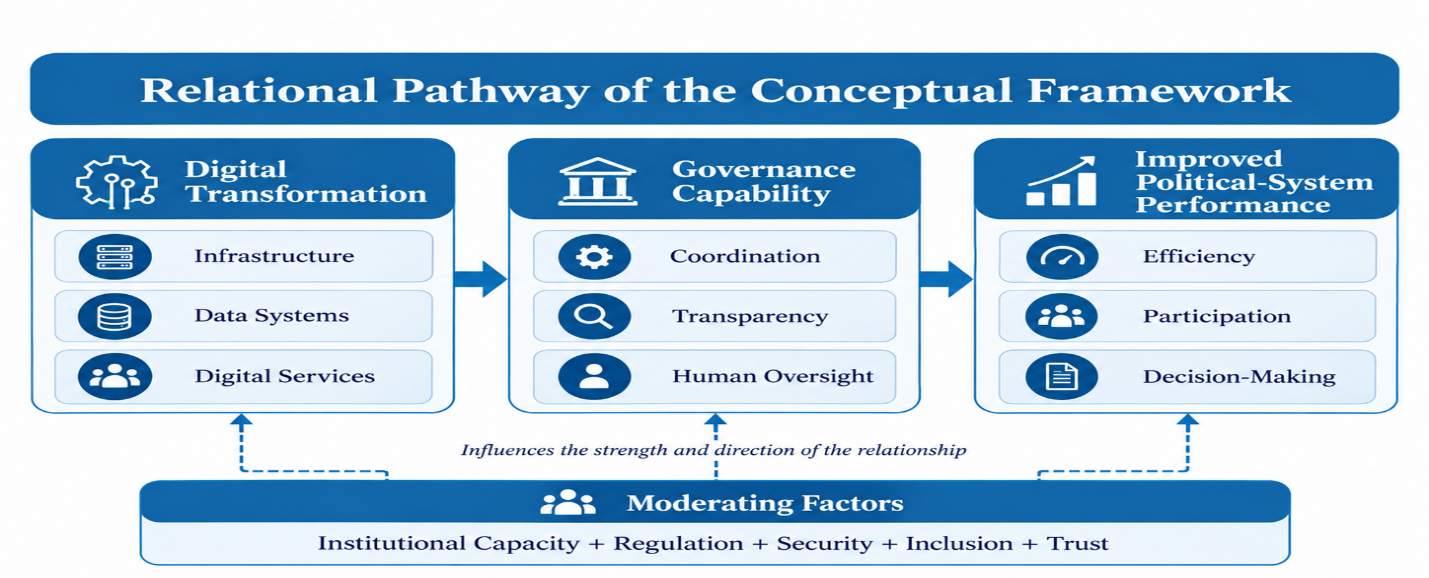
Figure 4: Proposed relational model showing the pathway from digital transformation to improved political-system performance and the moderating influence of institutional capacity, regulation, security, inclusion and trust
Digital transformation is reshaping contemporary government by altering how institutions manage information, provide public services, interact with citizens, coordinate activities and support decision-making. The analysis presented in this study indicates that digital transformation can improve political-system performance through greater administrative efficiency, wider availability of information, integrated public services, expanded transparency mechanisms, opportunities for citizen engagement and more data-informed decision-making.
These results are not guaranteed, however. Technology can improve existing institutional workflows, but without suitable institutional structures it can also perpetuate or aggravate institutional problems. Cybersecurity vulnerabilities, privacy risks, digital exclusion, fragmented information systems, a lack of digital skills, algorithmic opacity and weak accountability can all undermine the potential benefits.
Digital transformation is thus not merely technological modernization but a process of institutional transformation facilitated by technology. Effective digital governance requires technological infrastructure to be aligned with institutional change, human resources, the legal framework, data management, transparency, cybersecurity, ethics, inclusion and user-centered service design. In an increasingly digital world, the future of political systems will depend not only on how far governments use technology, but on whether digital capabilities are embedded in governance and decision-making in a responsible, inclusive, transparent and effective way.
*****
1. See Anwar Sadat, Digital Governance and Civic Inclusion to Enhance Public Participation in Political Decision-Making Processes, 7 Frontiers in Political Science 1671373 (2025), https://doi.org/10.3389/fpos.2025.1671373; Md Altab Hossin et al., Big Data-Driven Public Policy Decisions: Transformation Toward Smart Governance, 13 Sage Open 21582440231215123 (2023), https://doi.org/10.1177/21582440231215123; Shabnam Sharmin & Rakibul Hasan Chowdhury, Digital Transformation in Governance: The Impact of E-Governance on Public Administration and Transparency, 7 Journal of Computer Science and Technology Studies 362 (2025), https://doi.org/10.32996/jcsts.2025.7.1.27.
2. Ines Mergel, Noella Edelmann & Nathalie Haug, Defining Digital Transformation: Results from Expert Interviews, 36 Government Information Quarterly 101385 (2019), https://doi.org/10.1016/j.giq.2019.06.002.
3. Tomasz Janowski, Digital Government Evolution: From Transformation to Contextualization, 32 Government Information Quarterly 221 (2015), https://doi.org/10.1016/j.giq.2015.07.001.
4. OECD, Recommendation of the Council on Digital Government Strategies, OECD/LEGAL/0406 (July 15, 2014), https://legalinstruments.oecd.org/en/instruments/OECD-LEGAL-0406.
5. U.N. Dep’t of Econ. & Soc. Affs., United Nations E-Government Survey 2024: Accelerating Digital Transformation for Sustainable Development xix, xxi–xxii, 36 (2024), https://desapublications.un.org/publications/un-e-government-survey-2024.
6. OECD, Digital Government Outlook 2026: From Foundations to Transformational Impact 10–11, 13, 18–19 (2026), https://doi.org/10.1787/0496b2bc-en.
7. See Jeremy Millard, Impact of Digital Transformation on Public Governance: New Forms of Policy-Making and the Provision of Innovative, People-Centric and Inclusive Public Services (Marina Manzoni & Sven Schade eds., Publications Office of the European Union 2023), https://publications.jrc.ec.europa.eu/repository/handle/JRC133975; Ali Babazadeh, The Role of Big Data and Intelligent Systems in Improving Public Policy Design and Evaluation in Modern Governments and Digital Societies, 1 Advanced Journal of Management, Humanity and Social Science 716 (2025), https://www.ajmhss.com/article_236088_5da3a96599d258488945c0bad70c0dfa.pdf; Anuj Srivastava et al., Digital Transformation in Public Administration: Policy, Governance, and Social Implications, 8 Vascular and Endovascular Review 104 (2025), https://verjournal.com/index.php/ver/article/view/1055.
8. See, e.g., Md Nazirul Islam Sarker et al., Smart Governance Through Bigdata: Digital Transformation of Public Agencies, in 2018 International Conference on Artificial Intelligence and Big Data (ICAIBD) 62 (IEEE 2018), https://doi.org/10.1109/icaibd.2018.8396168; Ariawan Ariawan et al., Digital Transformation in Parliamentary Institutions: A Multi-Dimensional Analysis of SRIKANDI Implementation and Its Impact on Information Management Effectiveness, 24 Media Mahardhika 130 (2025), https://doi.org/10.29062/mahardika.v24i1.1420; Adem Ersin Bayra et al., Selecting Efficient Digital Transformation Strategies in Public Administration: A Novel Fractal Fuzzy-Based Decision-Making Perspective, 23 Veredas do Direito e234633 (2026), https://doi.org/10.18623/rvd.v23.n4.4633.
9. Janowski, supra note 3.
10. Mergel et al., supra note 2.
11. OECD, The E-Leaders Handbook on the Governance of Digital Government (2021), https://doi.org/10.1787/ac7f2531-en.
12. See Faisal Abdulhafez Alshawabkeh & Khaled Mustafa Al Jasmi, The Role of Modern Technology in Administrative Control Governance: A Legal Analytical Study of the Impact of Digital Transformation on Administrative Efficiency, 7 Corporate Law & Governance Review 120 (2025), https://doi.org/10.22495/clgrv7i3p12.
13. OECD, Digital Government Outlook 2026, supra note 6, at 11, 20–22.
14. See Hossin et al., supra note 1.
15. OECD, Digital Government Outlook 2026, supra note 6, at 11, 22, 25–26, 120.
16. See Temitayo Shenkoya, Can Digital Transformation Improve Transparency and Accountability of Public Governance in Nigeria?, 17 Transforming Government: People, Process and Policy 54 (2023), https://doi.org/10.1108/tg-08-2022-0115.
17. OECD, The OECD Digital Government Policy Framework: Six Dimensions of a Digital Government (OECD Public Governance Policy Papers No. 2, 2020), https://doi.org/10.1787/f64fed2a-en.
18. Gideon Mekonnen Jonathan, Public-Sector Digital Transformation in the Age of Generative AI, 6 Discover Artificial Intelligence 968 (2026), https://doi.org/10.1007/s44163-026-02077-3.
19. U.N. Dep’t of Econ. & Soc. Affs., supra note 5, at xxii, 73.
20. OECD, Digital Government Outlook 2026, supra note 6, at 10 (reporting that only 52% of people across 30 OECD countries trust their government to use their personal data for “legitimate purposes”).